C'est vs Il/Elle Est
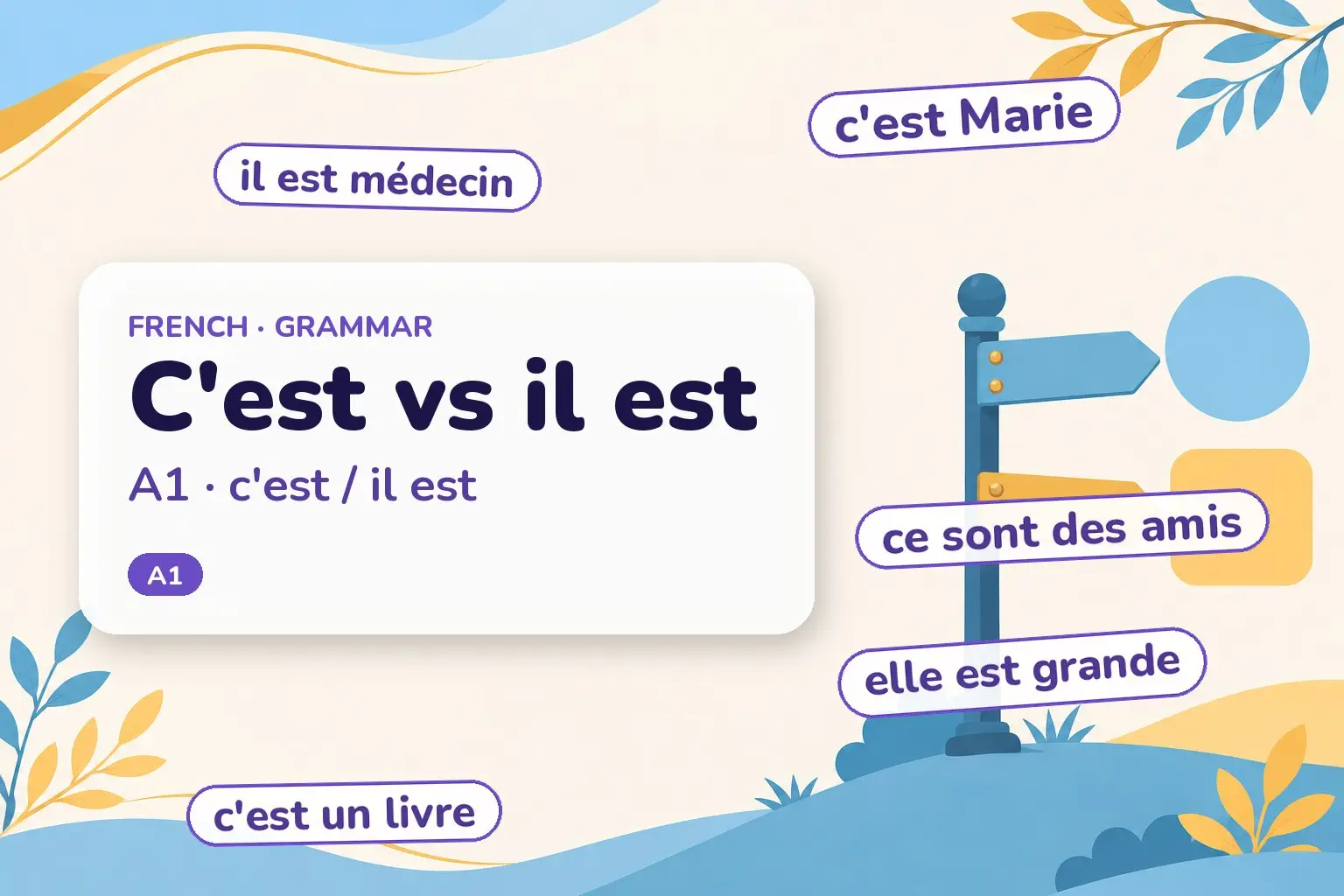
Use c'est before a noun with a determiner, a name or a general comment: C'est un médecin, C'est Marie, C'est bon. Use il/elle est before an adjective or a bare profession with no article: Il est grand, Elle est médecin.
Level: A1. French has two ways to say “he/she/it is”, and choosing the wrong one is one of the most common beginner mistakes. C’est points something out or names it; il est / elle est describes it. “He is a doctor” can be C’est un médecin (with the article) or Il est médecin (no article) — but never Il est un médecin.
The rule
Both come from the verb être (to be), but they take different things after them.
Use c’est (literally “this/it is”) before:
- a noun with a determiner (un, une, le, la, mon…): C’est un livre, C’est ma sœur.
- a name or a stressed pronoun: C’est Marie, C’est moi.
- a general comment on a situation, with a masculine adjective: C’est bon, C’est difficile, C’est vrai.
Use il est / elle est before:
- an adjective describing a specific person or thing: Il est grand, Elle est fatiguée.
- a profession, nationality or religion with no article: Il est médecin, Elle est française.
The quick test: is there an article or a name after it? → c’est. Is there a bare adjective or a bare job? → il/elle est.
Describing vs pointing out
The deeper idea: il/elle est describes something already known (its quality, its job), while c’est identifies or comments. Compare:
- Elle est médecin. — She is a doctor. (describing her job)
- C’est un bon médecin. — She’s a good doctor. (identifying + an adjective, so an article appears)
- Le film ? Il est long. — The film? It is long. (describing the specific film)
- Le film ? C’est long. — The film? It’s long. (a general comment on the experience)
Both last two are heard; c’est feels more like an overall verdict, il est like a property of that one film.
Forms at a glance
| Use | Form | Example |
|---|---|---|
| noun + determiner | c’est | C’est une voiture. |
| name / stressed pronoun | c’est | C’est Paul. / C’est moi. |
| general comment (masc. adj.) | c’est | C’est intéressant. |
| adjective describing a thing | il/elle est | Elle est rouge. |
| bare profession / nationality | il/elle est | Il est acteur. Elle est belge. |
| plural of c’est | ce sont | Ce sont mes amis. |
| plural of il/elle est | ils/elles sont | Ils sont contents. |
How to say it
- c’est is said “say” (like English “say” without the final glide): the c’ is an s-sound, the -st is silent-ish, linking to a vowel after it (c’est un = “say-tuhn”).
- il est is “eel eh”; the -l links softly and the final -t of est is silent, but it links before a vowel: il est ici = “eel-eh-tici”.
- elle est is “ell eh”, with the double -ll said as a single l.
- ce sont is “suh sohn”, the final -t silent; before a vowel it links: ce sont des stays “suh sohn day”.
Example sentences
- C'est un médecin.He/She is a doctor. (with the article)noun + un → c'est
- Il est médecin.He is a doctor.bare profession → il est, no article
- C'est Marie.It's Marie.a name → c'est
- C'est moi.It's me.stressed pronoun → c'est
- Elle est grande.She is tall.adjective describing her → elle est
- C'est grand !It's big! (general comment)comment → c'est + masculine adjective
- Il est français.He is French.nationality, no article → il est
- C'est un bon film.It's a good film.article + adjective → c'est
- Elle est professeure.She is a teacher.bare job → elle est
- C'est une professeure géniale.She's a brilliant teacher.article → c'est
- C'est intéressant.It's interesting.general comment → c'est
- Ce sont mes amis.They are my friends.plural of c'est → ce sont
- Ils sont contents.They are happy.plural adjective → ils sont
- C'est lundi.It's Monday.day → c'est
- Il est trois heures.It is three o'clock.clock time uses il est
- C'est vrai.It's true.comment → c'est
Common mistakes
- ❌ Il est un médecin. → ✅ Il est médecin. or C’est un médecin. A bare job takes il est with no article; add un and you need c’est.
- ❌ C’est grande. (as a comment) → ✅ C’est grand. A general comment uses the masculine form of the adjective after c’est.
- ❌ Elle est une amie. → ✅ C’est une amie. With the article une, use c’est, not elle est.
- ❌ Il est Paul. → ✅ C’est Paul. A name is introduced with c’est, never il est.
- ❌ C’est sont mes amis. → ✅ Ce sont mes amis. The plural of c’est is ce sont, not c’est sont.
A short conversation
— Qui est-ce ? — C’est Julie. — Qu’est-ce qu’elle fait ? — Elle est architecte. — Ah, c’est une bonne architecte ? — Oui, et elle est très gentille. C’est vrai !
Notice c’est for the name and the identifying noun, elle est for her job and her quality.
Usage notes
- Telling the time uses il est. The clock is impersonal: Il est midi, Il est huit heures. But a day or date uses c’est: C’est lundi, C’est le 5 mai.
- General truths use c’est + masculine adjective. C’est normal, C’est possible, C’est cher comment on a whole situation; the adjective stays masculine singular even about a feminine thing.
- With an adverb of quality, keep c’est. C’est très bien, C’est trop cher — the comment frame stays c’est.
- Stressed pronouns go with c’est. C’est moi, c’est toi, c’est lui, c’est nous — never il est moi.
Compared with être
Both forms are parts of the verb être, so make sure its six present forms are solid first: je suis, tu es, il est, nous sommes, vous êtes, ils sont. Review them in the verb être (present); that page also introduces the no-article-before-a-job rule that drives the choice here. Then browse the wider French grammar section.
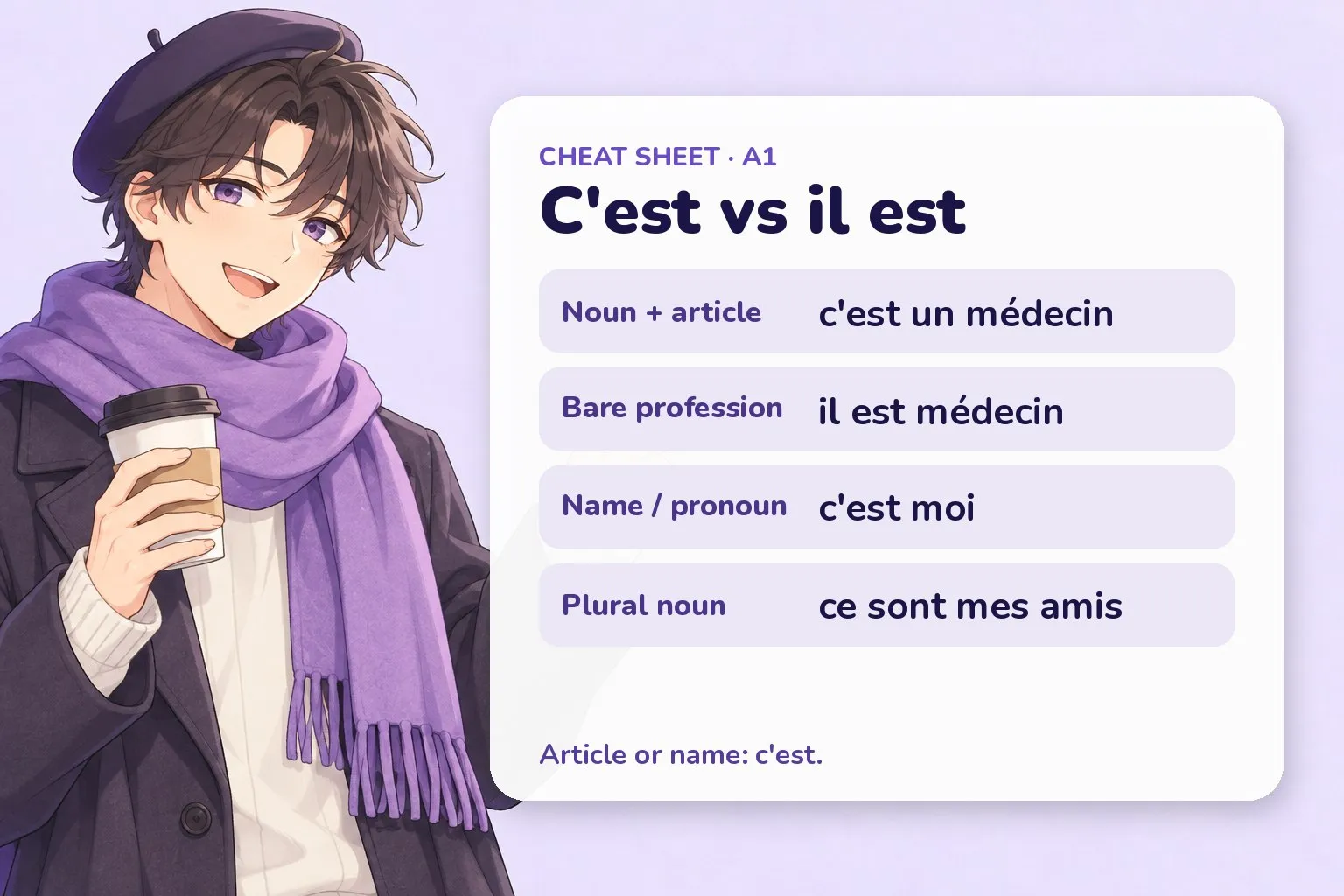
Quick recap before you practise.
Practice
C'est vs il est practice
Try each one, then press Check. No sign-up, nothing is sent anywhere — it all runs in your browser.
Hint: a name needs the pointing-out form
Show answer
C'est — A name is introduced with c'est: C'est Marie.
4 Build: 'They are my friends.'
Show answer
Ce sont mes amis — The plural of c'est is ce sont: Ce sont mes amis.
5 Match each start to what must follow it.
- C'est…
- Il/Elle est…
- Ce sont…
- Il est… (time)
Show answer
- C'est… → a noun with an article, a name, or a comment
- Il/Elle est… → a bare adjective or a bare profession
- Ce sont… → a plural noun (plural of c'est)
- Il est… (time) → the clock hour: il est deux heures
Article or name → c'est; bare adjective or job → il/elle est; clock time → il est.
Quiz
C'est vs il est quiz
12 questions · pick an answer and you'll see straight away if it's right.
-
Show answer
c'est — An article after it means c'est: C'est un livre.
-
Show answer
il/elle est — A profession with no article takes il/elle est: Il est médecin.
-
Show answer
Il est acteur. — Bare job → Il est acteur. Add un and you must say C'est un acteur.
-
Show answer
C'est Marie. — A name is introduced with c'est.
-
Show answer
C'est difficile. — A comment on a situation uses c'est + masculine adjective: C'est difficile.
-
Show answer
ce sont — Ce sont mes amis — ce sont is the plural of c'est.
-
Show answer
C'est une professeure géniale. — With an article (une) and an adjective, use c'est: C'est une professeure géniale.
-
Show answer
Il est trois heures. — The clock is impersonal and uses il est: Il est trois heures.
-
Show answer
C'est moi. — A stressed pronoun takes c'est: C'est moi.
-
Show answer
with the article une you need c'est — An article after it forces c'est: C'est une amie.
-
Show answer
Ce sont — The plural of c'est is ce sont: Ce sont des étudiants.
-
Show answer
an article or name → c'est; a bare adjective or job → il/elle est — Article or name → c'est; bare adjective or bare profession → il/elle est.
Recap cheat-sheet
| After it comes… | Use | Example |
|---|---|---|
| noun + article | c’est | C’est un médecin. |
| a name / moi, toi… | c’est | C’est Marie. / C’est moi. |
| general comment (masc. adj.) | c’est | C’est bon. |
| bare adjective | il/elle est | Elle est grande. |
| bare profession / nationality | il/elle est | Il est français. |
| plural noun | ce sont | Ce sont mes amis. |
Next
- Lock in the six forms in the verb être (present)
- Back to the French grammar section
- New here? Start with Start Learning French Here
All French grammar topics
Every grammar point in order, from your first sentence to advanced structures. Pick one and go straight to it. New lessons go live every day, so topics marked Coming soon fill in over the next weeks.
Grammar path
A1 32 topics · 21 ready
- 01 Definite Articles: le, la, les, l'
- 02 Indefinite Articles: un, une, des
- 03 Partitive Articles: du, de la, des
- 04 Noun Gender in French
- 05 Forming Plurals in French
- 06 Subject Pronouns (je, tu, il, nous, vous)
- 07 The Verb Être (To Be) - Present
- 08 The Verb Avoir (To Have) - Present
- 09 Present Tense: -ER Verbs
- 10 Present Tense: -IR Verbs (finir)
- 11 Present Tense: -RE Verbs (vendre)
- 12 Aller + Near Future (futur proche)
- 13 The Verb Faire (To Do/Make)
- 14 Negation: ne...pas
- 15 Asking Questions (est-ce que, inversion)
- 16 Adjective Agreement (Gender & Number)
- 17 Position of Adjectives (BAGS)
- 18 Possessive Adjectives (mon, ma, mes)
- 19 Demonstrative Adjectives (ce, cette, ces)
- 20 C'est vs Il/Elle Est You are here
- 21 Il Y A (There Is / There Are)
- 22 Contractions: au, aux, du, des (à/de + le) Coming soon
- 23 Question Words (qui, que, où, quand, comment) Coming soon
- 24 Vouloir, Pouvoir, Devoir (Present) Coming soon
- 25 Aimer / Préférer + Infinitive (Preferences) Coming soon
- 26 Pronominal (Reflexive) Verbs - Present Coming soon
- 27 The Imperative (Commands) Coming soon
- 28 Venir and Venir De (Recent Past) Coming soon
- 29 Prepositions with Places (à, en, au, aux) Coming soon
- 30 Expressions with Avoir (avoir faim, avoir 20 ans) Coming soon
- 31 Prepositions of Time (à, en, dans, depuis) Coming soon
- 32 Weather & Impersonal Expressions (il fait, il pleut) Coming soon
A2 26 topics
- 33 Passé Composé with Avoir Coming soon
- 34 Passé Composé with Être (+ agreement) Coming soon
- 35 The Imperfect Tense (imparfait) Coming soon
- 36 Passé Composé vs Imparfait Coming soon
- 37 The Simple Future (futur simple) Coming soon
- 38 Direct Object Pronouns (le, la, les) Coming soon
- 39 Indirect Object Pronouns (lui, leur) Coming soon
- 40 The Pronoun Y Coming soon
- 41 The Pronoun En Coming soon
- 42 Comparatives (plus, moins, aussi ... que) Coming soon
- 43 Superlatives (le plus, le moins) Coming soon
- 44 Forming Adverbs in -ment Coming soon
- 45 Depuis, Pendant, Il Y A, Pour (Time) Coming soon
- 46 Partitive & Articles in the Negative (de) Coming soon
- 47 Expressions of Quantity (beaucoup de, trop de) Coming soon
- 48 Pronominal Verbs in Passé Composé Coming soon
- 49 Stressed (Disjunctive) Pronouns (moi, toi, lui) Coming soon
- 50 Possessive Pronouns (le mien, la tienne) Coming soon
- 51 Object Pronoun Placement & Order Coming soon
- 52 Adverb Position in French Coming soon
- 53 Savoir vs Connaître (Two Ways to Know) Coming soon
- 54 Il Faut + Infinitive (Necessity) Coming soon
- 55 Verbs + à / de + Infinitive Coming soon
- 56 Comparing Quantities (plus de ... que) Coming soon
- 57 Adverbs of Frequency (souvent, toujours, jamais) Coming soon
- 58 Quel in Exclamations (Quel beau jour!) Coming soon
B1 24 topics
- 59 The Present Conditional Coming soon
- 60 The Present Subjunctive: Formation Coming soon
- 61 Subjunctive After Will & Necessity (il faut que) Coming soon
- 62 Subjunctive After Emotion & Opinion Coming soon
- 63 The Pluperfect (plus-que-parfait) Coming soon
- 64 The Future Perfect (futur antérieur) Coming soon
- 65 The Past Conditional (conditionnel passé) Coming soon
- 66 Si Clauses (Conditional Sentences) Coming soon
- 67 Relative Pronouns: qui, que, où, dont Coming soon
- 68 Order of Double Object Pronouns Coming soon
- 69 The Gérondif (en + -ant) Coming soon
- 70 The Present Participle (-ant) Coming soon
- 71 Reported Speech (discours indirect) Coming soon
- 72 Irregular Comparatives (meilleur, pire, mieux) Coming soon
- 73 Demonstrative Pronouns (celui, celle, ceux) Coming soon
- 74 The Causative Faire (faire faire) Coming soon
- 75 Depuis Que & Time Conjunctions Coming soon
- 76 Être en Train de / Sur le Point de Coming soon
- 77 Varied Negations (ne...jamais/rien/personne/plus) Coming soon
- 78 Y and En with Verbs (penser à / parler de) Coming soon
- 79 The Past Infinitive (après avoir fait) Coming soon
- 80 Tout: Adjective, Pronoun and Adverb Coming soon
- 81 Types of Pronominal Verbs (reflexive, reciprocal, idiomatic) Coming soon
- 82 Expressing Opinion (à mon avis, trouver que) Coming soon
B2 20 topics
- 83 The Past Subjunctive (subjonctif passé) Coming soon
- 84 Subjunctive After Conjunctions (bien que, pour que) Coming soon
- 85 Subjunctive vs Indicative (penser que, espérer) Coming soon
- 86 Sequence of Tenses (concordance des temps) Coming soon
- 87 The Passé Simple (Recognition) Coming soon
- 88 The Passive Voice (voix passive) Coming soon
- 89 Reported Speech in the Past Coming soon
- 90 Compound Relatives (lequel, auquel, duquel) Coming soon
- 91 Past Participle Agreement with Avoir Coming soon
- 92 Participle Agreement: Pronominal Verbs Coming soon
- 93 Expressing Opposition & Concession (bien que, malgré) Coming soon
- 94 Expressing Cause (parce que, puisque, comme, car) Coming soon
- 95 Expressing Consequence (donc, si bien que, tellement) Coming soon
- 96 Expressing Purpose (pour que, afin de, de peur que) Coming soon
- 97 Highlighting: C'est...qui / C'est...que Coming soon
- 98 Indefinite Adjectives (tout, chaque, quelques) Coming soon
- 99 Indefinite Pronouns (quelqu'un, chacun, certains) Coming soon
- 100 Verbs + Preposition + Noun (penser à, dépendre de) Coming soon
- 101 Verbs of Perception + Infinitive (je le vois arriver) Coming soon
- 102 When to Omit the Article Coming soon
C1 14 topics
- 103 The Imperfect Subjunctive (Literary) Coming soon
- 104 The Passé Antérieur (Literary) Coming soon
- 105 Sequence of Tenses with the Subjunctive Coming soon
- 106 The Expletive Ne (ne explétif) Coming soon
- 107 Restriction & Only (ne...que, ne faire que) Coming soon
- 108 Stylistic & Interrogative Inversion Coming soon
- 109 Advanced Logical Connectors (néanmoins, en revanche) Coming soon
- 110 Nominalisation (Formal/Press Style) Coming soon
- 111 Advanced Hypothesis (au cas où, à moins que) Coming soon
- 112 The Pronominal Passive (se + verb) Coming soon
- 113 Subjunctive in Relative Clauses (le seul qui...) Coming soon
- 114 Absolute & Participial Constructions (Le travail terminé) Coming soon
- 115 Registers: Soutenu, Courant, Familier Coming soon
- 116 Proportional & Advanced Comparison (plus...plus) Coming soon