Position of French Adjectives (BAGS)
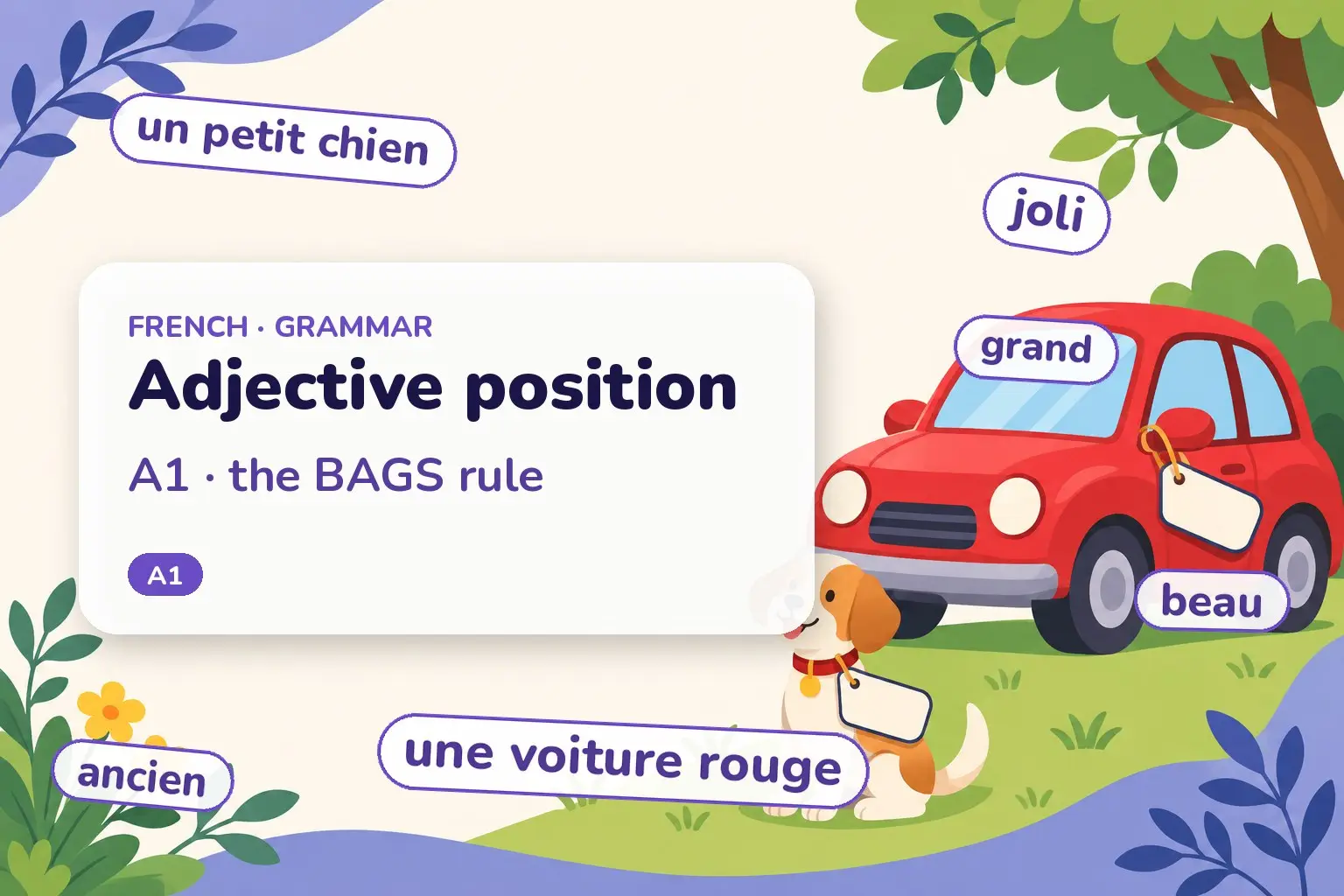
Most French adjectives come after the noun: une voiture rouge. A small, common group — the BAGS adjectives of beauty, age, goodness and size, like petit, grand, beau, jeune, bon — comes before: une petite voiture.
Level: A1. In English an adjective always comes before its noun: a red car, a small house. French usually does the opposite — the adjective comes after the noun: une voiture rouge. But a short list of very common adjectives breaks that rule and sits before the noun. The trick is knowing which ones, and the memory aid BAGS does most of the work.
The rule
An adjective is a describing word; its position is where it sits relative to the noun. The default in French is noun + adjective:
- une table ronde — a round table
- un livre intéressant — an interesting book
- une chemise bleue — a blue shirt
Colours, shapes, nationalities and most longer adjectives all follow the noun. Against that background, a small set of short, frequent adjectives comes before the noun. They fall into four meaning groups, which spell BAGS:
- B — Beauty: beau (beautiful), joli (pretty)
- A — Age: jeune (young), vieux (old), nouveau (new)
- G — Goodness: bon (good), mauvais (bad), gentil (kind)
- S — Size: grand (big/tall), petit (small), gros (fat), long (long)
So you say une belle maison (a beautiful house) and un petit chien (a small dog), with the adjective in front.
Before or after: the common sets
| Position | Meaning group | Examples |
|---|---|---|
| Before the noun | Beauty | beau, joli |
| Before the noun | Age | jeune, vieux, nouveau |
| Before the noun | Goodness | bon, mauvais, gentil |
| Before the noun | Size | grand, petit, gros, long |
| After the noun | Colour | rouge, bleu, vert |
| After the noun | Shape | rond, carré |
| After the noun | Nationality | français, japonais |
| After the noun | Most others | intéressant, moderne |
Adjectives that change meaning by position
A handful of adjectives can sit on either side, and the position changes the meaning. Before the noun they are usually figurative; after it they are literal.
| Adjective | Before the noun | After the noun |
|---|---|---|
| ancien | un ancien professeur (a former teacher) | un meuble ancien (an antique) |
| cher | un cher ami (a dear friend) | un repas cher (an expensive meal) |
| grand | un grand homme (a great man) | un homme grand (a tall man) |
| propre | ma propre chambre (my own room) | une chambre propre (a clean room) |
| pauvre | un pauvre homme (an unfortunate man) | un homme pauvre (a penniless man) |
Example sentences
- une voiture rougea red carcolour: after the noun
- un livre intéressantan interesting booklong adjective: after
- une chemise bleuea blue shirt
- un petit chiena small dogsize: before (BAGS)
- une grande maisona big housesize: before
- une belle plagea beautiful beachbeauty: before
- un jeune hommea young manage: before
- un bon repasa good mealgoodness: before
- une jolie robea pretty dress
- un nouveau téléphonea new phone
- un mauvais filma bad film
- une table rondea round tableshape: after
- un ami françaisa French friendnationality: after
- un ancien professeura former teacherbefore = figurative
- un meuble ancienan antique piece of furnitureafter = literal
- un grand hommea great man
- un homme granda tall man
- une petite voiture rougea small red carBAGS before, colour after
Notice the last one: when two adjectives apply, each keeps its own place — petite in front, rouge behind.
Common mistakes
- ❌ une bleue chemise → ✅ une chemise bleue. Colours follow the noun.
- ❌ un intéressant livre → ✅ un livre intéressant. Longer, non-BAGS adjectives go after.
- ❌ un chien petit → ✅ un petit chien. Petit is a size word (BAGS) and comes before.
- ❌ un professeur ancien for a former teacher → ✅ un ancien professeur. After the noun, ancien means antique/old, not former.
- ❌ une voiture petite rouge → ✅ une petite voiture rouge. Keep the BAGS adjective before and the colour after.
A short conversation
— Tu as une nouvelle voiture ? — Do you have a new car? — Oui, une petite voiture rouge. — Yes, a small red car. — C’est un bon choix ! — That’s a good choice!
Usage notes
- BAGS before, the rest after. Beauty, age, goodness and size words lead; colour, shape, nationality and longer adjectives follow.
- Position can carry meaning. With ancien, cher, grand, propre and pauvre, the side you choose changes the sense — figurative in front, literal behind.
- beau, nouveau, vieux have a special form. Before a masculine noun starting with a vowel they become bel, nouvel, vieil: un bel appartement, un nouvel ami.
- Agreement never changes. Wherever the adjective sits, it still matches the noun in gender and number: une petite voiture, de petites voitures.
Compared with adjective agreement
Position decides where the adjective sits; agreement decides its ending. The two rules work independently: une grande maison has the BAGS adjective in front and the feminine -e. Make sure you are comfortable with French adjective agreement and with noun gender first, since the adjective copies both no matter which side of the noun it is on. Browse more in the French grammar section.
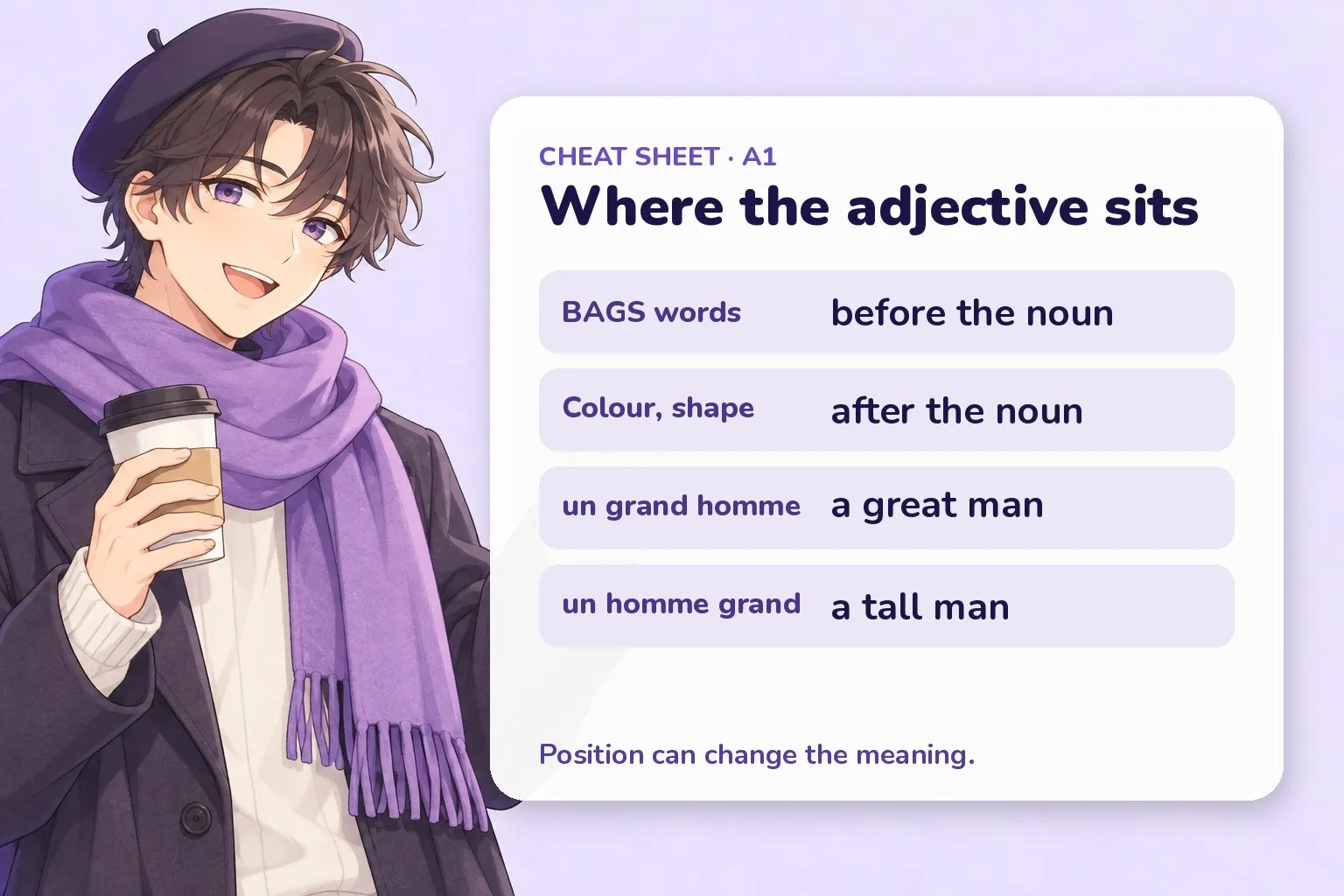
Quick recap before you practise.
Practice
Adjective position practice
Try each one, then press Check. No sign-up, nothing is sent anywhere — it all runs in your browser.
2 Build: 'a small dog'
Show answer
un petit chien — Petit is a BAGS size word, so it comes before: un petit chien.
Hint: figurative meaning goes before the noun
Show answer
ancien — un ancien professeur = a former teacher; after the noun it would mean antique.
5 Match each phrase to its meaning.
- un grand homme
- un homme grand
- un cher ami
- un repas cher
Show answer
- un grand homme → a great man
- un homme grand → a tall man
- un cher ami → a dear friend
- un repas cher → an expensive meal
Before the noun these adjectives are figurative; after it, literal.
Quiz
French adjective position quiz
12 questions · pick an answer and you'll see straight away if it's right.
-
Show answer
after the noun — The default is noun + adjective: une voiture rouge.
-
Show answer
before the noun — Beauty, age, goodness and size adjectives come before the noun.
-
Show answer
une voiture rouge — The colour follows the noun: une voiture rouge.
-
Show answer
petit — Petit is a size (BAGS) word and goes before the noun.
-
Show answer
un petit chien — Size adjectives precede: un petit chien.
-
Show answer
a former teacher — Before the noun, ancien means former.
-
Show answer
an antique piece of furniture — After the noun, ancien means antique or old.
-
Show answer
a great man — Before the noun, grand is figurative: a great man.
-
Show answer
Goodness — Goodness (bon, mauvais) is the G in BAGS.
-
Show answer
bel — un bel appartement: beau becomes bel before a vowel.
-
Show answer
no, the adjective still agrees — Agreement is independent: une petite voiture keeps the feminine -e.
-
Show answer
just stack them — une jolie petite maison: two BAGS adjectives simply stack before the noun.
Recap cheat-sheet
| Group | Position | Example |
|---|---|---|
| BAGS (beauty/age/goodness/size) | before | un petit chien |
| Colour, shape, nationality | after | une voiture rouge |
| Long/other adjectives | after | un livre intéressant |
| ancien, cher, grand… | meaning shifts | un ancien professeur |
| Two BAGS adjectives | stacked, no et | une jolie petite maison |
Next
- Revisit French adjective agreement
- Back to the French grammar section
- New here? Start with Start Learning French Here
All French grammar topics
Every grammar point in order, from your first sentence to advanced structures. Pick one and go straight to it. New lessons go live every day, so topics marked Coming soon fill in over the next weeks.
Grammar path
A1 32 topics · 21 ready
- 01 Definite Articles: le, la, les, l'
- 02 Indefinite Articles: un, une, des
- 03 Partitive Articles: du, de la, des
- 04 Noun Gender in French
- 05 Forming Plurals in French
- 06 Subject Pronouns (je, tu, il, nous, vous)
- 07 The Verb Être (To Be) - Present
- 08 The Verb Avoir (To Have) - Present
- 09 Present Tense: -ER Verbs
- 10 Present Tense: -IR Verbs (finir)
- 11 Present Tense: -RE Verbs (vendre)
- 12 Aller + Near Future (futur proche)
- 13 The Verb Faire (To Do/Make)
- 14 Negation: ne...pas
- 15 Asking Questions (est-ce que, inversion)
- 16 Adjective Agreement (Gender & Number)
- 17 Position of Adjectives (BAGS) You are here
- 18 Possessive Adjectives (mon, ma, mes)
- 19 Demonstrative Adjectives (ce, cette, ces)
- 20 C'est vs Il/Elle Est
- 21 Il Y A (There Is / There Are)
- 22 Contractions: au, aux, du, des (à/de + le) Coming soon
- 23 Question Words (qui, que, où, quand, comment) Coming soon
- 24 Vouloir, Pouvoir, Devoir (Present) Coming soon
- 25 Aimer / Préférer + Infinitive (Preferences) Coming soon
- 26 Pronominal (Reflexive) Verbs - Present Coming soon
- 27 The Imperative (Commands) Coming soon
- 28 Venir and Venir De (Recent Past) Coming soon
- 29 Prepositions with Places (à, en, au, aux) Coming soon
- 30 Expressions with Avoir (avoir faim, avoir 20 ans) Coming soon
- 31 Prepositions of Time (à, en, dans, depuis) Coming soon
- 32 Weather & Impersonal Expressions (il fait, il pleut) Coming soon
A2 26 topics
- 33 Passé Composé with Avoir Coming soon
- 34 Passé Composé with Être (+ agreement) Coming soon
- 35 The Imperfect Tense (imparfait) Coming soon
- 36 Passé Composé vs Imparfait Coming soon
- 37 The Simple Future (futur simple) Coming soon
- 38 Direct Object Pronouns (le, la, les) Coming soon
- 39 Indirect Object Pronouns (lui, leur) Coming soon
- 40 The Pronoun Y Coming soon
- 41 The Pronoun En Coming soon
- 42 Comparatives (plus, moins, aussi ... que) Coming soon
- 43 Superlatives (le plus, le moins) Coming soon
- 44 Forming Adverbs in -ment Coming soon
- 45 Depuis, Pendant, Il Y A, Pour (Time) Coming soon
- 46 Partitive & Articles in the Negative (de) Coming soon
- 47 Expressions of Quantity (beaucoup de, trop de) Coming soon
- 48 Pronominal Verbs in Passé Composé Coming soon
- 49 Stressed (Disjunctive) Pronouns (moi, toi, lui) Coming soon
- 50 Possessive Pronouns (le mien, la tienne) Coming soon
- 51 Object Pronoun Placement & Order Coming soon
- 52 Adverb Position in French Coming soon
- 53 Savoir vs Connaître (Two Ways to Know) Coming soon
- 54 Il Faut + Infinitive (Necessity) Coming soon
- 55 Verbs + à / de + Infinitive Coming soon
- 56 Comparing Quantities (plus de ... que) Coming soon
- 57 Adverbs of Frequency (souvent, toujours, jamais) Coming soon
- 58 Quel in Exclamations (Quel beau jour!) Coming soon
B1 24 topics
- 59 The Present Conditional Coming soon
- 60 The Present Subjunctive: Formation Coming soon
- 61 Subjunctive After Will & Necessity (il faut que) Coming soon
- 62 Subjunctive After Emotion & Opinion Coming soon
- 63 The Pluperfect (plus-que-parfait) Coming soon
- 64 The Future Perfect (futur antérieur) Coming soon
- 65 The Past Conditional (conditionnel passé) Coming soon
- 66 Si Clauses (Conditional Sentences) Coming soon
- 67 Relative Pronouns: qui, que, où, dont Coming soon
- 68 Order of Double Object Pronouns Coming soon
- 69 The Gérondif (en + -ant) Coming soon
- 70 The Present Participle (-ant) Coming soon
- 71 Reported Speech (discours indirect) Coming soon
- 72 Irregular Comparatives (meilleur, pire, mieux) Coming soon
- 73 Demonstrative Pronouns (celui, celle, ceux) Coming soon
- 74 The Causative Faire (faire faire) Coming soon
- 75 Depuis Que & Time Conjunctions Coming soon
- 76 Être en Train de / Sur le Point de Coming soon
- 77 Varied Negations (ne...jamais/rien/personne/plus) Coming soon
- 78 Y and En with Verbs (penser à / parler de) Coming soon
- 79 The Past Infinitive (après avoir fait) Coming soon
- 80 Tout: Adjective, Pronoun and Adverb Coming soon
- 81 Types of Pronominal Verbs (reflexive, reciprocal, idiomatic) Coming soon
- 82 Expressing Opinion (à mon avis, trouver que) Coming soon
B2 20 topics
- 83 The Past Subjunctive (subjonctif passé) Coming soon
- 84 Subjunctive After Conjunctions (bien que, pour que) Coming soon
- 85 Subjunctive vs Indicative (penser que, espérer) Coming soon
- 86 Sequence of Tenses (concordance des temps) Coming soon
- 87 The Passé Simple (Recognition) Coming soon
- 88 The Passive Voice (voix passive) Coming soon
- 89 Reported Speech in the Past Coming soon
- 90 Compound Relatives (lequel, auquel, duquel) Coming soon
- 91 Past Participle Agreement with Avoir Coming soon
- 92 Participle Agreement: Pronominal Verbs Coming soon
- 93 Expressing Opposition & Concession (bien que, malgré) Coming soon
- 94 Expressing Cause (parce que, puisque, comme, car) Coming soon
- 95 Expressing Consequence (donc, si bien que, tellement) Coming soon
- 96 Expressing Purpose (pour que, afin de, de peur que) Coming soon
- 97 Highlighting: C'est...qui / C'est...que Coming soon
- 98 Indefinite Adjectives (tout, chaque, quelques) Coming soon
- 99 Indefinite Pronouns (quelqu'un, chacun, certains) Coming soon
- 100 Verbs + Preposition + Noun (penser à, dépendre de) Coming soon
- 101 Verbs of Perception + Infinitive (je le vois arriver) Coming soon
- 102 When to Omit the Article Coming soon
C1 14 topics
- 103 The Imperfect Subjunctive (Literary) Coming soon
- 104 The Passé Antérieur (Literary) Coming soon
- 105 Sequence of Tenses with the Subjunctive Coming soon
- 106 The Expletive Ne (ne explétif) Coming soon
- 107 Restriction & Only (ne...que, ne faire que) Coming soon
- 108 Stylistic & Interrogative Inversion Coming soon
- 109 Advanced Logical Connectors (néanmoins, en revanche) Coming soon
- 110 Nominalisation (Formal/Press Style) Coming soon
- 111 Advanced Hypothesis (au cas où, à moins que) Coming soon
- 112 The Pronominal Passive (se + verb) Coming soon
- 113 Subjunctive in Relative Clauses (le seul qui...) Coming soon
- 114 Absolute & Participial Constructions (Le travail terminé) Coming soon
- 115 Registers: Soutenu, Courant, Familier Coming soon
- 116 Proportional & Advanced Comparison (plus...plus) Coming soon