Top Mistakes German Learners Make and the Fixes
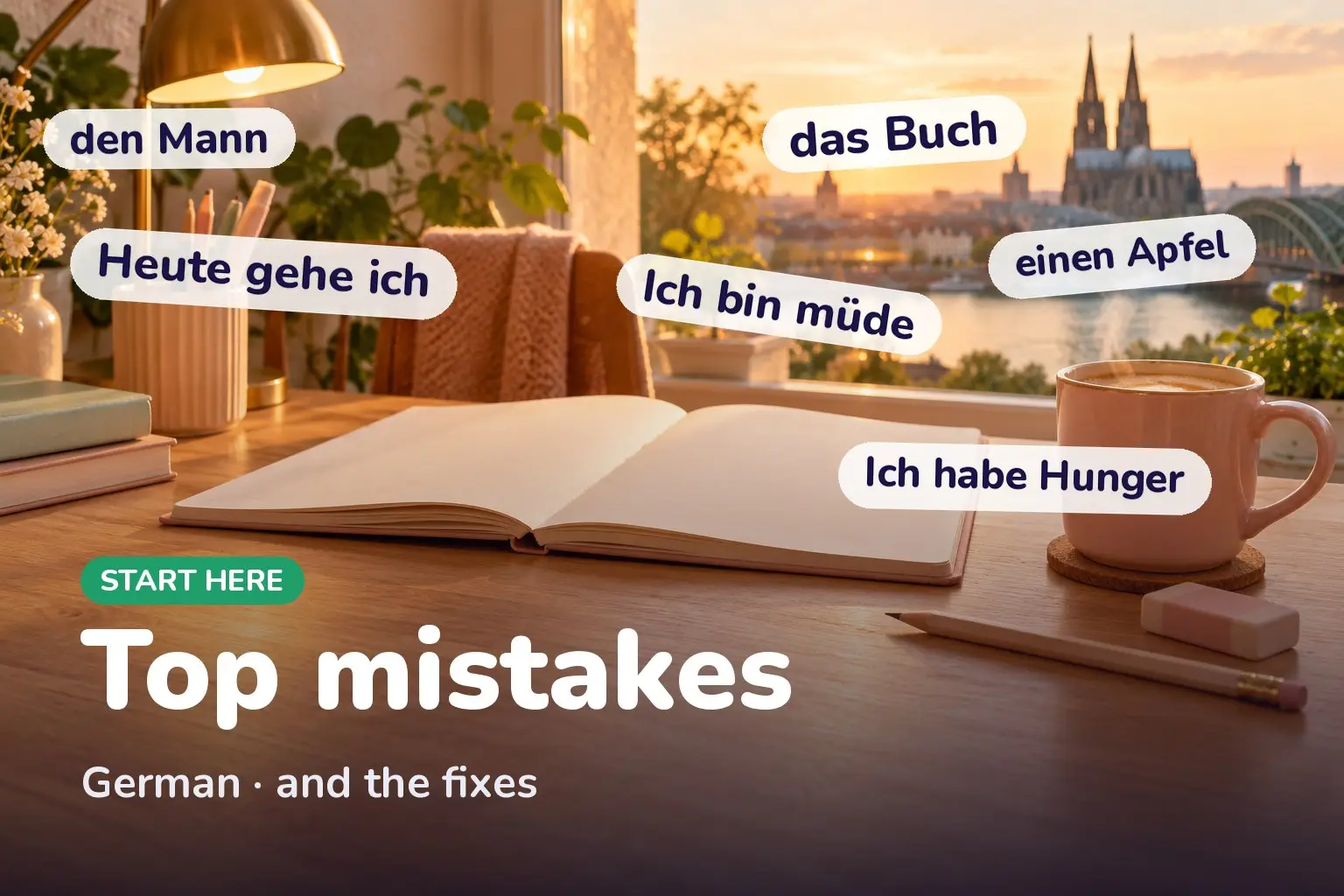
The most common German errors are predictable: wrong noun gender, forgetting to capitalise nouns, skipping the accusative change (der to den), breaking the verb-second word-order rule, mixing up sein and haben, and trusting false friends like bekommen (to receive, not become).
On this page12 sections · tap to jump
- 01By the end of this page you can…
- 021. Guessing noun gender (and not capitalising)
- 032. Skipping the accusative change
- 043. Breaking the verb-second rule
- 054. Mixing up sein and haben
- 065. Dropping or misplacing the formal Sie
- 076. Trusting false friends
- 08Hear the corrected sentences
- 09How to say it
- 10Practice
- 11Quiz
- 12Fix one at a time
Level: B1 (but useful from A1). Most German mistakes are not random — the same handful come up again and again. Here they are, with the fix and the lesson that drills each one.
By the end of this page you can…
…spot the six errors that slow learners down most, and know which grammar lesson fixes each.
1. Guessing noun gender (and not capitalising)
Every German noun has a gender shown in its article — der (m), die (f), das (n) — and the gender is usually not predictable from meaning (das Mädchen, “the girl”, is neuter). Learners who meet a noun without its article never learn the gender and guess wrongly later.
- ❌ die Buch → ✅ das Buch. Learn it as das Buch from the start.
- ❌ der mann ist hier → ✅ Der Mann ist hier. Every noun is capitalised.
Fix: memorise each noun as article + Noun and write the capital. See German Articles: Der, Die, Das.
2. Skipping the accusative change
In the accusative (direct object), only the masculine article changes: der → den, ein → einen. Beginners leave it as der.
- ❌ Ich sehe der Mann → ✅ Ich sehe den Mann.
- ❌ Ich kaufe ein Apfel → ✅ Ich kaufe einen Apfel.
Fix: drill the one change that matters in the German accusative case.
3. Breaking the verb-second rule
In a German main clause the conjugated verb sits in second position. If something other than the subject starts the sentence, the subject moves after the verb.
- ❌ Heute ich gehe ins Kino → ✅ Heute gehe ich ins Kino.
- ❌ Morgen wir spielen Fußball → ✅ Morgen spielen wir Fußball.
Fix: practise word order in German sentence word order.
4. Mixing up sein and haben
German uses sein (“to be”) and haben (“to have”) where English sometimes chooses differently, and both are irregular.
- ❌ Ich habe müde → ✅ Ich bin müde. (“I am tired” — a state uses sein.)
- ❌ Ich bin Hunger → ✅ Ich habe Hunger. (“I have hunger” — German has hunger.)
Fix: learn the two verbs side by side in sein and haben, and regular endings in the regular present tense.
5. Dropping or misplacing the formal Sie
German separates informal du (friends, family, children) from formal Sie (strangers, officials, older people you don’t know). Using du with a stranger can sound rude.
- ❌ Wie heißt du? to a shop clerk → ✅ Wie heißen Sie?
Fix: match the pronoun to the relationship; the verb ending changes with it (du kommst vs Sie kommen). See German personal pronouns.
6. Trusting false friends
Some German words look English but mean something else. These are checked in the dictionary, not guessed.
- bekommen = to receive / get, not “become”. (“become” = werden.)
- also = so / therefore, not English “also” (that is auch).
- Gift = poison, not a present (Geschenk).
Hear the corrected sentences
- Das Buch ist interessant.The book is interesting.neuter: das Buch
- Der Mann ist hier.The man is here.capital noun, der
- Ich sehe den Mann.I see the man.accusative: der becomes den
- Ich kaufe einen Apfel.I buy an apple.accusative: ein becomes einen
- Heute gehe ich ins Kino.Today I'm going to the cinema.verb second
- Morgen spielen wir Fußball.Tomorrow we play football.verb second
- Ich bin müde.I am tired.a state uses sein
- Ich habe Hunger.I am hungry (I have hunger).German has hunger
- Wie heißen Sie?What is your name? (formal)formal Sie
- Ich bekomme ein Geschenk.I receive a present.bekommen = to receive
How to say it
A few sounds trip up English speakers across all of these words:
| Sound | How to say it |
|---|---|
| ei vs ie | ei = “eye” (ein = “ine”, heißt = “hyst”); ie = “ee” (Kino = “KEE-no”, Sie = “zee”). |
| ch | Soft hissed “h” after e/i (ich = “ikh”); hard like Scottish loch after a/o/u (auch = “owkh”, Buch). |
| w / v | w = English “v” (wie = “vee”, werden); v usually “f” (Vater). |
| ß and -g | ß = “ss” (heißt); final -g often hardens to “k” (Tag = “tahk”). |
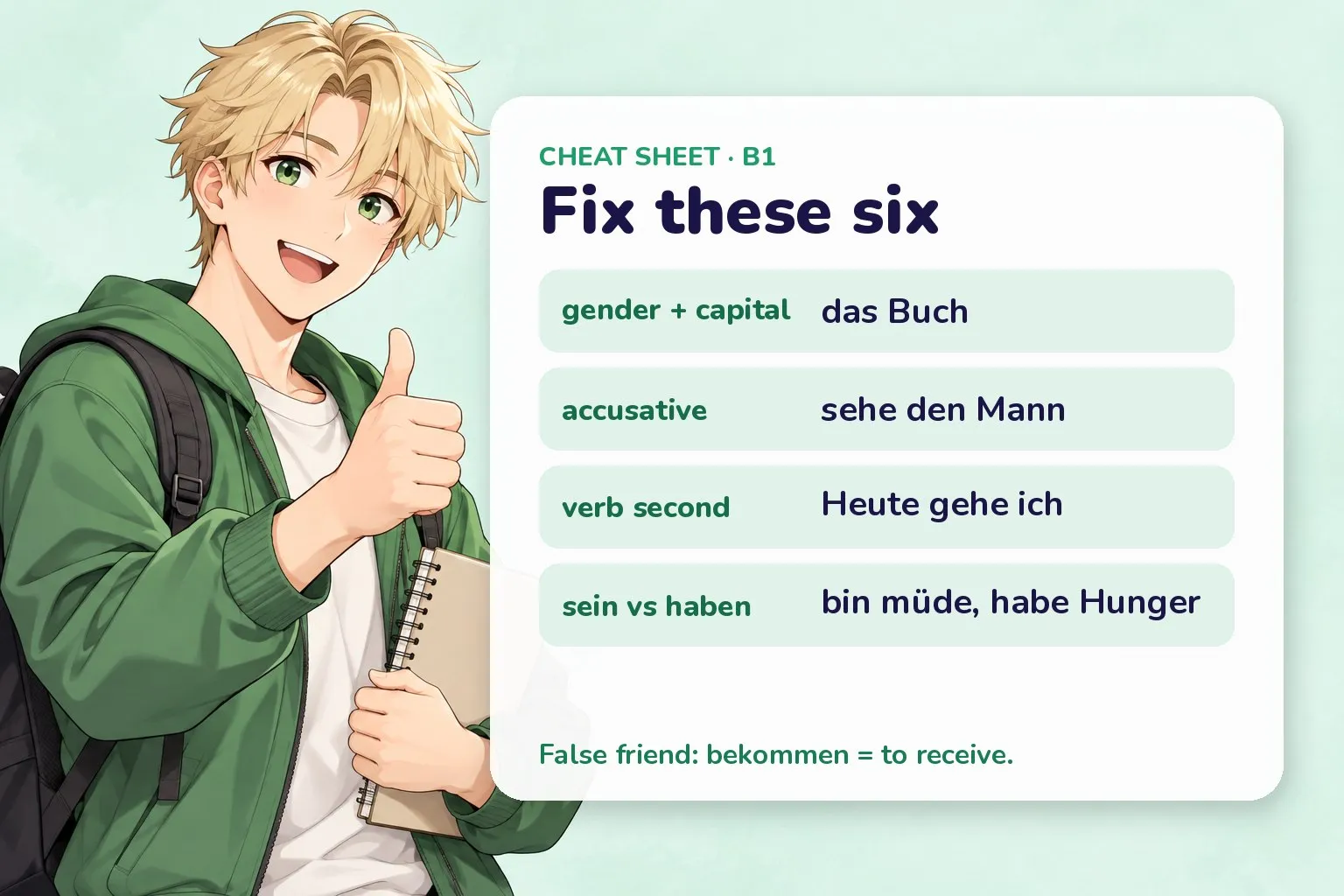
Quick recap before the quiz.
Practice
Fix the common mistakes
Try each one, then press Check. No sign-up, nothing is sent anywhere — it all runs in your browser.
2 Put it right: 'Today I'm going to the cinema.'
Show answer
Heute gehe ich ins Kino — Verb second: Heute gehe ich ins Kino.
Hint: a state uses sein
Show answer
bin — A state uses sein: Ich bin müde.
Hint: German has hunger
Show answer
habe — German uses haben: Ich habe Hunger.
5 Match the false friend to its real meaning.
- bekommen
- also
- Gift
- werden
Show answer
- bekommen → to receive
- also → so / therefore
- Gift → poison
- werden → to become
bekommen is 'receive', also is 'so', Gift is 'poison', and 'become' is werden.
Quiz
Common German mistakes
10 questions · pick an answer and you'll see straight away if it's right.
-
Show answer
das — Buch is neuter: das Buch.
-
Show answer
einen Apfel — Accusative masculine: einen Apfel.
-
Show answer
Heute gehe ich ins Kino — The verb must be second: Heute gehe ich.
-
Show answer
Ich bin müde — A state uses sein: Ich bin müde.
-
Show answer
I have hunger — Ich habe Hunger — German has hunger.
-
Show answer
to receive — bekommen = to receive/get; 'become' is werden.
-
Show answer
so/therefore — also = so/therefore; English 'also' is auch.
-
Show answer
Wie heißen Sie? — Use formal Sie with strangers: Wie heißen Sie?
-
Show answer
capital — All nouns are capitalised: der Tisch, die Lampe, das Buch.
-
Show answer
poison — Gift = poison; a present is ein Geschenk.
Fix one at a time
- Gender and capitals: German Articles: Der, Die, Das
- The direct object: the German accusative case
- Word order: German sentence word order
- Core verbs: sein and haben
Next
- Browse the German grammar section
- New here? Start with Start Learning German Here
All German study topics
Vocabulary, pronunciation, phrases, practice and exam help, ordered by level. Pick a topic and go straight to it. New lessons go live every day, so topics marked Coming soon fill in over the next weeks.
Study topics
Start here 5 topics · 5 ready
- 01 Start Learning German Here
- 02 German Level Self-Test (A1-C1 Guide)
- 03 How to Use Flashcards for German
- 04 Top Mistakes German Learners Make You are here
- 05 Building a Daily German Habit
Lessons 57 topics
See the lessons page →- 06 German: Greetings & Introductions Coming soon
- 07 German: Numbers 0 to 100 Coming soon
- 08 German: Introducing Yourself Coming soon
- 09 German: Days, Months & Dates Coming soon
- 10 German: Telling the Time Coming soon
- 11 German: Giving Personal Information Coming soon
- 12 German: Family Members Coming soon
- 13 German: Describing People Coming soon
- 14 German: Colours & Shapes Coming soon
- 15 German: Food & Drink Basics Coming soon
- 16 German: Ordering at a Cafe Coming soon
- 17 German: Shopping & Prices Coming soon
- 18 German: Clothing & Sizes Coming soon
- 19 German: Asking for Directions Coming soon
- 20 German: Using Public Transport Coming soon
- 21 German: At the Hotel Coming soon
- 22 German: Weather & Seasons Coming soon
- 23 German: Hobbies & Free Time Coming soon
- 24 German: Daily Routine Coming soon
- 25 German: Housing & Rooms Coming soon
- 26 German: Household Chores Coming soon
- 27 German: At the Doctor Coming soon
- 28 German: Parts of the Body Coming soon
- 29 German: Emotions & Feelings Coming soon
- 30 German: Making Appointments Coming soon
- 31 German: Making Plans & Invitations Coming soon
- 32 German: Phone & Messaging Coming soon
- 33 German: Expressing Opinions Coming soon
- 34 German: Talking About Past Experiences Coming soon
- 35 German: Future Plans & Goals Coming soon
- 36 German: School & Education Coming soon
- 37 German: Jobs & Professions Coming soon
- 38 German: At the Office Coming soon
- 39 German: The Job Interview Coming soon
- 40 German: Formal Writing & Emails Coming soon
- 41 German: Money & Banking Coming soon
- 42 German: Restaurant & Dining Out Coming soon
- 43 German: Supermarket & Groceries Coming soon
- 44 German: Travel & the Airport Coming soon
- 45 German: Sightseeing & Tourism Coming soon
- 46 German: Emergencies & Safety Coming soon
- 47 German: Technology & the Internet Coming soon
- 48 German: News & Current Affairs Coming soon
- 49 German: Environment & Nature Coming soon
- 50 German: Health & Lifestyle Coming soon
- 51 German: Culture & Traditions Coming soon
- 52 German: Describing Trends & Data Coming soon
- 53 German: Debating & Argumentation Coming soon
- 54 German: Idioms & Colloquialisms Coming soon
- 55 German: Formal vs Informal Register Coming soon
- 56 German: Storytelling & Narration Coming soon
- 57 German: Complaints & Solving Problems Coming soon
- 58 German: Giving a Short Presentation Coming soon
- 59 German: Small Talk & Networking Coming soon
- 60 German Modal Particles (doch, mal, ja) Coming soon
- 61 Writing Formal Emails in German Coming soon
- 62 Word Order: Time-Manner-Place Coming soon
Vocabulary 46 topics
See the vocabulary page →- 63 100 Most Common German Words Coming soon
- 64 German Words 101-250 (Frequency) Coming soon
- 65 German Words 251-500 (Frequency) Coming soon
- 66 German Words 501-1000 (Frequency) Coming soon
- 67 German Words 1001-1500 (Frequency) Coming soon
- 68 German Words 1501-2000 (Frequency) Coming soon
- 69 German Words 2001-3000 (Frequency) Coming soon
- 70 100 Essential German Verbs Coming soon
- 71 Common German Adjectives Coming soon
- 72 Everyday German Adverbs Coming soon
- 73 German Connectors & Linking Words Coming soon
- 74 German Question Words & Phrases Coming soon
- 75 German Time Expressions Coming soon
- 76 German Food & Cooking Vocabulary Coming soon
- 77 German Animals Vocabulary Coming soon
- 78 German Body & Health Vocabulary Coming soon
- 79 German Clothing Vocabulary Coming soon
- 80 German House & Furniture Vocabulary Coming soon
- 81 German Kitchen & Tableware Vocabulary Coming soon
- 82 German Transport & Travel Vocabulary Coming soon
- 83 German Places in Town Vocabulary Coming soon
- 84 German Nature & Geography Vocabulary Coming soon
- 85 German Weather Vocabulary Coming soon
- 86 German Jobs & Professions Vocabulary Coming soon
- 87 German Technology & Internet Vocabulary Coming soon
- 88 German Money & Shopping Vocabulary Coming soon
- 89 German Emotions & Feelings Vocabulary Coming soon
- 90 German Sports & Exercise Vocabulary Coming soon
- 91 German Education & School Vocabulary Coming soon
- 92 German Business & Work Vocabulary Coming soon
- 93 German Family & Relationships Vocabulary Coming soon
- 94 German Colours Vocabulary Coming soon
- 95 German Verbs of Motion Coming soon
- 96 German Opinion & Attitude Vocabulary Coming soon
- 97 German Academic Vocabulary Coming soon
- 98 German Medical & Pharmacy Vocabulary Coming soon
- 99 German Admin & Paperwork Vocabulary Coming soon
- 100 German Environment & Climate Vocabulary Coming soon
- 101 German Arts, Music & Film Vocabulary Coming soon
- 102 German Noun Gender Patterns Coming soon
- 103 German Case Endings Reference Coming soon
- 104 German Strong & Irregular Verbs Coming soon
- 105 German Separable & Inseparable Prefixes Coming soon
- 106 German-English False Friends Coming soon
- 107 German Numbers, Dates & Money Coming soon
- 108 German Connectors for Writing Coming soon
Pronunciation & writing 10 topics · 1 ready
See the pronunciation & writing page →- 109 German Pronunciation Overview
- 110 The German Alphabet & Umlauts Coming soon
- 111 German Vowels: Long vs Short Coming soon
- 112 German Umlauts (ä ö ü) & ß Coming soon
- 113 Tricky German Consonants (ch, r, z, w, v) Coming soon
- 114 German Consonant Clusters (sch, sp, st, pf) Coming soon
- 115 German Word Stress Coming soon
- 116 German Spelling & Capitalisation Rules Coming soon
- 117 German Final Devoicing (Auslautverhärtung) Coming soon
- 118 German Intonation & Rhythm Coming soon
Practice 9 topics · 6 ready
See the practice page →- 119 Shadowing to Improve German Speaking
- 120 How to Practise German Listening
- 121 German Reading Practice: Beginner
- 122 German Reading Practice: Elementary
- 123 German Reading Practice: Intermediate
- 124 German Reading Practice: Upper-Intermediate
- 125 How to Practise German Writing Coming soon
- 126 German Two-Way Prepositions Practice Coming soon
- 127 German Adjective Endings Practice Coming soon
Phrases 20 topics
See the phrases page →- 128 50 German Survival Phrases Coming soon
- 129 German Greetings & Goodbyes Coming soon
- 130 German Politeness & Please/Thank-You Coming soon
- 131 German Travel Phrases Coming soon
- 132 German Restaurant Phrases Coming soon
- 133 German Hotel Phrases Coming soon
- 134 German Shopping Phrases Coming soon
- 135 German Asking Directions Phrases Coming soon
- 136 German Emergency Phrases Coming soon
- 137 German Small Talk Phrases Coming soon
- 138 German Phone & Call Phrases Coming soon
- 139 German Business Meeting Phrases Coming soon
- 140 German Social & Making-Friends Phrases Coming soon
- 141 German Airport Phrases Coming soon
- 142 German Doctor & Pharmacy Phrases Coming soon
- 143 German Opinion & Discussion Phrases Coming soon
- 144 German Agreeing & Disagreeing Phrases Coming soon
- 145 German Texting & Chat Phrases Coming soon
- 146 German Classroom Phrases Coming soon
- 147 German Complaint & Problem Phrases Coming soon
Exams 11 topics
See the exams page →- 148 German Exams: Which One & How to Prepare Coming soon
- 149 Goethe-Zertifikat: Levels & Format Coming soon
- 150 Goethe-Zertifikat A1 (Start Deutsch 1) Coming soon
- 151 Goethe-Zertifikat A2 Coming soon
- 152 Goethe-Zertifikat B1 Coming soon
- 153 Goethe-Zertifikat B2 Coming soon
- 154 Goethe-Zertifikat C1 Coming soon
- 155 Goethe-Zertifikat C2 (GDS) Coming soon
- 156 telc Deutsch Exams Explained Coming soon
- 157 TestDaF: University Entrance German Coming soon
- 158 DSH: German for University Admission Coming soon