Shadowing to Improve German Speaking
Shadowing means playing a short clip of spoken German and speaking along with it almost at the same time, copying the sounds, stress and rhythm without reading. Work in short daily bursts on clips you already understand, and record yourself to hear what to fix.
Level: B1. Shadowing is one of the most efficient ways to make your spoken German clearer and more natural. You copy a speaker almost in real time, so your mouth learns the flow of German — its umlauts, its ch and its crisp consonants — instead of the rhythm of your first language.
By the end of this page you can…
…run a short German shadowing session on your own, avoid the common mistakes, and fit the practice into a daily routine.
What shadowing is
Shadowing means listening to a short piece of spoken German and speaking along with it at almost the same time — a beat behind the speaker — while you copy their sounds, stress and intonation. You are not translating and you are not reading aloud from a page. You are imitating a voice.
Because you speak with the audio rather than after it, you cannot slow down to think. That pressure is the point: it forces your mouth to produce connected, flowing German instead of one careful word at a time.
How to shadow, step by step
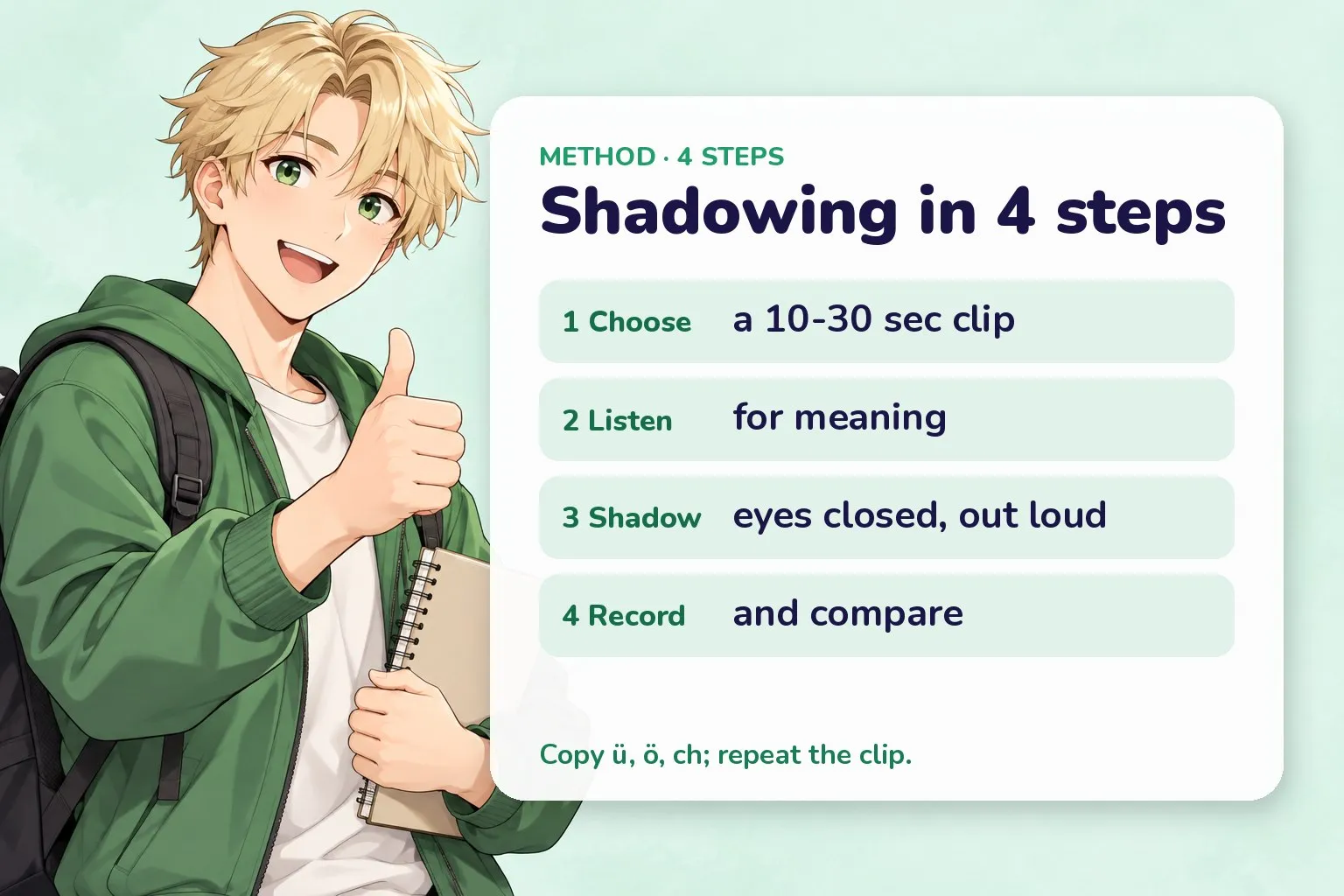
- Choose a short clip, 10–30 seconds. A sentence or two of clear German is plenty — a slow interview, a simple dialogue, or the audio on this site.
- Listen once or twice for meaning. Make sure you understand it before you try to speak.
- Shadow with your eyes closed, no text. Play the clip and speak along, a fraction behind the voice. Hold on to the melody and the beat.
- Replay the same clip several times. Each pass, catch a little more: an umlaut, a soft ch, the stress landing on the right syllable.
- Now open the transcript. Read along while you shadow to find the exact words you were blurring — long compound words especially.
- Record yourself shadowing once more, then play your voice next to the original. The gaps you hear are your to-do list.
Common pitfalls
- Reading instead of listening. If your eyes are glued to the text from the start, you copy spelling, not sound. Ears first, text later.
- Flattening the umlauts. English speakers often replace ü and ö with plain “u” and “o”. Copy the rounded-lip sound you hear: für, schön.
- Getting the ch wrong. ch is a soft hiss after e/i (ich) and a harsh throat sound after a/o/u (Buch) — never an English “ch”. Imitate it exactly.
- Practising silently. Shadowing only works out loud; mouthing the words gives your muscles no workout.
- One pass and move on. The improvement comes from repeating the same clip until it feels easy.
How to say it
German spelling is regular, so shadowing is where you groove in the few sounds English lacks:
- ü and ö. Say “ee” with rounded lips for ü (über, für); say “ay” with rounded lips for ö (schön, hören).
- ch. Soft after e/i (ich ≈ “ikh”); harsh after a/o/u (Buch, ach).
- w and v. w sounds like English “v” (Wasser = “VASS-er”); v usually sounds like “f” (Vater = “FAH-ter”).
- Final consonants are crisp. Unlike French, German pronounces its endings clearly, and final -b, -d, -g harden to “p, t, k”: und = “oont”, Tag = “tahk”.
Example sentences
Shadow each line below: play the audio, then speak along a beat behind. Start slow, repeat, and copy the rhythm.
- Guten Tag, wie geht es Ihnen?Hello, how are you?formal greeting
- Mir geht es gut, danke.I'm fine, thanks.
- Wie heißt du?What's your name?
- Ich heiße Anna.My name is Anna.
- Ich hätte gern einen Kaffee, bitte.I'd like a coffee, please.
- Wie spät ist es?What time is it?
- Können Sie das bitte wiederholen?Can you repeat that, please?
- Ich verstehe das nicht.I don't understand that.
- Wo ist der Bahnhof?Where is the station?ch in Bahnhof
- Die Freunde sind schon hier.The friends are already here.
- Ich warte seit etwa zehn Minuten.I've been waiting about ten minutes.
- Es freut mich, Sie kennenzulernen.Pleased to meet you.
- Vielen Dank für Ihre Hilfe.Thank you very much for your help.
- Wir brauchen noch ein bisschen Zeit.We still need a little more time.
- Bis bald!See you soon!
Quick recap before you practise.
Practice
Shadowing method practice
Try each one, then press Check. No sign-up, nothing is sent anywhere — it all runs in your browser.
Hint: the written version of the audio
Show answer
transcript — Ears first, then use the transcript to catch words you blurred.
4 Put a shadowing session in order.
Show answer
choose a short clip listen for meaning shadow with no text record and compare — Choose, understand, shadow by ear, then record and compare.
5 Match each pitfall to its fix.
- reading from the start
- flattening ü and ö
- an English 'ch'
- one pass only
Show answer
- reading from the start → listen first, text later
- flattening ü and ö → copy the rounded-lip sound
- an English 'ch' → imitate the German hiss
- one pass only → repeat the same clip
Each fix turns a common shadowing mistake into good practice.
Quiz
Shadowing quiz
8 questions · pick an answer and you'll see straight away if it's right.
-
Show answer
to copy the sounds, stress and rhythm of German — Shadowing reshapes how you sound by imitating a speaker closely.
-
Show answer
about 10–30 seconds — A short clip you can repeat beats a long one you cannot.
-
Show answer
so you copy the sound, not the spelling — Starting by ear keeps you honest about the real sounds.
-
Show answer
a soft hiss, like the start of 'huge' — After e/i, ch is a soft hiss: ich ≈ 'ikh'.
-
Show answer
saying 'ee' with rounded lips — Say 'ee' while rounding your lips: für, über.
-
Show answer
English 'v' — German w = English v: Wasser = 'VASS-er'.
-
Show answer
repeating the same clip until it feels easy — Repetition of one clip is what builds the muscle memory.
-
Show answer
hear the gaps between your voice and the original — Comparing your recording to the original shows you exactly what to fix.
Next
- Build the sounds it relies on in the German grammar section
- New here? Start with Start Learning German Here
All German practice topics
Vocabulary, pronunciation, phrases, practice and exam help, ordered by level. Pick a topic and go straight to it. New lessons go live every day, so topics marked Coming soon fill in over the next weeks.
Practice
A1 1 topics · 1 ready
A2 2 topics · 2 ready
B1 5 topics · 2 ready
- 04 Shadowing to Improve German Speaking You are here
- 05 German Reading Practice: Intermediate
- 06 How to Practise German Writing Coming soon
- 07 German Two-Way Prepositions Practice Coming soon
- 08 German Adjective Endings Practice Coming soon