How to Practise German Listening
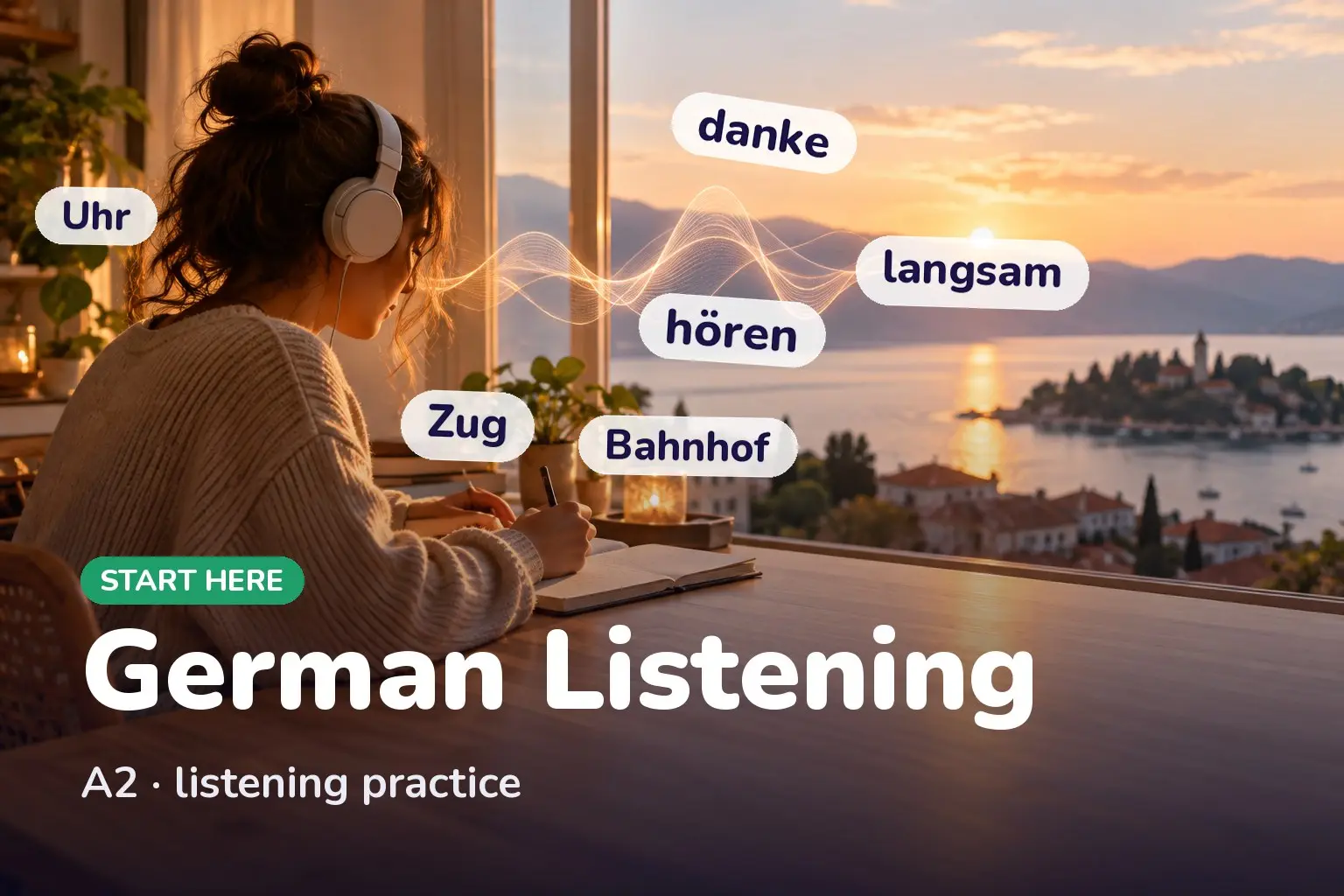
To practise German listening, pick audio at or just below your level and play the same short clip several times: first for the gist, then for detail, then with the transcript. Mix top-down guessing from context with bottom-up decoding of the actual sounds.
Level: A2. Listening is the skill most learners neglect and then panic about in a real conversation. The fix is not more hours of hard audio — it is the right audio, repeated the right way. This page gives you a routine you can run on any short German clip.
By the end of this page you can…
…choose listening material at your level, run a repeatable listening routine, handle the sounds and numbers that make German hard to catch, and find free audio to practise with.
What listening practice is
Listening practice is not background noise while you cook. It is active: you choose a short clip, set yourself a question, and listen with full attention to answer it. Two processes work together.
- Top-down listening uses what you already know — the topic, the situation, the words you expect — to predict and fill gaps. If someone at a bakery says a number, you know it is a price.
- Bottom-up listening decodes the actual sounds and words as they arrive, without guessing. This is what catches the detail top-down skips: the exact time, the negative nicht, the right name.
Good listeners switch between the two. Beginners lean too hard on one: all guessing (you miss nicht and reverse the meaning) or all decoding (you freeze on one unknown word and lose the sentence).
Graded listening: pick the right level
The material should be comprehensible: you follow most of it and stretch for the rest. Audio that is far above your level teaches you only that German is fast. Choose clips where you catch perhaps 70–90% unaided, then work on the gaps.
A listening routine, step by step
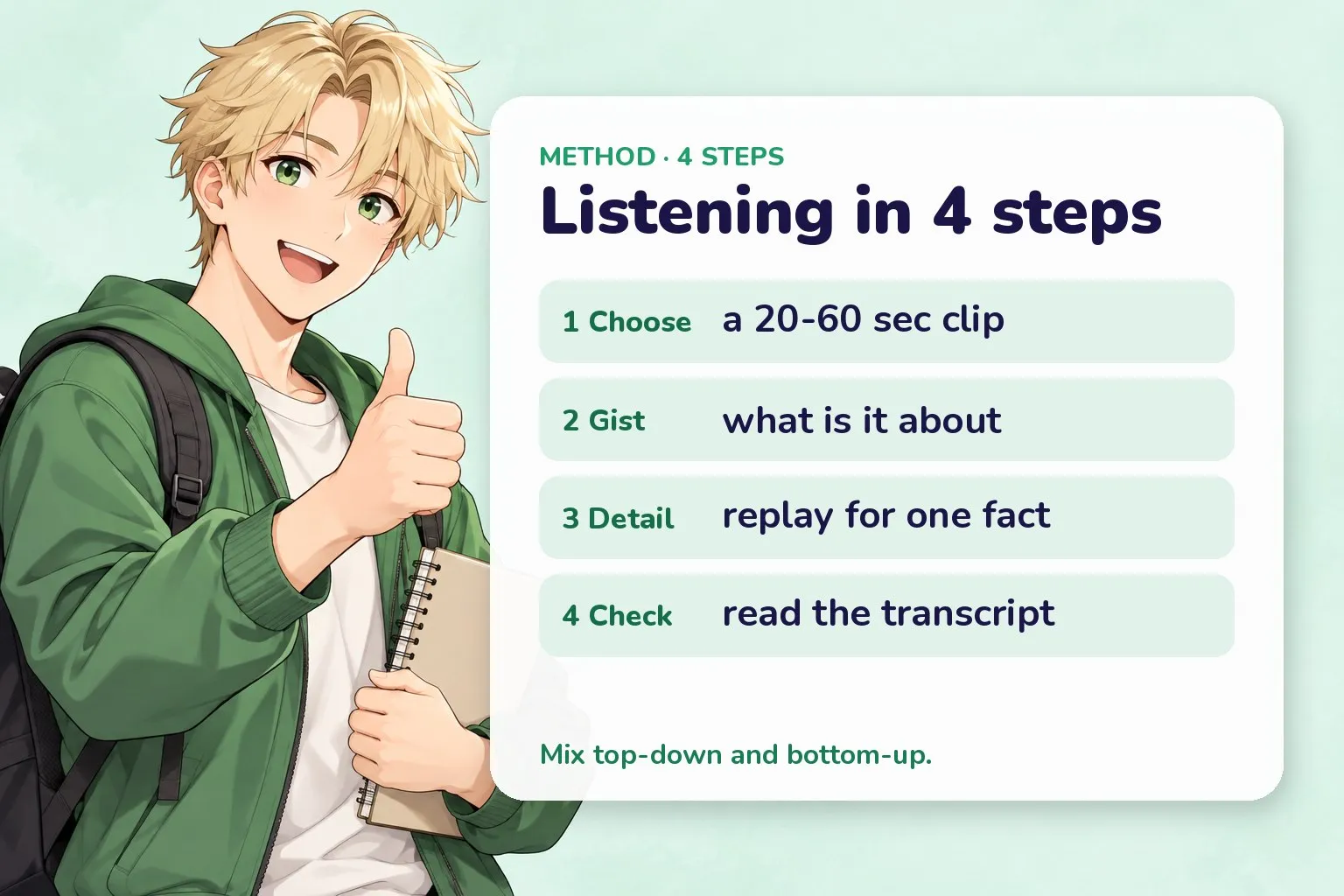
- Pick a short clip, 20–60 seconds. A news headline, a dialogue, or the audio on this site is plenty.
- Listen once for the gist. What is it about? Who is speaking? Do not read anything yet.
- Listen again for one detail. Set a question first: a number, a time, a name, a yes/no. Replay only the part you need.
- Do a mini-dictation. Play a sentence, pause, and write what you heard. Gaps show you exactly which sounds you are missing.
- Open the transcript. Compare it with what you wrote. Mark the words you heard wrong, not just the ones you did not know.
- Listen one last time while reading, then once more with the text hidden. The second hearing should feel noticeably clearer.
What makes German hard to hear
- The verb comes late. In many clauses the main verb or its second half lands at the end: Ich habe gestern einen Film gesehen. Keep listening to the last word or you miss the action.
- Compound words run together. Geschwindigkeitsbegrenzung (speed limit) is one long word; break it at the joints rather than hunting for a pause.
- Numbers are back-to-front. Einundzwanzig is literally “one-and-twenty” (21). Prices and phone numbers feel scrambled until you expect the flip.
- Final consonants are devoiced. und ends in a “t” sound, Tag in a “k”; the spelling and the sound differ.
How to say it
Hearing these sounds clearly is what you are training; it helps to be able to produce them too:
- ü and ö. Say “ee” then round your lips for ü (über); say “ay” then round for ö (schön). English has neither.
- ch. Soft after e/i (ich, like a loud whisper); harder after a/o/u (Buch, from the back of the throat).
- r. Often a soft throat sound or, at the end of a word, close to “ah”: der ≈ “dea”.
- z and the final -d/-g. z is “ts” (zehn = “tsayn”); final -d/-g harden to “t”/“k” (und ≈ “unt”, Tag ≈ “tahk”).
Example sentences
Play each line, then replay it with your eyes off the text and write what you hear:
- Wie spät ist es?What time is it?listen for the time that follows
- Es ist einundzwanzig Uhr.It is 21:00 (9 pm).number said one-and-twenty
- Der Zug fährt um acht Uhr ab.The train leaves at eight o'clock.separable verb: ab at the end
- Ich hätte gern einen Kaffee.I would like a coffee.polite request
- Das kostet drei Euro fünfzig.That costs three euros fifty.price
- Können Sie das bitte wiederholen?Can you repeat that, please?
- Ich habe das nicht verstanden.I did not understand that.listen for nicht
- Wo ist der Bahnhof?Where is the station?
- Gestern war ich im Kino.Yesterday I was at the cinema.
- Sprechen Sie bitte langsamer.Please speak more slowly.
- Der Film hat zwei Stunden gedauert.The film lasted two hours.verb at the end
- Wir treffen uns am Freitag.We are meeting on Friday.listen for the day
Quick recap before you practise.
Where to find audio
- Graded news: slow, clearly read German news (for example Deutsche Welle’s slowly spoken news) gives you real content at a learner’s pace.
- Course listening: the Goethe-Institut’s course and exam materials are built around CEFR listening targets, so you can match a clip to your level.
- This site’s audio: every example above plays through your browser’s built-in voice — use it for mini-dictation.
- High-frequency words first: the FrequencyWords lists tell you which words to expect most, so learning them makes any clip easier to decode.
Practice
Listening-strategy practice
Try each one, then press Check. No sign-up, nothing is sent anywhere — it all runs in your browser.
Hint: write exactly what you hear
Show answer
dictation — Dictation shows you precisely which sounds you are missing.
4 Put the listening routine in order.
Show answer
pick a short clip listen for the gist listen for one detail check the transcript — Choose, gist, detail, then confirm with the transcript.
5 Match each German listening trap to what it means.
- einundzwanzig
- verb at the end
- und ends in a t sound
- long compound word
Show answer
- einundzwanzig → the number 21, said one-and-twenty
- verb at the end → wait for the last word
- und ends in a t sound → final consonant devoicing
- long compound word → break it at the joints
Each is a feature of spoken German that trips new listeners.
Quiz
German listening quiz
8 questions · pick an answer and you'll see straight away if it's right.
-
Show answer
audio you can mostly follow, with a little stretch — You learn most from audio you largely understand.
-
Show answer
using context and expectations to predict — Top-down uses what you already know to fill gaps.
-
Show answer
decoding the actual sounds and words — Bottom-up catches the exact detail that guessing skips.
-
Show answer
each pass you catch a little more — Repetition on one clip is where the gains come from.
-
Show answer
21 — ein-und-zwanzig = one-and-twenty = 21.
-
Show answer
the verb often lands last — The main verb or its second part often comes at the end.
-
Show answer
get the gist and note the gaps — Gist first; detail and exact words come on later passes.
-
Show answer
many clips on the same topic — Staying on one topic recycles the same vocabulary.
Next
- Build the words you will hear in the German grammar section
- New here? Start with Start Learning German Here
All German practice topics
Vocabulary, pronunciation, phrases, practice and exam help, ordered by level. Pick a topic and go straight to it. New lessons go live every day, so topics marked Coming soon fill in over the next weeks.
Practice
A1 1 topics · 1 ready
A2 2 topics · 2 ready
- 02 How to Practise German Listening You are here
- 03 German Reading Practice: Elementary
B1 5 topics · 2 ready
- 04 Shadowing to Improve German Speaking
- 05 German Reading Practice: Intermediate
- 06 How to Practise German Writing Coming soon
- 07 German Two-Way Prepositions Practice Coming soon
- 08 German Adjective Endings Practice Coming soon