German Reading Practice: Beginner (A1)
This page gives you two short, original German texts at beginner (A1) level, with the new words glossed and comprehension questions. Read each text first for the general idea, then again slowly, and check the word list only when you are stuck.
Level: A1 (beginner). Reading is one of the gentlest ways to grow your German, because you set the speed. Below are two short texts written for beginners, with the new words explained and questions to check what you understood.
By the end of this page you can…
…read two short A1 German texts, work out the new words, and answer simple comprehension questions.
How to use this page
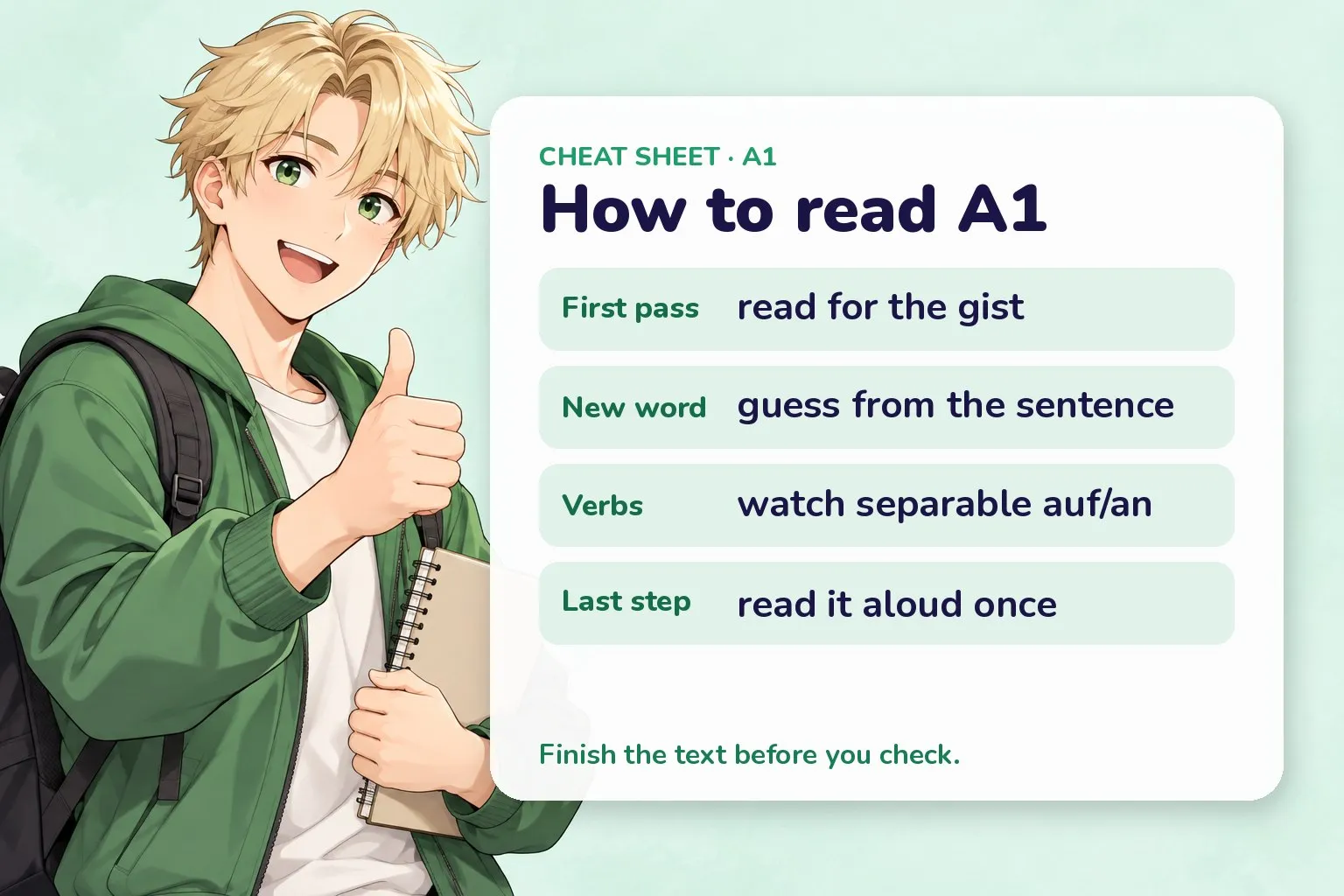
- Read once for the gist. Do not stop at every word. What is the text about? Who is in it?
- Read again, slowly. Try to guess any new words from the sentence around them.
- Check the word list under each text — but only for the words you could not guess.
- Read it aloud once, or play the audio sentences, so you hear the words too.
- Answer the questions at the bottom without looking back, then check.
Reading 1: Annas Tag
Anna ist Studentin. Sie wohnt in einer kleinen Wohnung in Köln. Jeden Morgen steht sie um sieben Uhr auf. Sie duscht und sie frühstückt. Sie trinkt Kaffee mit Milch. Sie mag Kaffee sehr.
Anna fährt mit dem Bus zur Universität. Der Unterricht beginnt um neun Uhr. Um eins isst sie mit ihren Freunden zu Mittag. Am Nachmittag lernt sie zu Hause.
Am Abend sieht Anna fern oder sie liest ein Buch. Um elf Uhr geht sie ins Bett. Sie ist müde, aber sie ist glücklich.
New words (Reading 1)
| Word | Meaning | Example from the text |
|---|---|---|
| die Wohnung | a flat, an apartment | Sie wohnt in einer kleinen Wohnung. |
| steht … auf | gets up (separable: aufstehen) | Sie steht um sieben Uhr auf. |
| frühstückt | has breakfast | Sie duscht und sie frühstückt. |
| mit dem Bus | by bus | Anna fährt mit dem Bus. |
| der Unterricht | the lesson, the class | Der Unterricht beginnt um neun Uhr. |
| zu Mittag essen | to have lunch | Um eins isst sie zu Mittag. |
| müde | tired | Sie ist müde, aber glücklich. |
Reading 2: Max am Wochenende
Max arbeitet nicht am Samstag und am Sonntag. Am Samstagmorgen spielt er mit seinem Bruder Fußball im Park. Sie mögen Fußball sehr. Nach dem Spiel haben sie Hunger, also essen sie viel.
Am Nachmittag geht Max einkaufen. Er kauft Brot, Eier, Obst und Gemüse.
Am Sonntag bleibt Max zu Hause. Er putzt die Wohnung und er ruft seine Mutter an. Am Abend kocht er für zwei Freunde. Sie essen, reden und lachen zusammen. Es ist ein schönes Wochenende.
New words (Reading 2)
| Word | Meaning | Example from the text |
|---|---|---|
| das Wochenende | the weekend | Max arbeitet nicht am Wochenende. |
| Hunger haben | to be hungry | Nach dem Spiel haben sie Hunger. |
| einkaufen gehen | to go shopping | Am Nachmittag geht Max einkaufen. |
| das Gemüse | vegetables | Er kauft Obst und Gemüse. |
| bleibt zu Hause | stays at home | Am Sonntag bleibt Max zu Hause. |
| ruft … an | calls (separable: anrufen) | Er ruft seine Mutter an. |
How to say it
A few words in these texts do not sound the way they look:
- ü in müde and Frühstück: say “ee” with rounded lips (“MÜ-deh”).
- ö in Köln: say “ay” with rounded lips.
- -ch in nicht, Buch: soft after i/e, harder after a/o/u.
- w sounds like English v: Wohnung ≈ “VO-nung”; z is “ts”: zu ≈ “tsoo”.
Example sentences
Listen to key sentences from the texts, then read them aloud.
- Anna ist Studentin.Anna is a student.a simple is-sentence
- Sie steht um sieben Uhr auf.She gets up at seven o'clock.separable verb aufstehen
- Anna fährt mit dem Bus zur Universität.Anna goes to university by bus.
- Der Unterricht beginnt um neun Uhr.The class starts at nine o'clock.
- Am Abend liest sie ein Buch.In the evening she reads a book.
- Max spielt Fußball im Park.Max plays football in the park.
- Nach dem Spiel haben sie Hunger.After the game they are hungry.
- Er ruft seine Mutter an.He calls his mother.separable verb anrufen
- Es ist ein schönes Wochenende.It is a nice weekend.
Quick recap before you answer the questions.
Comprehension practice
Reading comprehension practice
Try each one, then press Check. No sign-up, nothing is sent anywhere — it all runs in your browser.
Hint: a white drink
Show answer
Milch — The text says she drinks coffee with milk and likes it very much.
Hint: does not go out
Show answer
bleibt — On Sunday Max stays at home: bleibt zu Hause.
5 Match each person to what they do.
- Anna fährt zur Universität
- Max geht einkaufen
- Anna liest ein Buch
- Max putzt die Wohnung
Show answer
- Anna fährt zur Universität → mit dem Bus
- Max geht einkaufen → am Nachmittag
- Anna liest ein Buch → am Abend
- Max putzt die Wohnung → am Sonntag
Each pair matches a routine from the two texts.
6 Put Anna's day in order.
Show answer
sie steht auf sie fährt zur Universität sie isst zu Mittag sie geht ins Bett — Up first, then university, lunch at one, and bed at eleven.
Quiz
Beginner German reading quiz
8 questions · pick an answer and you'll see straight away if it's right.
-
Show answer
in einer kleinen Wohnung in Köln — The text says she lives in a small flat in Köln.
-
Show answer
sie lernt zu Hause — In the afternoon she studies at home; TV is in the evening.
-
Show answer
am Samstag und am Sonntag — Max does not work at the weekend — Saturday and Sunday.
-
Show answer
sie haben Hunger nach dem Spiel — After the football game they are hungry, so they eat a lot.
-
Show answer
Brot, Eier, Obst und Gemüse — He buys bread, eggs, fruit and vegetables.
-
Show answer
aufstehen (to get up) — aufstehen is separable: the auf goes to the end.
-
Show answer
einmal für die Idee lesen — Read for the gist first; check only the words you cannot guess.
-
Show answer
tired / needing rest — Anna is müde (tired), but she is happy.
Next
- Practise hearing it: How to Practise German Listening
- Build the grammar: German W-Questions
- New here? Start with Start Learning German Here
All German practice topics
Vocabulary, pronunciation, phrases, practice and exam help, ordered by level. Pick a topic and go straight to it. New lessons go live every day, so topics marked Coming soon fill in over the next weeks.
Practice
A1 1 topics · 1 ready
- 01 German Reading Practice: Beginner You are here
A2 2 topics · 2 ready
B1 5 topics · 2 ready
- 04 Shadowing to Improve German Speaking
- 05 German Reading Practice: Intermediate
- 06 How to Practise German Writing Coming soon
- 07 German Two-Way Prepositions Practice Coming soon
- 08 German Adjective Endings Practice Coming soon