German Pronunciation Overview for Beginners
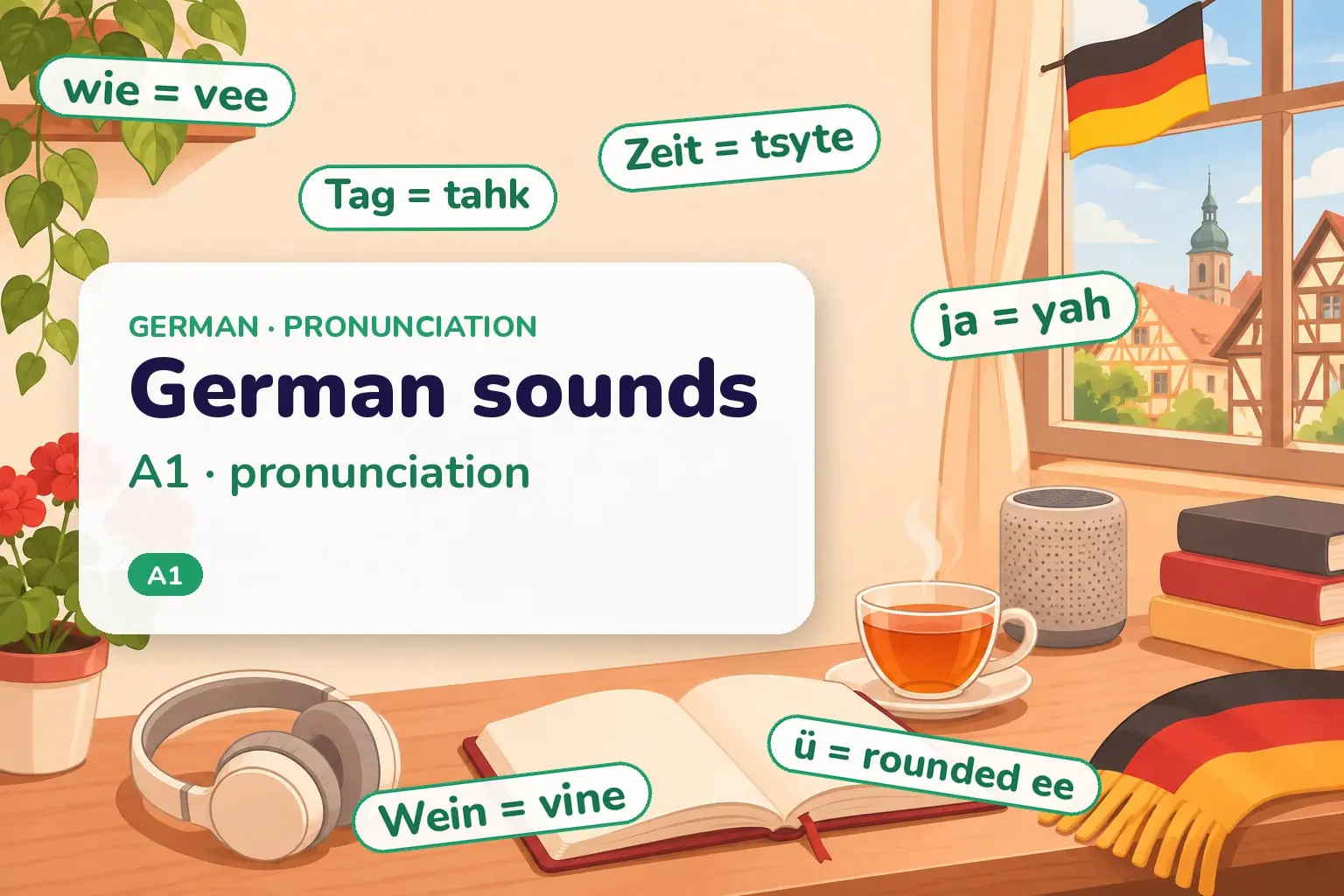
German spelling is regular: once you know a handful of sounds, you can read almost any word aloud. The usual traps for English speakers are the umlauts ä, ö, ü, the pair ei and ie, and the letters w, v, z and ch.
Level: A1 (beginner). Good news first: German is spelt the way it sounds. Learn a short list of letters and letter pairs and you can read a word you have never seen.
By the end of this page you can…
…say the German vowels and umlauts, read the ei/ie pair correctly, and pronounce the letters English speakers most often get wrong (w, v, z, ch).
What makes German sound “right”
German is a phonetic language: each letter, or small group of letters, has a steady sound. There are few silent letters, so spelling is a reliable guide to pronunciation — the opposite of English. The work is front-loaded: spend an hour on the sounds below and the rest of the course gets easier, because every new word is readable.
Three things shape the German sound overall: crisp vowels that keep their value, word stress on the first syllable in most native words, and clear consonants, including a few that look familiar but sound different.
Vowels and umlauts
German vowels are “pure”: a as in father, e as in bet, i as in machine, o as in more, u as in moon. They can be long or short, but the quality stays the same.
The three umlauts are the sounds that feel new:
- ä — like the e in bet (Mädchen, girl).
- ö — round your lips as if to say “oh”, then say “eh” (schön, beautiful).
- ü — round your lips as if to say “oo”, then say “ee” (über, over; für, for).
The ei / ie trap
This single pair causes more beginner mistakes than any other sound:
- ei sounds like English eye — mein (mine), Wein (wine), drei (three).
- ie sounds like English ee — wie (how), Liebe (love), vier (four).
A quick rule many learners use: say the name of the second letter. ei ends in i (“eye”); ie ends in e (“ee”). Wein (wine) and Wien (Vienna) differ only by this.
How to say it
These are the consonant sounds English speakers most often get wrong:
| Letter(s) | How to say it |
|---|---|
| w | Like English v: wie = “vee”, Wasser = “VAH-ser”. |
| v | Usually like English f: Vater = “FAH-ter”, vier = “feer”. |
| z | Like ts: Zeit = “tsyte”, Zoo = “tsoh”. |
| s before a vowel | Like English z: sagen = “ZAH-gen”. |
| ß / ss | A sharp s (never “z”): Straße = “SHTRAH-se”. |
| ch | After a/o/u a throaty sound (Buch); after e/i/consonants a soft “hy” (ich). |
| sch | Like English sh: Schule = “SHOO-le”. |
| sp / st at the start | “shp / sht”: Sport = “shport”, Stadt = “shtat”. |
| j | Like English y: ja = “yah”, Jahr = “yar”. |
| final -b -d -g | Harden toward p/t/k: Tag = “tahk”, und = “unt”. |
Example words
- wiehoww = v, ie = ee: 'vee'
- Weinwineei = eye: 'vine'
- vierfourv = f, ie = ee: 'feer'
- Zeittimez = ts: 'tsyte'
- überover / aboveü = rounded ee
- schönbeautifulö = rounded eh; sch = sh
- fürforü sound
- ichIsoft ch after i
- Buchbookthroaty ch after u
- Straßestreetß = sharp s; st = sht
- jayesj = y: 'yah'
- Tagdayfinal g hardens: 'tahk'
- Wasserwaterw = v; ss = sharp s
- Sportsportsp = shp
- Dankethank youfinal -e is a light 'uh'
Using the audio
Every example on this site has a Listen button that uses your own device’s built-in voice (the browser’s speech feature) — it is not a recording of a native speaker, so treat it as a close guide, not a perfect model. Play a word, pause, then say it back. Shadowing a word three times beats reading it ten.
A note on regional variation
Pronunciation varies across German-speaking regions — the r is rolled in parts of the south and more throaty in the north, and some speakers soften ch. This overview teaches the widely understood standard (Hochdeutsch); any of the regional versions will still be understood.
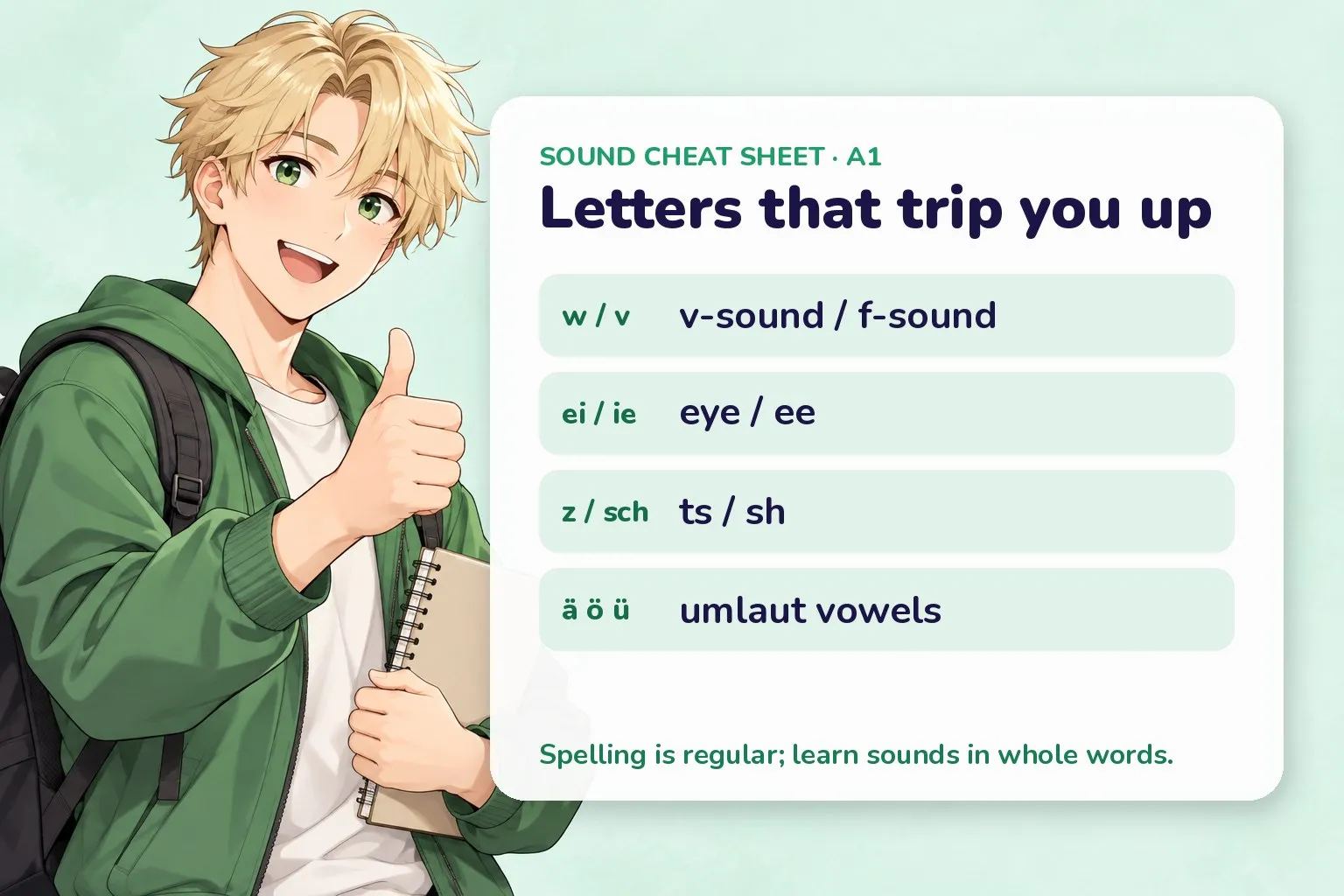
Quick recap of the trickiest letters.
Where to go next
Pin the sounds down inside real grammar: open Start Learning German Here for the course map, learn the first words and articles in Der, Die, Das, then read verbs aloud with the regular present tense. Browse everything in the German grammar section.
Practice
German sounds practice
Try each one, then press Check. No sign-up, nothing is sent anywhere — it all runs in your browser.
1 Match each letter to its German sound.
- w
- v
- z
- j
Show answer
- w → English v
- v → English f
- z → ts
- j → English y
w sounds like v, v like f, z like ts, j like y.
Hint: u + umlaut
Show answer
ü — ü is a rounded 'ee' sound.
Quiz
German pronunciation basics
8 questions · pick an answer and you'll see straight away if it's right.
-
Show answer
v — w = v: wie = 'vee'.
-
Show answer
f — v = f: Vater = 'FAH-ter'.
-
Show answer
eye — ei = eye; Wein = 'vine'.
-
Show answer
ee — ie = ee; wie = 'vee'.
-
Show answer
ts — z = ts: Zeit = 'tsyte'.
-
Show answer
sh — sch = sh: Schule = 'SHOO-le'.
-
Show answer
say ee with rounded lips — ü = round the lips for 'oo' and say 'ee'.
-
Show answer
first syllable — Stress usually sits on the first syllable.
Next
- Start the course: Start Learning German Here
- Your first grammar lesson: Der, Die, Das
All German pronunciation & writing topics
Vocabulary, pronunciation, phrases, practice and exam help, ordered by level. Pick a topic and go straight to it. New lessons go live every day, so topics marked Coming soon fill in over the next weeks.
Pronunciation & writing
A1 4 topics · 1 ready
- 01 German Pronunciation Overview You are here
- 02 The German Alphabet & Umlauts Coming soon
- 03 German Vowels: Long vs Short Coming soon
- 04 German Umlauts (ä ö ü) & ß Coming soon
A2 4 topics
- 05 Tricky German Consonants (ch, r, z, w, v) Coming soon
- 06 German Consonant Clusters (sch, sp, st, pf) Coming soon
- 07 German Word Stress Coming soon
- 08 German Spelling & Capitalisation Rules Coming soon
B1 2 topics
- 09 German Final Devoicing (Auslautverhärtung) Coming soon
- 10 German Intonation & Rhythm Coming soon