al and del: Spanish Contractions a + el, de + el
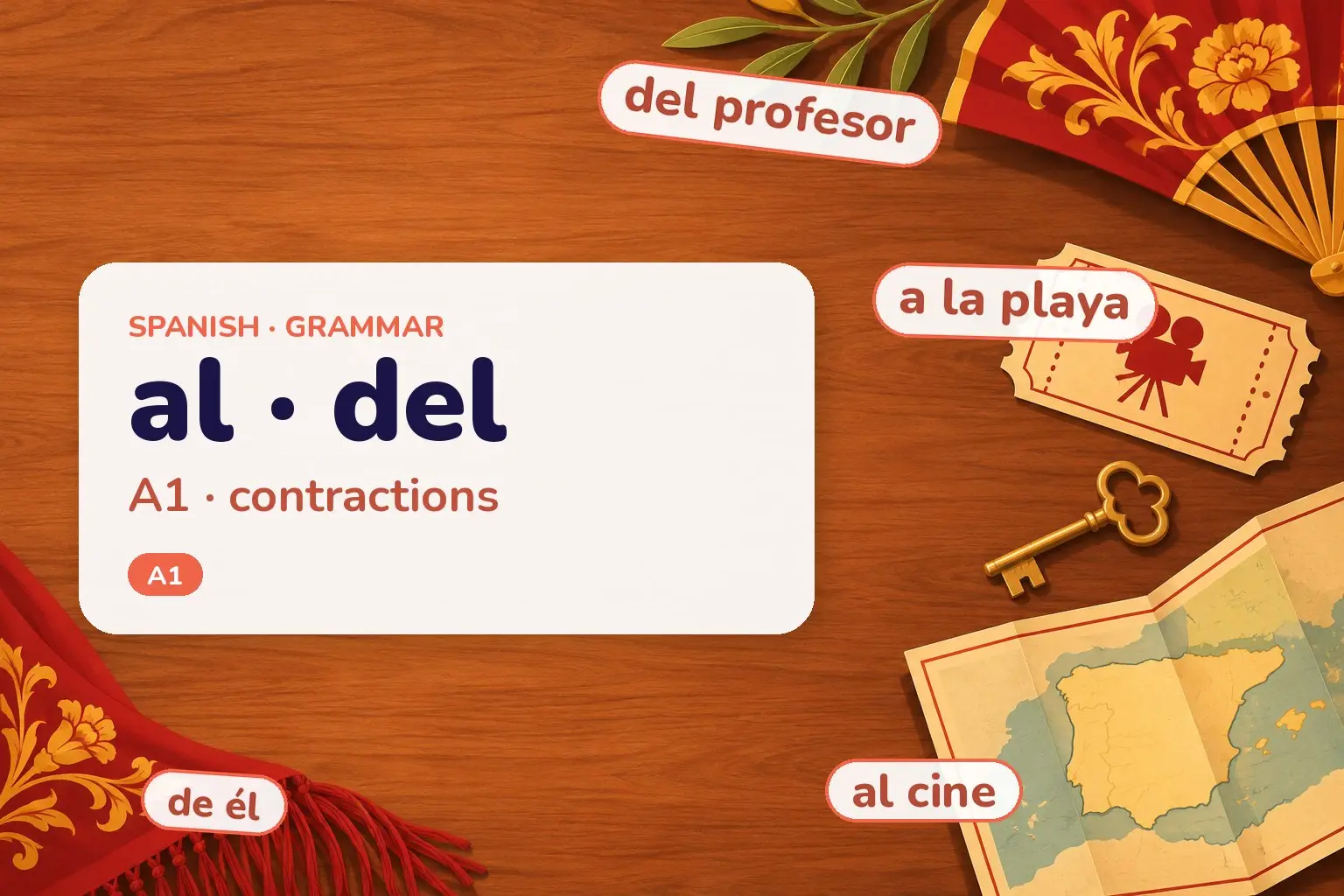
Spanish fuses the preposition a (to) with the article el into al, and de (of, from) with el into del. The fusion is compulsory: voy al cine, la casa del profesor. It happens only with the masculine singular article, never with la, los or las.
Level: A1. Two small words, al and del, cause more beginner errors than most verb tenses. The rule is short and absolute, and the exceptions are narrow enough to learn in one sitting.
The rule
Spanish has two contractions, pairs of words that must be written and pronounced as one: a + el = al and de + el = del. The preposition a means “to” or “at”; de means “of” or “from”. When either one meets the masculine singular article el, they merge.
- Voy al cine. (I am going to the cinema.)
- La casa del profesor. (The teacher’s house.)
This is not a style choice or a fast-speech habit. Writing a el or de el is a spelling mistake in every register, from a text message to a legal contract.
All eight combinations
The preposition changes shape only in front of el. Every other article keeps its distance.
| Preposition + article | Result | Example |
|---|---|---|
| a + el | al | Voy al mercado. (I am going to the market.) |
| de + el | del | Vengo del mercado. (I am coming from the market.) |
| a + la | a la | Voy a la playa. (I am going to the beach.) |
| de + la | de la | Vengo de la playa. (I am coming from the beach.) |
| a + los | a los | Voy a los conciertos. (I go to the concerts.) |
| de + los | de los | Vengo de los conciertos. (I am coming from the concerts.) |
| a + las | a las | Llego a las ocho. (I arrive at eight.) |
| de + las | de las | Salgo de las oficinas. (I leave the offices.) |
The reason is phonetic. El is the only definite article that starts with a vowel, so a + el and de + el run two vowels together and the language collapses them. La, los and las begin with consonants and need no repair.
When the fusion does not happen
El stays apart in writing in two cases: when it is part of a proper name, and when the article opens the title of a work. The pronoun él is a third case with a different reason: it is not an article at all.
A capitalised El inside a place name. When El is part of a proper name it stays separate on paper: Vamos a El Escorial, Mi nuevo vecino es de El Paso. In speech the two words often still blend, which is why the written form looks odd but is correct.
An El that opens the title of a work. The same written rule covers titles: Las críticas a El señor de los anillos (the reviews of The Lord of the Rings), La lectura de El Aleph (the reading of The Aleph). The capital El is part of the title, so the preposition stays alone.
The pronoun él. Él (he, him) is a pronoun with an accent, not an article, and it never fuses: Hablo de él (I am talking about him), Voy a él (I am going to him). Writing del or al there changes the meaning to “of the” or “to the”.
Nicknames are not an exception. The el in a nickname such as el Greco is a lowercase article attached to the nickname, so the fusion applies: no entendió al Greco (he did not understand El Greco), and las fantasías del Bosco. The capital letter belongs to the nickname, not to the article, which is why a El Greco is wrong.
al plus an infinitive
A frequent al has nothing to do with “to the”. Al + infinitive means “on doing” or “when doing”, and it opens a time clause.
- Al llegar a casa, preparo la cena. (On arriving home, I make dinner.)
- Al salir del metro, vi a Ana. (When I came out of the metro, I saw Ana.)
The second example contains both patterns: al salir is the time clause, del metro is the contraction of de + el. Once you can tell them apart, most of the confusion disappears.
How to say it
| Sound | How to say it | Example |
|---|---|---|
| al | One syllable, “ahl”, with a clear l | al cine = “ahl SEE-neh” |
| del | One syllable, “dehl”; the d is soft, tongue near the teeth | del profesor = “dehl proh-feh-SOHR” |
| d between vowels | Softer than English d, almost like th in this | nada, todo, cada |
| a | Pure “ah”, never the a in cat | casa, playa |
Spaniards and Latin Americans both pronounce these as one word. The trap for English speakers is inserting a pause or a schwa: “a-el” and “de-el” are exactly what the spelling forbids.
Example sentences
- Voy al cine esta tarde.I am going to the cinema this afternoon.a + el = al
- El libro está al lado de la ventana.The book is next to the window.fixed phrase: al lado de
- Llegamos al aeropuerto a las ocho.We arrive at the airport at eight.
- La casa del profesor es grande.The teacher's house is big.de + el = del
- Vengo del trabajo.I am coming from work.
- Es el mejor restaurante del barrio.It is the best restaurant in the neighbourhood.del in a superlative
- Al llegar a casa, preparo la cena.On arriving home, I make dinner.al + infinitive
- Al salir del metro, vi a Ana.When I came out of the metro, I saw Ana.both patterns in one sentence
- Vamos a la playa el domingo.We are going to the beach on Sunday.la does not fuse
- Hablo de él, no de su hermano.I am talking about him, not his brother.pronoun él never fuses
- Vamos a El Escorial mañana.We are going to El Escorial tomorrow.place name keeps El separate
- Soy del norte de España.I am from the north of Spain.
- El gato del vecino duerme al sol.The neighbour's cat sleeps in the sun.
- Dame el vaso del estante.Give me the glass from the shelf.
- Al final del día, estoy cansado.At the end of the day, I am tired.al final and del día together
- No me gusta el ruido del tráfico.I do not like the noise of the traffic.
- Fuimos al mercado a pie.We went to the market on foot.
- ¿A qué hora empieza el concierto?What time does the concert start?no article, so no contraction
Common mistakes
- ✗ Voy a el cine. → ✓ Voy al cine. The merger is compulsory after a.
- ✗ Vengo de el trabajo. → ✓ Vengo del trabajo. Same rule with de.
- ✗ Vamos al casa. → ✓ Vamos a la casa. La is feminine and never fuses.
- ✗ Hablo del él. → ✓ Hablo de él. The pronoun keeps its accent and its own word.
- ✗ Vamos al El Escorial. → ✓ Vamos a El Escorial. A proper name keeps its capital El apart.
A short conversation
Two friends planning an afternoon in the city.
Ana: ¿Vamos al centro esta tarde? (BAH-mohs ahl SEHN-troh EHS-tah TAHR-deh?) — Shall we go to the centre this afternoon? Luis: Sí, pero primero paso por la oficina del padre de Marta. (see, PEH-roh pree-MEH-roh PAH-soh pohr lah oh-fee-SEE-nah dehl PAH-dreh deh MAR-tah.) — Yes, but first I am stopping by Marta’s father’s office. Ana: ¿Y después? (ee dehs-PWEHS?) — And afterwards? Luis: Después vamos a la terraza del hotel, al lado del río. (dehs-PWEHS BAH-mohs ah lah teh-RRAH-sah dehl oh-TEHL, ahl LAH-doh dehl REE-oh.) — Then we go to the hotel terrace, next to the river. Ana: Perfecto. Al salir de casa te llamo. (pehr-FEHK-toh. ahl sah-LEER deh KAH-sah teh YAH-moh.) — Perfect. When I leave home I will call you.
Usage notes
Al final, al menos, al lado de. A handful of fixed phrases run on al and are worth learning as blocks: al final (in the end), al menos (at least), al lado de (next to), al aire libre (outdoors), al sol (in the sun). None of them means “to the”.
Del for origin and for superlatives. Soy del sur (I am from the south) uses del for origin, and el mejor del mundo (the best in the world) uses it to set a range. English uses “from the” and “in the” for these, which is why the translation drifts.
Questions with a + el. Questions contract exactly like statements: ¿A qué hora? has no article and no contraction, but ¿Vamos al parque? does. The presence or absence of el is the only thing that decides.
No contraction before a verb. Al plus an infinitive is the one case where al is not “to the”. If the next word is a verb in the infinitive, read it as “on doing”: al entrar, al terminar, al verlo.
Compared with the definite articles
The article decides everything. It is worth seeing the full grid once, because the four articles look similar and behave differently.
| Article | Meaning | With a | With de |
|---|---|---|---|
| el | the (masc. sing.) | al | del |
| la | the (fem. sing.) | a la | de la |
| los | the (masc. plural) | a los | de los |
| las | the (fem. plural) | a las | de las |
If you can name the article, you can predict the form. The definite articles lesson explains how to choose between el and la in the first place, including the el agua case where a feminine noun takes el — and there the contraction follows the article’s form, not the noun’s gender: el agua del vaso.
Practice
al and del practice
Try each one, then press Check. No sign-up, nothing is sent anywhere — it all runs in your browser.
Hint: playa is feminine
Show answer
a la — The article is la, so nothing fuses: a la playa.
Hint: de + el
Show answer
del — de + el becomes del.
5 Build: 'When I leave home, I will call you.'
Show answer
Al salir (ahl sah-LEER) de casa (deh KAH-sah) te llamo (teh YAH-moh) — Al + infinitive opens the time clause, then the main clause follows.
6 Match each pair to its contracted form.
- a + el
- de + el
- a + la
- de + los
Show answer
- a + el → al
- de + el → del
- a + la → a la
- de + los → de los
Only el fuses; the other articles keep the preposition separate.
Quiz
al and del quiz
12 questions · pick an answer and you'll see straight away if it's right.
-
Show answer
al — The two words merge into al.
-
Show answer
del — de + el merges into del.
-
Show answer
Voy al mercado. — a + el is written and said as al.
-
Show answer
el — Only el begins with a vowel, so only el contracts.
-
Show answer
de la — Oficina is feminine, so the article is la and nothing fuses.
-
Show answer
I am talking about him — Él is the pronoun, written with an accent, and it never fuses with de.
-
Show answer
on arriving home — Al plus an infinitive means 'on doing' or 'when doing'.
-
Show answer
del — Barrio is masculine singular, so de + el becomes del.
-
Show answer
because el starts with a vowel — The two vowels collide, so the language merges them into one syllable.
-
Show answer
Vamos a El Paso. — A capitalised El in a place name stays separate from the preposition.
-
Show answer
al — The fixed phrase is al sol, a contraction of a + el.
-
Show answer
del — Mercado is masculine singular: de + el becomes del.
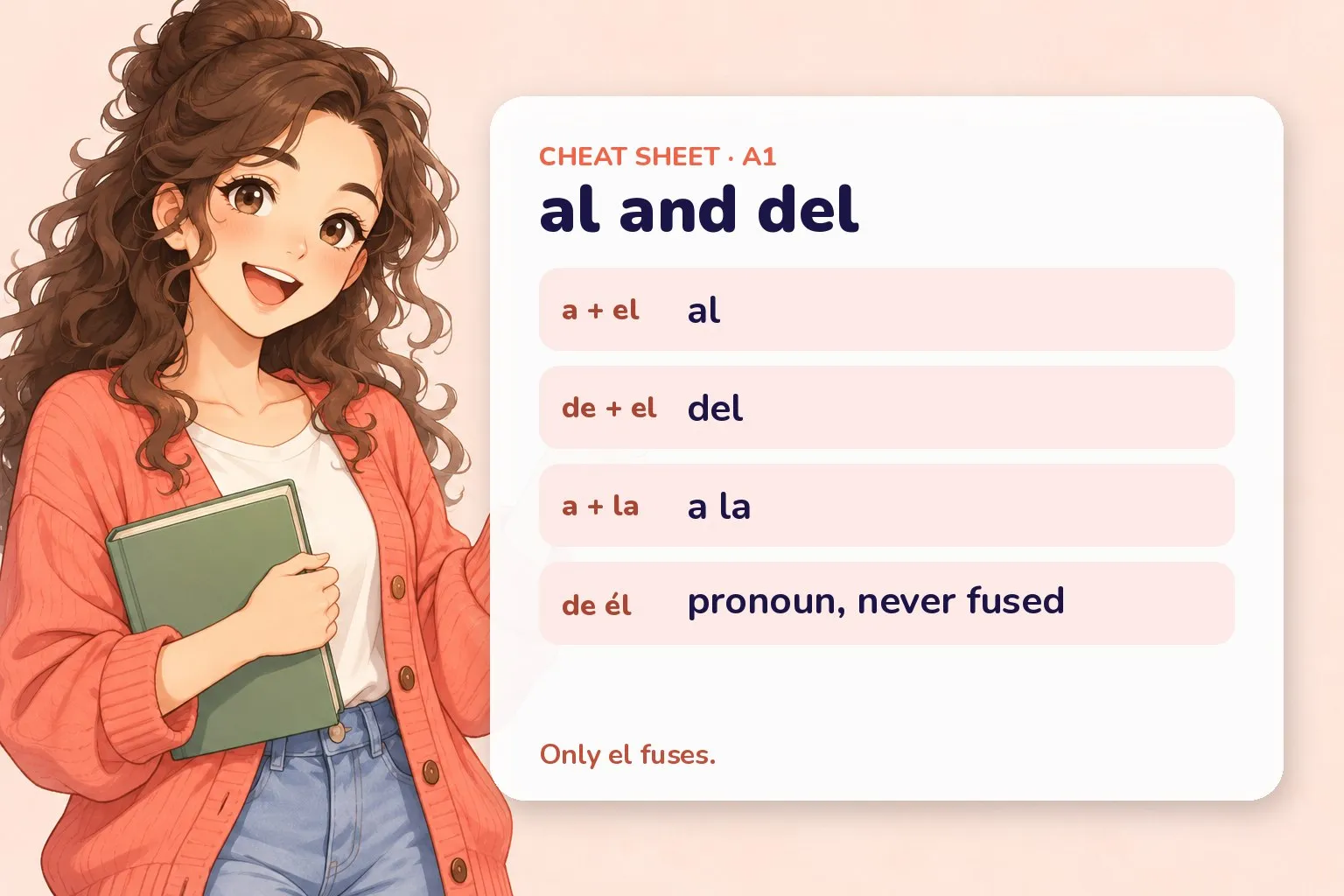
Quick recap before the quiz.
Recap cheat-sheet
| Form | Built from | Example |
|---|---|---|
| al | a + el | Voy al cine |
| del | de + el | La casa del profesor |
| a la | a + la | Voy a la playa |
| de los | de + los | Vengo de los conciertos |
| a El (name) | proper name keeps El | Vamos a El Escorial |
| de él | pronoun, never fused | Hablo de él |
| al + infinitive | “on doing” | Al llegar, ceno |
Next
- How to choose the article in the first place: Definite articles el, la, los, las
- The verb that keeps company with al: ir (to go) in the present
- Why nouns are masculine or feminine: Spanish noun gender
- New here? Start with Start Learning Spanish Here
All Spanish grammar topics
Every grammar point in order, from your first sentence to advanced structures. Pick one and go straight to it. New lessons go live every day, so topics marked Coming soon fill in over the next weeks.
Grammar path
A1 31 topics · 22 ready
- 01 Noun Gender in Spanish (Masculine & Feminine)
- 02 Forming Plurals in Spanish
- 03 Definite Articles: el, la, los, las
- 04 Indefinite Articles: un, una, unos, unas
- 05 Subject Pronouns (yo, tú, él, nosotros)
- 06 The Verb Ser (Permanent 'To Be')
- 07 The Verb Estar (States & Location)
- 08 Ser vs Estar: When to Use Each
- 09 Hay: There Is / There Are
- 10 Present Tense: Regular -AR Verbs
- 11 Present Tense: Regular -ER Verbs
- 12 Present Tense: Regular -IR Verbs
- 13 The Verb Tener (To Have) and Expressions
- 14 The Verb Ir (To Go) and Ir A + Infinitive
- 15 Gustar: Expressing Likes
- 16 Adjective Agreement (Gender & Number)
- 17 Position of Adjectives in Spanish
- 18 Possessive Adjectives (mi, tu, su, nuestro)
- 19 Demonstratives: este, ese, aquel
- 20 Question Words (qué, quién, dónde, cómo)
- 21 Negation: no and Double Negatives
- 22 Contractions: al (a + el) and del (de + el) You are here
- 23 Muy vs Mucho Coming soon
- 24 Stem-Changing Verbs e→ie (querer, pensar) Coming soon
- 25 Stem-Changing Verbs o→ue (poder, dormir) Coming soon
- 26 Reflexive Verbs (levantarse, ducharse) Coming soon
- 27 Present Progressive (estar + gerundio) Coming soon
- 28 Tener Que + Infinitive (Obligation) Coming soon
- 29 The Personal A (direct object people) Coming soon
- 30 Prepositions a, en, de (Core Uses) Coming soon
- 31 Weather Expressions with Hacer Coming soon
A2 25 topics
- 32 Preterite Tense: Regular Verbs Coming soon
- 33 Preterite: Irregular Verbs (ser, ir, tener) Coming soon
- 34 Imperfect Tense (Ongoing & Habitual Past) Coming soon
- 35 Preterite vs Imperfect: Which Past Tense? Coming soon
- 36 Near Future: Ir A + Infinitive Coming soon
- 37 Direct Object Pronouns (lo, la, los, las) Coming soon
- 38 Indirect Object Pronouns (me, te, le, nos) Coming soon
- 39 Double Object Pronouns (se lo, me lo) Coming soon
- 40 Comparatives (más que, menos que) Coming soon
- 41 Superlatives (el más, -ísimo) Coming soon
- 42 Stressed Possessives (el mío, la tuya) Coming soon
- 43 Saber vs Conocer (Two Ways to 'Know') Coming soon
- 44 Por vs Para: The Basics Coming soon
- 45 Verbs Like Gustar (encantar, molestar, doler) Coming soon
- 46 Informal Commands (tú affirmative) Coming soon
- 47 Hace / Desde Hace for Time Expressions Coming soon
- 48 Acabar De + Infinitive (Just Did) Coming soon
- 49 Stem-Changing Verbs e→i (pedir, servir) Coming soon
- 50 Hay Que + Infinitive (Impersonal Obligation) Coming soon
- 51 Deber and Deber De (Obligation & Probability) Coming soon
- 52 Prepositional Pronouns (mí, ti, conmigo) Coming soon
- 53 Pero vs Sino (But) Coming soon
- 54 También and Tampoco (Also / Neither) Coming soon
- 55 Indefinite Pronouns (alguien, algo, cualquiera) Coming soon
- 56 Apocopation (buen, gran, primer, san) Coming soon
B1 25 topics
- 57 Simple Future Tense (hablaré) Coming soon
- 58 Conditional Tense (hablaría) Coming soon
- 59 Present Subjunctive: Formation Coming soon
- 60 Subjunctive for Wishes & Emotions (querer que) Coming soon
- 61 Subjunctive After Impersonal Expressions Coming soon
- 62 Formal & Negative Commands (usted, no hagas) Coming soon
- 63 Present Perfect (he hablado) Coming soon
- 64 Past Participles (Regular & Irregular) Coming soon
- 65 Pluperfect (había hablado) Coming soon
- 66 Por vs Para: Advanced Uses Coming soon
- 67 Relative Pronouns (que, quien, el que) Coming soon
- 68 Passive Se and Impersonal Se Coming soon
- 69 Comparisons of Equality (tan, tanto como) Coming soon
- 70 Pronoun Placement with Infinitives & Gerunds Coming soon
- 71 Si Clauses Type 1 (Real Conditions) Coming soon
- 72 Uses of the Gerund (-ando / -iendo) Coming soon
- 73 Lo + Adjective and Lo Que (Neuter Lo) Coming soon
- 74 Adverbs Ending in -mente Coming soon
- 75 Subjunctive After cuando & Time Conjunctions Coming soon
- 76 Verbs of Becoming (ponerse, volverse, hacerse) Coming soon
- 77 Quedar and Quedarse (Multiple Meanings) Coming soon
- 78 Al + Infinitive and Infinitive as Noun Coming soon
- 79 Antes de / Después de + Infinitive Coming soon
- 80 Más de / Menos de with Numbers Coming soon
- 81 Porque, Por Qué, Porqué, Por Que Coming soon
B2 18 topics
- 82 Imperfect Subjunctive (hablara / hablase) Coming soon
- 83 Si Clauses Type 2 (Unreal Present) Coming soon
- 84 Subjunctive in Adjective Clauses Coming soon
- 85 Subjunctive After Conjunctions (para que, aunque) Coming soon
- 86 Present Perfect Subjunctive (haya hablado) Coming soon
- 87 Future Perfect (habré hablado) Coming soon
- 88 Conditional Perfect (habría hablado) Coming soon
- 89 Passive Voice with Ser (ser + participle) Coming soon
- 90 Reported Speech (estilo indirecto) Coming soon
- 91 Advanced Relatives (cuyo, el cual, donde) Coming soon
- 92 Verbal Periphrases (seguir/llevar + gerundio) Coming soon
- 93 Indicative vs Subjunctive in Noun Clauses Coming soon
- 94 Aunque: Indicative vs Subjunctive Coming soon
- 95 Ojalá, Quizás, Tal Vez + Subjunctive Coming soon
- 96 Diminutives and Augmentatives (-ito, -ón) Coming soon
- 97 Future & Conditional of Probability (Conjecture) Coming soon
- 98 Relative Superlative & de + Group Coming soon
- 99 Adjectives That Change Meaning with Ser/Estar Coming soon
C1 11 topics
- 100 Pluperfect Subjunctive (hubiera hablado) Coming soon
- 101 Si Clauses Type 3 & Mixed (Unreal Past) Coming soon
- 102 Sequence of Tenses (correlación de tiempos) Coming soon
- 103 All Uses of Se (reflexive, passive, impersonal, accidental) Coming soon
- 104 Future Subjunctive (hablare) — Literary/Legal Coming soon
- 105 Discourse Connectors (sin embargo, por lo tanto) Coming soon
- 106 Subjunctive Nuance (perception, comunicación verbs) Coming soon
- 107 Ser/Estar + Participle & Resultant States Coming soon
- 108 Nominalisation & Register (Formal Spanish) Coming soon
- 109 Advanced Concession (por más que, a pesar de) Coming soon
- 110 Modal & Aspectual Periphrases (deber de, acabar por) Coming soon