Position of Adjectives in Spanish (BAGS & More)
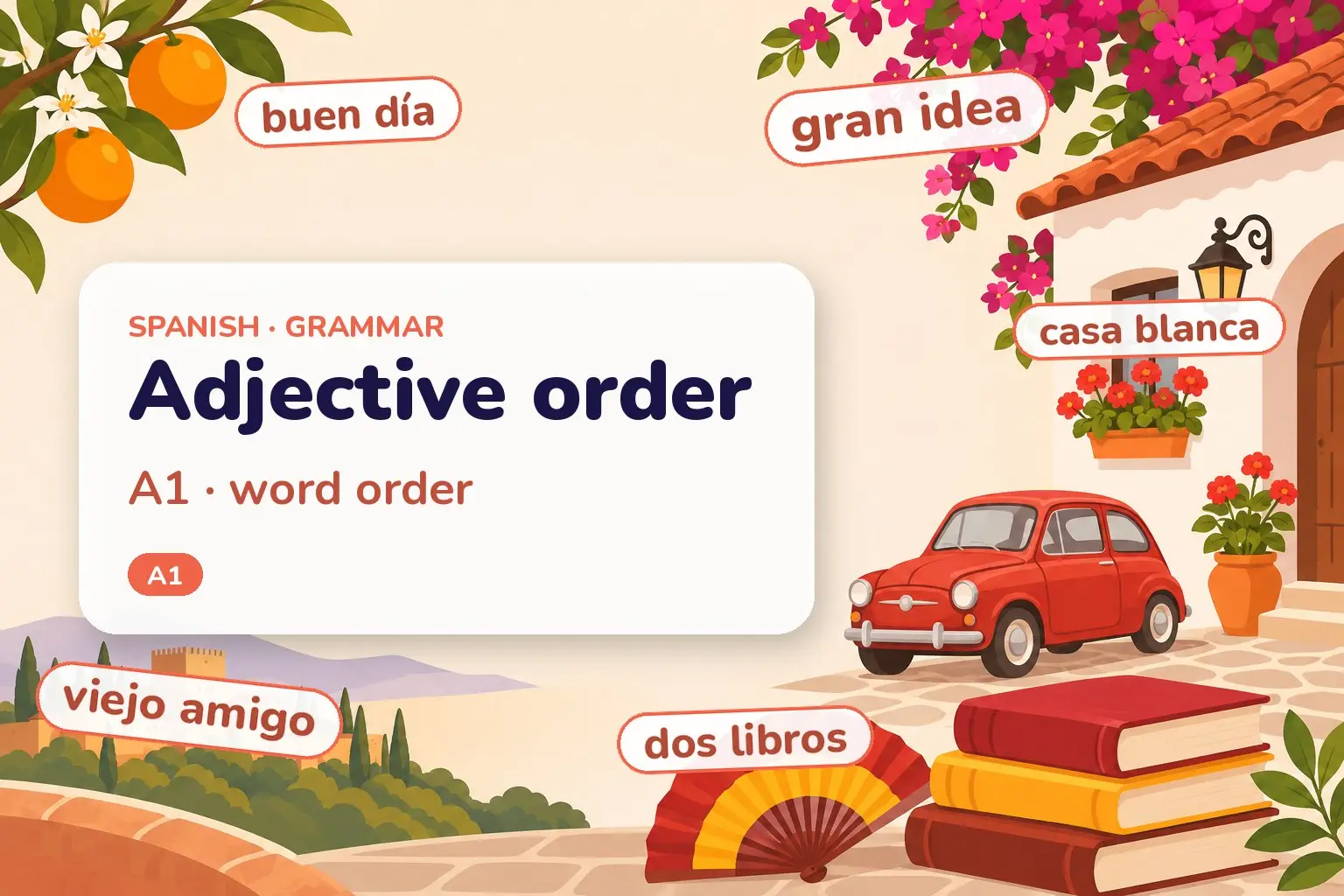
Most Spanish adjectives follow the noun: una casa blanca ('a white house'). Limiting words (numbers, possessives, quantifiers) go before it, and a small set change meaning by position: un gran hombre ('a great man') versus un hombre grande ('a big man').
Level: A1. English always puts the adjective in front of the noun — “a white house”. Spanish usually does the opposite, placing it after: una casa blanca. That one switch fixes most beginner word-order errors. Then there is a short list of adjectives that go before, and a handful that change meaning depending on where they sit.
The rule
An adjective describes a noun (white, big, first). In Spanish, where it sits depends on what kind of adjective it is.
- Descriptive adjectives normally follow the noun. Words that classify or distinguish — colour, shape, nationality, type — come after: un coche rojo (a red car), una mesa redonda (a round table), un profesor español (a Spanish teacher).
- Limiting adjectives come before the noun. Numbers, possessives, demonstratives and quantifiers go in front: dos libros (two books), mi casa (my house), esta silla (this chair), muchos amigos (many friends).
- A descriptive adjective can move before the noun to stress a quality taken for granted or to sound literary: la blanca nieve (the white snow). This is a stylistic choice, not the neutral order.
So the default you should reach for is noun + adjective. Put the adjective first only when it is a limiting word, or on purpose for effect.
Apocope: short forms before the noun
A few common adjectives drop their final vowel or syllable when they sit directly before a noun. This shortening is called apocope.
| Full form | Short form | Before | Example |
|---|---|---|---|
| bueno | buen | masculine singular noun | un buen libro (a good book) |
| malo | mal | masculine singular noun | un mal día (a bad day) |
| primero | primer | masculine singular noun | el primer piso (the first floor) |
| tercero | tercer | masculine singular noun | el tercer día (the third day) |
| grande | gran | any singular noun | una gran idea (a great idea) |
| ciento | cien | any noun | cien euros (a hundred euros) |
bueno, malo, primero and tercero shorten only before a masculine singular noun: un buen amigo, but una buena amiga and unos buenos amigos keep the full form. grande shortens to gran before any singular noun, masculine or feminine: un gran hombre, una gran mujer.
Position that changes meaning
For a small, high-frequency set, moving the adjective changes what it means. Before the noun the sense is figurative or subjective; after it, literal.
| Adjective | Before the noun | After the noun |
|---|---|---|
| grande / gran | un gran hombre (a great man) | un hombre grande (a big man) |
| viejo | un viejo amigo (a long-standing friend) | un amigo viejo (an elderly friend) |
| pobre | el pobre niño (the poor, pitiable child) | el niño pobre (the penniless child) |
| nuevo | un nuevo coche (another/different car) | un coche nuevo (a brand-new car) |
| antiguo | mi antiguo jefe (my former boss) | un mueble antiguo (an antique piece) |
Example sentences
Each sentence was written for this lesson.
- Vivo en una casa blanca.I live in a white house.colour: after the noun
- Tengo un coche rojo.I have a red car.
- Es una mesa redonda.It is a round table.shape: after the noun
- Compré dos libros nuevos.I bought two new books.number before, adjective after
- Mi casa es pequeña.My house is small.possessive before the noun
- Hay muchos coches en la calle.There are many cars on the street.quantifier before
- Fue un buen día.It was a good day.bueno → buen before a masc. sing. noun
- Tuvimos un mal año.We had a bad year.malo → mal
- Vivo en el primer piso.I live on the first floor.primero → primer
- Es una gran idea.It is a great idea.grande → gran before any singular noun
- Es un gran hombre.He is a great man.gran before: figurative
- Es un hombre grande.He is a big man.grande after: literal size
- Es un viejo amigo.He is a long-standing friend.viejo before: longtime
- Es un amigo viejo.He is an elderly friend.viejo after: aged
- El pobre niño está enfermo.The poor (pitiable) child is sick.
- Es un barrio pobre.It is a poor (low-income) neighbourhood.
- Tengo un coche nuevo.I have a brand-new car.
- Mi antiguo jefe vive en Madrid.My former boss lives in Madrid.
- Me gusta la comida española.I like Spanish food.nationality: after
- Cuesta cien euros.It costs a hundred euros.ciento → cien
Common mistakes
- ❌ la roja casa → ✅ la casa roja. A colour is a descriptive adjective and follows the noun; the English order is the trap.
- ❌ un español profesor → ✅ un profesor español. Nationality adjectives go after the noun.
- ❌ un bueno libro → ✅ un buen libro. bueno shortens to buen before a masculine singular noun.
- ❌ una buen idea → ✅ una buena idea. Apocope of bueno is masculine only; the feminine keeps buena.
- ❌ el libro es buen → ✅ el libro es bueno. After the noun (or as a predicate) the full form returns.
- ❌ un grande problema → ✅ un gran problema. grande becomes gran before any singular noun.
A short conversation
— ¿Qué tal el nuevo trabajo? (How’s the new job?) — Muy bien. Tengo un buen jefe y un gran equipo. (Very good. I have a good boss and a great team.) — ¿Y la oficina? (And the office?) — Es un edificio antiguo, pero muy bonito. (It’s an old building, but very pretty.)
Notice nuevo and buen and gran before their nouns, while antiguo and bonito describe the building after it.
Usage notes
- Two adjectives, two sides. You can place a limiting word before and a descriptor after the same noun: mis tres hijos pequeños (my three little children).
- Joining two descriptors. When two descriptive adjectives both follow, link them with y: una casa grande y blanca (a big, white house).
- Ordinal numbers go before. primero, segundo, tercero precede the noun like other limiting words: la segunda puerta (the second door).
- Fixed expressions. Some set phrases lock the adjective in front: Buenos días (good morning), mala suerte (bad luck), gran parte (a large part).
Compared with…
- Adjective agreement decides the ending (gender and number); position decides the order. They work together: unas grandes ciudades is plural agreement plus before-the-noun placement. See adjective agreement.
- Review the noun’s gender first, since it drives both agreement and apocope, in the Spanish grammar section.
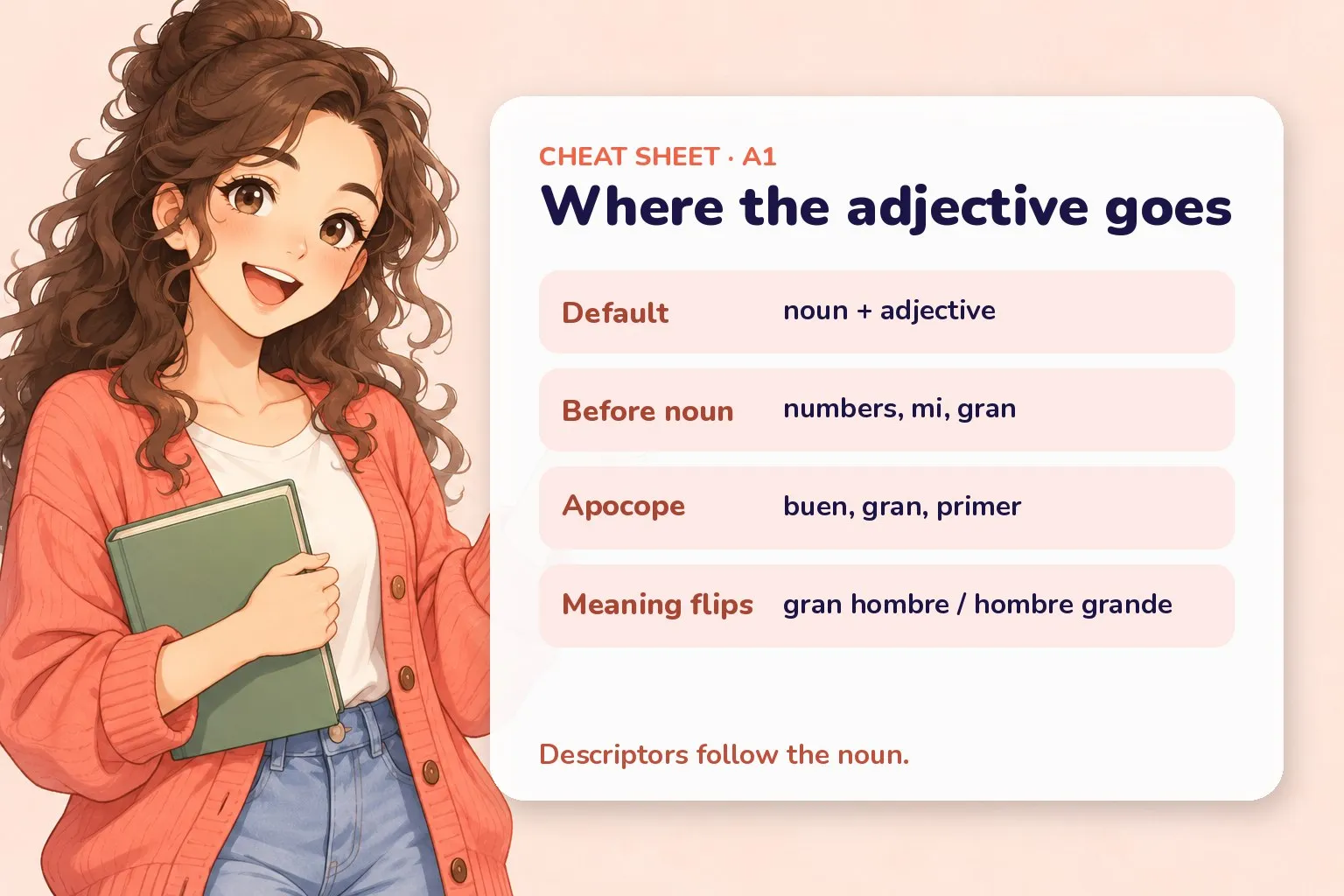
Quick recap before the quiz.
Practice
Spanish adjective position practice
Try each one, then press Check. No sign-up, nothing is sent anywhere — it all runs in your browser.
Hint: masculine singular apocope
Show answer
buen — bueno → buen before a masculine singular noun: un buen libro.
Hint: grande before any singular noun
Show answer
gran — grande → gran before any singular noun: una gran idea.
4 Order the words: 'two new books'.
Show answer
dos libros nuevos — Number before (dos), descriptor after (nuevos): dos libros nuevos.
5 Match each phrase to its meaning.
- un gran hombre
- un hombre grande
- un viejo amigo
- un amigo viejo
Show answer
- un gran hombre → a great man
- un hombre grande → a big man
- un viejo amigo → a long-standing friend
- un amigo viejo → an elderly friend
Before the noun the sense is figurative; after it, literal.
Quiz
Spanish adjective position quiz
12 questions · pick an answer and you'll see straight away if it's right.
-
Show answer
after the noun — Descriptive adjectives follow the noun: un coche rojo.
-
Show answer
numbers and possessives — Limiting words — numbers, possessives, demonstratives, quantifiers — precede the noun.
-
Show answer
buen — bueno → buen: un buen libro.
-
Show answer
any singular noun — grande → gran before any singular noun: una gran idea, un gran hombre.
-
Show answer
a great man — Before the noun, grande/gran is figurative: a great man.
-
Show answer
an elderly friend — After the noun, viejo is literal: an elderly friend.
-
Show answer
la casa roja — Colour follows the noun: la casa roja.
-
Show answer
gran — grande shortens to gran before a singular noun: una gran idea.
-
Show answer
bueno → buen before a masculine singular noun — Apocope: un buen día.
-
Show answer
primer — primero → primer before a masculine singular noun: el primer piso.
-
Show answer
mi antiguo jefe — Before the noun, antiguo means 'former': mi antiguo jefe.
-
Show answer
dos coches rojos — Number before, colour after: dos coches rojos.
Recap cheat-sheet
| Adjective type | Position | Example |
|---|---|---|
| colour / shape / nationality | after the noun | una casa blanca |
| numbers, possessives, quantifiers | before the noun | dos libros, mi casa |
| bueno / malo / primero / tercero | shorten before masc. sing. | un buen día |
| grande | gran before any singular | una gran idea |
| meaning-change (viejo, pobre) | before = figurative, after = literal | un gran hombre / un hombre grande |
Next
- Get the endings right with adjective agreement
- Explore more noun and adjective rules in the Spanish grammar section
- New here? Start with Start Learning Spanish Here
All Spanish grammar topics
Every grammar point in order, from your first sentence to advanced structures. Pick one and go straight to it. New lessons go live every day, so topics marked Coming soon fill in over the next weeks.
Grammar path
A1 31 topics · 21 ready
- 01 Noun Gender in Spanish (Masculine & Feminine)
- 02 Forming Plurals in Spanish
- 03 Definite Articles: el, la, los, las
- 04 Indefinite Articles: un, una, unos, unas
- 05 Subject Pronouns (yo, tú, él, nosotros)
- 06 The Verb Ser (Permanent 'To Be')
- 07 The Verb Estar (States & Location)
- 08 Ser vs Estar: When to Use Each
- 09 Hay: There Is / There Are
- 10 Present Tense: Regular -AR Verbs
- 11 Present Tense: Regular -ER Verbs
- 12 Present Tense: Regular -IR Verbs
- 13 The Verb Tener (To Have) and Expressions
- 14 The Verb Ir (To Go) and Ir A + Infinitive
- 15 Gustar: Expressing Likes
- 16 Adjective Agreement (Gender & Number)
- 17 Position of Adjectives in Spanish You are here
- 18 Possessive Adjectives (mi, tu, su, nuestro)
- 19 Demonstratives: este, ese, aquel
- 20 Question Words (qué, quién, dónde, cómo)
- 21 Negation: no and Double Negatives
- 22 Contractions: al (a + el) and del (de + el) Coming soon
- 23 Muy vs Mucho Coming soon
- 24 Stem-Changing Verbs e→ie (querer, pensar) Coming soon
- 25 Stem-Changing Verbs o→ue (poder, dormir) Coming soon
- 26 Reflexive Verbs (levantarse, ducharse) Coming soon
- 27 Present Progressive (estar + gerundio) Coming soon
- 28 Tener Que + Infinitive (Obligation) Coming soon
- 29 The Personal A (direct object people) Coming soon
- 30 Prepositions a, en, de (Core Uses) Coming soon
- 31 Weather Expressions with Hacer Coming soon
A2 25 topics
- 32 Preterite Tense: Regular Verbs Coming soon
- 33 Preterite: Irregular Verbs (ser, ir, tener) Coming soon
- 34 Imperfect Tense (Ongoing & Habitual Past) Coming soon
- 35 Preterite vs Imperfect: Which Past Tense? Coming soon
- 36 Near Future: Ir A + Infinitive Coming soon
- 37 Direct Object Pronouns (lo, la, los, las) Coming soon
- 38 Indirect Object Pronouns (me, te, le, nos) Coming soon
- 39 Double Object Pronouns (se lo, me lo) Coming soon
- 40 Comparatives (más que, menos que) Coming soon
- 41 Superlatives (el más, -ísimo) Coming soon
- 42 Stressed Possessives (el mío, la tuya) Coming soon
- 43 Saber vs Conocer (Two Ways to 'Know') Coming soon
- 44 Por vs Para: The Basics Coming soon
- 45 Verbs Like Gustar (encantar, molestar, doler) Coming soon
- 46 Informal Commands (tú affirmative) Coming soon
- 47 Hace / Desde Hace for Time Expressions Coming soon
- 48 Acabar De + Infinitive (Just Did) Coming soon
- 49 Stem-Changing Verbs e→i (pedir, servir) Coming soon
- 50 Hay Que + Infinitive (Impersonal Obligation) Coming soon
- 51 Deber and Deber De (Obligation & Probability) Coming soon
- 52 Prepositional Pronouns (mí, ti, conmigo) Coming soon
- 53 Pero vs Sino (But) Coming soon
- 54 También and Tampoco (Also / Neither) Coming soon
- 55 Indefinite Pronouns (alguien, algo, cualquiera) Coming soon
- 56 Apocopation (buen, gran, primer, san) Coming soon
B1 25 topics
- 57 Simple Future Tense (hablaré) Coming soon
- 58 Conditional Tense (hablaría) Coming soon
- 59 Present Subjunctive: Formation Coming soon
- 60 Subjunctive for Wishes & Emotions (querer que) Coming soon
- 61 Subjunctive After Impersonal Expressions Coming soon
- 62 Formal & Negative Commands (usted, no hagas) Coming soon
- 63 Present Perfect (he hablado) Coming soon
- 64 Past Participles (Regular & Irregular) Coming soon
- 65 Pluperfect (había hablado) Coming soon
- 66 Por vs Para: Advanced Uses Coming soon
- 67 Relative Pronouns (que, quien, el que) Coming soon
- 68 Passive Se and Impersonal Se Coming soon
- 69 Comparisons of Equality (tan, tanto como) Coming soon
- 70 Pronoun Placement with Infinitives & Gerunds Coming soon
- 71 Si Clauses Type 1 (Real Conditions) Coming soon
- 72 Uses of the Gerund (-ando / -iendo) Coming soon
- 73 Lo + Adjective and Lo Que (Neuter Lo) Coming soon
- 74 Adverbs Ending in -mente Coming soon
- 75 Subjunctive After cuando & Time Conjunctions Coming soon
- 76 Verbs of Becoming (ponerse, volverse, hacerse) Coming soon
- 77 Quedar and Quedarse (Multiple Meanings) Coming soon
- 78 Al + Infinitive and Infinitive as Noun Coming soon
- 79 Antes de / Después de + Infinitive Coming soon
- 80 Más de / Menos de with Numbers Coming soon
- 81 Porque, Por Qué, Porqué, Por Que Coming soon
B2 18 topics
- 82 Imperfect Subjunctive (hablara / hablase) Coming soon
- 83 Si Clauses Type 2 (Unreal Present) Coming soon
- 84 Subjunctive in Adjective Clauses Coming soon
- 85 Subjunctive After Conjunctions (para que, aunque) Coming soon
- 86 Present Perfect Subjunctive (haya hablado) Coming soon
- 87 Future Perfect (habré hablado) Coming soon
- 88 Conditional Perfect (habría hablado) Coming soon
- 89 Passive Voice with Ser (ser + participle) Coming soon
- 90 Reported Speech (estilo indirecto) Coming soon
- 91 Advanced Relatives (cuyo, el cual, donde) Coming soon
- 92 Verbal Periphrases (seguir/llevar + gerundio) Coming soon
- 93 Indicative vs Subjunctive in Noun Clauses Coming soon
- 94 Aunque: Indicative vs Subjunctive Coming soon
- 95 Ojalá, Quizás, Tal Vez + Subjunctive Coming soon
- 96 Diminutives and Augmentatives (-ito, -ón) Coming soon
- 97 Future & Conditional of Probability (Conjecture) Coming soon
- 98 Relative Superlative & de + Group Coming soon
- 99 Adjectives That Change Meaning with Ser/Estar Coming soon
C1 11 topics
- 100 Pluperfect Subjunctive (hubiera hablado) Coming soon
- 101 Si Clauses Type 3 & Mixed (Unreal Past) Coming soon
- 102 Sequence of Tenses (correlación de tiempos) Coming soon
- 103 All Uses of Se (reflexive, passive, impersonal, accidental) Coming soon
- 104 Future Subjunctive (hablare) — Literary/Legal Coming soon
- 105 Discourse Connectors (sin embargo, por lo tanto) Coming soon
- 106 Subjunctive Nuance (perception, comunicación verbs) Coming soon
- 107 Ser/Estar + Participle & Resultant States Coming soon
- 108 Nominalisation & Register (Formal Spanish) Coming soon
- 109 Advanced Concession (por más que, a pesar de) Coming soon
- 110 Modal & Aspectual Periphrases (deber de, acabar por) Coming soon