The Verb Estar (States & Location)
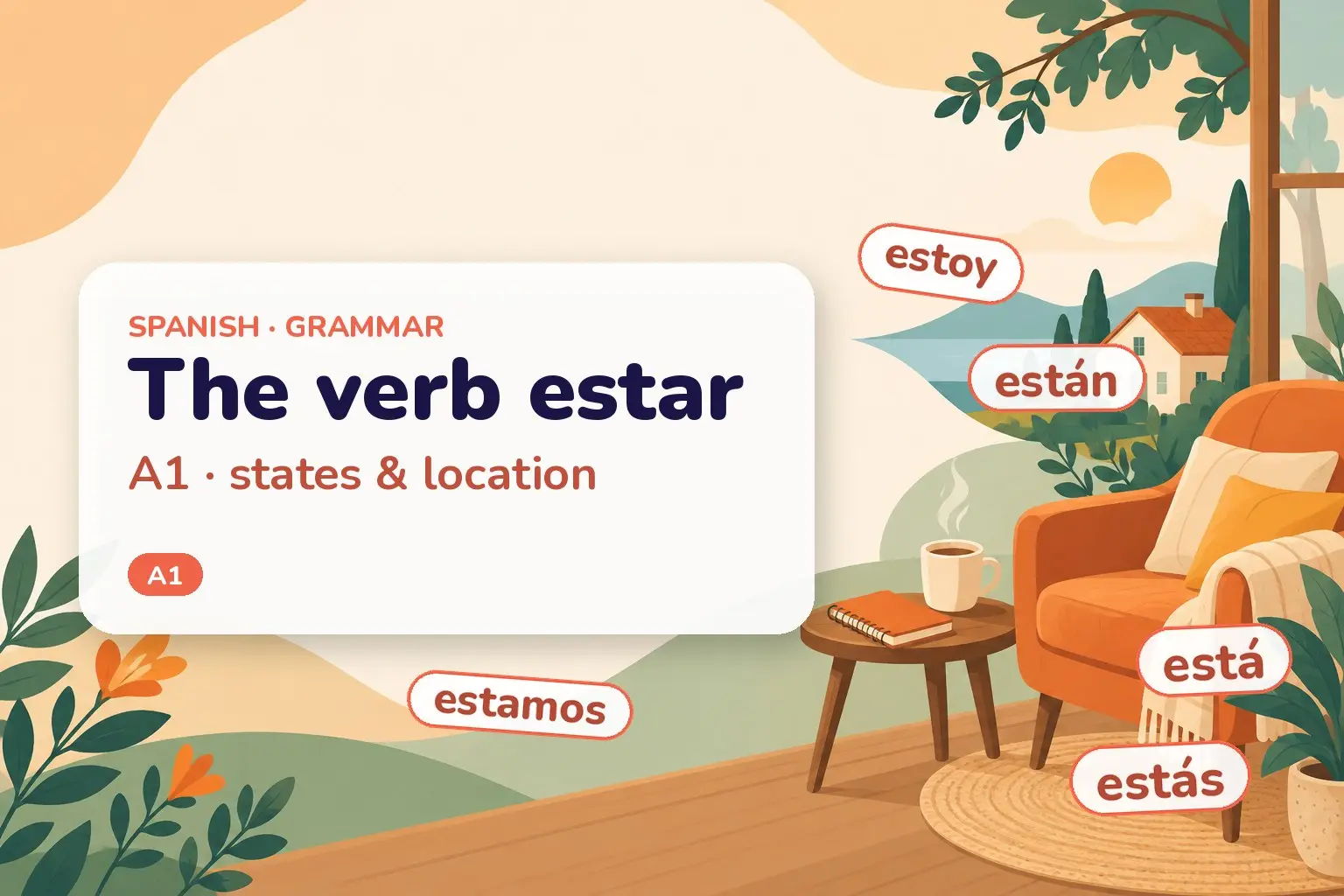
Estar is one of Spanish's two verbs for 'to be'. Its present tense is estoy, estás, está, estamos, estáis, están, and you use it for location, feelings and changing states: estoy en casa, está cansada, estamos listos.
Level: A1. Spanish has two verbs that both translate as “to be”: ser and estar. Estar is the one for things that can change — where you are, how you feel, what state you are in right now. Its present tense is irregular in the accents and the yo form, so it pays to learn it as a set.
The rule
Estar describes location, conditions and changing states — facts that could be different tomorrow or in an hour. These are not the defining traits an ID card would list (that is ser), but the current situation.
Use estar for:
- Physical location: Estoy en casa. El banco está cerca. (I’m at home. The bank is nearby.)
- Feelings and moods: Está contenta. Estamos cansados. (She is happy. We are tired.)
- Changeable conditions: La sopa está fría. La puerta está abierta. (The soup is cold. The door is open.)
- The present continuous (estar + -ando/-iendo): Estoy comiendo. (I am eating, right now.)
A quick test: if the quality is temporary, a result, or a position, it is almost always estar. If it is who or what something fundamentally is, that is ser.
Present tense of estar
| Person | Form | Example |
|---|---|---|
| yo | estoy | Estoy en casa. (I’m at home.) |
| tú | estás | Estás cansado. (You’re tired.) |
| él / ella / usted | está | Está en Madrid. (He/She is / You are in Madrid.) |
| nosotros / nosotras | estamos | Estamos listos. (We’re ready.) |
| vosotros / vosotras | estáis | Estáis contentos. (You all are happy.) |
| ellos / ellas / ustedes | están | Están aquí. (They are here.) |
Note the written accents: estás, está, estáis, están all carry one on the last syllable, while estoy and estamos do not. The accent marks where the stress falls when you say the word.
How to say it
Spanish spelling is regular; mind these few points in the forms of estar:
| Word | How to say it |
|---|---|
| estoy | one stressed syllable at the end: “es-TOY”, rhymes with “boy”. |
| estás | stress the á: “es-TAHSS”; the s is clear, not a z. |
| está | stress the á: “es-TAH”. |
| estamos | stress the middle: “es-TA-mos”. |
| están | stress the á: “es-TAHN”. |
Example sentences
Each sentence was written for this lesson (not copied from a third-party corpus).
- Estoy en casa.I am at home.location
- Estoy cansado.I am tired.a passing state
- ¿Dónde estás?Where are you?
- Tú estás muy contento hoy.You are very happy today.
- Ella está en la oficina.She is at the office.location
- El café está caliente.The coffee is hot.changeable condition
- La ventana está abierta.The window is open.a result / state
- Mi madre está bien.My mother is well.health
- Usted está en lo correcto.You (formal) are right.
- Nosotros estamos listos.We are ready.
- Estamos en Singapur esta semana.We are in Singapore this week.
- Vosotros estáis muy callados.You all are very quiet.Spain, informal plural
- Ellos están en el parque.They are in the park.location
- Las tiendas están cerradas.The shops are closed.current state
- El perro está durmiendo.The dog is sleeping.present continuous
- Estoy estudiando español.I am studying Spanish.present continuous
- ¿Cómo estás?How are you?asking after someone
- La comida está rica.The food is delicious.tastes right now
- El niño está enfermo.The child is sick.a temporary condition
- Madrid está en España.Madrid is in Spain.geographic location takes estar
Common mistakes
- ❌ Soy en casa. → ✅ Estoy en casa. Physical location takes estar, never ser.
- ❌ Soy cansado. → ✅ Estoy cansado. Tiredness is a passing state, so it takes estar; ser cansado would mean “to be tiresome”.
- ❌ Está profesora. → ✅ Es profesora. A profession is an identity, so it takes ser, not estar.
- ❌ Está un libro en la mesa. → ✅ Hay un libro en la mesa. To say something merely exists, use hay; está is for a known thing’s location.
- ❌ Yo estás bien. → ✅ Yo estoy bien. Match the form to the subject: yo takes estoy.
- ❌ El agua esta fría. → ✅ El agua está fría. The tú form estás and the él/ella form está carry a written accent.
A short conversation
— Hola, ¿cómo estás? (Hi, how are you?) — Estoy bien, gracias. ¿Y tú? (I’m well, thanks. And you?) — Un poco cansado. ¿Dónde estás ahora? (A bit tired. Where are you now?) — Estoy en la biblioteca. Estoy estudiando. (I’m at the library. I’m studying.)
Notice every line is about a current state or a location — exactly the work estar does.
Usage notes
- está and están cover three subjects each. Because usted and ustedes use third-person verbs, está serves él, ella and usted, and están serves ellos, ellas and ustedes.
- The pronoun is usually dropped. Estoy en casa needs no yo; the ending already shows the subject. Add the pronoun only for emphasis or contrast.
- estar builds the present continuous. Combine estar with the gerund (-ando for -ar verbs, -iendo for -er/-ir verbs) for an action in progress: estoy hablando (I am talking), está comiendo (he is eating).
- “Estar bien” is the normal “to be well”. For health and general wellbeing, Spanish says estoy bien, está mal, never soy bien.
- estar is irregular — learn it whole. The yo form estoy and the accents on estás, está, estáis, están do not follow the plain -ar pattern, so memorise the set.
Compared with…
- ser is the other “to be”, used for identity, origin, profession, material and time: soy María, es de México, son las dos. Where estar gives a current state or place, ser gives a fixed identity. See Ser in the present.
- ser vs estar is the choice that trips up every learner, because many adjectives work with both and change meaning: es listo (clever) versus está listo (ready). The full decision guide is on Ser vs Estar.
- hay (from haber) states that something exists, without pointing to a known thing: hay un problema (there is a problem). Use está only for the location of something already identified: el problema está aquí. See Hay: there is / there are.
Practice
Estar present practice
Try each one, then press Check. No sign-up, nothing is sent anywhere — it all runs in your browser.
Hint: the nosotros form of estar
Show answer
estamos — Nosotros estamos — the first-person plural of estar.
3 Build: 'The window is open.'
Show answer
la ventana está abierta — La ventana está abierta — a current state, so estar.
4 Match each subject with its estar form.
- yo
- tú
- él / ella
- ellos / ellas
Show answer
- yo → estoy
- tú → estás
- él / ella → está
- ellos / ellas → están
estoy, estás, está, están — the core present forms of estar.
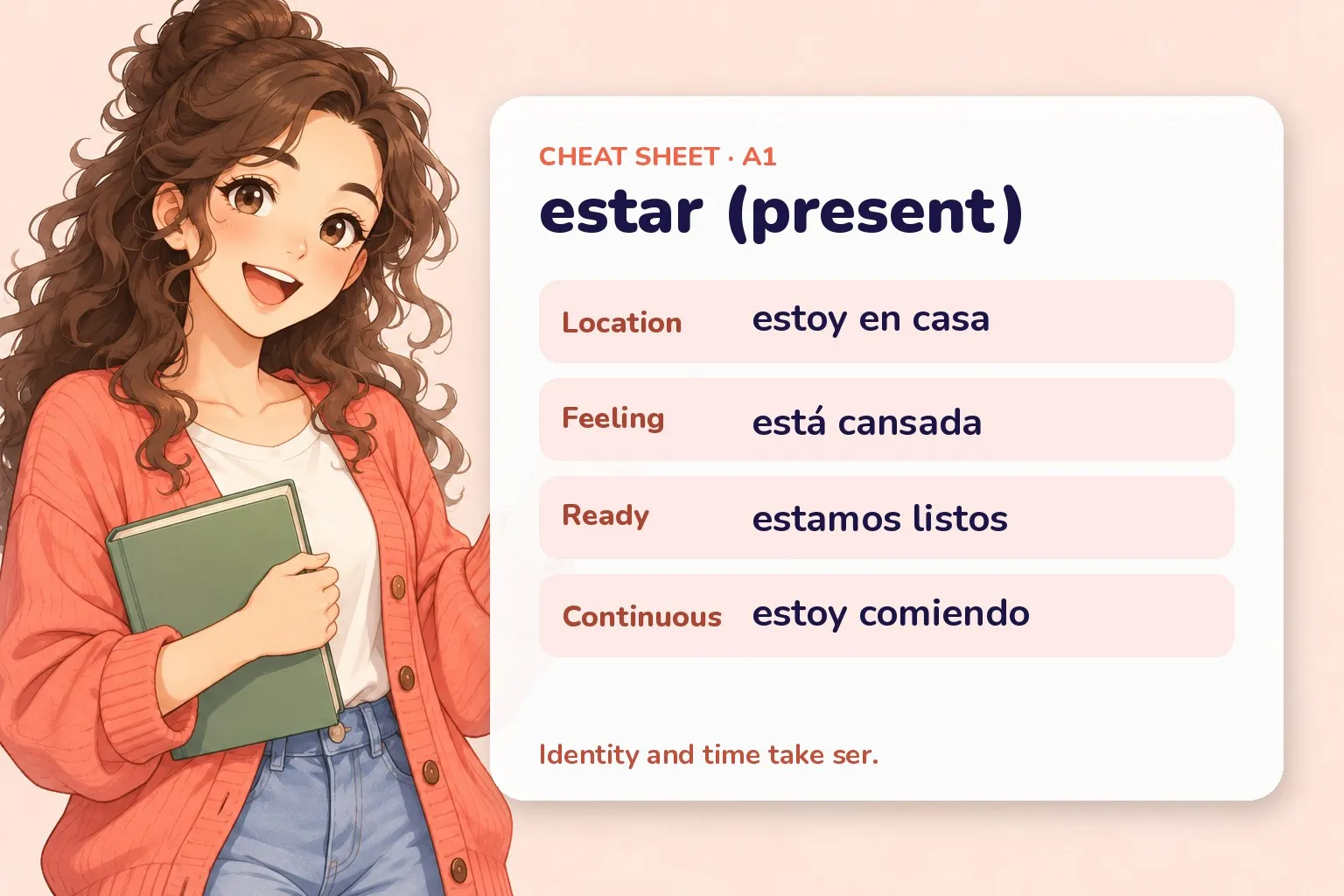
Quick recap before the quiz.
Quiz
Estar present quiz
12 questions · pick an answer and you'll see straight away if it's right.
-
Show answer
estoy — Yo estoy.
-
Show answer
Tú estás cansado — tú takes estás.
-
Show answer
location and changing states — Estar is for location, feelings and changing states; identity and time take ser.
-
Show answer
Ella está en la oficina — Location takes estar: ella está en la oficina.
-
Show answer
Nosotros estamos listos — nosotros takes estamos; 'ready' is a state, so estar.
-
Show answer
está — usted uses the third-person está, like él/ella.
-
Show answer
Hay un libro en la mesa — To say something exists, use hay; está is for the location of a known thing.
-
Show answer
estoy — For wellbeing, Spanish uses estar: estoy bien.
-
Show answer
El café está caliente — A changeable condition takes estar: el café está caliente.
-
Show answer
Soy cansado — Tiredness is a passing state, so it takes estar: estoy cansado, not soy cansado.
-
Show answer
Vosotros estáis muy callados — vosotros takes estáis.
-
Show answer
he is bored (a state) versus he is boring (a trait) — estar gives the passing state 'bored'; ser gives the trait 'boring'.
Recap cheat-sheet
| Person | Estar | Use example |
|---|---|---|
| yo | estoy | Estoy en casa. |
| tú | estás | Estás cansado. |
| él / ella / usted | está | Está contenta. |
| nosotros / ellos | estamos / están | Estamos listos. Están aquí. |
Next
- Compare it with the other “to be”: Ser in the present
- Then the decision guide: Ser vs Estar
- And existence: Hay: there is / there are
- Back to the Spanish grammar section
- New here? Start with Start Learning Spanish Here
All Spanish grammar topics
Every grammar point in order, from your first sentence to advanced structures. Pick one and go straight to it. New lessons go live every day, so topics marked Coming soon fill in over the next weeks.
Grammar path
A1 31 topics · 12 ready
- 01 Noun Gender in Spanish (Masculine & Feminine)
- 02 Forming Plurals in Spanish
- 03 Definite Articles: el, la, los, las
- 04 Indefinite Articles: un, una, unos, unas
- 05 Subject Pronouns (yo, tú, él, nosotros)
- 06 The Verb Ser (Permanent 'To Be')
- 07 The Verb Estar (States & Location) You are here
- 08 Ser vs Estar: When to Use Each
- 09 Hay: There Is / There Are
- 10 Present Tense: Regular -AR Verbs
- 11 Present Tense: Regular -ER Verbs
- 12 Present Tense: Regular -IR Verbs
- 13 The Verb Tener (To Have) and Expressions Coming soon
- 14 The Verb Ir (To Go) and Ir A + Infinitive Coming soon
- 15 Gustar: Expressing Likes Coming soon
- 16 Adjective Agreement (Gender & Number) Coming soon
- 17 Position of Adjectives in Spanish Coming soon
- 18 Possessive Adjectives (mi, tu, su, nuestro) Coming soon
- 19 Demonstratives: este, ese, aquel Coming soon
- 20 Question Words (qué, quién, dónde, cómo) Coming soon
- 21 Negation: no and Double Negatives Coming soon
- 22 Contractions: al (a + el) and del (de + el) Coming soon
- 23 Muy vs Mucho Coming soon
- 24 Stem-Changing Verbs e→ie (querer, pensar) Coming soon
- 25 Stem-Changing Verbs o→ue (poder, dormir) Coming soon
- 26 Reflexive Verbs (levantarse, ducharse) Coming soon
- 27 Present Progressive (estar + gerundio) Coming soon
- 28 Tener Que + Infinitive (Obligation) Coming soon
- 29 The Personal A (direct object people) Coming soon
- 30 Prepositions a, en, de (Core Uses) Coming soon
- 31 Weather Expressions with Hacer Coming soon
A2 25 topics
- 32 Preterite Tense: Regular Verbs Coming soon
- 33 Preterite: Irregular Verbs (ser, ir, tener) Coming soon
- 34 Imperfect Tense (Ongoing & Habitual Past) Coming soon
- 35 Preterite vs Imperfect: Which Past Tense? Coming soon
- 36 Near Future: Ir A + Infinitive Coming soon
- 37 Direct Object Pronouns (lo, la, los, las) Coming soon
- 38 Indirect Object Pronouns (me, te, le, nos) Coming soon
- 39 Double Object Pronouns (se lo, me lo) Coming soon
- 40 Comparatives (más que, menos que) Coming soon
- 41 Superlatives (el más, -ísimo) Coming soon
- 42 Stressed Possessives (el mío, la tuya) Coming soon
- 43 Saber vs Conocer (Two Ways to 'Know') Coming soon
- 44 Por vs Para: The Basics Coming soon
- 45 Verbs Like Gustar (encantar, molestar, doler) Coming soon
- 46 Informal Commands (tú affirmative) Coming soon
- 47 Hace / Desde Hace for Time Expressions Coming soon
- 48 Acabar De + Infinitive (Just Did) Coming soon
- 49 Stem-Changing Verbs e→i (pedir, servir) Coming soon
- 50 Hay Que + Infinitive (Impersonal Obligation) Coming soon
- 51 Deber and Deber De (Obligation & Probability) Coming soon
- 52 Prepositional Pronouns (mí, ti, conmigo) Coming soon
- 53 Pero vs Sino (But) Coming soon
- 54 También and Tampoco (Also / Neither) Coming soon
- 55 Indefinite Pronouns (alguien, algo, cualquiera) Coming soon
- 56 Apocopation (buen, gran, primer, san) Coming soon
B1 25 topics
- 57 Simple Future Tense (hablaré) Coming soon
- 58 Conditional Tense (hablaría) Coming soon
- 59 Present Subjunctive: Formation Coming soon
- 60 Subjunctive for Wishes & Emotions (querer que) Coming soon
- 61 Subjunctive After Impersonal Expressions Coming soon
- 62 Formal & Negative Commands (usted, no hagas) Coming soon
- 63 Present Perfect (he hablado) Coming soon
- 64 Past Participles (Regular & Irregular) Coming soon
- 65 Pluperfect (había hablado) Coming soon
- 66 Por vs Para: Advanced Uses Coming soon
- 67 Relative Pronouns (que, quien, el que) Coming soon
- 68 Passive Se and Impersonal Se Coming soon
- 69 Comparisons of Equality (tan, tanto como) Coming soon
- 70 Pronoun Placement with Infinitives & Gerunds Coming soon
- 71 Si Clauses Type 1 (Real Conditions) Coming soon
- 72 Uses of the Gerund (-ando / -iendo) Coming soon
- 73 Lo + Adjective and Lo Que (Neuter Lo) Coming soon
- 74 Adverbs Ending in -mente Coming soon
- 75 Subjunctive After cuando & Time Conjunctions Coming soon
- 76 Verbs of Becoming (ponerse, volverse, hacerse) Coming soon
- 77 Quedar and Quedarse (Multiple Meanings) Coming soon
- 78 Al + Infinitive and Infinitive as Noun Coming soon
- 79 Antes de / Después de + Infinitive Coming soon
- 80 Más de / Menos de with Numbers Coming soon
- 81 Porque, Por Qué, Porqué, Por Que Coming soon
B2 18 topics
- 82 Imperfect Subjunctive (hablara / hablase) Coming soon
- 83 Si Clauses Type 2 (Unreal Present) Coming soon
- 84 Subjunctive in Adjective Clauses Coming soon
- 85 Subjunctive After Conjunctions (para que, aunque) Coming soon
- 86 Present Perfect Subjunctive (haya hablado) Coming soon
- 87 Future Perfect (habré hablado) Coming soon
- 88 Conditional Perfect (habría hablado) Coming soon
- 89 Passive Voice with Ser (ser + participle) Coming soon
- 90 Reported Speech (estilo indirecto) Coming soon
- 91 Advanced Relatives (cuyo, el cual, donde) Coming soon
- 92 Verbal Periphrases (seguir/llevar + gerundio) Coming soon
- 93 Indicative vs Subjunctive in Noun Clauses Coming soon
- 94 Aunque: Indicative vs Subjunctive Coming soon
- 95 Ojalá, Quizás, Tal Vez + Subjunctive Coming soon
- 96 Diminutives and Augmentatives (-ito, -ón) Coming soon
- 97 Future & Conditional of Probability (Conjecture) Coming soon
- 98 Relative Superlative & de + Group Coming soon
- 99 Adjectives That Change Meaning with Ser/Estar Coming soon
C1 11 topics
- 100 Pluperfect Subjunctive (hubiera hablado) Coming soon
- 101 Si Clauses Type 3 & Mixed (Unreal Past) Coming soon
- 102 Sequence of Tenses (correlación de tiempos) Coming soon
- 103 All Uses of Se (reflexive, passive, impersonal, accidental) Coming soon
- 104 Future Subjunctive (hablare) — Literary/Legal Coming soon
- 105 Discourse Connectors (sin embargo, por lo tanto) Coming soon
- 106 Subjunctive Nuance (perception, comunicación verbs) Coming soon
- 107 Ser/Estar + Participle & Resultant States Coming soon
- 108 Nominalisation & Register (Formal Spanish) Coming soon
- 109 Advanced Concession (por más que, a pesar de) Coming soon
- 110 Modal & Aspectual Periphrases (deber de, acabar por) Coming soon