Present Tense: Regular -IR Verbs (Spanish)
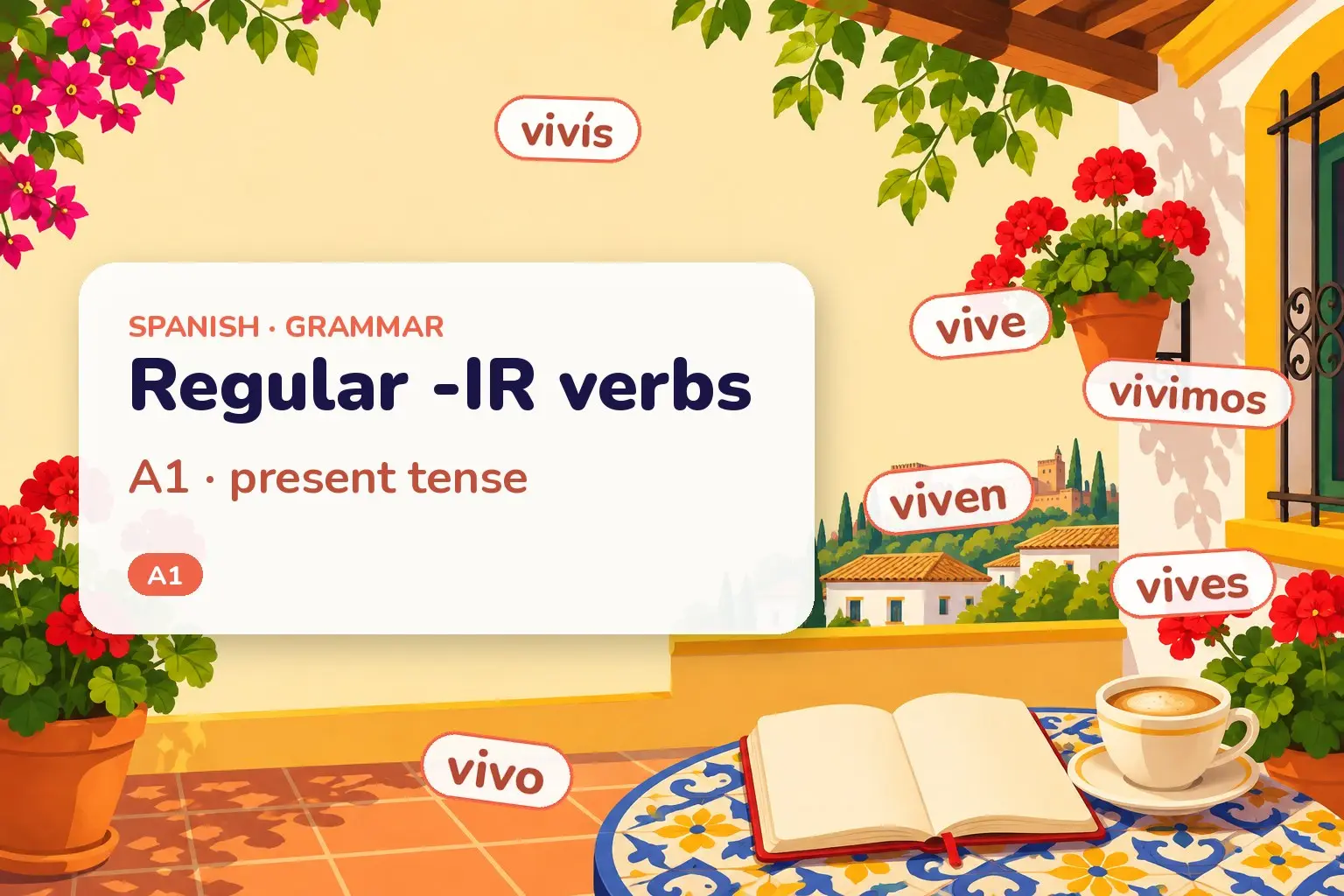
Regular -IR verbs are the smallest regular group in Spanish. Drop the -ir and add the present endings -o, -es, -e, -imos, -ís, -en, so vivir (to live) becomes vivo, vives, vive, vivimos, vivís, viven.
Level: A1. The third regular verb family ends in -ir — vivir, escribir, abrir. It is the smallest group, and the good news is you already know most of it: in the present it matches the -ER endings everywhere except two forms.
The rule
A verb’s infinitive is its dictionary form: vivir (to live), escribir (to write). To make the present of a regular -IR verb, drop the -ir to get the stem (viv-), then add the ending that matches the subject.
The six present endings are -o, -es, -e, -imos, -ís, -en:
- yo (I) → -o: vivo
- tú (you, informal) → -es: vives
- él / ella / usted (he / she / you formal) → -e: vive
- nosotros / nosotras (we) → -imos: vivimos
- vosotros / vosotras (you all, Spain) → -ís: vivís
- ellos / ellas / ustedes (they / you all) → -en: viven
Four of these six forms are identical to the -ER endings. Only nosotros (-imos, not -emos) and vosotros (-ís, not -éis) tell the two groups apart. As with every Spanish present, one form covers three English meanings: vivo aquí is “I live here”, “I am living here” and “I do live here”.
Present tense of vivir (to live)
| Person | Form | Example |
|---|---|---|
| yo | vivo | Vivo en Madrid. (I live in Madrid.) |
| tú | vives | ¿Dónde vives? (Where do you live?) |
| él / ella / usted | vive | Ella vive sola. (She lives alone.) |
| nosotros / nosotras | vivimos | Vivimos cerca. (We live nearby.) |
| vosotros / vosotras | vivís | Vivís muy lejos. (You all live very far.) |
| ellos / ellas / ustedes | viven | Ellos viven en España. (They live in Spain.) |
Every regular -IR verb takes exactly these endings: escribir → escribo, escribes, escribe, escribimos, escribís, escriben.
How to say it
Spanish spelling is regular; mind these few sounds in -IR verbs:
| Word | How to say it |
|---|---|
| vivo | both v’s sound like a soft b: “BEE-bo”. |
| escribes | the stress falls on the i: “es-KREE-bes”. |
| vivís | the í is stressed and the s is clear: “bee-BEES”. |
| reciben | the c before e is “th” in Spain, “s” in Latin America: “re-THEE-ben” / “re-SEE-ben”. |
| abren | the single r is a light tap, not the English r. |
Example sentences
Each sentence was written for this lesson.
- Vivo en Madrid.I live in Madrid.yo form
- ¿Dónde vives?Where do you live?
- Ella escribe una carta.She writes a letter.
- Escribimos correos cada día.We write emails every day.nosotros -imos
- Los niños abren los regalos.The children open the presents.
- Yo recibo muchos mensajes.I receive a lot of messages.
- ¿Tú compartes el postre?Do you share the dessert?
- Decidimos ir a la playa.We decide to go to the beach.
- Vosotros vivís muy lejos.You all live very far away.vosotros -ís
- Ellos suben la escalera.They go up the stairs.
- Usted describe la casa muy bien.You (formal) describe the house very well.
- Escribo en mi diario por la noche.I write in my diary at night.
- Mi hermano abre la tienda a las nueve.My brother opens the shop at nine.
- Nosotros asistimos a la clase de español.We attend the Spanish class.
- ¿Qué recibís en diciembre?What do you all receive in December?
- El tren parte a las ocho.The train departs at eight.
- Compartimos un piso en el centro.We share a flat in the centre.
- Ellas deciden la fecha mañana.They decide the date tomorrow.
- ¿Usted vive aquí?Do you (formal) live here?
- Abrimos las ventanas por la mañana.We open the windows in the morning.
Common mistakes
- ❌ Nosotros vivemos aquí. → ✅ Nosotros vivimos aquí. The -IR nosotros ending is -imos, not -emos; -emos belongs to -ER verbs (comemos).
- ❌ Vosotros vivéis lejos. → ✅ Vosotros vivís lejos. The -IR vosotros ending is -ís, not -éis; -éis belongs to -ER verbs (coméis).
- ❌ Yo vivir en Madrid. → ✅ Yo vivo en Madrid. Never leave the infinitive -ir after a subject; conjugate it to vivo.
- ❌ Tú escribo una carta. → ✅ Tú escribes una carta. Match the ending to the subject: tú takes -es, not -o.
- ❌ Yo estoy escribir. for “I write” → ✅ Yo escribo. Spanish does not use “to be + infinitive”; the single present already means “I write / I am writing”.
A short conversation
— ¿Dónde vives? (Where do you live?) — Vivo en Barcelona y escribo para un periódico. (I live in Barcelona and I write for a newspaper.) — ¿Y tus padres? (And your parents?) — Ellos viven en un pueblo y abren una pequeña tienda. (They live in a village and are opening a small shop.)
Every verb here is a regular -IR verb with the matching ending — vivo, vives, escribo, viven, abren.
Usage notes
- The pronoun is usually dropped. Because the ending shows the subject, vivo already means “I live”; add yo only for emphasis or contrast.
- ser and estar are different verbs. Do not mix in soy or estoy — regular -IR verbs take the -o/-es/-e/-imos/-ís/-en endings, not a form of “to be”.
- The present can point to the near future. With a time marker, the present works for plans: mañana escribo el informe (I’ll write the report tomorrow).
- Some -IR verbs change their stem. A large group changes the vowel in the stem (pedir → pido, dormir → duermo); those are learned separately. The pattern on this page is for the fully regular ones: vivir, escribir, abrir, recibir.
Compared with…
- -AR verbs (hablar, to speak) use -o, -as, -a, -amos, -áis, -an: hablo, hablas, habla, hablamos, habláis, hablan. Compare the full pattern in regular -AR verbs.
- -ER verbs (comer, to eat) use -o, -es, -e, -emos, -éis, -en: como, comes, come, comemos, coméis, comen. These are the closest match to -IR — see regular -ER verbs and line them up: only nosotros and vosotros differ. To review who does the action, revisit the subject pronouns, and note that the two “to be” verbs ser and estar are irregular and follow their own forms.
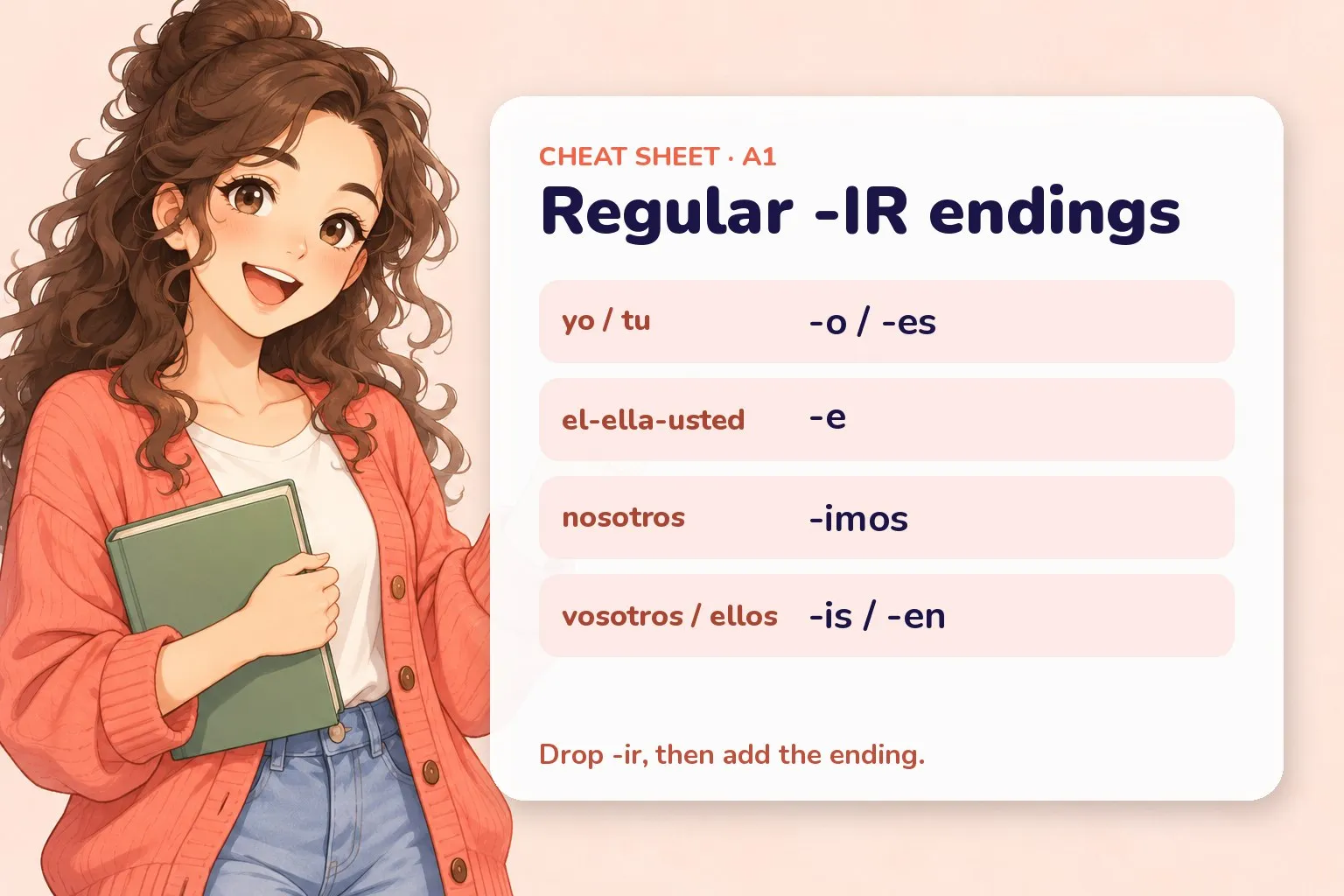
Quick recap before the quiz.
Practice
Regular -IR present practice
Try each one, then press Check. No sign-up, nothing is sent anywhere — it all runs in your browser.
Hint: escribir, nosotros form
Show answer
escribimos — The -IR nosotros ending is -imos: escribimos.
3 Build: 'They live in Spain.'
Show answer
ellos viven en España — Ellos viven en España — vivir takes -en for ellos.
4 Match each subject with its -IR ending.
- yo
- tú
- nosotros
- vosotros
Show answer
- yo → -o
- tú → -es
- nosotros → -imos
- vosotros → -ís
The present -IR endings are -o, -es, -e, -imos, -ís, -en.
Hint: tú ending is -es
Show answer
vives — tú takes -es: vives.
Quiz
Regular -IR present quiz
12 questions · pick an answer and you'll see straight away if it's right.
-
Show answer
Drop -ir and add -o/-es/-e/-imos/-ís/-en — Drop -ir to get the stem, then add the matching ending.
-
Show answer
escribo — yo takes -o: escribo.
-
Show answer
-imos — It is -imos: vivimos, escribimos.
-
Show answer
-ís — It is -ís: vivís, escribís.
-
Show answer
Ella escribe una carta — él/ella/usted takes -e: escribe.
-
Show answer
only in nosotros and vosotros — They share yo, tú, él and ellos; only nosotros and vosotros differ.
-
Show answer
I live / I am living / I do live here — One Spanish present covers all three English present ideas.
-
Show answer
Nosotros vivemos aquí — It should be vivimos; -emos is the -ER ending, not -IR.
-
Show answer
abren — ellos takes -en: abren.
-
Show answer
The ending already shows the subject — The -o ending shows 'I', so yo is optional.
-
Show answer
vivo — The yo form of vivir is vivo.
-
Show answer
Nosotros compartimos un piso — compartir is a regular -IR verb: nosotros compartimos.
Recap cheat-sheet
| Person | Ending | vivir |
|---|---|---|
| yo / tú | -o / -es | vivo / vives |
| él-ella-usted | -e | vive |
| nosotros | -imos | vivimos |
| vosotros / ellos | -ís / -en | vivís / viven |
Next
- Line it up with the two other families: regular -AR verbs and regular -ER verbs
- Start from the people: Subject pronouns in Spanish
- Back to the Spanish grammar section
- New here? Start with Start Learning Spanish Here
All Spanish grammar topics
Every grammar point in order, from your first sentence to advanced structures. Pick one and go straight to it. New lessons go live every day, so topics marked Coming soon fill in over the next weeks.
Grammar path
A1 31 topics · 12 ready
- 01 Noun Gender in Spanish (Masculine & Feminine)
- 02 Forming Plurals in Spanish
- 03 Definite Articles: el, la, los, las
- 04 Indefinite Articles: un, una, unos, unas
- 05 Subject Pronouns (yo, tú, él, nosotros)
- 06 The Verb Ser (Permanent 'To Be')
- 07 The Verb Estar (States & Location)
- 08 Ser vs Estar: When to Use Each
- 09 Hay: There Is / There Are
- 10 Present Tense: Regular -AR Verbs
- 11 Present Tense: Regular -ER Verbs
- 12 Present Tense: Regular -IR Verbs You are here
- 13 The Verb Tener (To Have) and Expressions Coming soon
- 14 The Verb Ir (To Go) and Ir A + Infinitive Coming soon
- 15 Gustar: Expressing Likes Coming soon
- 16 Adjective Agreement (Gender & Number) Coming soon
- 17 Position of Adjectives in Spanish Coming soon
- 18 Possessive Adjectives (mi, tu, su, nuestro) Coming soon
- 19 Demonstratives: este, ese, aquel Coming soon
- 20 Question Words (qué, quién, dónde, cómo) Coming soon
- 21 Negation: no and Double Negatives Coming soon
- 22 Contractions: al (a + el) and del (de + el) Coming soon
- 23 Muy vs Mucho Coming soon
- 24 Stem-Changing Verbs e→ie (querer, pensar) Coming soon
- 25 Stem-Changing Verbs o→ue (poder, dormir) Coming soon
- 26 Reflexive Verbs (levantarse, ducharse) Coming soon
- 27 Present Progressive (estar + gerundio) Coming soon
- 28 Tener Que + Infinitive (Obligation) Coming soon
- 29 The Personal A (direct object people) Coming soon
- 30 Prepositions a, en, de (Core Uses) Coming soon
- 31 Weather Expressions with Hacer Coming soon
A2 25 topics
- 32 Preterite Tense: Regular Verbs Coming soon
- 33 Preterite: Irregular Verbs (ser, ir, tener) Coming soon
- 34 Imperfect Tense (Ongoing & Habitual Past) Coming soon
- 35 Preterite vs Imperfect: Which Past Tense? Coming soon
- 36 Near Future: Ir A + Infinitive Coming soon
- 37 Direct Object Pronouns (lo, la, los, las) Coming soon
- 38 Indirect Object Pronouns (me, te, le, nos) Coming soon
- 39 Double Object Pronouns (se lo, me lo) Coming soon
- 40 Comparatives (más que, menos que) Coming soon
- 41 Superlatives (el más, -ísimo) Coming soon
- 42 Stressed Possessives (el mío, la tuya) Coming soon
- 43 Saber vs Conocer (Two Ways to 'Know') Coming soon
- 44 Por vs Para: The Basics Coming soon
- 45 Verbs Like Gustar (encantar, molestar, doler) Coming soon
- 46 Informal Commands (tú affirmative) Coming soon
- 47 Hace / Desde Hace for Time Expressions Coming soon
- 48 Acabar De + Infinitive (Just Did) Coming soon
- 49 Stem-Changing Verbs e→i (pedir, servir) Coming soon
- 50 Hay Que + Infinitive (Impersonal Obligation) Coming soon
- 51 Deber and Deber De (Obligation & Probability) Coming soon
- 52 Prepositional Pronouns (mí, ti, conmigo) Coming soon
- 53 Pero vs Sino (But) Coming soon
- 54 También and Tampoco (Also / Neither) Coming soon
- 55 Indefinite Pronouns (alguien, algo, cualquiera) Coming soon
- 56 Apocopation (buen, gran, primer, san) Coming soon
B1 25 topics
- 57 Simple Future Tense (hablaré) Coming soon
- 58 Conditional Tense (hablaría) Coming soon
- 59 Present Subjunctive: Formation Coming soon
- 60 Subjunctive for Wishes & Emotions (querer que) Coming soon
- 61 Subjunctive After Impersonal Expressions Coming soon
- 62 Formal & Negative Commands (usted, no hagas) Coming soon
- 63 Present Perfect (he hablado) Coming soon
- 64 Past Participles (Regular & Irregular) Coming soon
- 65 Pluperfect (había hablado) Coming soon
- 66 Por vs Para: Advanced Uses Coming soon
- 67 Relative Pronouns (que, quien, el que) Coming soon
- 68 Passive Se and Impersonal Se Coming soon
- 69 Comparisons of Equality (tan, tanto como) Coming soon
- 70 Pronoun Placement with Infinitives & Gerunds Coming soon
- 71 Si Clauses Type 1 (Real Conditions) Coming soon
- 72 Uses of the Gerund (-ando / -iendo) Coming soon
- 73 Lo + Adjective and Lo Que (Neuter Lo) Coming soon
- 74 Adverbs Ending in -mente Coming soon
- 75 Subjunctive After cuando & Time Conjunctions Coming soon
- 76 Verbs of Becoming (ponerse, volverse, hacerse) Coming soon
- 77 Quedar and Quedarse (Multiple Meanings) Coming soon
- 78 Al + Infinitive and Infinitive as Noun Coming soon
- 79 Antes de / Después de + Infinitive Coming soon
- 80 Más de / Menos de with Numbers Coming soon
- 81 Porque, Por Qué, Porqué, Por Que Coming soon
B2 18 topics
- 82 Imperfect Subjunctive (hablara / hablase) Coming soon
- 83 Si Clauses Type 2 (Unreal Present) Coming soon
- 84 Subjunctive in Adjective Clauses Coming soon
- 85 Subjunctive After Conjunctions (para que, aunque) Coming soon
- 86 Present Perfect Subjunctive (haya hablado) Coming soon
- 87 Future Perfect (habré hablado) Coming soon
- 88 Conditional Perfect (habría hablado) Coming soon
- 89 Passive Voice with Ser (ser + participle) Coming soon
- 90 Reported Speech (estilo indirecto) Coming soon
- 91 Advanced Relatives (cuyo, el cual, donde) Coming soon
- 92 Verbal Periphrases (seguir/llevar + gerundio) Coming soon
- 93 Indicative vs Subjunctive in Noun Clauses Coming soon
- 94 Aunque: Indicative vs Subjunctive Coming soon
- 95 Ojalá, Quizás, Tal Vez + Subjunctive Coming soon
- 96 Diminutives and Augmentatives (-ito, -ón) Coming soon
- 97 Future & Conditional of Probability (Conjecture) Coming soon
- 98 Relative Superlative & de + Group Coming soon
- 99 Adjectives That Change Meaning with Ser/Estar Coming soon
C1 11 topics
- 100 Pluperfect Subjunctive (hubiera hablado) Coming soon
- 101 Si Clauses Type 3 & Mixed (Unreal Past) Coming soon
- 102 Sequence of Tenses (correlación de tiempos) Coming soon
- 103 All Uses of Se (reflexive, passive, impersonal, accidental) Coming soon
- 104 Future Subjunctive (hablare) — Literary/Legal Coming soon
- 105 Discourse Connectors (sin embargo, por lo tanto) Coming soon
- 106 Subjunctive Nuance (perception, comunicación verbs) Coming soon
- 107 Ser/Estar + Participle & Resultant States Coming soon
- 108 Nominalisation & Register (Formal Spanish) Coming soon
- 109 Advanced Concession (por más que, a pesar de) Coming soon
- 110 Modal & Aspectual Periphrases (deber de, acabar por) Coming soon