Hay: There Is / There Are in Spanish
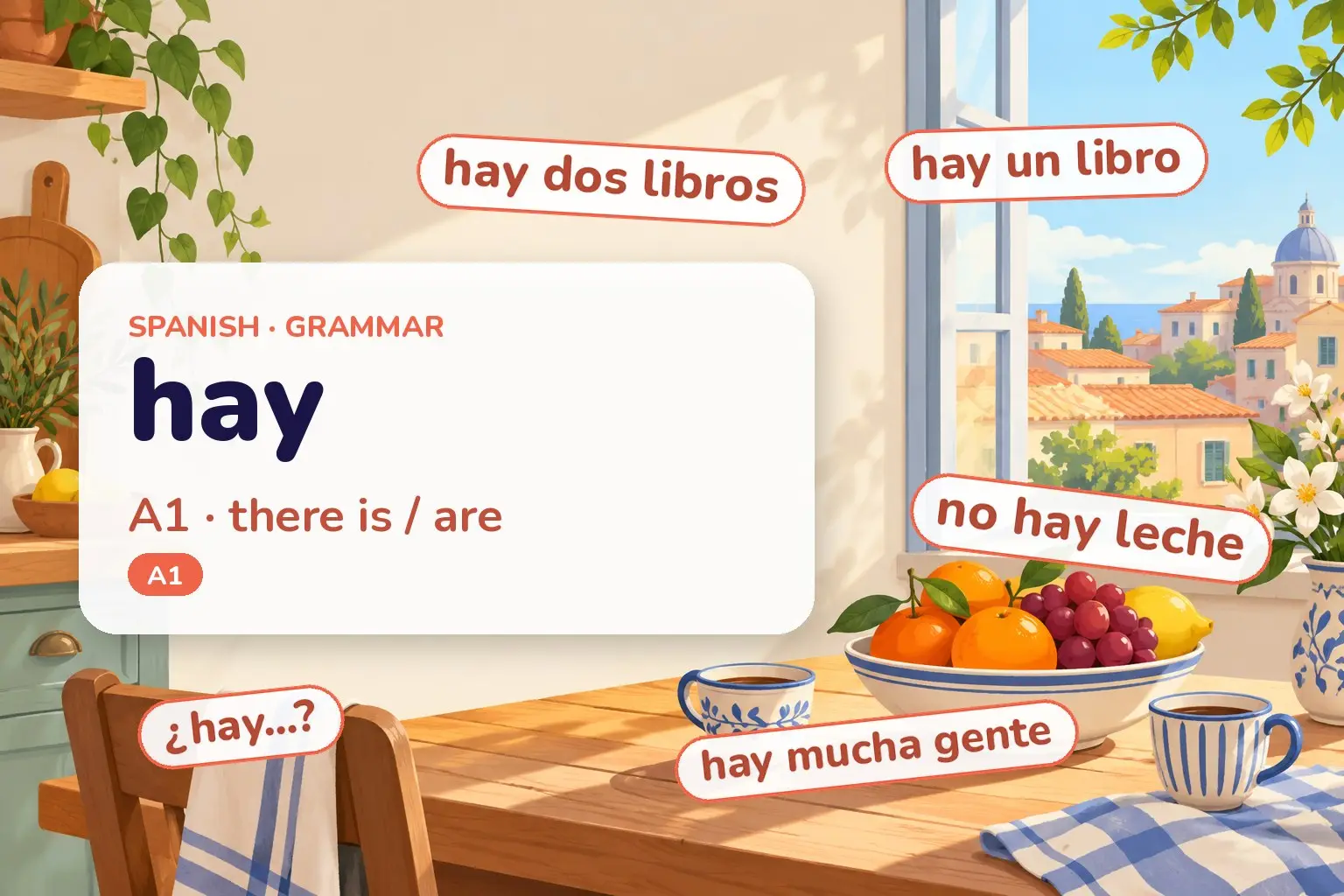
Hay means 'there is' and 'there are'. It is invariable — the same word for one thing or many: hay un libro (there is a book), hay dos libros (there are two books). Use it for existence; use estar for where a known thing is.
Level: A1. Hay is the Spanish way to say “there is” and “there are”. It is a special form of the verb haber, and it has one job: to say that something exists or is present, without pointing to a particular, already-known thing.
The rule
Hay states existence or availability: that something is there, or how much of it there is. The pattern is hay + [thing]: hay un problema (there is a problem), hay dos cafés cerca (there are two cafés nearby).
The key feature is that hay is invariable — it does not change for singular or plural. One book or ten, it is still hay: hay un libro, hay muchos libros. There is no “hayn” and no “han” for this meaning.
What follows hay is something not yet identified: you use it with the indefinite article un/una, with numbers, with quantity words (mucho, poco, algo, nadie), or with no article at all. You do not use it with the definite article el/la — that would point to a specific, known thing, which is the job of estar.
Hay vs está
| Spanish | English | Why |
|---|---|---|
| Hay un libro en la mesa. | There is a book on the table. | existence of an unspecified thing → hay |
| El libro está en la mesa. | The book is on the table. | location of a known thing → estar |
| Hay un banco cerca. | There is a bank nearby. | first mention, exists → hay |
| El banco está cerca. | The bank is nearby. | known thing’s position → estar |
How to say it
Spanish spelling is regular; mind these few sounds from this lesson:
| Word | How to say it |
|---|---|
| hay | one syllable, like English “eye”: “eye”. The h is silent and ay is the vowel. |
| gente | g before e is a breathy h: “HEN-teh”. |
| nevera | the v is a soft b: “ne-BEH-ra”. |
| ciudad | c before i is “s” (Latin America) or “th” (much of Spain): “see-oo-DAH”. |
Example sentences
Each sentence was written for this lesson (not copied from a third-party corpus).
- Hay un libro en la mesa.There is a book on the table.singular
- Hay dos ventanas en la sala.There are two windows in the room.plural, same hay
- ¿Hay un baño aquí?Is there a bathroom here?
- No hay leche en la nevera.There is no milk in the fridge.negative: no hay
- Hay muchos turistas en verano.There are many tourists in summer.
- En mi ciudad hay un río.In my city there is a river.
- ¿Cuántos estudiantes hay en la clase?How many students are there in the class?
- Hay mucha gente en el parque.There are a lot of people in the park.
- No hay ningún problema.There is no problem at all.
- Hay algo en el suelo.There is something on the floor.
- Hay tres cafés cerca.There are three cafés nearby.
- Aquí hay un error.There is a mistake here.
- ¿Hay wifi en el hotel?Is there wifi in the hotel?
- Hay una farmacia en la esquina.There is a pharmacy on the corner.
- No hay nadie en casa.There is nobody at home.
- Hay pan y queso.There is bread and cheese.no article needed
- ¿Qué hay para comer?What is there to eat?
- Hay un gato debajo de la mesa.There is a cat under the table.
- En la fiesta hay música.At the party there is music.
- Hay poco tiempo.There is little time.
Common mistakes
- ❌ Hay el libro en la mesa. → ✅ Hay un libro en la mesa. / El libro está en la mesa. Hay does not take el/la; use it with un/una, a number or no article, and use estar for a known thing.
- ❌ Está un libro en la mesa. → ✅ Hay un libro en la mesa. For the existence of an unspecified thing, use hay, not está.
- ❌ Hayn muchos coches. / Han muchos coches. → ✅ Hay muchos coches. Hay is invariable; it never takes a plural ending.
- ❌ ¿Cuántos hay estudiantes? → ✅ ¿Cuántos estudiantes hay? The counted noun comes before hay in this question.
- ❌ Hay son tres sillas. → ✅ Hay tres sillas. Do not combine hay with ser; hay already means “there are”.
A short conversation
— ¿Hay un supermercado cerca? (Is there a supermarket nearby?) — Sí, hay uno en la esquina. (Yes, there is one on the corner.) — ¿Y dónde está el supermercado grande? (And where is the big supermarket?) — Está al lado del parque. (It’s next to the park.)
Notice the switch: hay introduces the supermarket; once it is the known “big supermarket”, estar locates it.
Usage notes
- One form only. Hay covers “there is” and “there are”; it does not agree with the noun that follows, unlike English.
- It comes from haber. In other tenses this existence verb does change — había (there was/were), habrá (there will be) — but in the present it is simply hay.
- Use it with quantities. Hay pairs naturally with numbers and amount words: hay tres, hay mucha gente, hay poco tiempo, no hay nada.
- “¿Qué hay?” literally “what is there?”, is also a casual “what’s up?” in everyday speech.
Compared with estar
- Estar gives the location of a known thing, while hay states that something exists. Hay un libro en la mesa introduces a book; el libro está en la mesa tells you where the known book is. A quick test: if the noun takes el/la/mi, use estar; if it takes un/una, a number or nothing, use hay. See the verb estar, and the fuller “to be” comparison in Ser vs Estar.
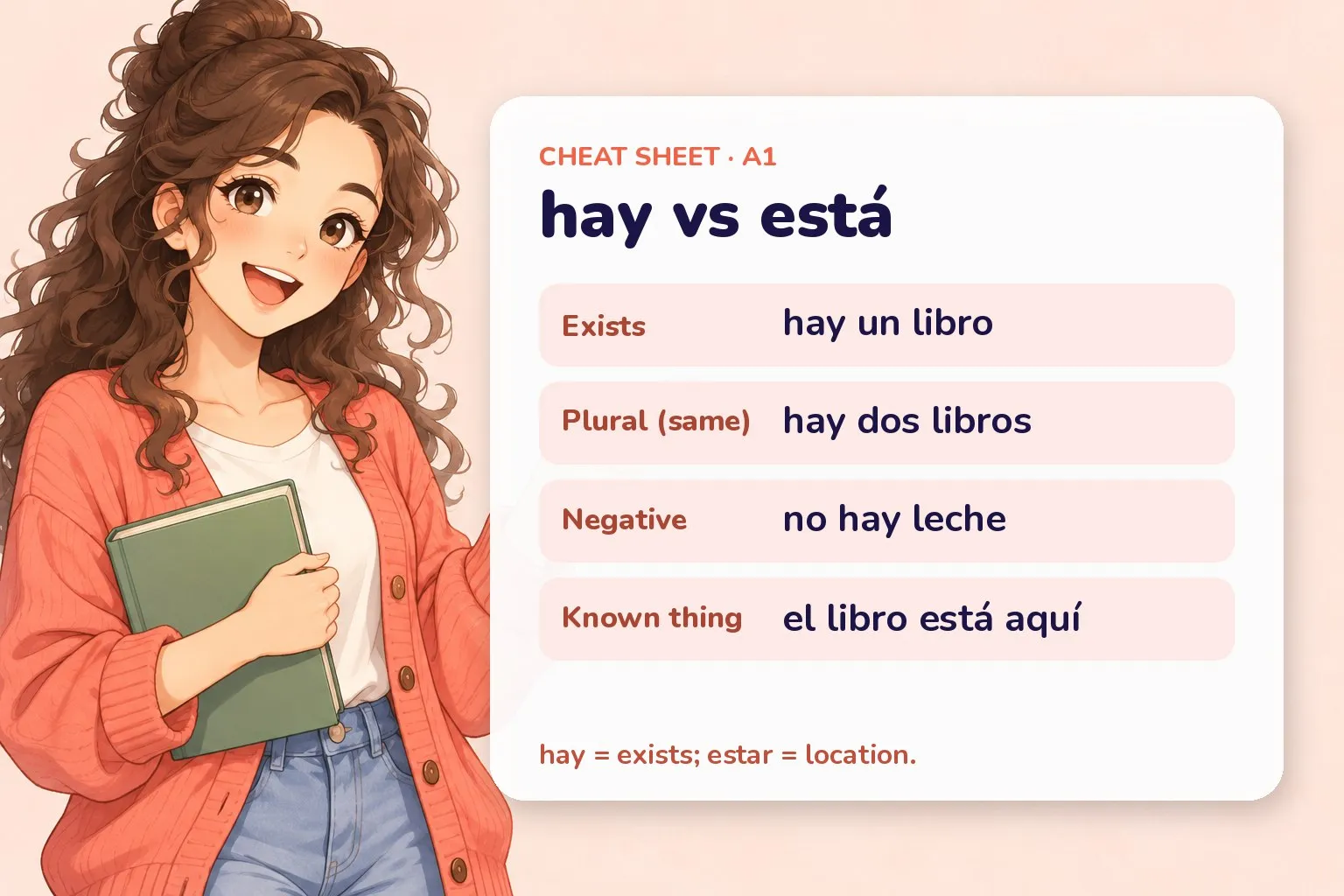
Quick recap before the quiz.
Practice
Hay practice
Try each one, then press Check. No sign-up, nothing is sent anywhere — it all runs in your browser.
Hint: the existence word
Show answer
hay — ¿Cuántas sillas hay…? — hay is invariable and goes after the counted noun.
3 Build: 'There are two cafés nearby.'
Show answer
hay dos cafés cerca — Hay dos cafés cerca — one hay for singular and plural alike.
4 Match each sentence with the reason for hay or está.
- Hay un banco cerca.
- El banco está cerca.
- Hay mucha gente.
- Mi casa está aquí.
Show answer
- Hay un banco cerca. → existence → hay
- El banco está cerca. → known thing's location → estar
- Hay mucha gente. → quantity → hay
- Mi casa está aquí. → known thing → estar
hay = exists/indefinite; estar = location of a known thing.
Quiz
Hay quiz
12 questions · pick an answer and you'll see straight away if it's right.
-
Show answer
there is / there are — Hay states existence: 'there is / there are'.
-
Show answer
hay — Hay is invariable: the same form for singular and plural.
-
Show answer
Hay un libro en la mesa — Existence of an unspecified thing: hay un libro.
-
Show answer
El libro está en la mesa — A known thing's location takes estar: el libro está en la mesa.
-
Show answer
el — Hay does not take the definite article el/la; that is a known thing (estar).
-
Show answer
Hay muchos turistas — Hay muchos turistas — one invariable hay, even in the plural.
-
Show answer
¿Cuántas sillas hay? — The counted noun comes before hay: ¿Cuántas sillas hay?
-
Show answer
Hay tres sillas — Hay already means 'there are'; don't add ser: hay tres sillas.
-
Show answer
hay — No hay leche — the negative of hay is simply no hay.
-
Show answer
for the location of a known thing — Estar locates a known/definite thing; hay introduces an unspecified one.
-
Show answer
haber — Hay is the present existence form of haber.
-
Show answer
No hay nadie en casa — Spanish doubles the negative: no hay nadie.
Recap cheat-sheet
| Use | Example | English |
|---|---|---|
| Existence (singular) | Hay un libro. | There is a book. |
| Existence (plural) | Hay dos libros. | There are two books. |
| Negative | No hay leche. | There is no milk. |
| Known thing → estar | El libro está aquí. | The book is here. |
Next
- Prerequisite to review: the verb estar
- Compare the two “to be” verbs: Ser vs Estar
- Back to the Spanish grammar section
- New here? Start with Start Learning Spanish Here
All Spanish grammar topics
Every grammar point in order, from your first sentence to advanced structures. Pick one and go straight to it. New lessons go live every day, so topics marked Coming soon fill in over the next weeks.
Grammar path
A1 31 topics · 12 ready
- 01 Noun Gender in Spanish (Masculine & Feminine)
- 02 Forming Plurals in Spanish
- 03 Definite Articles: el, la, los, las
- 04 Indefinite Articles: un, una, unos, unas
- 05 Subject Pronouns (yo, tú, él, nosotros)
- 06 The Verb Ser (Permanent 'To Be')
- 07 The Verb Estar (States & Location)
- 08 Ser vs Estar: When to Use Each
- 09 Hay: There Is / There Are You are here
- 10 Present Tense: Regular -AR Verbs
- 11 Present Tense: Regular -ER Verbs
- 12 Present Tense: Regular -IR Verbs
- 13 The Verb Tener (To Have) and Expressions Coming soon
- 14 The Verb Ir (To Go) and Ir A + Infinitive Coming soon
- 15 Gustar: Expressing Likes Coming soon
- 16 Adjective Agreement (Gender & Number) Coming soon
- 17 Position of Adjectives in Spanish Coming soon
- 18 Possessive Adjectives (mi, tu, su, nuestro) Coming soon
- 19 Demonstratives: este, ese, aquel Coming soon
- 20 Question Words (qué, quién, dónde, cómo) Coming soon
- 21 Negation: no and Double Negatives Coming soon
- 22 Contractions: al (a + el) and del (de + el) Coming soon
- 23 Muy vs Mucho Coming soon
- 24 Stem-Changing Verbs e→ie (querer, pensar) Coming soon
- 25 Stem-Changing Verbs o→ue (poder, dormir) Coming soon
- 26 Reflexive Verbs (levantarse, ducharse) Coming soon
- 27 Present Progressive (estar + gerundio) Coming soon
- 28 Tener Que + Infinitive (Obligation) Coming soon
- 29 The Personal A (direct object people) Coming soon
- 30 Prepositions a, en, de (Core Uses) Coming soon
- 31 Weather Expressions with Hacer Coming soon
A2 25 topics
- 32 Preterite Tense: Regular Verbs Coming soon
- 33 Preterite: Irregular Verbs (ser, ir, tener) Coming soon
- 34 Imperfect Tense (Ongoing & Habitual Past) Coming soon
- 35 Preterite vs Imperfect: Which Past Tense? Coming soon
- 36 Near Future: Ir A + Infinitive Coming soon
- 37 Direct Object Pronouns (lo, la, los, las) Coming soon
- 38 Indirect Object Pronouns (me, te, le, nos) Coming soon
- 39 Double Object Pronouns (se lo, me lo) Coming soon
- 40 Comparatives (más que, menos que) Coming soon
- 41 Superlatives (el más, -ísimo) Coming soon
- 42 Stressed Possessives (el mío, la tuya) Coming soon
- 43 Saber vs Conocer (Two Ways to 'Know') Coming soon
- 44 Por vs Para: The Basics Coming soon
- 45 Verbs Like Gustar (encantar, molestar, doler) Coming soon
- 46 Informal Commands (tú affirmative) Coming soon
- 47 Hace / Desde Hace for Time Expressions Coming soon
- 48 Acabar De + Infinitive (Just Did) Coming soon
- 49 Stem-Changing Verbs e→i (pedir, servir) Coming soon
- 50 Hay Que + Infinitive (Impersonal Obligation) Coming soon
- 51 Deber and Deber De (Obligation & Probability) Coming soon
- 52 Prepositional Pronouns (mí, ti, conmigo) Coming soon
- 53 Pero vs Sino (But) Coming soon
- 54 También and Tampoco (Also / Neither) Coming soon
- 55 Indefinite Pronouns (alguien, algo, cualquiera) Coming soon
- 56 Apocopation (buen, gran, primer, san) Coming soon
B1 25 topics
- 57 Simple Future Tense (hablaré) Coming soon
- 58 Conditional Tense (hablaría) Coming soon
- 59 Present Subjunctive: Formation Coming soon
- 60 Subjunctive for Wishes & Emotions (querer que) Coming soon
- 61 Subjunctive After Impersonal Expressions Coming soon
- 62 Formal & Negative Commands (usted, no hagas) Coming soon
- 63 Present Perfect (he hablado) Coming soon
- 64 Past Participles (Regular & Irregular) Coming soon
- 65 Pluperfect (había hablado) Coming soon
- 66 Por vs Para: Advanced Uses Coming soon
- 67 Relative Pronouns (que, quien, el que) Coming soon
- 68 Passive Se and Impersonal Se Coming soon
- 69 Comparisons of Equality (tan, tanto como) Coming soon
- 70 Pronoun Placement with Infinitives & Gerunds Coming soon
- 71 Si Clauses Type 1 (Real Conditions) Coming soon
- 72 Uses of the Gerund (-ando / -iendo) Coming soon
- 73 Lo + Adjective and Lo Que (Neuter Lo) Coming soon
- 74 Adverbs Ending in -mente Coming soon
- 75 Subjunctive After cuando & Time Conjunctions Coming soon
- 76 Verbs of Becoming (ponerse, volverse, hacerse) Coming soon
- 77 Quedar and Quedarse (Multiple Meanings) Coming soon
- 78 Al + Infinitive and Infinitive as Noun Coming soon
- 79 Antes de / Después de + Infinitive Coming soon
- 80 Más de / Menos de with Numbers Coming soon
- 81 Porque, Por Qué, Porqué, Por Que Coming soon
B2 18 topics
- 82 Imperfect Subjunctive (hablara / hablase) Coming soon
- 83 Si Clauses Type 2 (Unreal Present) Coming soon
- 84 Subjunctive in Adjective Clauses Coming soon
- 85 Subjunctive After Conjunctions (para que, aunque) Coming soon
- 86 Present Perfect Subjunctive (haya hablado) Coming soon
- 87 Future Perfect (habré hablado) Coming soon
- 88 Conditional Perfect (habría hablado) Coming soon
- 89 Passive Voice with Ser (ser + participle) Coming soon
- 90 Reported Speech (estilo indirecto) Coming soon
- 91 Advanced Relatives (cuyo, el cual, donde) Coming soon
- 92 Verbal Periphrases (seguir/llevar + gerundio) Coming soon
- 93 Indicative vs Subjunctive in Noun Clauses Coming soon
- 94 Aunque: Indicative vs Subjunctive Coming soon
- 95 Ojalá, Quizás, Tal Vez + Subjunctive Coming soon
- 96 Diminutives and Augmentatives (-ito, -ón) Coming soon
- 97 Future & Conditional of Probability (Conjecture) Coming soon
- 98 Relative Superlative & de + Group Coming soon
- 99 Adjectives That Change Meaning with Ser/Estar Coming soon
C1 11 topics
- 100 Pluperfect Subjunctive (hubiera hablado) Coming soon
- 101 Si Clauses Type 3 & Mixed (Unreal Past) Coming soon
- 102 Sequence of Tenses (correlación de tiempos) Coming soon
- 103 All Uses of Se (reflexive, passive, impersonal, accidental) Coming soon
- 104 Future Subjunctive (hablare) — Literary/Legal Coming soon
- 105 Discourse Connectors (sin embargo, por lo tanto) Coming soon
- 106 Subjunctive Nuance (perception, comunicación verbs) Coming soon
- 107 Ser/Estar + Participle & Resultant States Coming soon
- 108 Nominalisation & Register (Formal Spanish) Coming soon
- 109 Advanced Concession (por más que, a pesar de) Coming soon
- 110 Modal & Aspectual Periphrases (deber de, acabar por) Coming soon