Indefinite Articles: un, una, unos, unas
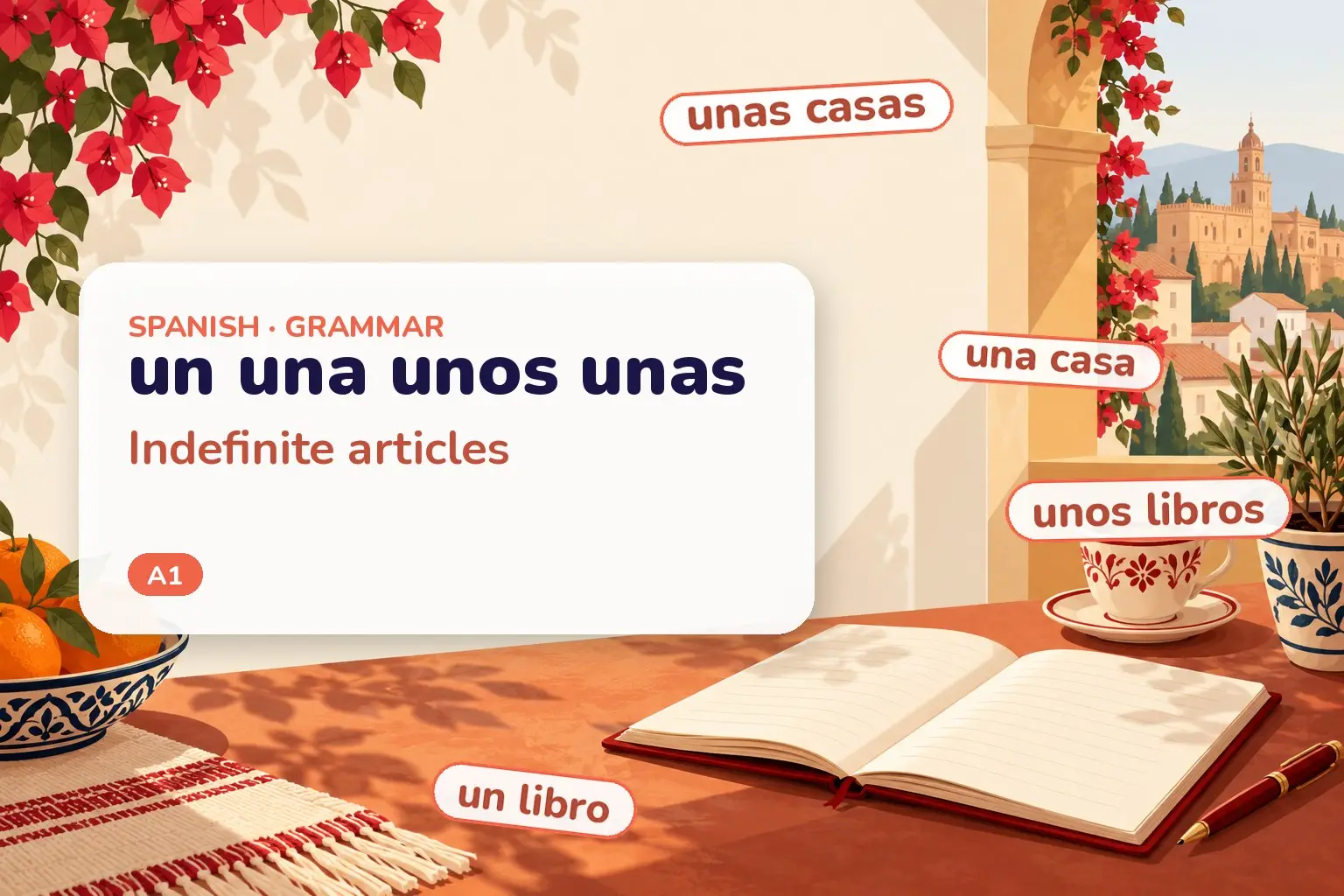
Spanish has four words for 'a / some': un (masculine singular), una (feminine singular), unos and unas (the plurals, meaning 'some'). The article agrees with the noun's gender and number: un libro, una casa, unos libros, unas casas.
Level: A1. An indefinite article is the word for “a” or “an” — the one you use for something not yet specific or mentioned for the first time. Where English has “a / an” and “some”, Spanish has four forms, because the article must match the noun’s gender (masculine or feminine) and number (singular or plural).
The rule
Pick the article from a simple grid. Gender is the masculine/feminine label every Spanish noun carries; number is singular versus plural.
- un — masculine singular → un libro (a book)
- una — feminine singular → una casa (a house)
- unos — masculine plural → unos libros (some books)
- unas — feminine plural → unas casas (some houses)
The article sits before the noun and copies its gender and number. The singulars mean “a / an”; the plurals mean “some” or “a few”. Because the article carries the gender, the safest habit is to learn every noun with its article.
The four forms
| Singular | Plural | |
|---|---|---|
| Masculine | un | unos |
| Feminine | una | unas |
Dropping the article after ser
Spanish normally omits the indefinite article after the verb ser (“to be”) when you state a profession, nationality or religion on its own:
- Soy profesor. (I am a teacher.)
- Ella es médica. (She is a doctor.)
- Somos estudiantes. (We are students.)
But you keep the article as soon as the noun is described by an adjective:
- Soy un buen profesor. (I am a good teacher.)
- Es una médica excelente. (She is an excellent doctor.)
The un águila rule
A feminine noun that begins with a stressed a- or ha- takes un in the singular, purely so the two “a” sounds do not clash: un águila (an eagle), un hacha (an axe), un aula (a classroom).
The noun stays feminine, so:
- Adjectives keep the feminine form: un águila blanca (a white eagle).
- The plural goes back to unas: unas águilas, unas hachas.
- If the a- is not stressed, use the normal una: una amiga (a friend).
When to use unos and unas
- “Some / a few”: Compré unas manzanas. (I bought some apples.)
- “About” before a number: Hay unos veinte euros. (There are about twenty euros.)
- Paired body parts or objects: unas gafas (a pair of glasses), unas tijeras (a pair of scissors).
Often, where English says a bare plural, Spanish simply drops the article: Compré manzanas (I bought apples) is just as natural as Compré unas manzanas.
How to say it
Spanish spelling is regular, so once you know these sounds you can read the forms aloud:
| Sound | How to say it |
|---|---|
| Vowels a u o | Pure and short: un = “oon”, una = “OO-nah”. Never glide them. |
| u in un/unos | Always a full “oo”, never the English “uh”: unos = “OO-nohs”. |
| Final -s | Clear and light: unas = “OO-nahs”. |
| Stress on á | The written accent shows the stressed syllable: águila = “AH-gee-lah”. |
Example sentences
Each sentence was written for this lesson (not copied from a third-party corpus).
- Tengo un libro.I have a book.
- Es una casa grande.It is a big house.
- Compré unos libros.I bought some books.
- Vi unas flores bonitas.I saw some pretty flowers.
- Hay un perro en el jardín.There is a dog in the garden.
- Quiero una manzana.I want an apple.
- Soy profesor.I am a teacher.no article after ser + bare profession
- Soy un buen profesor.I am a good teacher.article returns with an adjective
- Ella es médica.She is a doctor.
- Un águila vuela alto.An eagle flies high.feminine, but un before stressed a-
- Unas águilas descansan en el árbol.Some eagles are resting in the tree.plural goes back to unas
- Necesito unas gafas nuevas.I need a new pair of glasses.
- Hay unos veinte estudiantes.There are about twenty students.unos = about before a number
- Me dio un consejo.He gave me a piece of advice.
- Es un día bonito.It is a nice day.
- Tengo unas preguntas.I have some questions.
Common mistakes
- ❌ Soy un profesor → ✅ Soy profesor. Drop the article after ser with a bare profession.
- ❌ una águila → ✅ un águila. A feminine noun with a stressed initial a- takes un in the singular.
- ❌ un águila blanco → ✅ un águila blanca. The noun is feminine, so the adjective stays feminine.
- ❌ unos aguas → ✅ unas aguas. The plural of these feminine nouns returns to unas.
- ❌ un casa → ✅ una casa. casa is feminine, so the article is una.
A short conversation
— ¿Tienes un bolígrafo? (Do you have a pen?) — Sí, tengo unos bolígrafos en la mochila. (Yes, I have some pens in the backpack.) — ¿A qué te dedicas? (What do you do?) — Soy ingeniera. Trabajo en una empresa pequeña. (I’m an engineer. I work at a small company.)
Notice un bolígrafo (a pen), unos bolígrafos (some pens), the dropped article in soy ingeniera, and una empresa once there is a noun to count.
Usage notes
- No article after bare profession. The rule covers ser + profession, nationality (es español) and religion (es budista). Add the article only with a describing adjective.
- Only the stressed a- triggers un. un águila works because the stress is on the first a-; una amiga keeps una because the a- is unstressed.
- Plural often dropped. Spanish frequently leaves out unos/unas before a plain plural: Hay flores en la mesa (There are flowers on the table).
- Register. The choice of un, una, unos, unas is standard across Spain and Latin America; it never changes by formality, only by the noun’s gender and number.
Compared with…
- Definite articles (el, la, los, las) mean “the” and point to something specific or already known, while un, una, unos, unas introduce something new or not yet identified. Compare Quiero el libro (I want the book — a specific one) with Quiero un libro (I want a book — any book). See Definite Articles: el, la, los, las.
- Noun gender decides whether you use the masculine or feminine form; how a noun’s gender is worked out is covered in Noun Gender in Spanish.
- Plurals (unos, unas) follow the plural of the noun itself; see Making Nouns Plural.
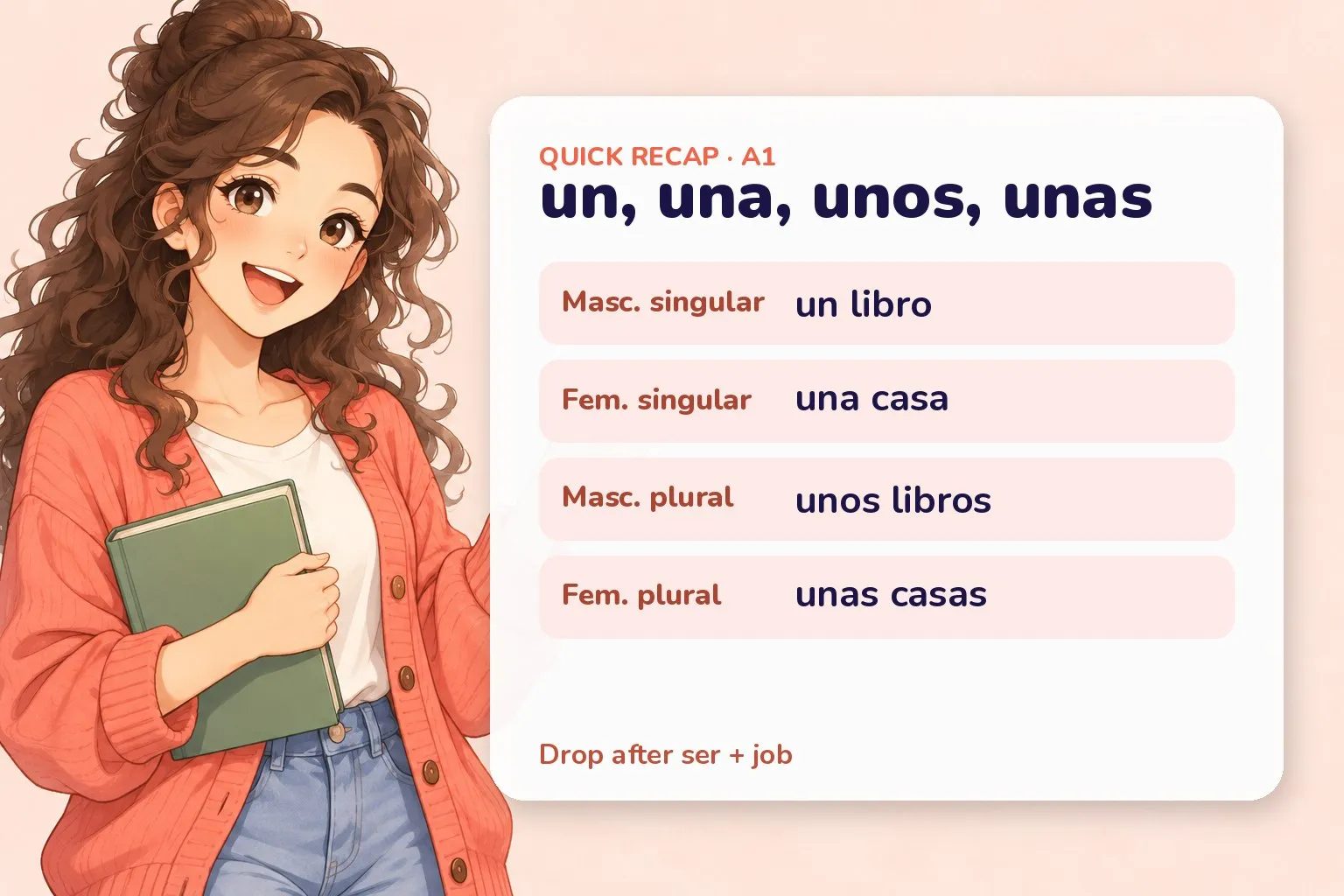
Quick recap before the quiz.
Practice
Indefinite article practice
Try each one, then press Check. No sign-up, nothing is sent anywhere — it all runs in your browser.
Hint: There is an adjective (paciente).
Show answer
un — With an adjective, the article returns: soy un profesor paciente.
Hint: Stressed initial a-.
Show answer
un — A stressed initial a- makes a feminine noun take un in the singular: un águila.
5 Match each noun with its article.
- ___ perro
- ___ casa
- ___ flores
- ___ libros
Show answer
- ___ perro → un
- ___ casa → una
- ___ flores → unas
- ___ libros → unos
un perro (m. sing), una casa (f. sing), unas flores (f. pl), unos libros (m. pl).
Quiz
Spanish indefinite articles
12 questions · pick an answer and you'll see straight away if it's right.
-
Show answer
un — Masculine singular: un libro.
-
Show answer
una — Feminine singular: una casa.
-
Show answer
unos — Masculine plural: unos libros.
-
Show answer
unas — Feminine plural: unas casas.
-
Show answer
Soy profesor — Drop the article after ser with a bare profession: Soy profesor.
-
Show answer
Soy un buen profesor — The article returns with an adjective: Soy un buen profesor.
-
Show answer
un águila — A stressed initial a- makes a feminine noun take un in the singular: un águila.
-
Show answer
unas águilas — The noun is feminine, so the plural is unas águilas.
-
Show answer
un águila blanca — águila takes un for sound but stays feminine, so the adjective is blanca.
-
Show answer
Hay unos veinte euros — unos before a number means 'about': unos veinte euros.
-
Show answer
unas — Feminine plural: unas.
-
Show answer
They introduce something new or not specific ('a / some') — Indefinite articles introduce something new or unspecified; definite articles point to something known.
Recap cheat-sheet
| Form | Use | Example |
|---|---|---|
| un | masculine singular | un libro |
| una | feminine singular | una casa |
| unos | masculine plural / “some” | unos libros |
| unas | feminine plural / “some” | unas casas |
Next
- Compare: Definite Articles: el, la, los, las
- Back to the Spanish grammar section
- New here? Start with Start Learning Spanish Here
All Spanish grammar topics
Every grammar point in order, from your first sentence to advanced structures. Pick one and go straight to it. New lessons go live every day, so topics marked Coming soon fill in over the next weeks.
Grammar path
A1 31 topics · 12 ready
- 01 Noun Gender in Spanish (Masculine & Feminine)
- 02 Forming Plurals in Spanish
- 03 Definite Articles: el, la, los, las
- 04 Indefinite Articles: un, una, unos, unas You are here
- 05 Subject Pronouns (yo, tú, él, nosotros)
- 06 The Verb Ser (Permanent 'To Be')
- 07 The Verb Estar (States & Location)
- 08 Ser vs Estar: When to Use Each
- 09 Hay: There Is / There Are
- 10 Present Tense: Regular -AR Verbs
- 11 Present Tense: Regular -ER Verbs
- 12 Present Tense: Regular -IR Verbs
- 13 The Verb Tener (To Have) and Expressions Coming soon
- 14 The Verb Ir (To Go) and Ir A + Infinitive Coming soon
- 15 Gustar: Expressing Likes Coming soon
- 16 Adjective Agreement (Gender & Number) Coming soon
- 17 Position of Adjectives in Spanish Coming soon
- 18 Possessive Adjectives (mi, tu, su, nuestro) Coming soon
- 19 Demonstratives: este, ese, aquel Coming soon
- 20 Question Words (qué, quién, dónde, cómo) Coming soon
- 21 Negation: no and Double Negatives Coming soon
- 22 Contractions: al (a + el) and del (de + el) Coming soon
- 23 Muy vs Mucho Coming soon
- 24 Stem-Changing Verbs e→ie (querer, pensar) Coming soon
- 25 Stem-Changing Verbs o→ue (poder, dormir) Coming soon
- 26 Reflexive Verbs (levantarse, ducharse) Coming soon
- 27 Present Progressive (estar + gerundio) Coming soon
- 28 Tener Que + Infinitive (Obligation) Coming soon
- 29 The Personal A (direct object people) Coming soon
- 30 Prepositions a, en, de (Core Uses) Coming soon
- 31 Weather Expressions with Hacer Coming soon
A2 25 topics
- 32 Preterite Tense: Regular Verbs Coming soon
- 33 Preterite: Irregular Verbs (ser, ir, tener) Coming soon
- 34 Imperfect Tense (Ongoing & Habitual Past) Coming soon
- 35 Preterite vs Imperfect: Which Past Tense? Coming soon
- 36 Near Future: Ir A + Infinitive Coming soon
- 37 Direct Object Pronouns (lo, la, los, las) Coming soon
- 38 Indirect Object Pronouns (me, te, le, nos) Coming soon
- 39 Double Object Pronouns (se lo, me lo) Coming soon
- 40 Comparatives (más que, menos que) Coming soon
- 41 Superlatives (el más, -ísimo) Coming soon
- 42 Stressed Possessives (el mío, la tuya) Coming soon
- 43 Saber vs Conocer (Two Ways to 'Know') Coming soon
- 44 Por vs Para: The Basics Coming soon
- 45 Verbs Like Gustar (encantar, molestar, doler) Coming soon
- 46 Informal Commands (tú affirmative) Coming soon
- 47 Hace / Desde Hace for Time Expressions Coming soon
- 48 Acabar De + Infinitive (Just Did) Coming soon
- 49 Stem-Changing Verbs e→i (pedir, servir) Coming soon
- 50 Hay Que + Infinitive (Impersonal Obligation) Coming soon
- 51 Deber and Deber De (Obligation & Probability) Coming soon
- 52 Prepositional Pronouns (mí, ti, conmigo) Coming soon
- 53 Pero vs Sino (But) Coming soon
- 54 También and Tampoco (Also / Neither) Coming soon
- 55 Indefinite Pronouns (alguien, algo, cualquiera) Coming soon
- 56 Apocopation (buen, gran, primer, san) Coming soon
B1 25 topics
- 57 Simple Future Tense (hablaré) Coming soon
- 58 Conditional Tense (hablaría) Coming soon
- 59 Present Subjunctive: Formation Coming soon
- 60 Subjunctive for Wishes & Emotions (querer que) Coming soon
- 61 Subjunctive After Impersonal Expressions Coming soon
- 62 Formal & Negative Commands (usted, no hagas) Coming soon
- 63 Present Perfect (he hablado) Coming soon
- 64 Past Participles (Regular & Irregular) Coming soon
- 65 Pluperfect (había hablado) Coming soon
- 66 Por vs Para: Advanced Uses Coming soon
- 67 Relative Pronouns (que, quien, el que) Coming soon
- 68 Passive Se and Impersonal Se Coming soon
- 69 Comparisons of Equality (tan, tanto como) Coming soon
- 70 Pronoun Placement with Infinitives & Gerunds Coming soon
- 71 Si Clauses Type 1 (Real Conditions) Coming soon
- 72 Uses of the Gerund (-ando / -iendo) Coming soon
- 73 Lo + Adjective and Lo Que (Neuter Lo) Coming soon
- 74 Adverbs Ending in -mente Coming soon
- 75 Subjunctive After cuando & Time Conjunctions Coming soon
- 76 Verbs of Becoming (ponerse, volverse, hacerse) Coming soon
- 77 Quedar and Quedarse (Multiple Meanings) Coming soon
- 78 Al + Infinitive and Infinitive as Noun Coming soon
- 79 Antes de / Después de + Infinitive Coming soon
- 80 Más de / Menos de with Numbers Coming soon
- 81 Porque, Por Qué, Porqué, Por Que Coming soon
B2 18 topics
- 82 Imperfect Subjunctive (hablara / hablase) Coming soon
- 83 Si Clauses Type 2 (Unreal Present) Coming soon
- 84 Subjunctive in Adjective Clauses Coming soon
- 85 Subjunctive After Conjunctions (para que, aunque) Coming soon
- 86 Present Perfect Subjunctive (haya hablado) Coming soon
- 87 Future Perfect (habré hablado) Coming soon
- 88 Conditional Perfect (habría hablado) Coming soon
- 89 Passive Voice with Ser (ser + participle) Coming soon
- 90 Reported Speech (estilo indirecto) Coming soon
- 91 Advanced Relatives (cuyo, el cual, donde) Coming soon
- 92 Verbal Periphrases (seguir/llevar + gerundio) Coming soon
- 93 Indicative vs Subjunctive in Noun Clauses Coming soon
- 94 Aunque: Indicative vs Subjunctive Coming soon
- 95 Ojalá, Quizás, Tal Vez + Subjunctive Coming soon
- 96 Diminutives and Augmentatives (-ito, -ón) Coming soon
- 97 Future & Conditional of Probability (Conjecture) Coming soon
- 98 Relative Superlative & de + Group Coming soon
- 99 Adjectives That Change Meaning with Ser/Estar Coming soon
C1 11 topics
- 100 Pluperfect Subjunctive (hubiera hablado) Coming soon
- 101 Si Clauses Type 3 & Mixed (Unreal Past) Coming soon
- 102 Sequence of Tenses (correlación de tiempos) Coming soon
- 103 All Uses of Se (reflexive, passive, impersonal, accidental) Coming soon
- 104 Future Subjunctive (hablare) — Literary/Legal Coming soon
- 105 Discourse Connectors (sin embargo, por lo tanto) Coming soon
- 106 Subjunctive Nuance (perception, comunicación verbs) Coming soon
- 107 Ser/Estar + Participle & Resultant States Coming soon
- 108 Nominalisation & Register (Formal Spanish) Coming soon
- 109 Advanced Concession (por más que, a pesar de) Coming soon
- 110 Modal & Aspectual Periphrases (deber de, acabar por) Coming soon