Noun Gender in Spanish (Masculine & Feminine)
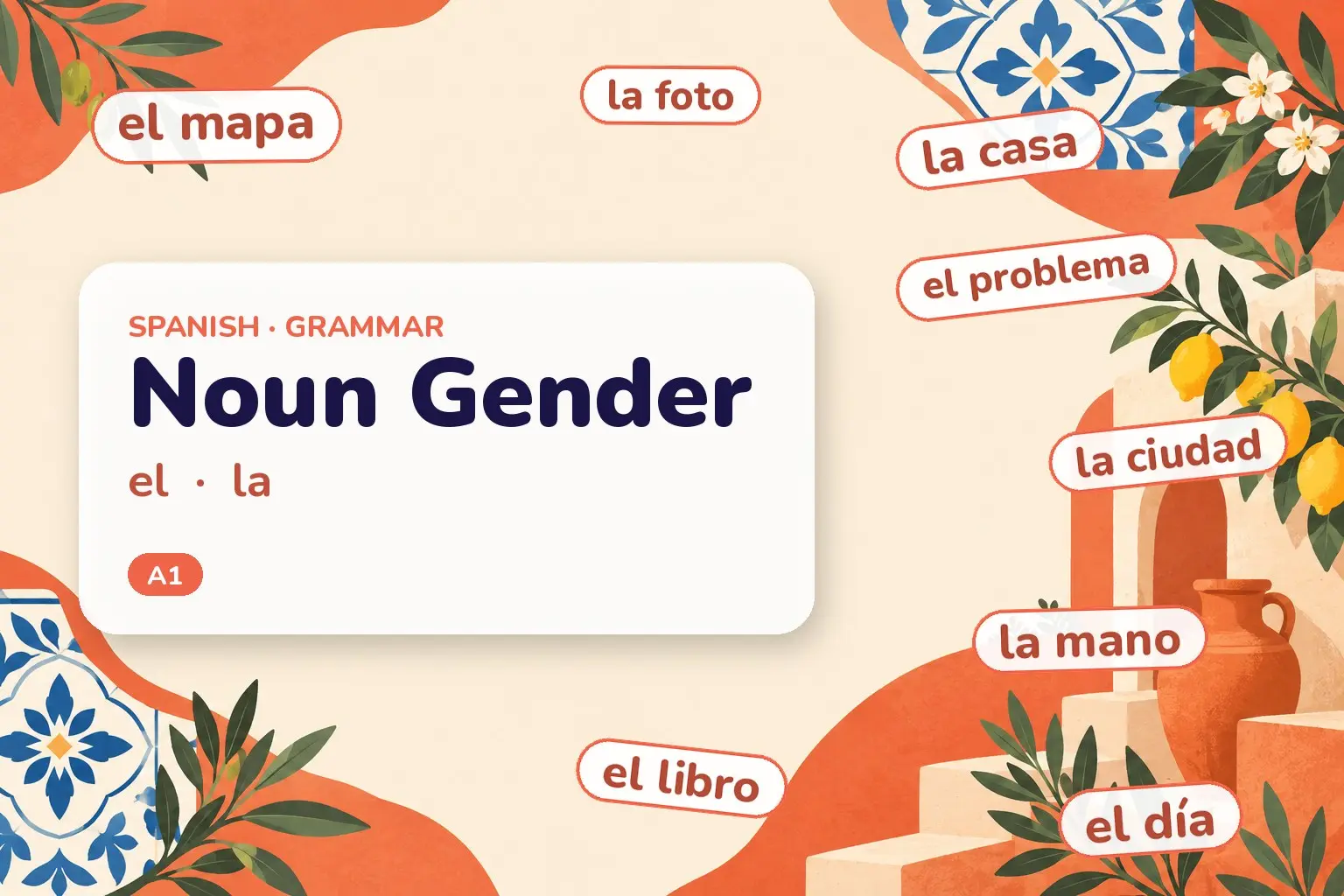
Every Spanish noun is either masculine or feminine. As a rule of thumb, nouns ending in -o are usually masculine (el libro) and those ending in -a are usually feminine (la casa). But there are important exceptions — el problema, el día, la mano, la foto — so you should learn each noun with its article (el or la).
Level: A1. In Spanish every noun has a gender — masculine or feminine — even for objects that have nothing to do with people. The gender usually decides which article you use (el or la) and how adjectives change. The good news: there is a reliable pattern, with a set of exceptions to learn.
The rule
Gender here is just a grammatical label, not a statement about the real world. A noun is a word for a person, place or thing. The ending often tells you the gender:
- Nouns ending in -o are usually masculine → el libro (the book).
- Nouns ending in -a are usually feminine → la casa (the house).
The article usually signals the gender (though a few feminine nouns take el in the singular, like el agua, and stay feminine). The safest habit is to learn every noun with its article: not libro but el libro, not casa but la casa.
Endings and exceptions
| Ending | Usual gender | Examples | Watch out for |
|---|---|---|---|
| -o | masculine | el libro, el perro, el dinero | la mano, la foto (feminine) |
| -a | feminine | la casa, la mesa, la silla | el problema, el día, el mapa, el sofá (masculine) |
| -ción / -sión | feminine | la canción, la televisión | — |
| -dad / -tad | feminine | la ciudad, la libertad | — |
| -or | usually masculine | el color, el amor | la flor (feminine) |
Many nouns ending in -ma that come from Greek are masculine: el problema, el tema, el programa, el sistema.
Example sentences
Each sentence was written for this lesson (not copied from a third-party corpus).
- El libro es nuevo. — The book is new.
- La casa es grande. — The house is big.
- El problema es difícil. — The problem is difficult. (-a but masculine)
- La mano está fría. — The hand is cold. (-o but feminine)
- El día es largo. — The day is long.
- La mesa es blanca. — The table is white.
- El mapa está en la pared. — The map is on the wall.
- La ciudad es bonita. — The city is pretty.
- El color es azul. — The colour is blue.
- La foto es vieja. — The photo is old.
- El coche es rápido. — The car is fast.
- La universidad es famosa. — The university is famous.
Common mistakes
- ❌ la problema → ✅ el problema. Not every -a noun is feminine.
- ❌ el mano → ✅ la mano. Not every -o noun is masculine.
- ❌ la casa blanco → ✅ la casa blanca. The adjective must agree with the feminine noun.
- ❌ el agua frío → ✅ el agua fría. Agua is feminine; it takes el in the singular only because it starts with a stressed a-, but adjectives stay feminine.
Compared with…
- Definite articles (el, la, los, las) — the articles that show gender and number.
- Adjective agreement — adjectives copy the noun’s gender and number.
Both topics are listed in the Spanish grammar section.
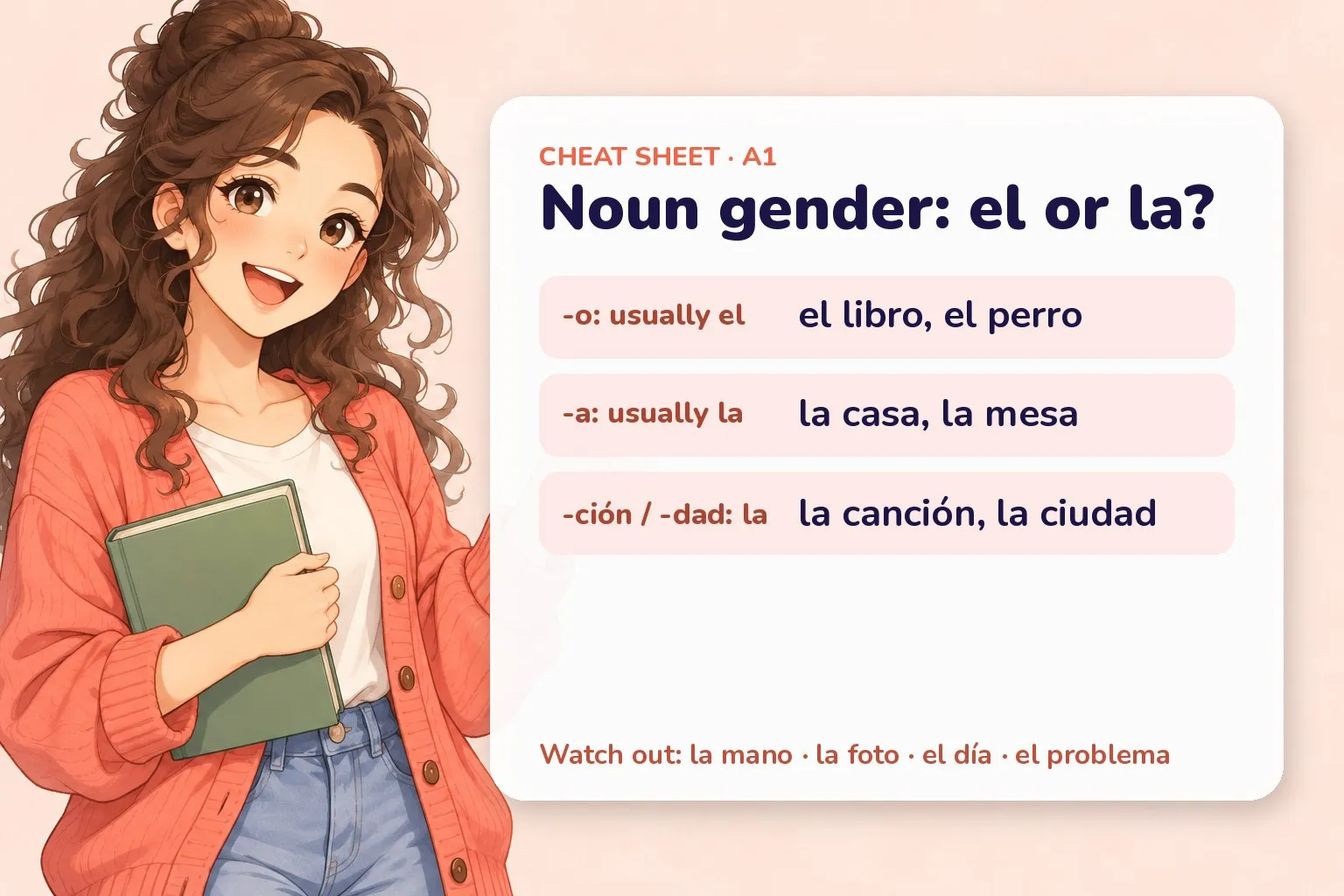
Quick recap before the quiz.
Mini quiz
- ___ libro (the book)
- ___ mano (the hand)
- ___ problema (the problem)
- la casa blanc__ (white)
- ___ ciudad (the city)
Answers
- el — -o, masculine.
- la — exception: mano is feminine.
- el — exception: problema is masculine.
- a → blanca — agrees with feminine casa.
- la — -dad nouns are feminine.
Sources & licensing
- Gender patterns cross-checked with Wiktionary (CC BY-SA 4.0).
- This topic sits at beginner level (A1) in common course sequencing; the Instituto Cervantes Plan Curricular and CEFR are used as general references, not as a topic-by-topic level ruling.
- Example sentences were written for this lesson; no third-party sentences were copied.
Next
- Back to the Spanish grammar section
- New here? Start with Start Learning Spanish Here
Sources
- Spanish grammar: gender of nouns — Wiktionary (CC BY-SA 4.0) (as of October 2026)
- Plan Curricular del Instituto Cervantes — Instituto Cervantes (as of October 2026)
- CEFR level descriptions (A1) — Council of Europe (as of October 2026)