Ser vs Estar: When to Use Each
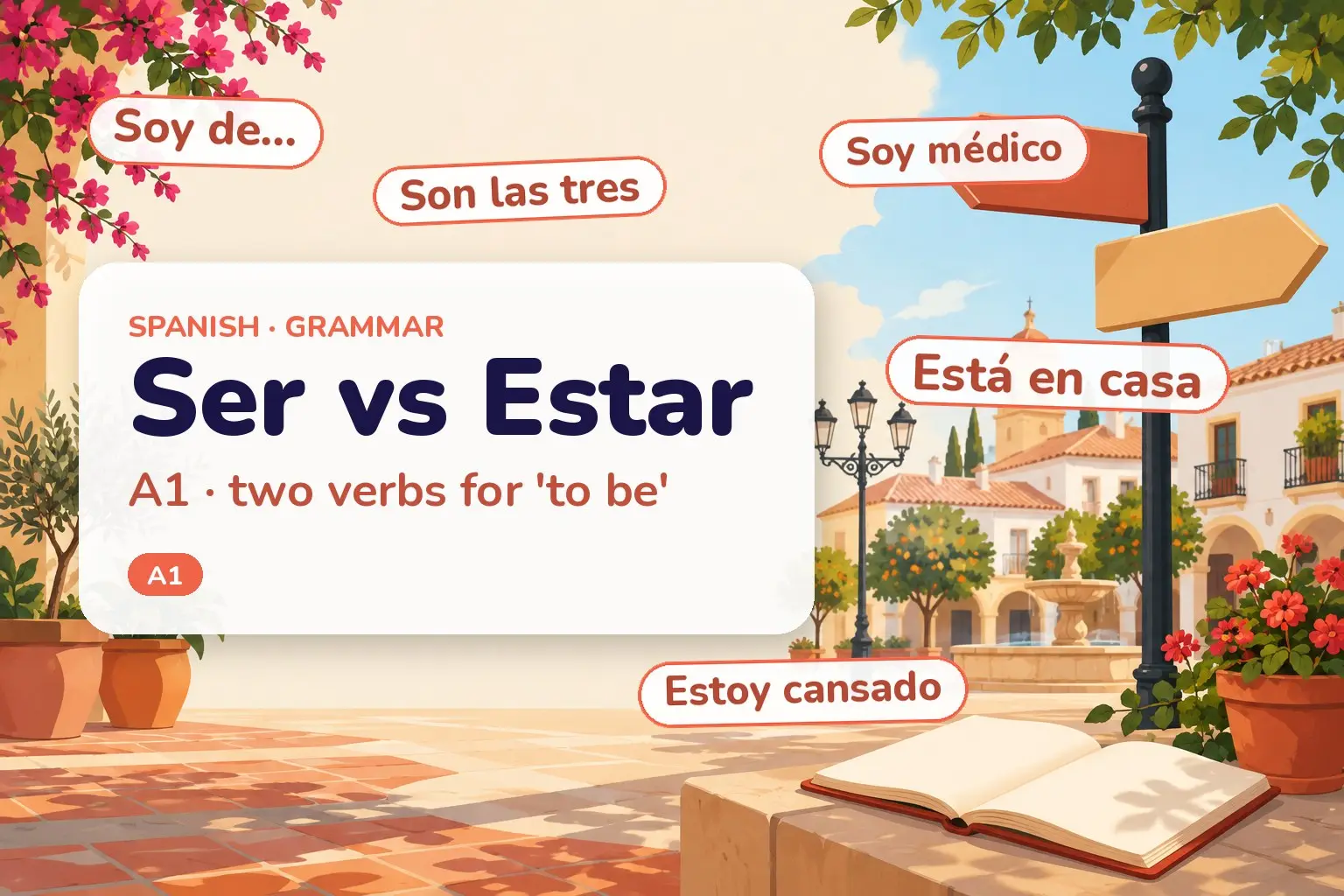
Use ser for identity, origin, profession and defining traits (Soy médico, 'I am a doctor'); use estar for states, moods and location (Estoy cansado, 'I am tired'). A few adjectives change meaning: es listo means 'he is clever', está listo means 'he is ready'.
Level: A1. Spanish has two verbs for English “to be”: ser and estar. They are not interchangeable. The short version: ser tells you what something is (identity, essence), estar tells you how or where something is (state, location).
The rule
Both ser and estar translate as “to be”, so English gives you no clue which to pick. You choose by meaning, not by the English word.
Use ser for things that define what someone or something is: identity and name, origin and nationality, profession, relationships, material, possession, and the time or date. These are the stable, defining facts: Soy María, Soy de España, Es profesora, Son las tres.
Use estar for the condition something is in right now: physical and emotional states, the result of a change, and — crucially — location. These can change: Estoy cansado (“I am tired”), Está en casa (“he is at home”), La sopa está fría (“the soup is cold”).
The one location exception to memorise: a thing or person is located with estar, but an event (a party, a class, a concert) uses ser: La fiesta es en mi casa (“the party is at my house”).
Present tense of ser and estar
| Subject | ser | estar |
|---|---|---|
| yo | soy | estoy |
| tú | eres | estás |
| él / ella / usted | es | está |
| nosotros/as | somos | estamos |
| vosotros/as | sois | estáis |
| ellos / ellas / ustedes | son | están |
Note that estar carries written accents on most forms (estás, está, estáis, están), and the stress falls on that final syllable when you say it.
How to say it
Spanish spelling is regular; mind these few sounds from this lesson’s words:
| Word | How to say it |
|---|---|
| estoy / está | stress the end: “es-TOY”, “es-TA”; the written accent shows the stressed syllable. |
| verde | the v sounds like a soft Spanish b: “BEHR-deh”. |
| aburrido | roll the double rr: “a-boo-RREE-do”; the single d between vowels is soft, near English “th”. |
| cansado | the d between vowels softens: “kan-SA-tho”; stress the middle, “kan-SA-do”. |
Example sentences
Each sentence was written for this lesson.
- Soy estudiante.I am a student.ser: profession/role
- Soy de Singapur.I am from Singapore.ser: origin
- Mi madre es profesora.My mother is a teacher.ser: profession
- La mesa es de madera.The table is (made) of wood.ser: material
- Son las tres.It is three o'clock.ser: time
- El coche es rojo.The car is red.ser: defining colour
- Estoy cansado.I am tired.estar: state
- Estamos en casa.We are at home.estar: location
- La sopa está fría.The soup is cold.estar: changeable condition
- ¿Cómo estás?How are you?estar: how you feel
- Mi hermano está enfermo.My brother is ill.estar: temporary condition
- La tienda está cerrada.The shop is closed.estar: result of a change
- La fiesta es en mi casa.The party is at my house.ser: location of an event
- Hoy estoy muy contento.Today I am very happy.estar: mood
- Ella es alta.She is tall.ser: defining physical trait
- El café está caliente.The coffee is hot.estar: current condition
- Somos amigos.We are friends.ser: relationship
- El niño es listo.The boy is clever.ser listo = 'clever'
- Ya estoy listo.I am ready now.estar listo = 'ready'
- La película es aburrida.The film is boring.ser aburrido = 'boring'
- Estoy aburrido en casa.I am bored at home.estar aburrido = 'bored'
Common mistakes
- ✗ Soy cansado → ✓ Estoy cansado (“I am tired”). Tiredness is a passing state, so it takes estar.
- ✗ Estoy estudiante → ✓ Soy estudiante (“I am a student”). A role or profession defines you, so it takes ser.
- ✗ La fiesta está en mi casa → ✓ La fiesta es en mi casa (“the party is at my house”). An event’s location uses ser, even though a thing’s location uses estar.
- ✗ ¿Cómo eres? when you mean “How are you (feeling)?” → ✓ ¿Cómo estás? (¿Cómo eres? asks what someone is like in character.)
- ✗ Soy en casa → ✓ Estoy en casa (“I am at home”). Location of a person is always estar.
A short conversation
— ¡Hola! ¿Cómo estás? (“Hi! How are you?”) — Estoy bien, gracias. Estoy un poco cansada hoy. (“I’m well, thanks. I’m a little tired today.”) — ¿Y tú a qué te dedicas? (“And what do you do?”) — Soy enfermera. Soy de Valencia, pero ahora estoy en Madrid. (“I’m a nurse. I’m from Valencia, but right now I’m in Madrid.”)
Usage notes
- Permanent vs temporary is a guide, not a law. Estar muerto (“to be dead”) uses estar even though it is hardly temporary — because it is the result of a change. Think “state resulting from a change” rather than only “temporary”.
- Feelings and health are estar. Estoy triste / feliz / enfermo / nervioso. The one everyday exception is ser feliz for a settled, defining happiness (“he is a happy person”), while estar feliz is “happy right now”.
- Passive and description. Ser + past participle describes an action by someone (La casa fue construida, “the house was built”); estar + past participle describes the resulting state (La casa está construida, “the house is built”).
- With prices and the weather, verbs vary. Cost often uses ser (Son diez euros) or estar a (El kilo está a dos euros); for weather Spanish usually prefers hacer (Hace frío), not ser/estar.
Compared with…
- Ser on its own covers identity, origin, profession, material and time. If you are still shaky on its forms, review ser in the present tense before drilling the contrast.
- Estar on its own covers states, moods and location. Lock down its accented forms in estar in the present tense, then come back here. For the bigger picture, see the full Spanish grammar section.
Practice
Ser vs estar practice
Try each one, then press Check. No sign-up, nothing is sent anywhere — it all runs in your browser.
Hint: tiredness is a state
Show answer
estoy — Tiredness is a passing state → estar: Estoy cansado.
3 Build: 'The party is at my house.'
Show answer
La fiesta es en mi casa — An event's location uses ser: La fiesta es en mi casa.
4 Match each use with the right verb.
- origin / nationality
- location of a person
- mood right now
- profession
Show answer
- origin / nationality → ser
- location of a person → estar
- mood right now → estar
- profession → ser
Ser = identity/essence; estar = state/location.
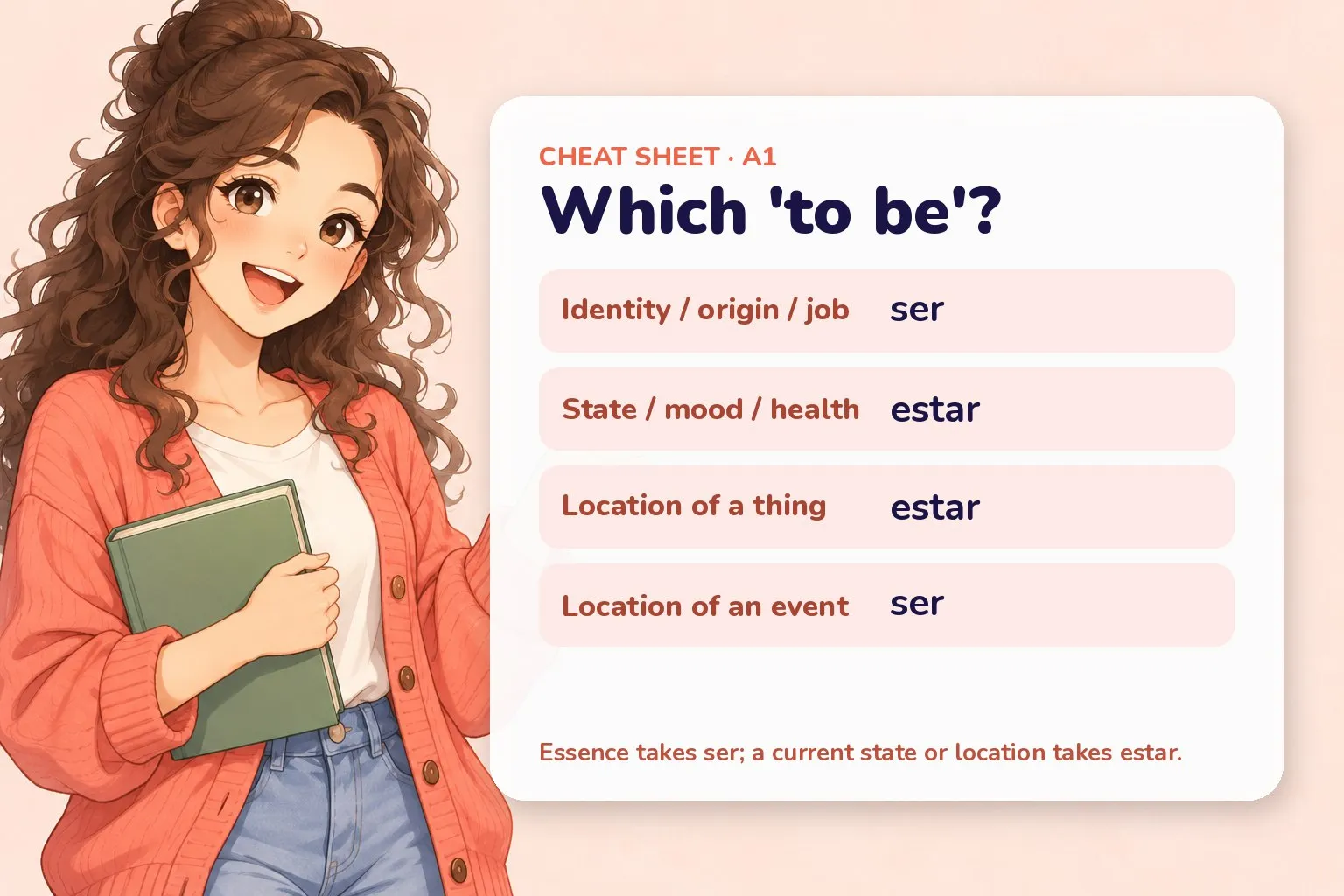
Quick recap before the quiz.
Quiz
Ser vs estar quiz
11 questions · pick an answer and you'll see straight away if it's right.
-
Show answer
ser — Ser describes what something essentially is: identity, origin, profession.
-
Show answer
Estoy en casa — Location of a person always uses estar: Estoy en casa.
-
Show answer
Soy profesor — A profession defines you, so use ser: Soy profesor.
-
Show answer
La sopa está fría — A changeable condition takes estar: La sopa está fría.
-
Show answer
ser (La fiesta es…) — An event's location is the ser exception: La fiesta es en mi casa.
-
Show answer
he is bored — estar aburrido = 'bored'; ser aburrido = 'boring'.
-
Show answer
the boy is clever — ser listo = 'clever'; estar listo = 'ready'.
-
Show answer
estás — Feelings/states use estar: ¿Cómo estás?
-
Show answer
estoy — estar → yo estoy.
-
Show answer
Somos amigos — A relationship defines you, so use ser: Somos amigos.
-
Show answer
what it IS → ser; how/where it IS now → estar — Essence → ser; current state or location → estar (the permanent/temporary rule has exceptions).
Recap cheat-sheet
| Use | Verb | Example |
|---|---|---|
| Identity / profession / origin | ser | Soy de Singapur |
| Material / time | ser | Son las tres |
| State / mood / health | estar | Estoy cansado |
| Location of a person or thing | estar | Está en casa |
| Location of an event | ser | La fiesta es aquí |
Next
- Drill the forms: ser in the present tense and estar in the present tense
- Back to the Spanish grammar section
- New here? Start with Start Learning Spanish Here
All Spanish grammar topics
Every grammar point in order, from your first sentence to advanced structures. Pick one and go straight to it. New lessons go live every day, so topics marked Coming soon fill in over the next weeks.
Grammar path
A1 31 topics · 12 ready
- 01 Noun Gender in Spanish (Masculine & Feminine)
- 02 Forming Plurals in Spanish
- 03 Definite Articles: el, la, los, las
- 04 Indefinite Articles: un, una, unos, unas
- 05 Subject Pronouns (yo, tú, él, nosotros)
- 06 The Verb Ser (Permanent 'To Be')
- 07 The Verb Estar (States & Location)
- 08 Ser vs Estar: When to Use Each You are here
- 09 Hay: There Is / There Are
- 10 Present Tense: Regular -AR Verbs
- 11 Present Tense: Regular -ER Verbs
- 12 Present Tense: Regular -IR Verbs
- 13 The Verb Tener (To Have) and Expressions Coming soon
- 14 The Verb Ir (To Go) and Ir A + Infinitive Coming soon
- 15 Gustar: Expressing Likes Coming soon
- 16 Adjective Agreement (Gender & Number) Coming soon
- 17 Position of Adjectives in Spanish Coming soon
- 18 Possessive Adjectives (mi, tu, su, nuestro) Coming soon
- 19 Demonstratives: este, ese, aquel Coming soon
- 20 Question Words (qué, quién, dónde, cómo) Coming soon
- 21 Negation: no and Double Negatives Coming soon
- 22 Contractions: al (a + el) and del (de + el) Coming soon
- 23 Muy vs Mucho Coming soon
- 24 Stem-Changing Verbs e→ie (querer, pensar) Coming soon
- 25 Stem-Changing Verbs o→ue (poder, dormir) Coming soon
- 26 Reflexive Verbs (levantarse, ducharse) Coming soon
- 27 Present Progressive (estar + gerundio) Coming soon
- 28 Tener Que + Infinitive (Obligation) Coming soon
- 29 The Personal A (direct object people) Coming soon
- 30 Prepositions a, en, de (Core Uses) Coming soon
- 31 Weather Expressions with Hacer Coming soon
A2 25 topics
- 32 Preterite Tense: Regular Verbs Coming soon
- 33 Preterite: Irregular Verbs (ser, ir, tener) Coming soon
- 34 Imperfect Tense (Ongoing & Habitual Past) Coming soon
- 35 Preterite vs Imperfect: Which Past Tense? Coming soon
- 36 Near Future: Ir A + Infinitive Coming soon
- 37 Direct Object Pronouns (lo, la, los, las) Coming soon
- 38 Indirect Object Pronouns (me, te, le, nos) Coming soon
- 39 Double Object Pronouns (se lo, me lo) Coming soon
- 40 Comparatives (más que, menos que) Coming soon
- 41 Superlatives (el más, -ísimo) Coming soon
- 42 Stressed Possessives (el mío, la tuya) Coming soon
- 43 Saber vs Conocer (Two Ways to 'Know') Coming soon
- 44 Por vs Para: The Basics Coming soon
- 45 Verbs Like Gustar (encantar, molestar, doler) Coming soon
- 46 Informal Commands (tú affirmative) Coming soon
- 47 Hace / Desde Hace for Time Expressions Coming soon
- 48 Acabar De + Infinitive (Just Did) Coming soon
- 49 Stem-Changing Verbs e→i (pedir, servir) Coming soon
- 50 Hay Que + Infinitive (Impersonal Obligation) Coming soon
- 51 Deber and Deber De (Obligation & Probability) Coming soon
- 52 Prepositional Pronouns (mí, ti, conmigo) Coming soon
- 53 Pero vs Sino (But) Coming soon
- 54 También and Tampoco (Also / Neither) Coming soon
- 55 Indefinite Pronouns (alguien, algo, cualquiera) Coming soon
- 56 Apocopation (buen, gran, primer, san) Coming soon
B1 25 topics
- 57 Simple Future Tense (hablaré) Coming soon
- 58 Conditional Tense (hablaría) Coming soon
- 59 Present Subjunctive: Formation Coming soon
- 60 Subjunctive for Wishes & Emotions (querer que) Coming soon
- 61 Subjunctive After Impersonal Expressions Coming soon
- 62 Formal & Negative Commands (usted, no hagas) Coming soon
- 63 Present Perfect (he hablado) Coming soon
- 64 Past Participles (Regular & Irregular) Coming soon
- 65 Pluperfect (había hablado) Coming soon
- 66 Por vs Para: Advanced Uses Coming soon
- 67 Relative Pronouns (que, quien, el que) Coming soon
- 68 Passive Se and Impersonal Se Coming soon
- 69 Comparisons of Equality (tan, tanto como) Coming soon
- 70 Pronoun Placement with Infinitives & Gerunds Coming soon
- 71 Si Clauses Type 1 (Real Conditions) Coming soon
- 72 Uses of the Gerund (-ando / -iendo) Coming soon
- 73 Lo + Adjective and Lo Que (Neuter Lo) Coming soon
- 74 Adverbs Ending in -mente Coming soon
- 75 Subjunctive After cuando & Time Conjunctions Coming soon
- 76 Verbs of Becoming (ponerse, volverse, hacerse) Coming soon
- 77 Quedar and Quedarse (Multiple Meanings) Coming soon
- 78 Al + Infinitive and Infinitive as Noun Coming soon
- 79 Antes de / Después de + Infinitive Coming soon
- 80 Más de / Menos de with Numbers Coming soon
- 81 Porque, Por Qué, Porqué, Por Que Coming soon
B2 18 topics
- 82 Imperfect Subjunctive (hablara / hablase) Coming soon
- 83 Si Clauses Type 2 (Unreal Present) Coming soon
- 84 Subjunctive in Adjective Clauses Coming soon
- 85 Subjunctive After Conjunctions (para que, aunque) Coming soon
- 86 Present Perfect Subjunctive (haya hablado) Coming soon
- 87 Future Perfect (habré hablado) Coming soon
- 88 Conditional Perfect (habría hablado) Coming soon
- 89 Passive Voice with Ser (ser + participle) Coming soon
- 90 Reported Speech (estilo indirecto) Coming soon
- 91 Advanced Relatives (cuyo, el cual, donde) Coming soon
- 92 Verbal Periphrases (seguir/llevar + gerundio) Coming soon
- 93 Indicative vs Subjunctive in Noun Clauses Coming soon
- 94 Aunque: Indicative vs Subjunctive Coming soon
- 95 Ojalá, Quizás, Tal Vez + Subjunctive Coming soon
- 96 Diminutives and Augmentatives (-ito, -ón) Coming soon
- 97 Future & Conditional of Probability (Conjecture) Coming soon
- 98 Relative Superlative & de + Group Coming soon
- 99 Adjectives That Change Meaning with Ser/Estar Coming soon
C1 11 topics
- 100 Pluperfect Subjunctive (hubiera hablado) Coming soon
- 101 Si Clauses Type 3 & Mixed (Unreal Past) Coming soon
- 102 Sequence of Tenses (correlación de tiempos) Coming soon
- 103 All Uses of Se (reflexive, passive, impersonal, accidental) Coming soon
- 104 Future Subjunctive (hablare) — Literary/Legal Coming soon
- 105 Discourse Connectors (sin embargo, por lo tanto) Coming soon
- 106 Subjunctive Nuance (perception, comunicación verbs) Coming soon
- 107 Ser/Estar + Participle & Resultant States Coming soon
- 108 Nominalisation & Register (Formal Spanish) Coming soon
- 109 Advanced Concession (por más que, a pesar de) Coming soon
- 110 Modal & Aspectual Periphrases (deber de, acabar por) Coming soon