Present Tense: Regular -AR Verbs (Spanish)
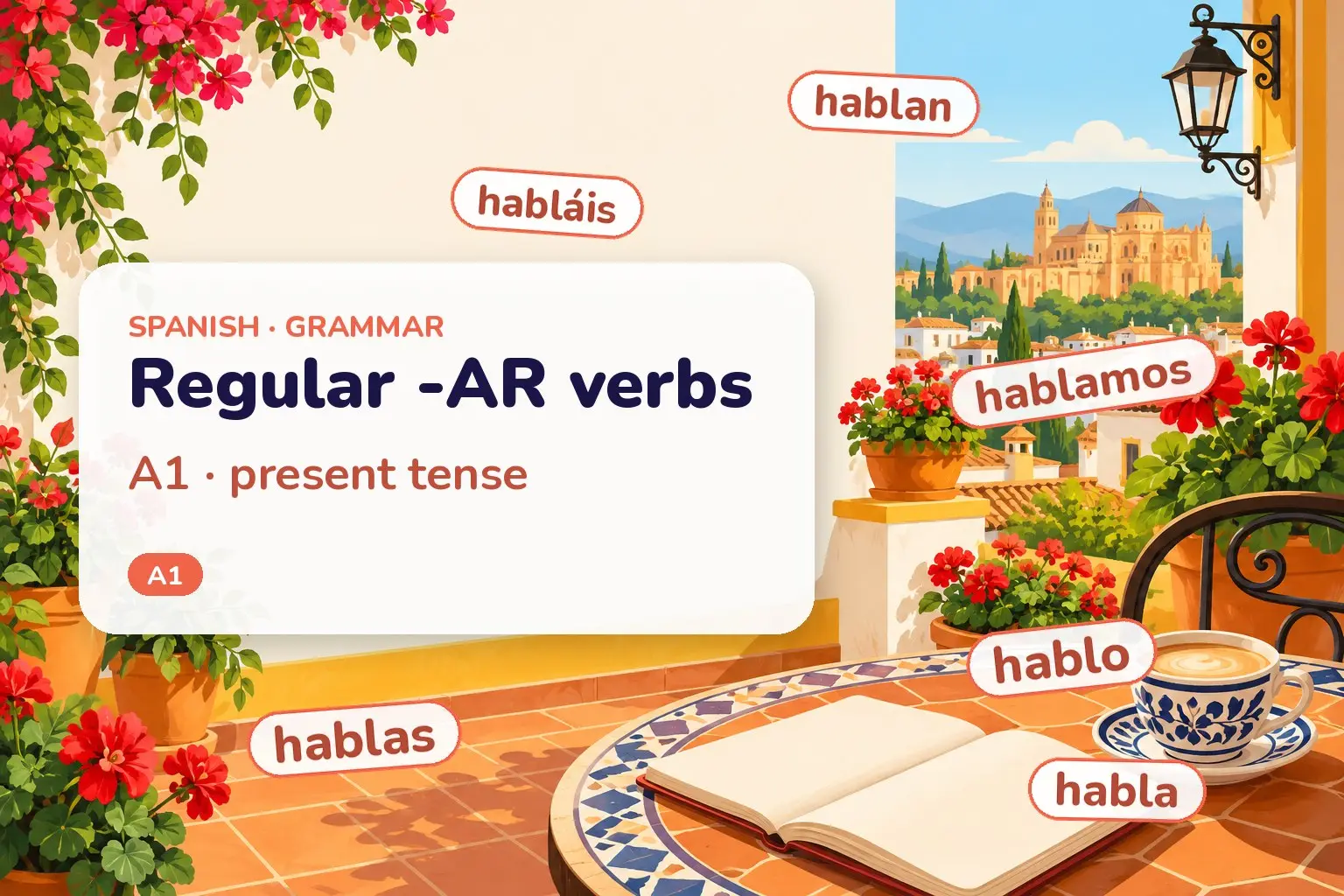
Regular -AR verbs are the biggest, easiest group in Spanish. Drop the -ar and add the present endings -o, -as, -a, -amos, -áis, -an, so hablar (to speak) becomes hablo, hablas, habla, hablamos, habláis, hablan.
Level: A1. Most Spanish verbs end in -ar — hablar, trabajar, estudiar — and in the present they all follow one simple pattern. Learn it once and you can use hundreds of verbs straight away.
The rule
A verb’s infinitive is its dictionary form: hablar (to speak), trabajar (to work). To make the present tense of a regular -AR verb, remove the -ar to get the stem (habl-), then add the ending that matches the subject.
The six present endings are -o, -as, -a, -amos, -áis, -an:
- yo (I) → -o: hablo
- tú (you, informal) → -as: hablas
- él / ella / usted (he / she / you formal) → -a: habla
- nosotros / nosotras (we) → -amos: hablamos
- vosotros / vosotras (you all, Spain) → -áis: habláis
- ellos / ellas / ustedes (they / you all) → -an: hablan
The same present covers three English meanings: hablo español is “I speak Spanish”, “I am speaking Spanish” and “I do speak Spanish”. Spanish does not add a separate helper verb for these.
Present tense of hablar (to speak)
| Person | Form | Example |
|---|---|---|
| yo | hablo | Hablo español. (I speak Spanish.) |
| tú | hablas | Hablas muy rápido. (You speak very fast.) |
| él / ella / usted | habla | Ella habla inglés. (She speaks English.) |
| nosotros / nosotras | hablamos | Hablamos en clase. (We talk in class.) |
| vosotros / vosotras | habláis | Habláis mucho. (You all talk a lot.) |
| ellos / ellas / ustedes | hablan | Ellos hablan francés. (They speak French.) |
Every regular -AR verb takes exactly these endings: estudiar → estudio, estudias, estudia, estudiamos, estudiáis, estudian.
How to say it
Spanish spelling is regular; mind these few sounds in -AR verbs:
| Word | How to say it |
|---|---|
| hablo | the h is silent: “AH-blo”. |
| trabajas | the j is a throaty h: “tra-BA-has”. |
| estudia | the -dia is two quick vowels: “es-TOO-dya”. |
| habláis | the á is stressed, -áis is one glide: “a-BLA-ees”. |
| compran | the single r is a light tap, not the English r. |
Example sentences
Each sentence was written for this lesson.
- Hablo español.I speak Spanish.yo form
- ¿Hablas inglés?Do you speak English?
- Ella trabaja en un banco.She works in a bank.
- Estudiamos en la biblioteca.We study in the library.nosotros -amos
- Los niños cantan una canción.The children sing a song.
- Yo escucho música por la noche.I listen to music at night.
- ¿Tú cocinas los fines de semana?Do you cook at the weekends?
- Compramos pan cada mañana.We buy bread every morning.
- Vosotros habláis muy rápido.You all talk very fast.vosotros -áis
- Ellos viajan a España en verano.They travel to Spain in summer.
- Usted necesita un boleto.You (formal) need a ticket.
- Camino al trabajo todos los días.I walk to work every day.
- Mi hermana baila muy bien.My sister dances very well.
- Nosotros estudiamos japonés.We study Japanese.
- ¿Qué miras en la televisión?What are you watching on television?
- El tren llega a las ocho.The train arrives at eight.
- Ayudo a mi madre en casa.I help my mother at home.
- Ellas compran verduras en el mercado.They buy vegetables at the market.
- ¿Usted trabaja aquí?Do you (formal) work here?
- Tomamos café todas las tardes.We drink coffee every afternoon.
Common mistakes
- ❌ Yo hablar español. → ✅ Yo hablo español. Never leave the infinitive -ar after a subject; conjugate it to hablo.
- ❌ Tú hablo inglés. → ✅ Tú hablas inglés. Match the ending to the subject: tú takes -as, not -o.
- ❌ Nosotros hablemos en clase. → ✅ Nosotros hablamos en clase. The nosotros present ending is -amos, not -emos (that would be the subjunctive).
- ❌ Vosotros hablais mucho. → ✅ Vosotros habláis mucho. The vosotros form carries a written accent: habláis.
- ❌ Yo estoy hablar. for “I speak” → ✅ Yo hablo. Spanish does not use “to be + infinitive”; the single present form already means “I speak / I am speaking”.
A short conversation
— ¿Dónde trabajas? (Where do you work?) — Trabajo en una escuela y enseño español. (I work in a school and teach Spanish.) — ¿Y tus hermanos? (And your siblings?) — Ellos estudian en la universidad. (They study at university.)
Every verb here is a regular -AR verb with the matching ending — trabajo, trabajas, estudian.
Usage notes
- The pronoun is usually dropped. Because the ending shows the subject, hablo already means “I speak”; add yo only for emphasis or contrast.
- es and son belong to other verbs. Mixing in a form of ser or estar is common at first — remember that hablar, trabajar and friends take the -o/-as/-a/-amos/-áis/-an endings, not soy/eres/es.
- The present can point to the near future. With a time marker, the present works for plans: mañana trabajo (I work tomorrow), el lunes viajo a Madrid (I travel to Madrid on Monday).
- Spelling-change -AR verbs exist. A few keep the sound by changing spelling before -e endings (buscar → busqué in the past, pagar → pagué), but in the present they are perfectly regular: busco, buscas, busca.
Compared with…
- -ER verbs (comer, to eat) use -o, -es, -e, -emos, -éis, -en: como, comes, come, comemos, coméis, comen. The yo form matches -AR (-o), but the other vowels change to e.
- -IR verbs (vivir, to live) use -o, -es, -e, -imos, -ís, -en: vivo, vives, vive, vivimos, vivís, viven. They differ from -ER only in the nosotros and vosotros forms. Build your foundation with the subject pronouns, and see how the irregular verb ser and estar in the present behave differently from these regular patterns.
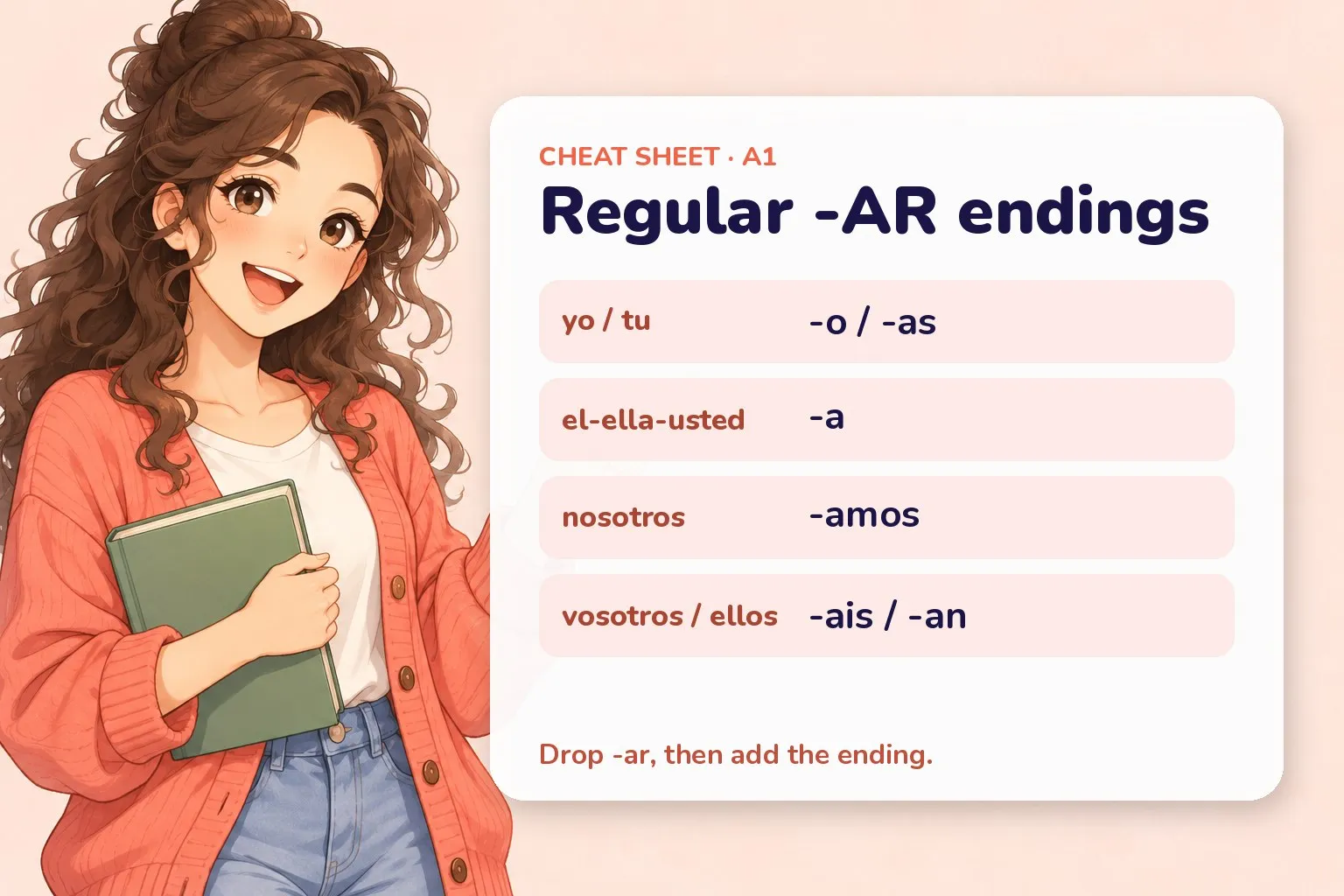
Quick recap before the quiz.
Practice
Regular -AR present practice
Try each one, then press Check. No sign-up, nothing is sent anywhere — it all runs in your browser.
Hint: estudiar, nosotros form
Show answer
estudiamos — The nosotros ending for -AR verbs is -amos: estudiamos.
3 Build: 'They travel to Spain.'
Show answer
ellos viajan a España — Ellos viajan a España — viajar takes -an for ellos.
4 Match each subject with its -AR ending.
- yo
- tú
- nosotros
- ellos / ellas
Show answer
- yo → -o
- tú → -as
- nosotros → -amos
- ellos / ellas → -an
The present -AR endings are -o, -as, -a, -amos, -áis, -an.
Hint: the vosotros form of hablar
Show answer
habláis — The vosotros -AR form carries an accent: habláis.
Quiz
Regular -AR present quiz
12 questions · pick an answer and you'll see straight away if it's right.
-
Show answer
Drop -ar and add -o/-as/-a/-amos/-áis/-an — Drop -ar to get the stem, then add the matching ending.
-
Show answer
trabajo — yo takes -o: trabajo.
-
Show answer
Tú hablas muy rápido — tú takes -as: hablas.
-
Show answer
-amos — It is -amos: hablamos, estudiamos.
-
Show answer
habláis — The accent falls on the a: habláis.
-
Show answer
Ella trabaja en un banco — él/ella/usted takes -a: trabaja.
-
Show answer
I speak / I am speaking / I do speak Spanish — One Spanish present covers all three English present ideas.
-
Show answer
Yo hablar inglés — Never keep the infinitive after a subject: it should be yo hablo inglés.
-
Show answer
cantan — ellos takes -an: cantan.
-
Show answer
The ending already shows the subject — The -o ending shows 'I', so yo is optional.
-
Show answer
-o, same as -AR — The yo form is -o for -AR, -ER and -IR alike: hablo, como, vivo.
-
Show answer
Nosotros tomamos café — nosotros takes -amos: tomamos.
Recap cheat-sheet
| Person | Ending | hablar |
|---|---|---|
| yo / tú | -o / -as | hablo / hablas |
| él-ella-usted | -a | habla |
| nosotros | -amos | hablamos |
| vosotros / ellos | -áis / -an | habláis / hablan |
Next
- Start from the people: Subject pronouns in Spanish
- Compare the two irregular “to be” verbs: the verb ser and estar in the present
- Back to the Spanish grammar section
- New here? Start with Start Learning Spanish Here
All Spanish grammar topics
Every grammar point in order, from your first sentence to advanced structures. Pick one and go straight to it. New lessons go live every day, so topics marked Coming soon fill in over the next weeks.
Grammar path
A1 31 topics · 12 ready
- 01 Noun Gender in Spanish (Masculine & Feminine)
- 02 Forming Plurals in Spanish
- 03 Definite Articles: el, la, los, las
- 04 Indefinite Articles: un, una, unos, unas
- 05 Subject Pronouns (yo, tú, él, nosotros)
- 06 The Verb Ser (Permanent 'To Be')
- 07 The Verb Estar (States & Location)
- 08 Ser vs Estar: When to Use Each
- 09 Hay: There Is / There Are
- 10 Present Tense: Regular -AR Verbs You are here
- 11 Present Tense: Regular -ER Verbs
- 12 Present Tense: Regular -IR Verbs
- 13 The Verb Tener (To Have) and Expressions Coming soon
- 14 The Verb Ir (To Go) and Ir A + Infinitive Coming soon
- 15 Gustar: Expressing Likes Coming soon
- 16 Adjective Agreement (Gender & Number) Coming soon
- 17 Position of Adjectives in Spanish Coming soon
- 18 Possessive Adjectives (mi, tu, su, nuestro) Coming soon
- 19 Demonstratives: este, ese, aquel Coming soon
- 20 Question Words (qué, quién, dónde, cómo) Coming soon
- 21 Negation: no and Double Negatives Coming soon
- 22 Contractions: al (a + el) and del (de + el) Coming soon
- 23 Muy vs Mucho Coming soon
- 24 Stem-Changing Verbs e→ie (querer, pensar) Coming soon
- 25 Stem-Changing Verbs o→ue (poder, dormir) Coming soon
- 26 Reflexive Verbs (levantarse, ducharse) Coming soon
- 27 Present Progressive (estar + gerundio) Coming soon
- 28 Tener Que + Infinitive (Obligation) Coming soon
- 29 The Personal A (direct object people) Coming soon
- 30 Prepositions a, en, de (Core Uses) Coming soon
- 31 Weather Expressions with Hacer Coming soon
A2 25 topics
- 32 Preterite Tense: Regular Verbs Coming soon
- 33 Preterite: Irregular Verbs (ser, ir, tener) Coming soon
- 34 Imperfect Tense (Ongoing & Habitual Past) Coming soon
- 35 Preterite vs Imperfect: Which Past Tense? Coming soon
- 36 Near Future: Ir A + Infinitive Coming soon
- 37 Direct Object Pronouns (lo, la, los, las) Coming soon
- 38 Indirect Object Pronouns (me, te, le, nos) Coming soon
- 39 Double Object Pronouns (se lo, me lo) Coming soon
- 40 Comparatives (más que, menos que) Coming soon
- 41 Superlatives (el más, -ísimo) Coming soon
- 42 Stressed Possessives (el mío, la tuya) Coming soon
- 43 Saber vs Conocer (Two Ways to 'Know') Coming soon
- 44 Por vs Para: The Basics Coming soon
- 45 Verbs Like Gustar (encantar, molestar, doler) Coming soon
- 46 Informal Commands (tú affirmative) Coming soon
- 47 Hace / Desde Hace for Time Expressions Coming soon
- 48 Acabar De + Infinitive (Just Did) Coming soon
- 49 Stem-Changing Verbs e→i (pedir, servir) Coming soon
- 50 Hay Que + Infinitive (Impersonal Obligation) Coming soon
- 51 Deber and Deber De (Obligation & Probability) Coming soon
- 52 Prepositional Pronouns (mí, ti, conmigo) Coming soon
- 53 Pero vs Sino (But) Coming soon
- 54 También and Tampoco (Also / Neither) Coming soon
- 55 Indefinite Pronouns (alguien, algo, cualquiera) Coming soon
- 56 Apocopation (buen, gran, primer, san) Coming soon
B1 25 topics
- 57 Simple Future Tense (hablaré) Coming soon
- 58 Conditional Tense (hablaría) Coming soon
- 59 Present Subjunctive: Formation Coming soon
- 60 Subjunctive for Wishes & Emotions (querer que) Coming soon
- 61 Subjunctive After Impersonal Expressions Coming soon
- 62 Formal & Negative Commands (usted, no hagas) Coming soon
- 63 Present Perfect (he hablado) Coming soon
- 64 Past Participles (Regular & Irregular) Coming soon
- 65 Pluperfect (había hablado) Coming soon
- 66 Por vs Para: Advanced Uses Coming soon
- 67 Relative Pronouns (que, quien, el que) Coming soon
- 68 Passive Se and Impersonal Se Coming soon
- 69 Comparisons of Equality (tan, tanto como) Coming soon
- 70 Pronoun Placement with Infinitives & Gerunds Coming soon
- 71 Si Clauses Type 1 (Real Conditions) Coming soon
- 72 Uses of the Gerund (-ando / -iendo) Coming soon
- 73 Lo + Adjective and Lo Que (Neuter Lo) Coming soon
- 74 Adverbs Ending in -mente Coming soon
- 75 Subjunctive After cuando & Time Conjunctions Coming soon
- 76 Verbs of Becoming (ponerse, volverse, hacerse) Coming soon
- 77 Quedar and Quedarse (Multiple Meanings) Coming soon
- 78 Al + Infinitive and Infinitive as Noun Coming soon
- 79 Antes de / Después de + Infinitive Coming soon
- 80 Más de / Menos de with Numbers Coming soon
- 81 Porque, Por Qué, Porqué, Por Que Coming soon
B2 18 topics
- 82 Imperfect Subjunctive (hablara / hablase) Coming soon
- 83 Si Clauses Type 2 (Unreal Present) Coming soon
- 84 Subjunctive in Adjective Clauses Coming soon
- 85 Subjunctive After Conjunctions (para que, aunque) Coming soon
- 86 Present Perfect Subjunctive (haya hablado) Coming soon
- 87 Future Perfect (habré hablado) Coming soon
- 88 Conditional Perfect (habría hablado) Coming soon
- 89 Passive Voice with Ser (ser + participle) Coming soon
- 90 Reported Speech (estilo indirecto) Coming soon
- 91 Advanced Relatives (cuyo, el cual, donde) Coming soon
- 92 Verbal Periphrases (seguir/llevar + gerundio) Coming soon
- 93 Indicative vs Subjunctive in Noun Clauses Coming soon
- 94 Aunque: Indicative vs Subjunctive Coming soon
- 95 Ojalá, Quizás, Tal Vez + Subjunctive Coming soon
- 96 Diminutives and Augmentatives (-ito, -ón) Coming soon
- 97 Future & Conditional of Probability (Conjecture) Coming soon
- 98 Relative Superlative & de + Group Coming soon
- 99 Adjectives That Change Meaning with Ser/Estar Coming soon
C1 11 topics
- 100 Pluperfect Subjunctive (hubiera hablado) Coming soon
- 101 Si Clauses Type 3 & Mixed (Unreal Past) Coming soon
- 102 Sequence of Tenses (correlación de tiempos) Coming soon
- 103 All Uses of Se (reflexive, passive, impersonal, accidental) Coming soon
- 104 Future Subjunctive (hablare) — Literary/Legal Coming soon
- 105 Discourse Connectors (sin embargo, por lo tanto) Coming soon
- 106 Subjunctive Nuance (perception, comunicación verbs) Coming soon
- 107 Ser/Estar + Participle & Resultant States Coming soon
- 108 Nominalisation & Register (Formal Spanish) Coming soon
- 109 Advanced Concession (por más que, a pesar de) Coming soon
- 110 Modal & Aspectual Periphrases (deber de, acabar por) Coming soon