Forming Plurals in Spanish
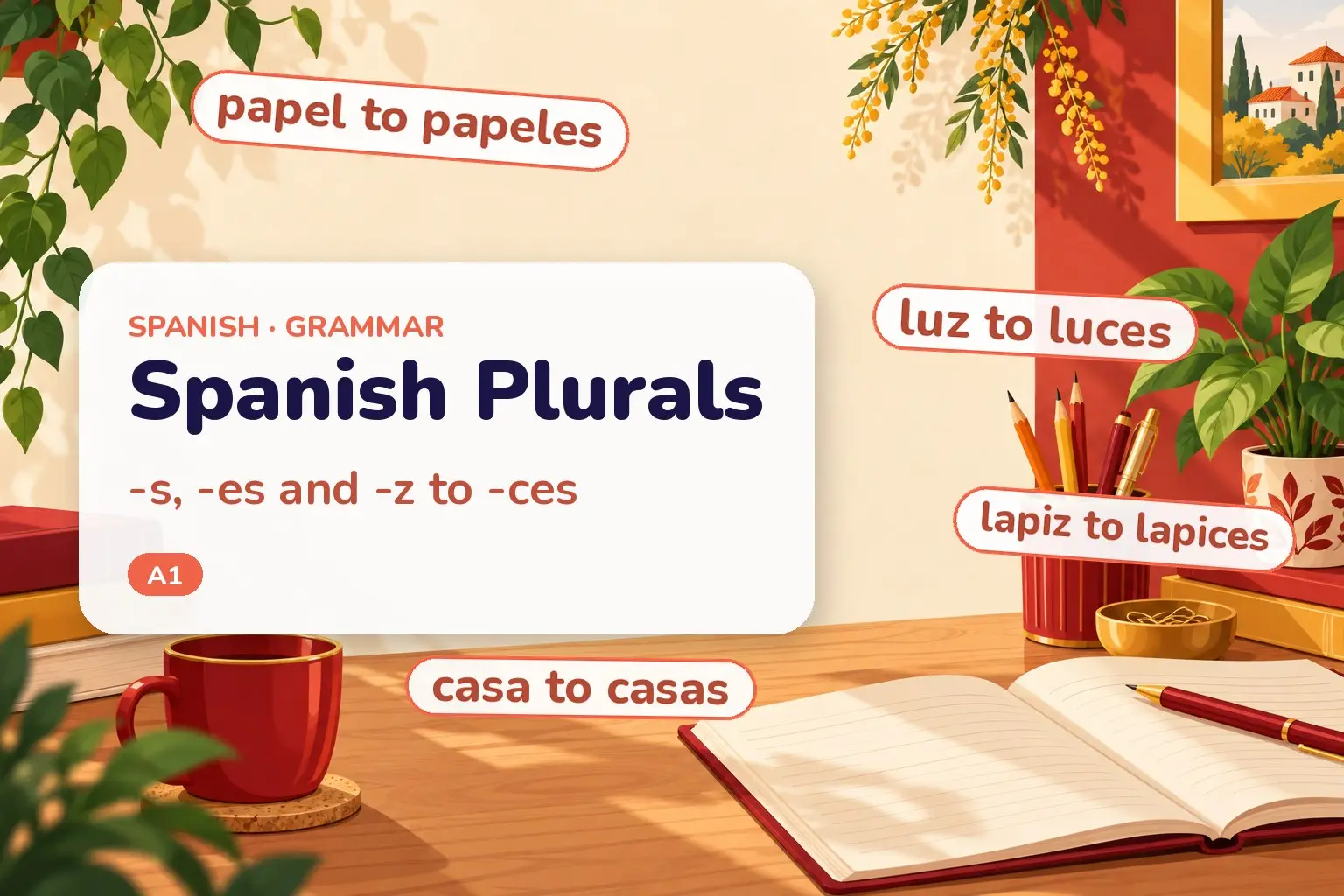
Most Spanish nouns add -s after a vowel (casa to casas) and -es after a consonant (papel to papeles). A final -z changes to -c first: lapiz becomes lapices.
Level: A1. This page shows you how to turn one Spanish noun into many — the three patterns, the spelling changes that trip people up, and where the written accent moves.
The rule
A noun is a naming word (a person, thing or idea). To make it plural — more than one — Spanish looks at the last letter of the singular word.
- Ends in an unstressed vowel (a, e, o) or a stressed -e: add -s. casa to casas, calle to calles, café to cafés.
- Ends in a consonant: add -es. papel to papeles, ciudad to ciudades, profesor to profesores.
- Ends in -z: change the z to c and add -es. lápiz to lápices, luz to luces. The sound stays the same; only the spelling follows the Spanish rule that c (not z) is written before e.
Two smaller patterns round this out. Words stressed on a final -í or -ú usually add -es in careful writing (rubí to rubíes, though rubís is also accepted). Words that already end in -s and are not stressed on the last syllable do not change at all (el lunes to los lunes).
Plural forms
| Singular | Plural | Rule |
|---|---|---|
| casa | casas | ends in a vowel, add -s |
| café | cafés | stressed final -e, add -s |
| papel | papeles | ends in a consonant, add -es |
| ciudad | ciudades | ends in a consonant, add -es |
| lápiz | lápices | final -z becomes -c, add -es |
| luz | luces | final -z becomes -c, add -es |
| canción | canciones | add -es and drop the written accent |
| examen | exámenes | add -es and add a written accent |
| rubí | rubíes | stressed final -í, add -es |
| lunes | lunes | unstressed word ending in -s, no change |
Example sentences
Each sentence was written for this lesson so the plural pattern is clear.
- Las casas son grandes.The houses are big.casa to casas, vowel ending
- Tengo dos gatos.I have two cats.
- Los libros están en la mesa.The books are on the table.
- Compré tres papeles.I bought three sheets of paper.papel to papeles, consonant ending
- Las ciudades españolas son bonitas.The Spanish cities are pretty.
- Los profesores son muy amables.The teachers are very kind.
- Necesito unos lápices nuevos.I need some new pencils.lápiz to lápices, z becomes c
- Las luces están encendidas.The lights are on.luz to luces
- Cantamos muchas canciones.We sing many songs.canción to canciones, the accent disappears
- Hay dos exámenes esta semana.There are two exams this week.examen to exámenes, an accent is added
- Los jóvenes juegan en el parque.The young people are playing in the park.joven to jóvenes
- Mis hermanos viven en Madrid.My brothers live in Madrid.
- Las flores huelen muy bien.The flowers smell lovely.
- Los lunes voy al gimnasio.On Mondays I go to the gym.lunes stays lunes, no change
- Los autobuses llegan tarde.The buses are arriving late.autobús to autobuses, accent dropped
- Tienen varios clubes de fútbol.They have several football clubs.club to clubes
- Las manos están frías.My hands are cold.
- Comemos muchas frutas por la mañana.We eat a lot of fruit in the morning.
Common mistakes
- ❌ lápizs → ✅ lápices. Never just add -s to a word ending in -z; swap the z for c and add -es.
- ❌ cafeses → ✅ cafés. A word ending in a stressed vowel like café only takes -s, not -es.
- ❌ canciónes → ✅ canciones. Once the word grows a syllable, the stress is regular again, so the written accent is dropped.
- ❌ los luneses → ✅ los lunes. Days like lunes and words like la crisis already end in -s and do not change.
- ❌ las exámenes → ✅ los exámenes. Making a noun plural never changes its gender; examen is masculine, so the article stays los.
A short conversation
— ¿Cuántos lápices necesitas? (How many pencils do you need?) — Dos lápices y tres papeles, por favor. (Two pencils and three sheets of paper, please.) — ¿Y las luces del salón? (And the living-room lights?) — Las luces ya están encendidas. (The lights are already on.)
Usage notes
- Agreement. The article and any adjective match the plural noun: el coche rojo becomes los coches rojos.
- Mixed groups. A group with any masculine member takes the masculine plural: two sisters and one brother are los hermanos.
- Plural-only nouns. Some words are normally plural: las gafas (glasses), las vacaciones (holidays), los pantalones (trousers).
- Surnames don’t change. Family names stay the same: los García, los Pérez.
Compared with…
- Definite articles change for number too: el / la become los / las. Get the plural noun and its article moving together. See definite articles in Spanish.
- Builds on noun gender, since the article and adjective endings depend on it: review noun gender.
How to say it
Spanish spelling tells you the sound, once you know three habits English speakers miss:
- c before e or i (in luces, lápices, ciudades) is a soft sound: “th” as in think in most of Spain, and “s” in Latin America. It is never the hard “k” of casa.
- j and g before e/i (as in jóvenes) is a strong breathy “h”, further back than the English h.
- The written accent (café, canción) does not change the vowel — it only shows which syllable you push harder.
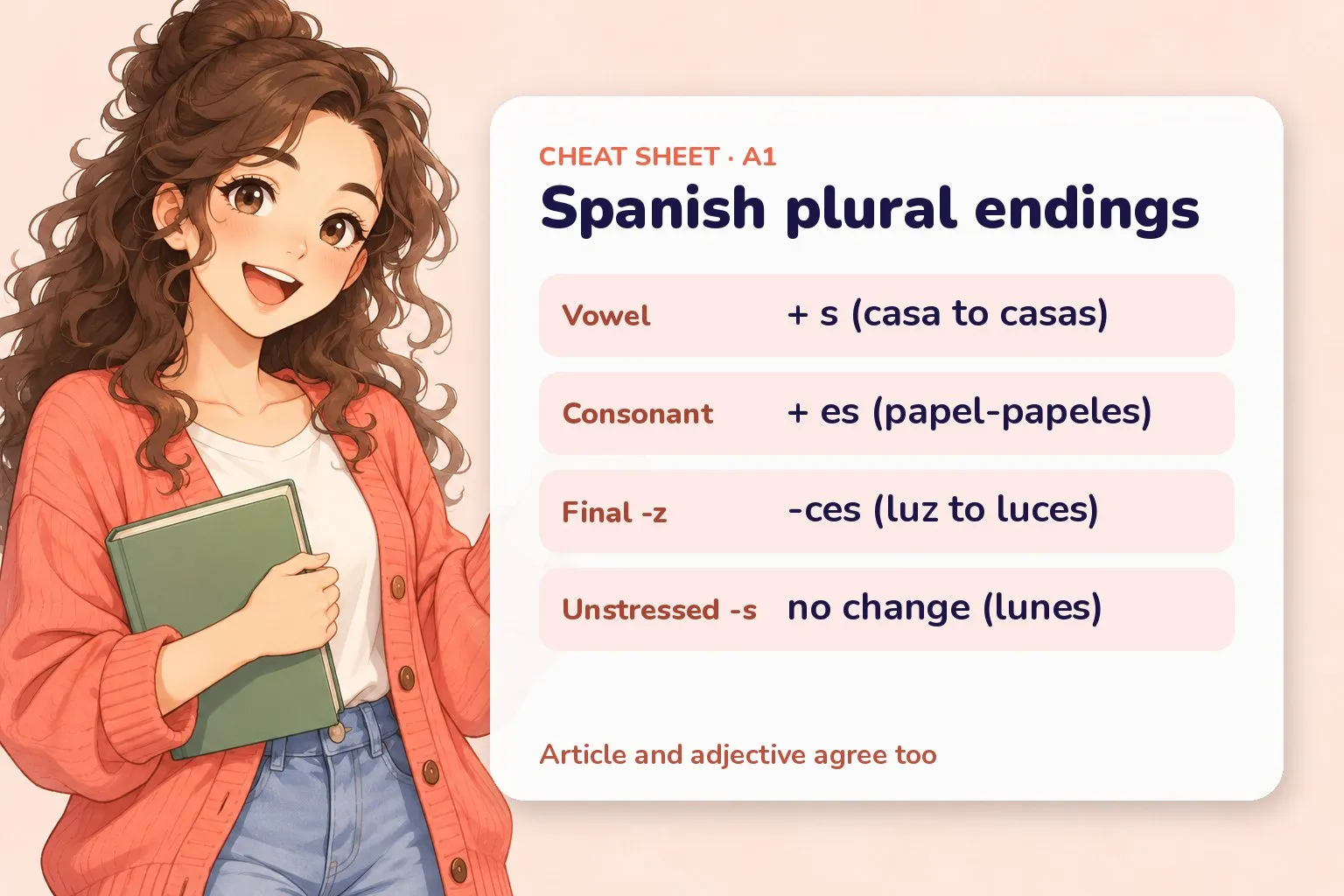
Quick recap before the quiz.
Practice
Spanish plurals practice
Try each one, then press Check. No sign-up, nothing is sent anywhere — it all runs in your browser.
Hint: The z becomes c.
Show answer
lápices — A final -z changes to -c and takes -es: lápices.
3 Put the words in order: 'The lights are on.'
Show answer
Las luces están encendidas — luz becomes luces; article and adjective agree in the plural.
4 Match each singular with its plural.
- casa
- ciudad
- canción
- lunes
Show answer
- casa → casas
- ciudad → ciudades
- canción → canciones
- lunes → lunes
Vowel adds -s; consonant adds -es; canción drops its accent; lunes does not change.
Quiz
Spanish plurals quiz
12 questions · pick an answer and you'll see straight away if it's right.
-
Show answer
Add -s — A vowel ending takes -s: casa → casas.
-
Show answer
ciudades — A consonant ending takes -es: ciudades.
-
Show answer
lápices — Final -z becomes -c and adds -es: lápices.
-
Show answer
canciones — Add -es and drop the written accent: canciones.
-
Show answer
exámenes — Add -es and add an accent to keep the stress: exámenes.
-
Show answer
los lunes — Unstressed words ending in -s do not change: los lunes.
-
Show answer
cafés — A stressed final -e takes only -s: cafés.
-
Show answer
los coches — el becomes los in the masculine plural: los coches.
-
Show answer
luces — Final -z becomes -c and adds -es: luces.
-
Show answer
gafas — las gafas (glasses) is normally plural, like vacaciones and pantalones.
-
Show answer
flores — A consonant ending takes -es: flores.
-
Show answer
It stays the same — The plural never changes a noun's gender; only the article and adjective show number.
Recap cheat-sheet
| Ending | Add | Example |
|---|---|---|
| Vowel (a, e, o) | -s | mesa → mesas |
| Consonant | -es | reloj → relojes |
| -z | -ces | pez → peces |
| Unstressed -s | nothing | la crisis → las crisis |
Next
- Next grammar point: definite articles in Spanish
- Back to the Spanish grammar section
- New here? Start with Start Learning Spanish Here
All Spanish grammar topics
Every grammar point in order, from your first sentence to advanced structures. Pick one and go straight to it. New lessons go live every day, so topics marked Coming soon fill in over the next weeks.
Grammar path
A1 31 topics · 2 ready
- 01 Noun Gender in Spanish (Masculine & Feminine)
- 02 Forming Plurals in Spanish You are here
- 03 Definite Articles: el, la, los, las Coming soon
- 04 Indefinite Articles: un, una, unos, unas Coming soon
- 05 Subject Pronouns (yo, tú, él, nosotros) Coming soon
- 06 The Verb Ser (Permanent 'To Be') Coming soon
- 07 The Verb Estar (States & Location) Coming soon
- 08 Ser vs Estar: When to Use Each Coming soon
- 09 Hay: There Is / There Are Coming soon
- 10 Present Tense: Regular -AR Verbs Coming soon
- 11 Present Tense: Regular -ER Verbs Coming soon
- 12 Present Tense: Regular -IR Verbs Coming soon
- 13 The Verb Tener (To Have) and Expressions Coming soon
- 14 The Verb Ir (To Go) and Ir A + Infinitive Coming soon
- 15 Gustar: Expressing Likes Coming soon
- 16 Adjective Agreement (Gender & Number) Coming soon
- 17 Position of Adjectives in Spanish Coming soon
- 18 Possessive Adjectives (mi, tu, su, nuestro) Coming soon
- 19 Demonstratives: este, ese, aquel Coming soon
- 20 Question Words (qué, quién, dónde, cómo) Coming soon
- 21 Negation: no and Double Negatives Coming soon
- 22 Contractions: al (a + el) and del (de + el) Coming soon
- 23 Muy vs Mucho Coming soon
- 24 Stem-Changing Verbs e→ie (querer, pensar) Coming soon
- 25 Stem-Changing Verbs o→ue (poder, dormir) Coming soon
- 26 Reflexive Verbs (levantarse, ducharse) Coming soon
- 27 Present Progressive (estar + gerundio) Coming soon
- 28 Tener Que + Infinitive (Obligation) Coming soon
- 29 The Personal A (direct object people) Coming soon
- 30 Prepositions a, en, de (Core Uses) Coming soon
- 31 Weather Expressions with Hacer Coming soon
A2 25 topics
- 32 Preterite Tense: Regular Verbs Coming soon
- 33 Preterite: Irregular Verbs (ser, ir, tener) Coming soon
- 34 Imperfect Tense (Ongoing & Habitual Past) Coming soon
- 35 Preterite vs Imperfect: Which Past Tense? Coming soon
- 36 Near Future: Ir A + Infinitive Coming soon
- 37 Direct Object Pronouns (lo, la, los, las) Coming soon
- 38 Indirect Object Pronouns (me, te, le, nos) Coming soon
- 39 Double Object Pronouns (se lo, me lo) Coming soon
- 40 Comparatives (más que, menos que) Coming soon
- 41 Superlatives (el más, -ísimo) Coming soon
- 42 Stressed Possessives (el mío, la tuya) Coming soon
- 43 Saber vs Conocer (Two Ways to 'Know') Coming soon
- 44 Por vs Para: The Basics Coming soon
- 45 Verbs Like Gustar (encantar, molestar, doler) Coming soon
- 46 Informal Commands (tú affirmative) Coming soon
- 47 Hace / Desde Hace for Time Expressions Coming soon
- 48 Acabar De + Infinitive (Just Did) Coming soon
- 49 Stem-Changing Verbs e→i (pedir, servir) Coming soon
- 50 Hay Que + Infinitive (Impersonal Obligation) Coming soon
- 51 Deber and Deber De (Obligation & Probability) Coming soon
- 52 Prepositional Pronouns (mí, ti, conmigo) Coming soon
- 53 Pero vs Sino (But) Coming soon
- 54 También and Tampoco (Also / Neither) Coming soon
- 55 Indefinite Pronouns (alguien, algo, cualquiera) Coming soon
- 56 Apocopation (buen, gran, primer, san) Coming soon
B1 25 topics
- 57 Simple Future Tense (hablaré) Coming soon
- 58 Conditional Tense (hablaría) Coming soon
- 59 Present Subjunctive: Formation Coming soon
- 60 Subjunctive for Wishes & Emotions (querer que) Coming soon
- 61 Subjunctive After Impersonal Expressions Coming soon
- 62 Formal & Negative Commands (usted, no hagas) Coming soon
- 63 Present Perfect (he hablado) Coming soon
- 64 Past Participles (Regular & Irregular) Coming soon
- 65 Pluperfect (había hablado) Coming soon
- 66 Por vs Para: Advanced Uses Coming soon
- 67 Relative Pronouns (que, quien, el que) Coming soon
- 68 Passive Se and Impersonal Se Coming soon
- 69 Comparisons of Equality (tan, tanto como) Coming soon
- 70 Pronoun Placement with Infinitives & Gerunds Coming soon
- 71 Si Clauses Type 1 (Real Conditions) Coming soon
- 72 Uses of the Gerund (-ando / -iendo) Coming soon
- 73 Lo + Adjective and Lo Que (Neuter Lo) Coming soon
- 74 Adverbs Ending in -mente Coming soon
- 75 Subjunctive After cuando & Time Conjunctions Coming soon
- 76 Verbs of Becoming (ponerse, volverse, hacerse) Coming soon
- 77 Quedar and Quedarse (Multiple Meanings) Coming soon
- 78 Al + Infinitive and Infinitive as Noun Coming soon
- 79 Antes de / Después de + Infinitive Coming soon
- 80 Más de / Menos de with Numbers Coming soon
- 81 Porque, Por Qué, Porqué, Por Que Coming soon
B2 18 topics
- 82 Imperfect Subjunctive (hablara / hablase) Coming soon
- 83 Si Clauses Type 2 (Unreal Present) Coming soon
- 84 Subjunctive in Adjective Clauses Coming soon
- 85 Subjunctive After Conjunctions (para que, aunque) Coming soon
- 86 Present Perfect Subjunctive (haya hablado) Coming soon
- 87 Future Perfect (habré hablado) Coming soon
- 88 Conditional Perfect (habría hablado) Coming soon
- 89 Passive Voice with Ser (ser + participle) Coming soon
- 90 Reported Speech (estilo indirecto) Coming soon
- 91 Advanced Relatives (cuyo, el cual, donde) Coming soon
- 92 Verbal Periphrases (seguir/llevar + gerundio) Coming soon
- 93 Indicative vs Subjunctive in Noun Clauses Coming soon
- 94 Aunque: Indicative vs Subjunctive Coming soon
- 95 Ojalá, Quizás, Tal Vez + Subjunctive Coming soon
- 96 Diminutives and Augmentatives (-ito, -ón) Coming soon
- 97 Future & Conditional of Probability (Conjecture) Coming soon
- 98 Relative Superlative & de + Group Coming soon
- 99 Adjectives That Change Meaning with Ser/Estar Coming soon
C1 11 topics
- 100 Pluperfect Subjunctive (hubiera hablado) Coming soon
- 101 Si Clauses Type 3 & Mixed (Unreal Past) Coming soon
- 102 Sequence of Tenses (correlación de tiempos) Coming soon
- 103 All Uses of Se (reflexive, passive, impersonal, accidental) Coming soon
- 104 Future Subjunctive (hablare) — Literary/Legal Coming soon
- 105 Discourse Connectors (sin embargo, por lo tanto) Coming soon
- 106 Subjunctive Nuance (perception, comunicación verbs) Coming soon
- 107 Ser/Estar + Participle & Resultant States Coming soon
- 108 Nominalisation & Register (Formal Spanish) Coming soon
- 109 Advanced Concession (por más que, a pesar de) Coming soon
- 110 Modal & Aspectual Periphrases (deber de, acabar por) Coming soon