Spanish Negation: no and Double Negatives
To make a Spanish sentence negative, put no directly before the verb: No hablo inglés ('I do not speak English'). When a negative word like nada or nadie comes after the verb, Spanish keeps the no too, so No veo nada means 'I see nothing'.
Level: A1. Saying “no” in Spanish is wonderfully simple at first — one little word in one fixed place — and then one rule surprises English speakers: Spanish piles negatives on top of each other on purpose. Learn both halves and you can deny, refuse and say “never” with confidence.
The rule
To make any sentence negative, put no directly in front of the verb (the action word). Nothing separates them except an object pronoun.
- No hablo inglés. — “I do not speak English.”
- Ella no come carne. — “She does not eat meat.”
- No lo veo. — “I do not see it.” (the pronoun lo stays between no and the verb)
That is the whole of basic negation. The second rule is about negative words — nada (nothing), nunca (never), nadie (nobody), ninguno (none), tampoco (neither), jamás (never). When one of these comes after the verb, Spanish still keeps the no in front of the verb, giving two negatives in one sentence:
- No veo nada. — “I see nothing / I don’t see anything.”
- No voy nunca. — “I never go.”
Unlike English, this double negative is correct and required. It does not cancel out; both words point the same way.
Negative words and where they sit
| Word | Meaning | After the verb (needs no) | Before the verb (no dropped) |
|---|---|---|---|
| nada | nothing | No como nada. | Nada me gusta. |
| nadie | nobody | No veo a nadie. | Nadie viene. |
| nunca | never | No voy nunca. | Nunca voy. |
| jamás | never (emphatic) | No lo haré jamás. | Jamás lo haré. |
| ninguno/a | none, not any | No tengo ninguno. | Ninguno sirve. |
| tampoco | neither, not either | No viene tampoco. | Tampoco viene. |
From positive to negative
| Positive | Negative |
|---|---|
| algo (something) | nada (nothing) |
| alguien (someone) | nadie (nobody) |
| siempre (always) | nunca / jamás (never) |
| también (also) | tampoco (neither) |
| alguno (some) | ninguno (none) |
How to say it
Spanish spelling is regular; mind these few sounds in the negation words:
| Word | How to say it |
|---|---|
| no | a pure short “o”, not the English “noh” glide: “noh” kept crisp. |
| nada | both as are open “ah”: “NAH-dah”; the d is soft, almost “th”. |
| nadie | three quick syllables: “NAH-dyeh”. |
| nunca | the u is “oo”: “NOON-ka”. |
| jamás | the j is a throaty h and the stress is on the last syllable: “ha-MAS”. |
Example sentences
Each sentence was written for this lesson.
- No hablo francés.I do not speak French.no + verb
- No tengo tiempo.I do not have time.
- Ella no trabaja hoy.She is not working today.
- No lo entiendo.I do not understand it.pronoun between no and verb
- No veo nada.I see nothing.double negative
- No viene nadie.Nobody is coming.
- Nadie viene.Nobody is coming.negative before the verb, no dropped
- No voy nunca al gimnasio.I never go to the gym.
- Nunca como carne.I never eat meat.
- No hay ningún problema.There is no problem.ninguno shortens to ningún before a noun
- No conozco a nadie aquí.I do not know anyone here.
- No quiero nada más.I do not want anything more.
- Yo tampoco.Me neither.
- Ella no bebe café y yo tampoco.She does not drink coffee and neither do I.
- No lo haré jamás.I will never do it.
- No dice nada a nadie.He says nothing to anybody.several negatives all point the same way
- ¿No tienes hambre?Are you not hungry?
- Todavía no.Not yet.
- Claro que no.Of course not.
- No, gracias.No, thank you.
Common mistakes
- ❌ Como nada. for “I eat nothing” → ✅ No como nada. When the negative word follows the verb, you must keep no in front; the double negative is required.
- ❌ No nada veo. → ✅ No veo nada. Do not stack no and the negative word both before the verb; no goes before the verb, nada after it.
- ❌ No nadie viene. → ✅ No viene nadie. or Nadie viene. Either no…nadie around the verb, or nadie alone before it — not no plus nadie together up front.
- ❌ Veo a nadie. → ✅ No veo a nadie. “Nadie” as an object still needs the no and the personal a.
- ❌ No como también. → ✅ No como tampoco. In a negative sentence “also/either” becomes tampoco, never también.
A short conversation
— ¿Quieres algo de comer? (Do you want something to eat?) — No, gracias, no quiero nada. (No thanks, I don’t want anything.) — ¿Nunca comes a esta hora? (Do you never eat at this time?) — No, nunca. Y mi hermano tampoco. (No, never. And my brother neither.)
Notice no quiero nada and mi hermano tampoco — the negative words lean on the no when they follow the verb.
Usage notes
- Only object pronouns split no and the verb. Nothing else fits between them: No lo veo, No te oigo, No me gusta. The subject, if stated, comes before no: Yo no lo sé.
- Several negatives can share one sentence. No le digo nada a nadie nunca (“I never say anything to anybody”) is natural; every word simply reinforces the negation.
- ninguno shortens before a masculine noun. Ninguno becomes ningún: No tengo ningún libro (“I have no book”). It is almost always singular: say ningún problema, not ningunos problemas.
- Short answers drop the verb. “No” alone answers a yes/no question, and set phrases like todavía no (“not yet”), ahora no (“not now”) and claro que no (“of course not”) are everyday replies.
Compared with…
- Question words such as qué, quién and dónde are not negatives — they ask, they do not deny. Compare ¿Qué quieres? (“What do you want?”) with its negative answer No quiero nada (“I want nothing”). Keep the two systems apart: to ask, use the Spanish question words; to deny, use no plus the negative words above. Build the verbs you negate with the regular -AR present, and start from the people with the subject pronouns.
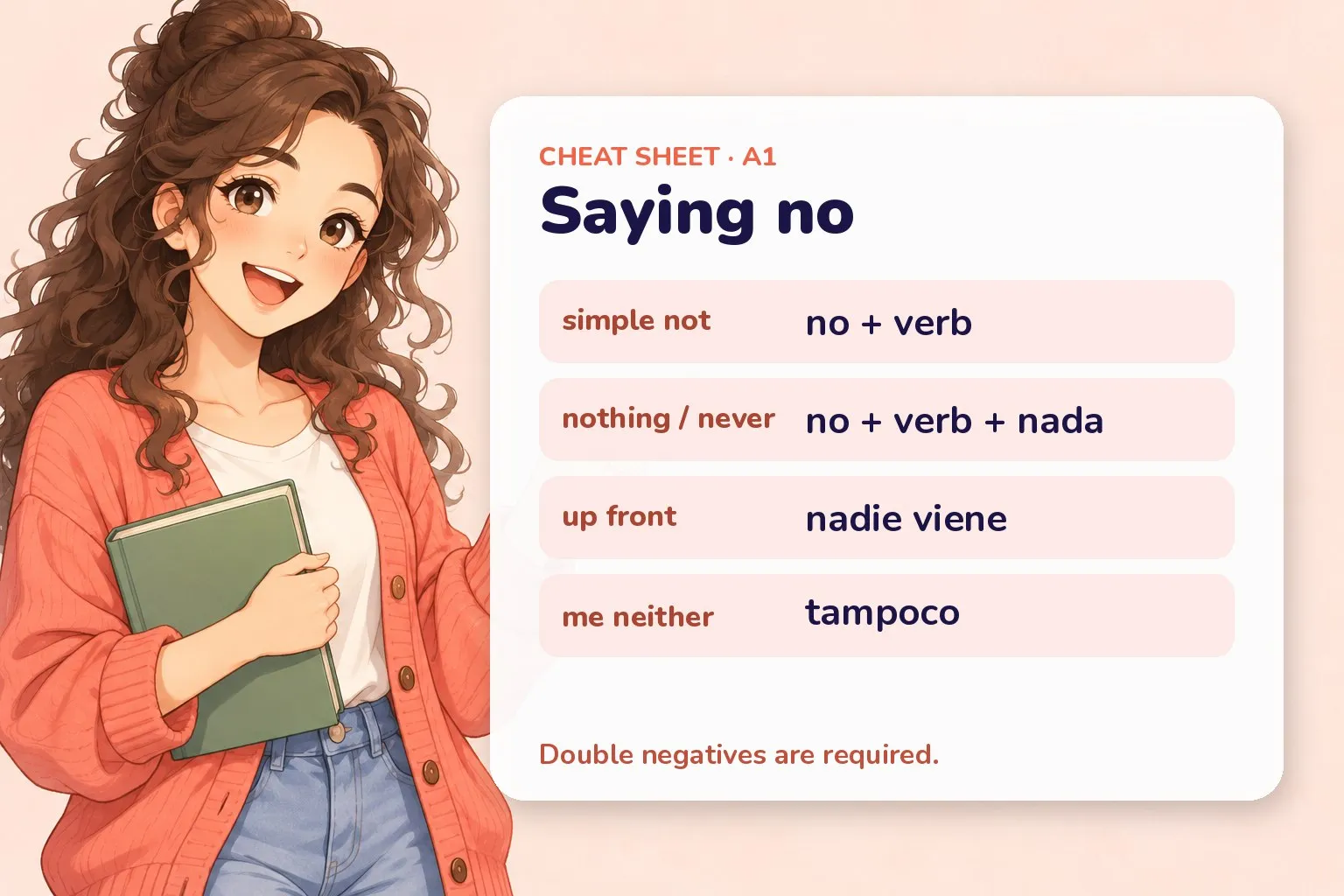
Quick recap before the quiz.
Practice
Spanish negation practice
Try each one, then press Check. No sign-up, nothing is sent anywhere — it all runs in your browser.
Hint: the word before the verb
Show answer
No — A negative word after the verb still needs no in front: No veo nada.
4 Build: 'I never eat meat.'
Show answer
no como nunca carne — No como nunca carne — no before the verb, nunca after it.
5 Match each positive word to its negative.
- algo
- alguien
- siempre
- también
Show answer
- algo → nada
- alguien → nadie
- siempre → nunca
- también → tampoco
Each positive word has a fixed negative partner.
Hint: the negative of también
Show answer
tampoco — In a negative context 'also/either' is tampoco: Yo tampoco.
Quiz
Spanish negation quiz
12 questions · pick an answer and you'll see straight away if it's right.
-
Show answer
put no directly before the verb — Place no in front of the verb: No hablo inglés.
-
Show answer
only an object pronoun — Only an object pronoun fits: No lo veo.
-
Show answer
No veo nada — The negative word after the verb keeps the no: No veo nada.
-
Show answer
Nadie viene — A negative before the verb drops the no: Nadie viene (or No viene nadie).
-
Show answer
required when the negative word follows the verb — It is correct and required; both words reinforce the negation.
-
Show answer
tampoco — In a negative sentence 'also/either' becomes tampoco.
-
Show answer
ningún — It shortens to ningún: No tengo ningún libro.
-
Show answer
Como nada — 'Como nada' drops the required no; it must be No como nada.
-
Show answer
a — A personal 'a' comes before a person object: No conozco a nadie.
-
Show answer
todavía no — The set phrase is todavía no.
-
Show answer
No dice nada a nadie — Several negatives share one no: No dice nada a nadie.
-
Show answer
before no — The subject comes before no: Yo no lo sé.
Recap cheat-sheet
| Want to say | Pattern | Example |
|---|---|---|
| simple “not” | no + verb | No hablo inglés |
| nothing / never | no + verb + nada/nunca | No veo nada |
| negative up front | negative word + verb | Nadie viene |
| me neither | tampoco | Yo tampoco |
Next
- Tell negatives apart from the Spanish question words
- Conjugate the verbs you negate: regular -AR present
- Start from the people: subject pronouns in Spanish
- New here? Start with Start Learning Spanish Here
All Spanish grammar topics
Every grammar point in order, from your first sentence to advanced structures. Pick one and go straight to it. New lessons go live every day, so topics marked Coming soon fill in over the next weeks.
Grammar path
A1 31 topics · 21 ready
- 01 Noun Gender in Spanish (Masculine & Feminine)
- 02 Forming Plurals in Spanish
- 03 Definite Articles: el, la, los, las
- 04 Indefinite Articles: un, una, unos, unas
- 05 Subject Pronouns (yo, tú, él, nosotros)
- 06 The Verb Ser (Permanent 'To Be')
- 07 The Verb Estar (States & Location)
- 08 Ser vs Estar: When to Use Each
- 09 Hay: There Is / There Are
- 10 Present Tense: Regular -AR Verbs
- 11 Present Tense: Regular -ER Verbs
- 12 Present Tense: Regular -IR Verbs
- 13 The Verb Tener (To Have) and Expressions
- 14 The Verb Ir (To Go) and Ir A + Infinitive
- 15 Gustar: Expressing Likes
- 16 Adjective Agreement (Gender & Number)
- 17 Position of Adjectives in Spanish
- 18 Possessive Adjectives (mi, tu, su, nuestro)
- 19 Demonstratives: este, ese, aquel
- 20 Question Words (qué, quién, dónde, cómo)
- 21 Negation: no and Double Negatives You are here
- 22 Contractions: al (a + el) and del (de + el) Coming soon
- 23 Muy vs Mucho Coming soon
- 24 Stem-Changing Verbs e→ie (querer, pensar) Coming soon
- 25 Stem-Changing Verbs o→ue (poder, dormir) Coming soon
- 26 Reflexive Verbs (levantarse, ducharse) Coming soon
- 27 Present Progressive (estar + gerundio) Coming soon
- 28 Tener Que + Infinitive (Obligation) Coming soon
- 29 The Personal A (direct object people) Coming soon
- 30 Prepositions a, en, de (Core Uses) Coming soon
- 31 Weather Expressions with Hacer Coming soon
A2 25 topics
- 32 Preterite Tense: Regular Verbs Coming soon
- 33 Preterite: Irregular Verbs (ser, ir, tener) Coming soon
- 34 Imperfect Tense (Ongoing & Habitual Past) Coming soon
- 35 Preterite vs Imperfect: Which Past Tense? Coming soon
- 36 Near Future: Ir A + Infinitive Coming soon
- 37 Direct Object Pronouns (lo, la, los, las) Coming soon
- 38 Indirect Object Pronouns (me, te, le, nos) Coming soon
- 39 Double Object Pronouns (se lo, me lo) Coming soon
- 40 Comparatives (más que, menos que) Coming soon
- 41 Superlatives (el más, -ísimo) Coming soon
- 42 Stressed Possessives (el mío, la tuya) Coming soon
- 43 Saber vs Conocer (Two Ways to 'Know') Coming soon
- 44 Por vs Para: The Basics Coming soon
- 45 Verbs Like Gustar (encantar, molestar, doler) Coming soon
- 46 Informal Commands (tú affirmative) Coming soon
- 47 Hace / Desde Hace for Time Expressions Coming soon
- 48 Acabar De + Infinitive (Just Did) Coming soon
- 49 Stem-Changing Verbs e→i (pedir, servir) Coming soon
- 50 Hay Que + Infinitive (Impersonal Obligation) Coming soon
- 51 Deber and Deber De (Obligation & Probability) Coming soon
- 52 Prepositional Pronouns (mí, ti, conmigo) Coming soon
- 53 Pero vs Sino (But) Coming soon
- 54 También and Tampoco (Also / Neither) Coming soon
- 55 Indefinite Pronouns (alguien, algo, cualquiera) Coming soon
- 56 Apocopation (buen, gran, primer, san) Coming soon
B1 25 topics
- 57 Simple Future Tense (hablaré) Coming soon
- 58 Conditional Tense (hablaría) Coming soon
- 59 Present Subjunctive: Formation Coming soon
- 60 Subjunctive for Wishes & Emotions (querer que) Coming soon
- 61 Subjunctive After Impersonal Expressions Coming soon
- 62 Formal & Negative Commands (usted, no hagas) Coming soon
- 63 Present Perfect (he hablado) Coming soon
- 64 Past Participles (Regular & Irregular) Coming soon
- 65 Pluperfect (había hablado) Coming soon
- 66 Por vs Para: Advanced Uses Coming soon
- 67 Relative Pronouns (que, quien, el que) Coming soon
- 68 Passive Se and Impersonal Se Coming soon
- 69 Comparisons of Equality (tan, tanto como) Coming soon
- 70 Pronoun Placement with Infinitives & Gerunds Coming soon
- 71 Si Clauses Type 1 (Real Conditions) Coming soon
- 72 Uses of the Gerund (-ando / -iendo) Coming soon
- 73 Lo + Adjective and Lo Que (Neuter Lo) Coming soon
- 74 Adverbs Ending in -mente Coming soon
- 75 Subjunctive After cuando & Time Conjunctions Coming soon
- 76 Verbs of Becoming (ponerse, volverse, hacerse) Coming soon
- 77 Quedar and Quedarse (Multiple Meanings) Coming soon
- 78 Al + Infinitive and Infinitive as Noun Coming soon
- 79 Antes de / Después de + Infinitive Coming soon
- 80 Más de / Menos de with Numbers Coming soon
- 81 Porque, Por Qué, Porqué, Por Que Coming soon
B2 18 topics
- 82 Imperfect Subjunctive (hablara / hablase) Coming soon
- 83 Si Clauses Type 2 (Unreal Present) Coming soon
- 84 Subjunctive in Adjective Clauses Coming soon
- 85 Subjunctive After Conjunctions (para que, aunque) Coming soon
- 86 Present Perfect Subjunctive (haya hablado) Coming soon
- 87 Future Perfect (habré hablado) Coming soon
- 88 Conditional Perfect (habría hablado) Coming soon
- 89 Passive Voice with Ser (ser + participle) Coming soon
- 90 Reported Speech (estilo indirecto) Coming soon
- 91 Advanced Relatives (cuyo, el cual, donde) Coming soon
- 92 Verbal Periphrases (seguir/llevar + gerundio) Coming soon
- 93 Indicative vs Subjunctive in Noun Clauses Coming soon
- 94 Aunque: Indicative vs Subjunctive Coming soon
- 95 Ojalá, Quizás, Tal Vez + Subjunctive Coming soon
- 96 Diminutives and Augmentatives (-ito, -ón) Coming soon
- 97 Future & Conditional of Probability (Conjecture) Coming soon
- 98 Relative Superlative & de + Group Coming soon
- 99 Adjectives That Change Meaning with Ser/Estar Coming soon
C1 11 topics
- 100 Pluperfect Subjunctive (hubiera hablado) Coming soon
- 101 Si Clauses Type 3 & Mixed (Unreal Past) Coming soon
- 102 Sequence of Tenses (correlación de tiempos) Coming soon
- 103 All Uses of Se (reflexive, passive, impersonal, accidental) Coming soon
- 104 Future Subjunctive (hablare) — Literary/Legal Coming soon
- 105 Discourse Connectors (sin embargo, por lo tanto) Coming soon
- 106 Subjunctive Nuance (perception, comunicación verbs) Coming soon
- 107 Ser/Estar + Participle & Resultant States Coming soon
- 108 Nominalisation & Register (Formal Spanish) Coming soon
- 109 Advanced Concession (por más que, a pesar de) Coming soon
- 110 Modal & Aspectual Periphrases (deber de, acabar por) Coming soon