Dictionary Form Japanese: The Plain Verb, Explained
The dictionary form (辞書形, jishokei) is a verb's plain non-past affirmative, the shape a dictionary lists. It always ends in an -u sound: 飲む (nomu, drink), 食べる (taberu, eat), する (suru, do). You build it from the masu form by verb group.
Level: N5. (Note: the JLPT publishes no official grammar list; the level shown is the common textbook convention.) Every verb you meet in a dictionary or a textbook word list is printed in one shape, and it is not the polite one. Learning that shape properly is the step that opens casual Japanese and most of the grammar that comes after it.
The rule
Japanese verbs have two present-tense shapes, and the one dictionaries print is the plainer of them: 辞書形 (jishokei). The dictionary form is plain, non-past and affirmative. “Plain” means the everyday register you use with friends and family, not the polite one you use with strangers. “Non-past” means it covers both the present and the future. “Affirmative” means it is the positive statement, not the negative.
It is called the dictionary form because dictionaries list verbs this way: 食べる (taberu) rather than 食べます (tabemasu). Every verb in this form ends in one of nine -u sounds: う (u), く (ku), ぐ (gu), す (su), つ (tsu), ぬ (nu), ぶ (bu), む (mu) or る (ru). That ending is the giveaway.
Building it from the ます (masu) form
Most courses teach the polite form first, so this table works backwards: take the polite form you already know and strip it to the dictionary form. The group decides the rule.
| Group | ます (masu) form (reading) | Dictionary form (reading) |
|---|---|---|
| Group 1 u-verb | 書きます (kakimasu) | 書く (kaku, write) |
| Group 1 u-verb | 待ちます (machimasu) | 待つ (matsu, wait) |
| Group 1 u-verb | 飲みます (nomimasu) | 飲む (nomu, drink) |
| Group 1 u-verb | 話します (hanashimasu) | 話す (hanasu, speak) |
| Group 1 u-verb | 泳ぎます (oyogimasu) | 泳ぐ (oyogu, swim) |
| Group 1 u-verb | 遊びます (asobimasu) | 遊ぶ (asobu, play) |
| Group 1 u-verb | 死にます (shinimasu) | 死ぬ (shinu, die) |
| Group 1 u-verb | 買います (kaimasu) | 買う (kau, buy) |
| Group 1 u-verb | 帰ります (kaerimasu) | 帰る (kaeru, go home) |
| Group 2 ru-verb | 食べます (tabemasu) | 食べる (taberu, eat) |
| Group 2 ru-verb | 見ます (mimasu) | 見る (miru, see) |
| Group 2 ru-verb | 起きます (okimasu) | 起きる (okiru, get up) |
| Group 3 irregular | します (shimasu) | する (suru, do) |
| Group 3 irregular | 来ます (kimasu) | 来る (kuru, come) |
The rule underneath the table: an u-verb changes its -i stem vowel back to -u, so 書きます (kakimasu) becomes 書く (kaku) and 買います (kaimasu) becomes 買う (kau). A ru-verb simply drops ます (masu) and adds る (ru), so 食べます (tabemasu) becomes 食べる (taberu). The two irregulars are memorised: します (shimasu) and 来ます (kimasu) become する (suru) and 来る (kuru).
The four plain forms
The dictionary form is only the positive non-past corner of the plain paradigm. The other three corners are built from it, and the group decides their shape.
| Plain form | 書く (kaku, write) | 食べる (taberu, eat) | する (suru, do) |
|---|---|---|---|
| Non-past affirmative (reading) | 書く (kaku) | 食べる (taberu) | する (suru) |
| Non-past negative (reading) | 書かない (kakanai) | 食べない (tabenai) | しない (shinai) |
| Past affirmative (reading) | 書いた (kaita) | 食べた (tabeta) | した (shita) |
| Past negative (reading) | 書かなかった (kakanakatta) | 食べなかった (tabenakatta) | しなかった (shinakatta) |
Adjectives and nouns have their own plain non-past, and one detail catches almost everyone: nouns and na-adjectives take だ (da), while i-adjectives do not.
| Word | Plain non-past | Negative | Past |
|---|---|---|---|
| 高い (takai, expensive) | 高い (takai) | 高くない (takakunai) | 高かった (takakatta) |
| 静か (shizuka, quiet) | 静かだ (shizuka da) | 静かじゃない (shizuka ja nai) | 静かだった (shizuka datta) |
| 学生 (gakusei, student) | 学生だ (gakusei da) | 学生じゃない (gakusei ja nai) | 学生だった (gakusei datta) |
Example sentences
Each sentence was written for this lesson, with its reading.
- 毎朝コーヒーを飲む。Maiasa kōhī o nomu.I drink coffee every morning.Plain non-past, group 1.
- 明日、映画を見る。Ashita, eiga o miru.I will watch a film tomorrow.The same form covers the future.
- 日本語を勉強する。Nihongo o benkyō suru.I study Japanese.Irregular する (suru).
- 今日は仕事に行かない。Kyō wa shigoto ni ikanai.I am not going to work today.Plain negative of 行く (iku).
- 昨日、友達と話した。Kinō, tomodachi to hanashita.I talked with a friend yesterday.Plain past of 話す (hanasu).
- その本を読んだことがある。Sono hon o yonda koto ga aru.I have read that book.Plain past plus ことがある (koto ga aru).
- 日本に行くつもりです。Nihon ni iku tsumori desu.I intend to go to Japan.つもり (tsumori) follows the dictionary form.
- 食べる前に手を洗う。Taberu mae ni te o arau.I wash my hands before eating.前に (mae ni) follows the dictionary form.
- 漢字を書くのは難しい。Kanji o kaku no wa muzukashii.Writing kanji is difficult.The plain verb plus の (no) makes a noun phrase.
- 何を食べる?Nani o taberu?What are you eating?Casual question with no particle.
- 明日は来る?Ashita wa kuru?Are you coming tomorrow?来る (kuru) is irregular.
- 彼は来ないと思う。Kare wa konai to omou.I think he is not coming.Plain negative of 来る (kuru) is 来ない (konai).
- 時間がないから、タクシーで行く。Jikan ga nai kara, takushī de iku.There is no time, so I will go by taxi.から (kara) after a plain clause.
- このケーキはおいしい。Kono kēki wa oishii.This cake is delicious.An i-adjective needs no だ (da).
- この部屋は静かだ。Kono heya wa shizuka da.This room is quiet.A na-adjective keeps だ (da).
- 私は学生だ。Watashi wa gakusei da.I am a student.A noun takes だ (da) in the plain form.
- 学生じゃない。Gakusei ja nai.I am not a student.じゃない (ja nai) is the plain negative of だ (da).
- 一緒に行かない?Issho ni ikanai?Won't you come along?A plain negative question is a casual invitation.
- 雨が降るかもしれない。Ame ga furu kamo shirenai.It might rain.かもしれない (kamo shirenai) follows the dictionary form.
Common mistakes
- ✗ 高いだ (takai da) → ✓ 高い (takai). An i-adjective is already a complete plain predicate; only nouns and na-adjectives add だ (da).
- ✗ 食べらない (taberanai) → ✓ 食べない (tabenai). A ru-verb drops る (ru) and adds ない (nai); the -a negative belongs to u-verbs.
- ✗ 来らない (kuranai) → ✓ 来ない (konai). The irregular 来る (kuru) changes its stem in the negative.
- ✗ 学生だです (gakusei da desu) → ✓ 学生です (gakusei desu). Do not stack the plain copula on top of the polite one.
- ✗ Using the plain form with a shop assistant or a teacher you do not know → ✓ ます (masu). The plain register is for people you are close to.
A short conversation
Two friends planning tomorrow, both using the plain register.
A: 明日、何をする?(Ashita, nani o suru?) — What are you doing tomorrow? B: 友達と映画を見る。一緒に行く?(Tomodachi to eiga o miru. Issho ni iku?) — I am seeing a film with a friend. Want to come? A: いいね。何時に会う?(Ii ne. Nanji ni au?) — Nice. What time shall we meet? B: 六時に駅で。(Rokuji ni eki de.) — At the station at six.
Usage notes
Register, not rudeness. The plain form is the normal register between friends, family, classmates and close colleagues, and it is the voice of diaries, notes, tweets and newspaper headlines. It becomes rude only when it is aimed at someone who expects the polite form, such as a customer, a stranger or a teacher.
Questions without か (ka). In casual speech the question particle is often dropped and a rising intonation does the work: 明日は来る? (Ashita wa kuru?) is a question even without か (ka). Add の (no) for a softer, explanatory question: どこに行くの? (Doko ni iku no?, where are you going?).
The base of relative clauses. A plain verb can sit directly in front of a noun to describe it: 昨日買った本 (kinō katta hon, the book I bought yesterday). The polite form cannot do this, which is one reason the plain form matters early.
Explanation with んだ (nda). んだ (nda) or のだ (noda) attaches to the plain form to explain or ask for a reason: どうしたの? (Dō shita no?, what happened?). It is a conversational habit rather than a tense.
Compared with ます (masu) form
Both forms say the same thing about time; the table below sets them side by side.
| ます (masu) form | Dictionary form | |
|---|---|---|
| Register (reading) | polite | plain |
| 飲む (nomu, drink) | 飲みます (nomimasu) | 飲む (nomu) |
| 食べる (taberu, eat) | 食べます (tabemasu) | 食べる (taberu) |
| する (suru, do) | します (shimasu) | する (suru) |
| Typical setting | shop, office, first meeting | friends, family, diary |
The polite form is built from the same verb, so the two are not rivals: the masu form lesson shows the polite endings, and this page gives you the base they are built on. If you are still unsure which group a verb belongs to, work through Japanese verb groups first.
Practice
Dictionary form practice
Try each one, then press Check. No sign-up, nothing is sent anywhere — it all runs in your browser.
Hint: a u-verb that hides behind a -ru ending
Show answer
kaeru — 帰ります (kaerimasu) becomes 帰る (kaeru); despite the -ru shape it is a group 1 verb.
Hint: drop る (ru), add ない
Show answer
tabenai — 食べる (taberu) becomes 食べない (tabenai).
5 Build the sentence: 'I intend to go to Japan.'
Show answer
日本に (Nihon ni) 行く (iku) つもりです (tsumori desu) — Destination, then the dictionary form, then つもりです (tsumori desu).
6 Match each verb to its plain negative.
- 書く (kaku)
- 食べる (taberu)
- する (suru)
- 来る (kuru)
Show answer
- 書く (kaku) → 書かない (kakanai)
- 食べる (taberu) → 食べない (tabenai)
- する (suru) → しない (shinai)
- 来る (kuru) → 来ない (konai)
u-verbs take -anai, ru-verbs drop る (ru) and add ない (nai), and the two irregulars are memorised.
Quiz
Dictionary form quiz
12 questions · pick an answer and you'll see straight away if it's right.
-
Show answer
plain non-past affirmative — It is the plain, non-past, affirmative shape.
-
Show answer
an -u sound — Every ending is an -u sound: う (u), く (ku), ぐ (gu), す (su), つ (tsu), ぬ (nu), ぶ (bu), む (mu), る (ru).
-
Show answer
書く (kaku) — The -i stem vowel returns to -u.
-
Show answer
する (suru) — する (suru) is one of the two irregular verbs.
-
Show answer
来る (kuru) — 来る (kuru) is read kuru, not kiru.
-
Show answer
飲まない (nomanai) — A u-verb takes -anai: 飲まない (nomanai).
-
Show answer
食べた (tabeta) — A ru-verb adds た (ta) after dropping る (ru).
-
Show answer
高い (takai) — An i-adjective takes no だ (da) in the plain form.
-
Show answer
学生だ (gakusei da) — A noun takes だ (da) in the plain non-past.
-
Show answer
the dictionary form — つもり (tsumori) attaches to the dictionary form, as in 行くつもりです (iku tsumori desu).
-
Show answer
too casual; use ます (masu) — The plain register suits people you are close to; use the polite form otherwise.
-
Show answer
matsu — 待ちます (machimasu) becomes 待つ (matsu); -chi goes back to -tsu.
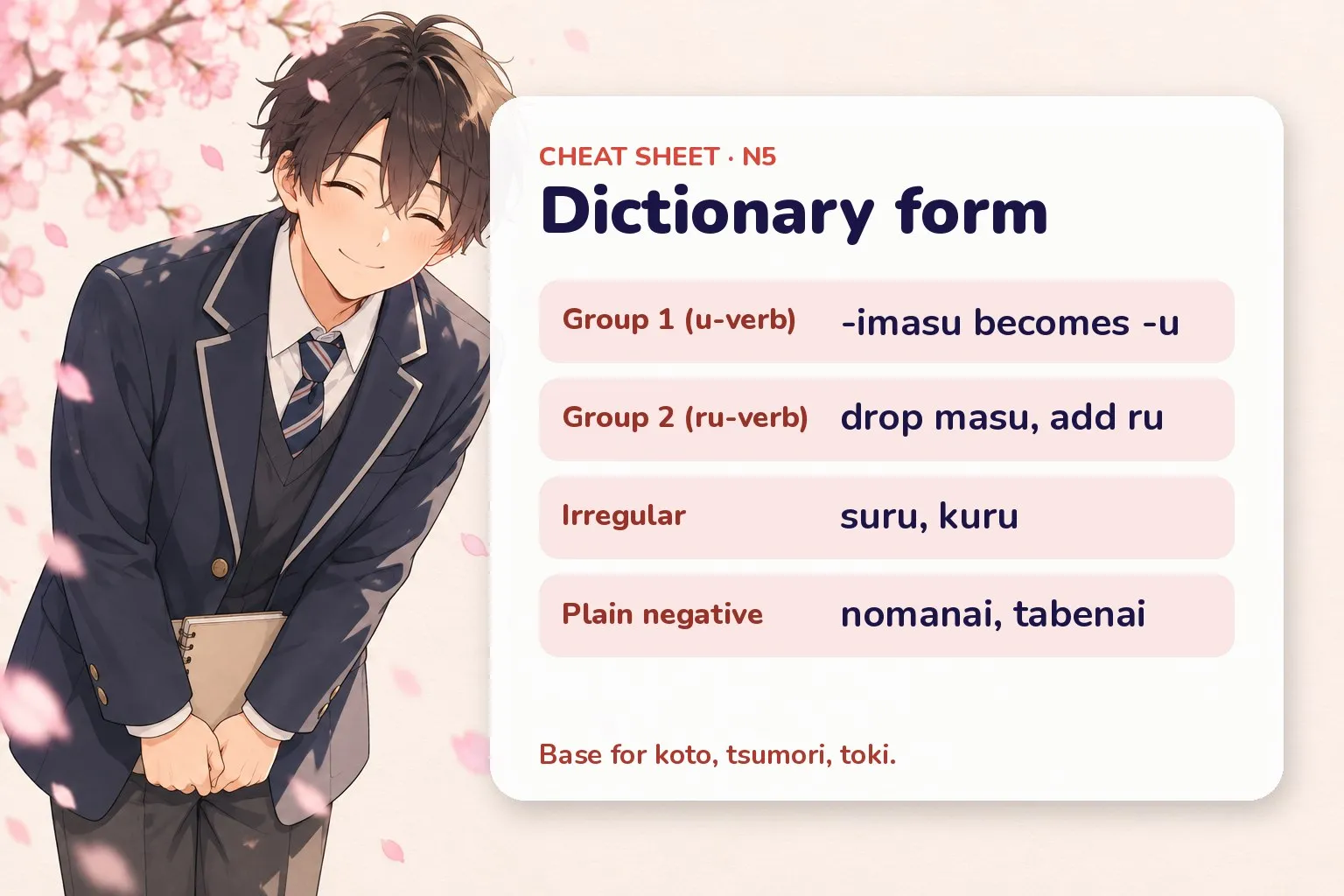
Quick recap before the quiz.
Recap cheat-sheet
| Point | Rule | Example (reading) |
|---|---|---|
| What it is | Plain non-past affirmative (reading) | 飲む (nomu, I drink) |
| Ending | Always an -u sound | 書く (kaku), 見る (miru) |
| From the polite form | u-verb: -i back to -u | 書きます to 書く (kakimasu to kaku) |
| From the polite form | ru-verb: drop ます, add る | 食べます to 食べる (tabemasu to taberu) |
| Irregulars | する (suru), 来る (kuru) | します to する (shimasu to suru) |
| Plain negative | u-verb -anai, ru-verb -nai | 飲まない (nomanai), 食べない (tabenai) |
| What follows it | こと, つもり, とき, かもしれない | 行くつもりです (iku tsumori desu) |
Next
- The polite endings built on the same verb: ます (masu) form
- Sort any verb into its group: Japanese verb groups
- The plain copula for nouns: です / だ (desu / da)
- New here? Start with Start Learning Japanese Here
All Japanese grammar topics
Every grammar point in order, from your first sentence to advanced structures. Pick one and go straight to it. New lessons go live every day, so topics marked Coming soon fill in over the next weeks.
Grammar path
N5 35 topics · 22 ready
- 01 です / だ (desu / da): The Japanese Copula
- 02 は (wa): The Topic Particle
- 03 が (ga): The Subject Particle
- 04 を (o): The Direct Object Particle
- 05 に (ni): Time, Location & Direction Particle
- 06 で (de): Place of Action & Means Particle
- 07 と (to): And / With Particle
- 08 も (mo): Also / Too Particle
- 09 の (no): Possession & Noun Linking
- 10 へ (e): Direction Particle
- 11 から / まで (kara / made): From and Until
- 12 か (ka): The Question Particle
- 13 ね (ne) and よ (yo): Sentence-Ending Particles
- 14 これ / それ / あれ (Demonstrative Pronouns)
- 15 この / その / あの (Demonstrative Adjectives)
- 16 ここ / そこ / あそこ (Here, There)
- 17 い-Adjectives: Conjugation
- 18 な-Adjectives: Conjugation
- 19 Japanese Verb Groups (る/う ru/u, irregular)
- 20 ます (masu) Form: Polite Verbs
- 21 ます (masu) Form: Past & Negative
- 22 Dictionary (Plain Non-Past) Form You are here
- 23 て (te) Form: The Connector Form Coming soon
- 24 てください (tekudasai): Making Requests Coming soon
- 25 ています (teimasu): Progressive & States Coming soon
- 26 ない (nai) Form: Plain Negative Coming soon
- 27 た (ta) Form: Plain Past Coming soon
- 28 あります / います (arimasu / imasu): Existence Coming soon
- 29 ましょう / ましょうか (mashō / mashō ka): Let's / Shall We Coming soon
- 30 たい (tai): Wanting to Do Something Coming soon
- 31 がほしい (gahoshii): Wanting a Thing Coming soon
- 32 が好き / が上手 (ga suki / ga jōzu): Likes & Skills Coming soon
- 33 Japanese Counters (枚 mai, 本 hon, 人 nin, つ tsu) Coming soon
- 34 もう (mō) and まだ (mada): Already / Still / Not Yet Coming soon
- 35 Making Adverbs (く ku and に ni Forms) Coming soon
N4 45 topics
- 36 てもいい (temoii): Giving Permission Coming soon
- 37 てはいけません (te wa ikemasen): Prohibition Coming soon
- 38 てから (tekara): After Doing Coming soon
- 39 なければならない (nakerebanaranai): Must / Have To Coming soon
- 40 なくてもいい (nakutemoii): Don't Have To Coming soon
- 41 Potential Form: Being Able To Coming soon
- 42 Volitional Form (よう / おう, yō / ō) Coming soon
- 43 つもり (tsumori): Intending To Coming soon
- 44 たら (tara): The If/When Conditional Coming soon
- 45 ば (ba): The Conditional Form Coming soon
- 46 と (to): Natural Consequence Conditional Coming soon
- 47 なら (nara): Contextual Conditional Coming soon
- 48 Transitive vs Intransitive Verb Pairs Coming soon
- 49 あげる / くれる / もらう (ageru / kureru / morau): Giving & Receiving Coming soon
- 50 ようにする / ようになる (yō ni suru / yō ni naru): Change Coming soon
- 51 ように (yō ni): So That (Purpose) Coming soon
- 52 ために (tameni): For / In Order To Coming soon
- 53 たり~たり (tari tari): Listing Actions Coming soon
- 54 ながら (nagara): While Doing (Simultaneous) Coming soon
- 55 たほうがいい (ta hō ga ii): Giving Advice Coming soon
- 56 より / ほうが (yori / hō ga): Comparisons Coming soon
- 57 そうだ (sō da): Looks Like / Hearsay Coming soon
- 58 らしい (rashii): Seems / I Heard Coming soon
- 59 ようだ / みたいだ (yō da / mitai da): Seems Like Coming soon
- 60 Plain (Casual) Form & Register Coming soon
- 61 Noun Modification (Relative Clauses) Coming soon
- 62 と思う (to omou): Expressing Thoughts Coming soon
- 63 と言う / と (to iu / to): Quotation Coming soon
- 64 という (to iu): The Name/Definition Marker Coming soon
- 65 Passive Form (受身 ukemi) Coming soon
- 66 Causative Form (使役 shieki) Coming soon
- 67 Causative-Passive (させられる saserareru) Coming soon
- 68 すぎる (sugiru): Too Much Coming soon
- 69 やすい / にくい (yasui / nikui): Easy / Hard to Do Coming soon
- 70 方 (kata): Way of Doing Coming soon
- 71 ことができる (kotogadekiru): Can / Be Able To Coming soon
- 72 たことがある (takotogaaru): Have Done Before Coming soon
- 73 前に / 後で (mae ni / atode): Before and After Coming soon
- 74 とき (toki): When (Time Clauses) Coming soon
- 75 は (wa) vs が (ga): Choosing the Right Particle Coming soon
- 76 から / ので (kara / node): Because (Reason) Coming soon
- 77 たがる (tagaru): Third Person Wants To Coming soon
- 78 ないほうがいい (nai hō ga ii): Had Better Not Coming soon
- 79 一番 / 最も (ichiban / mottomo): Superlatives Coming soon
- 80 だろう / でしょう (darō / deshō): Probably / Right? Coming soon
N3 31 topics
- 81 の / こと (no / koto): Nominalising Verbs Coming soon
- 82 Keigo: Polite Language Overview Coming soon
- 83 尊敬語 (sonkeigo): Honorific Language Coming soon
- 84 謙譲語 (kenjōgo): Humble Language Coming soon
- 85 はず (hazu): Expectation / Should Be Coming soon
- 86 べき (beki): Should (Moral/Strong) Coming soon
- 87 わけ (wake): Reason / It Means That Coming soon
- 88 ところ (tokoro): About To / In the Middle / Just Did Coming soon
- 89 たばかり (tabakari): Just Finished Coming soon
- 90 うちに (uchini): While / Before It Changes Coming soon
- 91 間 / 間に (aida / aida ni): During / While Coming soon
- 92 ようとする (yō to suru): Try To / Be About To Coming soon
- 93 てみる (temiru): Try Doing (and See) Coming soon
- 94 ことにする / ことになる (kotonisuru / kotoninaru): Decisions Coming soon
- 95 まま (mama): As It Is / Unchanged State Coming soon
- 96 ても (temo): Even If / Even Though Coming soon
- 97 のに (noni): Although / Despite (Unexpected) Coming soon
- 98 くらい / ぐらい (kurai / gurai): Approximate Extent Coming soon
- 99 ほど (hodo): Extent / The More... Coming soon
- 100 だけ / しか (dake / shika): Only Coming soon
- 101 ばかり (bakari): Only / Nothing But Coming soon
- 102 さえ / でも (sae / demo): Even Coming soon
- 103 ずに / ないで (zuni / naide): Without Doing Coming soon
- 104 について (nitsuite): About / Concerning Coming soon
- 105 に対して (ni taishite): Toward / In Contrast To Coming soon
- 106 にとって (nitotte): For / From the Viewpoint Of Coming soon
- 107 として (toshite): As / In the Role Of Coming soon
- 108 によって (niyotte): By Means Of / Depending On Coming soon
- 109 代わりに (kawari ni): Instead Of / In Return Coming soon
- 110 たびに (tabini): Every Time Coming soon
- 111 場合 (baai): In the Case Of Coming soon
N2 22 topics
- 112 ば~ほど (ba hodo): The More... The More Coming soon
- 113 Compound Verbs: 始める/出す/続ける/終わる (hajimeru/dasu/tsuzukeru/owaru) Coming soon
- 114 Compound Verbs: 切る/かねる/かける (kiru/kaneru/kakeru) Coming soon
- 115 得る / 得ない (eru / enai): Possible / Impossible Coming soon
- 116 に違いない (ni chigai nai): Must Be / No Doubt Coming soon
- 117 ばかりか / だけでなく (bakarika / dakedenaku): Not Only...But Also Coming soon
- 118 上に (ueni): In Addition / On Top Of Coming soon
- 119 反面 (hanmen): On the Other Hand Coming soon
- 120 にもかかわらず (nimokakawarazu): Despite Coming soon
- 121 くせに (kuseni): Even Though (Criticism) Coming soon
- 122 どころか (dokoroka): Far From / Let Alone Coming soon
- 123 たところで (tatokorode): Even If (Futile) Coming soon
- 124 たとたん / やいなや (tatotan / yainaya): As Soon As Coming soon
- 125 さえ~ば (sae ba): If Only / As Long As Coming soon
- 126 わけにはいかない (wake ni wa ikanai): Can't Afford To Coming soon
- 127 限り (kagiri): As Long As / As Far As Coming soon
- 128 に限り / に限って (ni kagiri / ni kagitte): Limited To / Of All Coming soon
- 129 にわたって / にかけて (niwatatte / nikakete): Over / Throughout Coming soon
- 130 を通して / を通じて (o tōshite / o tsūjite): Through / Via Coming soon
- 131 ものだ (monoda): Should / Used To / Nature Coming soon
- 132 ことだ (kotoda): Should (Advice) / Exclamation Coming soon
- 133 Keigo in Practice: Set Verb Pairs Coming soon
N1 16 topics
- 134 だに / すら (dani / sura): Even (Literary) Coming soon
- 135 ごとき / ごとく (gotoki / gotoku): Like / As If (Literary) Coming soon
- 136 といえども (toiedomo): Even Though / Although Coming soon
- 137 ざるを得ない (zaru o enai): Have No Choice But To Coming soon
- 138 べく / べからず (beku / bekarazu): In Order To / Must Not (Formal) Coming soon
- 139 が早いか (ga hayai ka): No Sooner Than Coming soon
- 140 ものなら / ようものなら (mono nara / yō mono nara): If Coming soon
- 141 とは (to wa): Definition / Surprise Coming soon
- 142 ばかりに (bakarini): Just Because (Bad Result) Coming soon
- 143 なり~なり (nari nari): Whether...Or (Choices) Coming soon
- 144 限りだ / 極まりない (kagiri da / kiwamarinai): Extremely Coming soon
- 145 をよそに / をものともせず (o yoso ni / o mono tomo sezu): Despite Coming soon
- 146 ではあるまいし (de wa arumai shi): It's Not As If Coming soon
- 147 なくして(は) / なしに (nakushite wa / nashini): Without Coming soon
- 148 たりとも~ない (taritomo nai): Not Even One Coming soon
- 149 とあって / 以来 (toatte / irai): Given That / Ever Since Coming soon