ます (masu) Form: Polite Japanese Verbs
The ます (masu) form is the polite non-past of a Japanese verb. Add ます (masu) to the verb's stem: 飲む (nomu) becomes 飲みます (nomimasu), 'I drink'. Negative ません (masen), past ました (mashita), past negative ませんでした (masen deshita).
Level: N5. (Note: the JLPT publishes no official grammar list; the level shown is the common textbook convention.) The ます (masu) form is the polite way to say what you do. It is the first verb ending most learners use, because it is safe with almost anyone — a stranger, a teacher, a shop clerk.
The rule
A Japanese verb is listed in the dictionary in its plain form, which always ends in the vowel -u: 飲む (nomu, “drink”), 食べる (taberu, “eat”), する (suru, “do”). To make it polite, you take the verb’s stem (also called the masu-stem) and add ます (masu).
How you find the stem depends on which of three groups the verb belongs to. Defining the groups fully is the job of the verb-groups lesson; here is what each group does for ます (masu):
- Group 1 (u-verbs): change the final -u sound to -i, then add ます (masu). 飲む (nomu) has the stem 飲み (nomi), so 飲みます (nomimasu). 書く (kaku) becomes 書きます (kakimasu).
- Group 2 (ru-verbs): just drop る (ru) and add ます (masu). 食べる (taberu) becomes 食べます (tabemasu); 見る (miru) becomes 見ます (mimasu).
- Group 3 (irregular): only two verbs, learned by heart. する (suru) becomes します (shimasu); 来る (kuru) becomes 来ます (kimasu).
How each group builds ます (masu)
| Group | Dictionary form | What you do | ます form |
|---|---|---|---|
| Group 1 (u-verb) | 飲む (nomu, drink) | -u to -i, add ます (masu) | 飲みます (nomimasu) |
| Group 1 (u-verb) | 書く (kaku, write) | -u to -i, add ます (masu) | 書きます (kakimasu) |
| Group 1 (u-verb) | 待つ (matsu, wait) | -u to -i, add ます (masu) | 待ちます (machimasu) |
| Group 2 (ru-verb) | 食べる (taberu, eat) | drop る (ru), add ます (masu) | 食べます (tabemasu) |
| Group 2 (ru-verb) | 見る (miru, see) | drop る (ru), add ます (masu) | 見ます (mimasu) |
| Group 3 (irregular) | する (suru, do) | memorise | します (shimasu) |
| Group 3 (irregular) | 来る (kuru, come) | memorise | 来ます (kimasu) |
The four polite endings
Once you have the stem, all four polite tenses are built on it. Using 飲む (nomu) as the model:
| Tense | Ending | Example | Reading |
|---|---|---|---|
| Non-past (“drink / will drink”) | ます | 飲みます | nomimasu |
| Negative (“don’t drink”) | ません | 飲みません | nomimasen |
| Past (“drank”) | ました | 飲みました | nomimashita |
| Past negative (“didn’t drink”) | ませんでした | 飲みませんでした | nomimasen deshita |
The ending carries both the politeness and the tense; the stem never changes. So from 食べ (tabe) you get 食べます (tabemasu), 食べません (tabemasen), 食べました (tabemashita), 食べませんでした (tabemasen deshita).
Example sentences
Each sentence was written for this lesson, with romaji.
- 私は毎日コーヒーを飲みます。Watashi wa mainichi kōhī o nomimasu.I drink coffee every day.飲む (nomu), u-verb
- 友達に手紙を書きます。Tomodachi ni tegami o kakimasu.I write a letter to my friend.書く (kaku), u-verb
- バスを待ちます。Basu o machimasu.I wait for the bus.待つ (matsu) to 待ちます
- お店で水を買います。Omise de mizu o kaimasu.I buy water at the shop.買う (kau) to 買います
- 毎朝パンを食べます。Maiasa pan o tabemasu.I eat bread every morning.食べる (taberu), ru-verb
- テレビで映画を見ます。Terebi de eiga o mimasu.I watch a movie on TV.見る (miru), ru-verb
- 毎晩日本語を勉強します。Maiban nihongo o benkyō shimasu.I study Japanese every evening.する (suru) to します
- 友達がうちに来ます。Tomodachi ga uchi ni kimasu.My friend comes to my house.来る (kuru) to 来ます
- 六時にうちへ帰ります。Rokuji ni uchi e kaerimasu.I go home at six.帰る (kaeru) is a u-verb: 帰ります
- 毎朝新聞を読みます。Maiasa shinbun o yomimasu.I read the newspaper every morning.
- お酒を飲みません。Osake o nomimasen.I don't drink alcohol.negative ません
- 朝ごはんを食べません。Asagohan o tabemasen.I don't eat breakfast.
- 昨日映画を見ました。Kinō eiga o mimashita.I watched a movie yesterday.past ました
- 今朝コーヒーを飲みました。Kesa kōhī o nomimashita.I drank coffee this morning.
- 昨日は勉強しませんでした。Kinō wa benkyō shimasen deshita.I didn't study yesterday.past negative ませんでした
- 毎日運動しますか。Mainichi undō shimasu ka.Do you exercise every day?か (ka) makes a question
- 何を飲みますか。Nani o nomimasu ka.What will you drink?
- 明日東京へ行きます。Ashita Tōkyō e ikimasu.I will go to Tokyo tomorrow.行く (iku); non-past as future
Common mistakes
- ❌ 食べります (taberimasu) → ✅ 食べます (tabemasu). 食べる (taberu) is a Group 2 ru-verb: drop る (ru), do not add an -ri.
- ❌ 見ります (mirimasu) → ✅ 見ます (mimasu). 見る (miru) is also a ru-verb, so just 見 (mi) + ます (masu).
- ❌ するます (surumasu) → ✅ します (shimasu). する (suru) is irregular; the polite form is します (shimasu).
- ❌ 来ります (kurimasu) → ✅ 来ます (kimasu). 来る (kuru) is irregular, read きます (kimasu).
- ❌ 帰ます (kaemasu) → ✅ 帰ります (kaerimasu). 帰る (kaeru) looks like a ru-verb but is a u-verb, so change -ru to -ri.
- ❌ 飲みませんだった (nomimasen datta) → ✅ 飲みませんでした (nomimasen deshita). The polite past negative is ませんでした (masen deshita).
A short conversation
— 何を飲みますか。 (Nani o nomimasu ka.) — “What would you like to drink?” — コーヒーを飲みます。 (Kōhī o nomimasu.) — “I’ll have coffee.” — 田中さんも飲みますか。 (Tanaka-san mo nomimasu ka.) — “Will you have one too, Tanaka?” — いいえ、私は飲みません。お茶をお願いします。 (Iie, watashi wa nomimasen. Ocha o onegai shimasu.) — “No, I won’t. Tea, please.”
Usage notes
- Politeness lives in the ending. The dictionary form 飲む (nomu) is plain and casual; 飲みます (nomimasu) is polite. Nothing else in the sentence has to change to switch register.
- か (ka) turns a statement into a yes/no question. 飲みます (nomimasu) becomes 飲みますか (nomimasu ka), “Do you drink?” — no change in word order, no rising intonation needed in writing.
- The stem has a life of its own. The masu-stem (飲み (nomi), 食べ (tabe)) also joins other polite patterns and compound verbs later on; getting it right now pays off well beyond ます (masu).
- ます (masu) is non-past only. For “was doing / used to”, you still build on the same stem with ました (mashita); there is no separate continuous form at this level.
Compared with…
- Plain (dictionary) form. 飲む (nomu) and 飲みます (nomimasu) mean the same thing; one is casual, one is polite. Choose by who you are talking to. The groups that decide the stem are set out in the verb-groups lesson.
- The copula です (desu). With nouns you do not use ます (masu) at all — you use です (desu): 学生です (gakusei desu), “I am a student”. Both are in the Japanese grammar section.
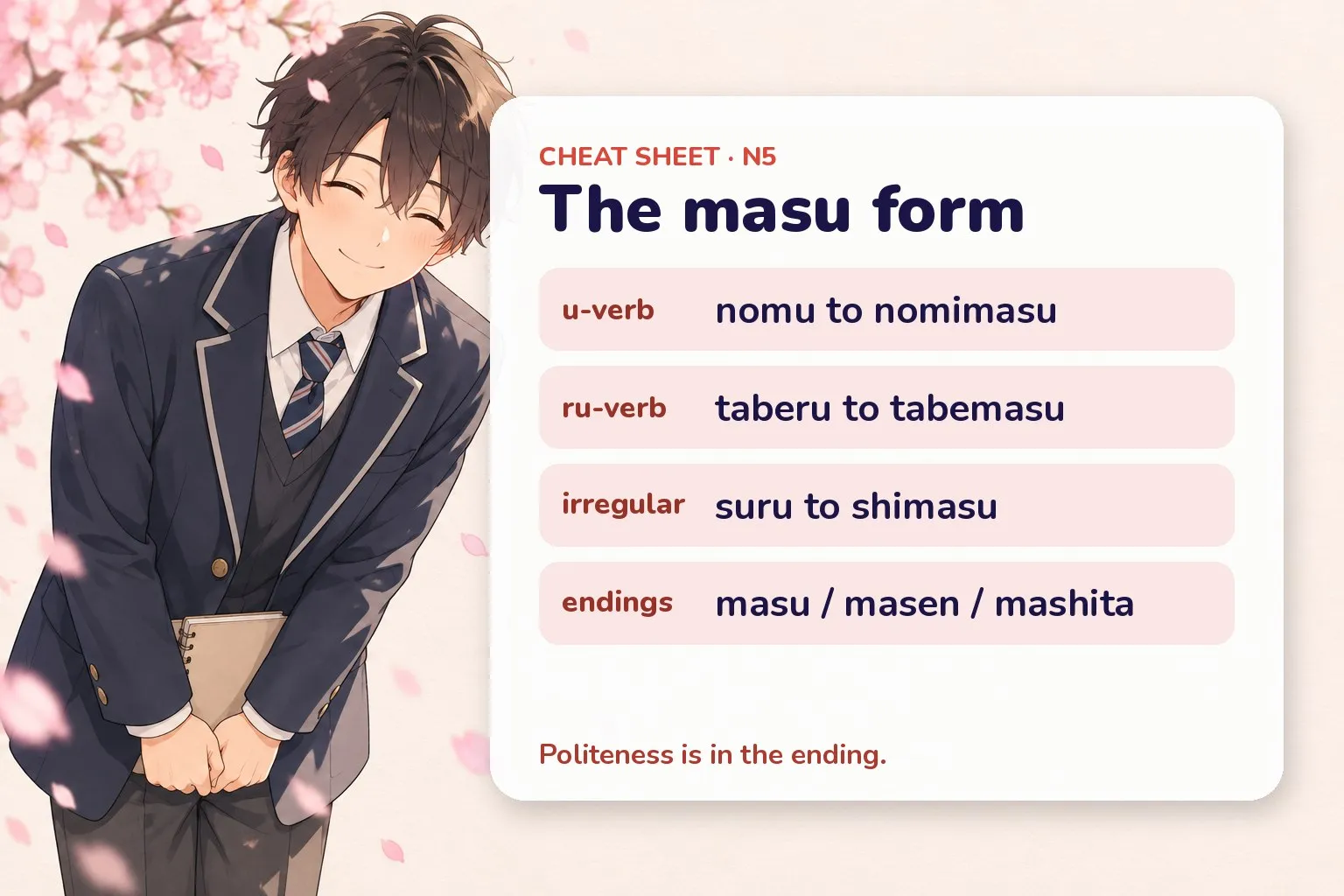
Quick recap before you practise.
Practice
Masu form practice
Try each one, then press Check. No sign-up, nothing is sent anywhere — it all runs in your browser.
Hint: irregular
Show answer
shimasu — する (suru) is irregular: します (shimasu).
4 Build: 'I drink coffee.' (polite)
Show answer
私は (watashi wa) コーヒーを (kōhī o) 飲みます (nomimasu) — Japanese order is topic + object + verb: 私はコーヒーを飲みます (watashi wa kōhī o nomimasu).
5 Match each ending to its meaning.
- ます (masu)
- ません (masen)
- ました (mashita)
- ませんでした (masen deshita)
Show answer
- ます (masu) → polite non-past
- ません (masen) → polite negative
- ました (mashita) → polite past
- ませんでした (masen deshita) → polite past negative
ます (masu) non-past, ません (masen) negative, ました (mashita) past, ませんでした (masen deshita) past negative.
Hint: ru-verb stem 見 (mi) + ました
Show answer
mimashita — 見る (miru) to 見ました (mimashita).
Quiz
Masu form quiz
12 questions · pick an answer and you'll see straight away if it's right.
-
Show answer
politeness — ます (masu) makes the verb polite; it is the polite non-past.
-
Show answer
飲みます (nomimasu) — A u-verb changes -u to -i: 飲みます (nomimasu).
-
Show answer
食べます (tabemasu) — A ru-verb drops る (ru): 食べます (tabemasu).
-
Show answer
します (shimasu) — する (suru) is irregular: します (shimasu).
-
Show answer
来ます (kimasu) — 来る (kuru) is irregular and read 来ます (kimasu).
-
Show answer
飲みません (nomimasen) — ません (masen) is the polite negative ending.
-
Show answer
食べました (tabemashita) — ました (mashita) is the polite past ending.
-
Show answer
勉強しませんでした (benkyō shimasen deshita) — ませんでした (masen deshita) is the polite past negative.
-
Show answer
帰ります (kaerimasu) — 帰る (kaeru) is a u-verb despite ending in -ru, so 帰ります (kaerimasu).
-
Show answer
add か (ka): 飲みますか — Add か (ka): 飲みますか (nomimasu ka), 'Do you drink?'
-
Show answer
I will go tomorrow — Non-past ます (masu) covers the future; 明日 (ashita) = tomorrow.
-
Show answer
machimasu — 待つ (matsu) is a u-verb: -tsu to -chi, so 待ちます (machimasu).
Recap cheat-sheet
| Group | Rule for the stem | Example | Reading |
|---|---|---|---|
| Group 1 (u-verb) | -u to -i, add ます | 飲む to 飲みます | nomu to nomimasu |
| Group 2 (ru-verb) | drop る, add ます | 食べる to 食べます | taberu to tabemasu |
| Group 3 (irregular) | memorise | する, 来る to します, 来ます | suru, kuru to shimasu, kimasu |
| Endings | tense on the stem | ます ません ました ませんでした | masu masen mashita masen deshita |
Next
- Learn how the groups are decided in Japanese verb groups
- See the noun sentence pattern with です / だ (desu / da), the copula
- New here? Start with Start Learning Japanese Here
All Japanese grammar topics
Every grammar point in order, from your first sentence to advanced structures. Pick one and go straight to it. New lessons go live every day, so topics marked Coming soon fill in over the next weeks.
Grammar path
N5 35 topics · 21 ready
- 01 です / だ (desu / da): The Japanese Copula
- 02 は (wa): The Topic Particle
- 03 が (ga): The Subject Particle
- 04 を (o): The Direct Object Particle
- 05 に (ni): Time, Location & Direction Particle
- 06 で (de): Place of Action & Means Particle
- 07 と (to): And / With Particle
- 08 も (mo): Also / Too Particle
- 09 の (no): Possession & Noun Linking
- 10 へ (e): Direction Particle
- 11 から / まで (kara / made): From and Until
- 12 か (ka): The Question Particle
- 13 ね (ne) and よ (yo): Sentence-Ending Particles
- 14 これ / それ / あれ (Demonstrative Pronouns)
- 15 この / その / あの (Demonstrative Adjectives)
- 16 ここ / そこ / あそこ (Here, There)
- 17 い-Adjectives: Conjugation
- 18 な-Adjectives: Conjugation
- 19 Japanese Verb Groups (る/う ru/u, irregular)
- 20 ます (masu) Form: Polite Verbs You are here
- 21 ます (masu) Form: Past & Negative
- 22 Dictionary (Plain Non-Past) Form Coming soon
- 23 て (te) Form: The Connector Form Coming soon
- 24 てください (tekudasai): Making Requests Coming soon
- 25 ています (teimasu): Progressive & States Coming soon
- 26 ない (nai) Form: Plain Negative Coming soon
- 27 た (ta) Form: Plain Past Coming soon
- 28 あります / います (arimasu / imasu): Existence Coming soon
- 29 ましょう / ましょうか (mashō / mashō ka): Let's / Shall We Coming soon
- 30 たい (tai): Wanting to Do Something Coming soon
- 31 がほしい (gahoshii): Wanting a Thing Coming soon
- 32 が好き / が上手 (ga suki / ga jōzu): Likes & Skills Coming soon
- 33 Japanese Counters (枚 mai, 本 hon, 人 nin, つ tsu) Coming soon
- 34 もう (mō) and まだ (mada): Already / Still / Not Yet Coming soon
- 35 Making Adverbs (く ku and に ni Forms) Coming soon
N4 45 topics
- 36 てもいい (temoii): Giving Permission Coming soon
- 37 てはいけません (te wa ikemasen): Prohibition Coming soon
- 38 てから (tekara): After Doing Coming soon
- 39 なければならない (nakerebanaranai): Must / Have To Coming soon
- 40 なくてもいい (nakutemoii): Don't Have To Coming soon
- 41 Potential Form: Being Able To Coming soon
- 42 Volitional Form (よう / おう, yō / ō) Coming soon
- 43 つもり (tsumori): Intending To Coming soon
- 44 たら (tara): The If/When Conditional Coming soon
- 45 ば (ba): The Conditional Form Coming soon
- 46 と (to): Natural Consequence Conditional Coming soon
- 47 なら (nara): Contextual Conditional Coming soon
- 48 Transitive vs Intransitive Verb Pairs Coming soon
- 49 あげる / くれる / もらう (ageru / kureru / morau): Giving & Receiving Coming soon
- 50 ようにする / ようになる (yō ni suru / yō ni naru): Change Coming soon
- 51 ように (yō ni): So That (Purpose) Coming soon
- 52 ために (tameni): For / In Order To Coming soon
- 53 たり~たり (tari tari): Listing Actions Coming soon
- 54 ながら (nagara): While Doing (Simultaneous) Coming soon
- 55 たほうがいい (ta hō ga ii): Giving Advice Coming soon
- 56 より / ほうが (yori / hō ga): Comparisons Coming soon
- 57 そうだ (sō da): Looks Like / Hearsay Coming soon
- 58 らしい (rashii): Seems / I Heard Coming soon
- 59 ようだ / みたいだ (yō da / mitai da): Seems Like Coming soon
- 60 Plain (Casual) Form & Register Coming soon
- 61 Noun Modification (Relative Clauses) Coming soon
- 62 と思う (to omou): Expressing Thoughts Coming soon
- 63 と言う / と (to iu / to): Quotation Coming soon
- 64 という (to iu): The Name/Definition Marker Coming soon
- 65 Passive Form (受身 ukemi) Coming soon
- 66 Causative Form (使役 shieki) Coming soon
- 67 Causative-Passive (させられる saserareru) Coming soon
- 68 すぎる (sugiru): Too Much Coming soon
- 69 やすい / にくい (yasui / nikui): Easy / Hard to Do Coming soon
- 70 方 (kata): Way of Doing Coming soon
- 71 ことができる (kotogadekiru): Can / Be Able To Coming soon
- 72 たことがある (takotogaaru): Have Done Before Coming soon
- 73 前に / 後で (mae ni / atode): Before and After Coming soon
- 74 とき (toki): When (Time Clauses) Coming soon
- 75 は (wa) vs が (ga): Choosing the Right Particle Coming soon
- 76 から / ので (kara / node): Because (Reason) Coming soon
- 77 たがる (tagaru): Third Person Wants To Coming soon
- 78 ないほうがいい (nai hō ga ii): Had Better Not Coming soon
- 79 一番 / 最も (ichiban / mottomo): Superlatives Coming soon
- 80 だろう / でしょう (darō / deshō): Probably / Right? Coming soon
N3 31 topics
- 81 の / こと (no / koto): Nominalising Verbs Coming soon
- 82 Keigo: Polite Language Overview Coming soon
- 83 尊敬語 (sonkeigo): Honorific Language Coming soon
- 84 謙譲語 (kenjōgo): Humble Language Coming soon
- 85 はず (hazu): Expectation / Should Be Coming soon
- 86 べき (beki): Should (Moral/Strong) Coming soon
- 87 わけ (wake): Reason / It Means That Coming soon
- 88 ところ (tokoro): About To / In the Middle / Just Did Coming soon
- 89 たばかり (tabakari): Just Finished Coming soon
- 90 うちに (uchini): While / Before It Changes Coming soon
- 91 間 / 間に (aida / aida ni): During / While Coming soon
- 92 ようとする (yō to suru): Try To / Be About To Coming soon
- 93 てみる (temiru): Try Doing (and See) Coming soon
- 94 ことにする / ことになる (kotonisuru / kotoninaru): Decisions Coming soon
- 95 まま (mama): As It Is / Unchanged State Coming soon
- 96 ても (temo): Even If / Even Though Coming soon
- 97 のに (noni): Although / Despite (Unexpected) Coming soon
- 98 くらい / ぐらい (kurai / gurai): Approximate Extent Coming soon
- 99 ほど (hodo): Extent / The More... Coming soon
- 100 だけ / しか (dake / shika): Only Coming soon
- 101 ばかり (bakari): Only / Nothing But Coming soon
- 102 さえ / でも (sae / demo): Even Coming soon
- 103 ずに / ないで (zuni / naide): Without Doing Coming soon
- 104 について (nitsuite): About / Concerning Coming soon
- 105 に対して (ni taishite): Toward / In Contrast To Coming soon
- 106 にとって (nitotte): For / From the Viewpoint Of Coming soon
- 107 として (toshite): As / In the Role Of Coming soon
- 108 によって (niyotte): By Means Of / Depending On Coming soon
- 109 代わりに (kawari ni): Instead Of / In Return Coming soon
- 110 たびに (tabini): Every Time Coming soon
- 111 場合 (baai): In the Case Of Coming soon
N2 22 topics
- 112 ば~ほど (ba hodo): The More... The More Coming soon
- 113 Compound Verbs: 始める/出す/続ける/終わる (hajimeru/dasu/tsuzukeru/owaru) Coming soon
- 114 Compound Verbs: 切る/かねる/かける (kiru/kaneru/kakeru) Coming soon
- 115 得る / 得ない (eru / enai): Possible / Impossible Coming soon
- 116 に違いない (ni chigai nai): Must Be / No Doubt Coming soon
- 117 ばかりか / だけでなく (bakarika / dakedenaku): Not Only...But Also Coming soon
- 118 上に (ueni): In Addition / On Top Of Coming soon
- 119 反面 (hanmen): On the Other Hand Coming soon
- 120 にもかかわらず (nimokakawarazu): Despite Coming soon
- 121 くせに (kuseni): Even Though (Criticism) Coming soon
- 122 どころか (dokoroka): Far From / Let Alone Coming soon
- 123 たところで (tatokorode): Even If (Futile) Coming soon
- 124 たとたん / やいなや (tatotan / yainaya): As Soon As Coming soon
- 125 さえ~ば (sae ba): If Only / As Long As Coming soon
- 126 わけにはいかない (wake ni wa ikanai): Can't Afford To Coming soon
- 127 限り (kagiri): As Long As / As Far As Coming soon
- 128 に限り / に限って (ni kagiri / ni kagitte): Limited To / Of All Coming soon
- 129 にわたって / にかけて (niwatatte / nikakete): Over / Throughout Coming soon
- 130 を通して / を通じて (o tōshite / o tsūjite): Through / Via Coming soon
- 131 ものだ (monoda): Should / Used To / Nature Coming soon
- 132 ことだ (kotoda): Should (Advice) / Exclamation Coming soon
- 133 Keigo in Practice: Set Verb Pairs Coming soon
N1 16 topics
- 134 だに / すら (dani / sura): Even (Literary) Coming soon
- 135 ごとき / ごとく (gotoki / gotoku): Like / As If (Literary) Coming soon
- 136 といえども (toiedomo): Even Though / Although Coming soon
- 137 ざるを得ない (zaru o enai): Have No Choice But To Coming soon
- 138 べく / べからず (beku / bekarazu): In Order To / Must Not (Formal) Coming soon
- 139 が早いか (ga hayai ka): No Sooner Than Coming soon
- 140 ものなら / ようものなら (mono nara / yō mono nara): If Coming soon
- 141 とは (to wa): Definition / Surprise Coming soon
- 142 ばかりに (bakarini): Just Because (Bad Result) Coming soon
- 143 なり~なり (nari nari): Whether...Or (Choices) Coming soon
- 144 限りだ / 極まりない (kagiri da / kiwamarinai): Extremely Coming soon
- 145 をよそに / をものともせず (o yoso ni / o mono tomo sezu): Despite Coming soon
- 146 ではあるまいし (de wa arumai shi): It's Not As If Coming soon
- 147 なくして(は) / なしに (nakushite wa / nashini): Without Coming soon
- 148 たりとも~ない (taritomo nai): Not Even One Coming soon
- 149 とあって / 以来 (toatte / irai): Given That / Ever Since Coming soon