Japanese Verb Groups (る/う ru/u, irregular)
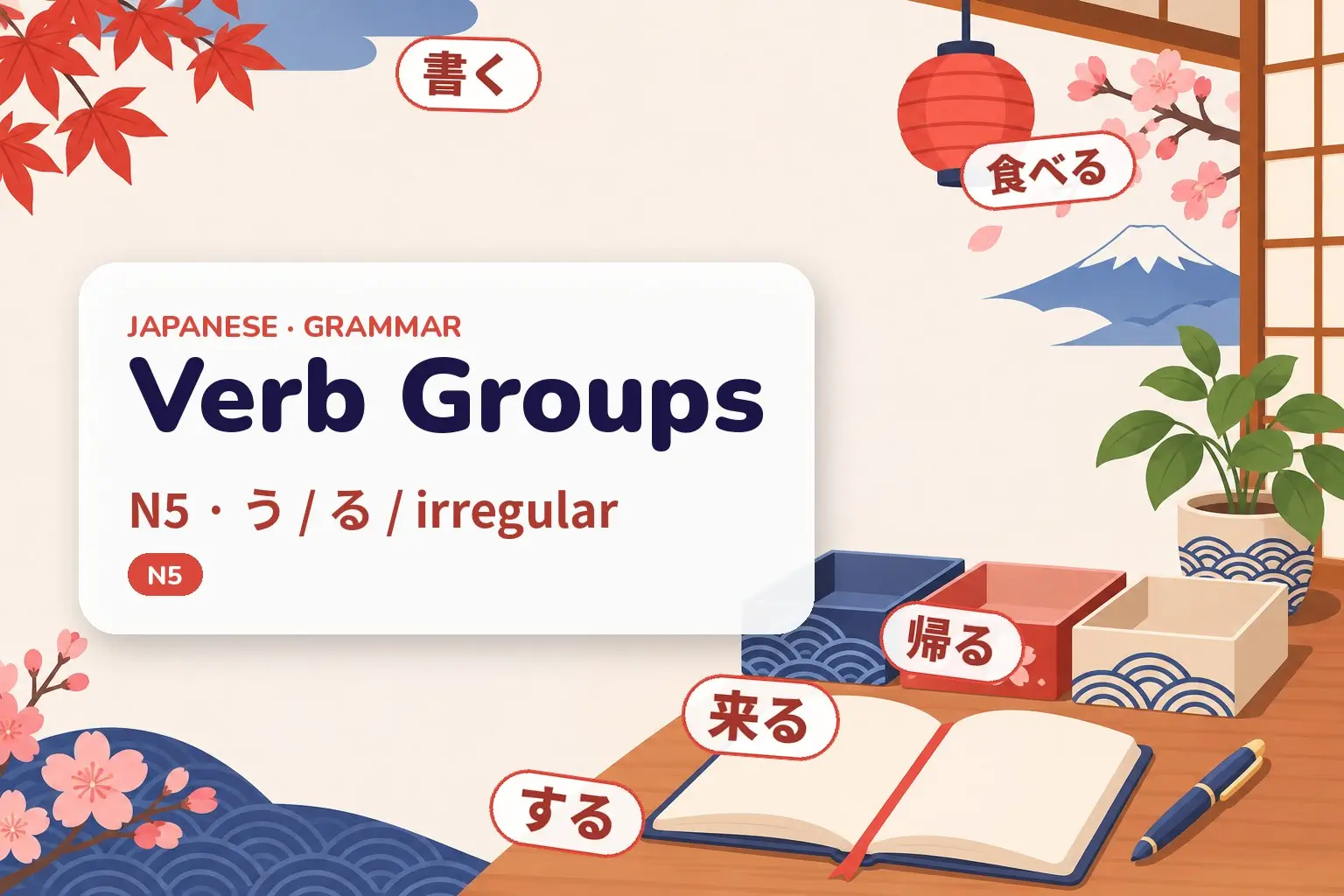
Japanese verbs split into three groups that decide how they conjugate: Group 1 (godan, う-verbs) like 書く (kaku, write), Group 2 (ichidan, る-verbs) like 食べる (taberu, eat), and the two irregulars する (suru, do) and 来る (kuru, come). Learn a verb's group once and every form follows.
Level: N5. JLPT publishes no official grammar list; level is the common textbook convention. Before you can make the polite ます (masu) form, the connecting て (te) form or the negative ない (nai) form, you have to know which group a verb belongs to. Every verb falls into one of three, and the group decides how it bends.
The rule
A Japanese verb’s group is a fixed label that tells you how to conjugate it. There are three.
Group 2 (ichidan, 一段 (ichidan), the “る (ru)-verbs”). The dictionary form ends in る (ru), and the sound just before る (ru) is -e or -i: 食べる (taberu, to eat), 見る (miru, to see), 起きる (okiru, to get up), 教える (oshieru, to teach). To conjugate, you simply drop る (ru) and add the ending. They are the easy group.
Group 1 (godan, 五段 (godan), the “う (u)-verbs”). Everything else. The dictionary form ends in one of the u-sound kana — う (u), く (ku), ぐ (gu), す (su), つ (tsu), ぬ (nu), ぶ (bu), む (mu) or る (ru): 書く (kaku, to write), 飲む (nomu, to drink), 話す (hanasu, to speak), 買う (kau, to buy), 待つ (matsu, to wait). To conjugate, you change that final kana to another kana in the same column.
Group 3 (irregular, 不規則 (fukisoku)). Just two verbs: する (suru, to do) and 来る (kuru, to come). They do not follow either pattern, so you memorise their forms.
How to classify a る (ru) verb
When a verb ends in る (ru), look at the vowel sound right before it.
- If that sound is -e (as in 食べる (taberu)) or -i (as in 起きる (okiru)), the verb is usually Group 2.
- If that sound is -a, -u or -o (as in 分かる (wakaru), 作る (tsukuru), 乗る (noru)), the verb is Group 1.
The catch is a short list of common verbs that end in -eru or -iru but are Group 1 anyway. You cannot tell these from spelling; they must be learned.
The three groups at a glance
| Group | Name | Dictionary ending | Find the stem | Examples |
|---|---|---|---|---|
| Group 1 | godan (u-verb) | an u-sound kana: -ku, -mu, -su, -u, -tsu, -bu, -gu, -nu, -ru | change the last kana | 書く (kaku), 飲む (nomu), 話す (hanasu) |
| Group 2 | ichidan (ru-verb) | -eru or -iru | drop る (ru) | 食べる (taberu), 見る (miru), 起きる (okiru) |
| Group 3 | irregular | する (suru) / 来る (kuru) | memorise the forms | する (suru), 勉強する (benkyō suru), 来る (kuru) |
Why the group matters
The group is the key to every other verb form. Take the polite ます (masu) form: a Group 2 verb drops る (ru) and adds ます (masu), so 食べる (taberu) becomes 食べます (tabemasu); a Group 1 verb shifts its last kana to the -i row, so 書く (kaku) becomes 書きます (kakimasu). The connecting て (te) form and the negative ない (nai) form each have their own group-based pattern too. Get the group wrong and every form built on it comes out wrong.
Example sentences
Each sentence was written for this lesson. The note names the verb and its group.
- 毎日コーヒーを飲む。Mainichi kōhī o nomu.I drink coffee every day.飲む (nomu), Group 1
- 手紙を書く。Tegami o kaku.I write a letter.書く (kaku), Group 1
- 日本語を話す。Nihongo o hanasu.I speak Japanese.話す (hanasu), Group 1
- パンを買う。Pan o kau.I buy bread.買う (kau), Group 1
- バスを待つ。Basu o matsu.I wait for the bus.待つ (matsu), Group 1
- プールで泳ぐ。Pūru de oyogu.I swim in the pool.泳ぐ (oyogu), Group 1
- 公園で遊ぶ。Kōen de asobu.I play in the park.遊ぶ (asobu), Group 1
- 朝ごはんを食べる。Asagohan o taberu.I eat breakfast.食べる (taberu), Group 2
- テレビを見る。Terebi o miru.I watch TV.見る (miru), Group 2
- 六時に起きる。Roku-ji ni okiru.I get up at six.起きる (okiru), Group 2
- 日本語を教える。Nihongo o oshieru.I teach Japanese.教える (oshieru), Group 2
- ドアを開ける。Doa o akeru.I open the door.開ける (akeru), Group 2
- 毎日勉強する。Mainichi benkyō suru.I study every day.勉強する (benkyō suru), Group 3
- 友だちが来る。Tomodachi ga kuru.My friend comes.来る (kuru), Group 3
- 家に帰る。Ie ni kaeru.I return home.帰る (kaeru): looks Group 2, is Group 1
- 部屋に入る。Heya ni hairu.I enter the room.入る (hairu): looks Group 2, is Group 1
- 毎朝走る。Maiasa hashiru.I run every morning.走る (hashiru): looks Group 2, is Group 1
- 答えを知る。Kotae o shiru.I come to know the answer.知る (shiru): looks Group 2, is Group 1
Common mistakes
- ❌ treating 見る (miru) as Group 1 → ✅ 見る (miru) is Group 2. It is a short verb, but the sound before る (ru) is -i and it is a true ichidan verb, so it drops る (ru): 見ます (mimasu).
- ❌ treating 帰る (kaeru) as Group 2 → ✅ 帰る (kaeru) is Group 1. Despite the -eru spelling it is godan, so it becomes 帰ります (kaerimasu), not “kaemasu”.
- ❌ conjugating する (suru) regularly → ✅ する (suru) is irregular: its polite form is します (shimasu), not “surimasu”.
- ❌ reading 来る (kuru) the same way in every form → ✅ the reading changes: 来る (kuru), 来ます (kimasu), 来ない (konai). The written form stays the same, but the sound shifts.
- ❌ dropping る (ru) from a Group 1 verb like 作る (tsukuru) → ✅ Group 1 verbs change the final kana, they do not drop it: 作る (tsukuru) becomes 作ります (tsukurimasu).
A short conversation
— 毎朝何をしますか。(Maiasa nani o shimasu ka?) — “What do you do every morning?” — 走ります。それから朝ごはんを食べます。(Hashirimasu. Sorekara asagohan o tabemasu.) — “I run. Then I eat breakfast.” — 日本語も勉強しますか。(Nihongo mo benkyō shimasu ka?) — “Do you study Japanese too?” — はい、毎日勉強します。(Hai, mainichi benkyō shimasu.) — “Yes, I study every day.”
Usage notes
- The dictionary form is the citation form. It is how verbs are listed in a dictionary and the base you learn each verb in; it is also plain, casual present/future.
- “Group 1 / 2 / 3” and “godan / ichidan / irregular” mean the same thing. Textbooks like Genki use the numbers; grammar references use the Japanese names 五段 (godan), 一段 (ichidan). Pick whichever your course uses.
- する (suru) makes verbs from nouns. Many nouns become verbs with する (suru): 勉強 (benkyō, study) → 勉強する (benkyō suru), 運動 (undō, exercise) → 運動する (undō suru). All of them conjugate like する (suru).
- The exception list is short. Beyond the common six — 帰る (kaeru), 入る (hairu), 走る (hashiru), 知る (shiru), 要る (iru), 切る (kiru) — most -eru/-iru verbs really are Group 2, so the odds favour ichidan when you are unsure, but confirm new verbs as you learn them.
Compared with…
- ます (masu) form turns the dictionary form polite, and the rule depends entirely on the group: Group 2 drops る (ru) + ます (masu); Group 1 shifts the final kana to its -i sound + ます (masu); する (suru)/来る (kuru) become します (shimasu)/来ます (kimasu). The group you learn here is the input to that rule.
- て (te) form connects clauses and makes requests, and Group 1 verbs split into sub-patterns by their final kana (って (tte) / んで (nde) / いて (ite) / して (shite)). You still start by knowing the group.
- ない (nai) form is the plain negative; again Group 2 drops る (ru) + ない (nai), while Group 1 shifts the final kana to its -a sound + ない (nai).
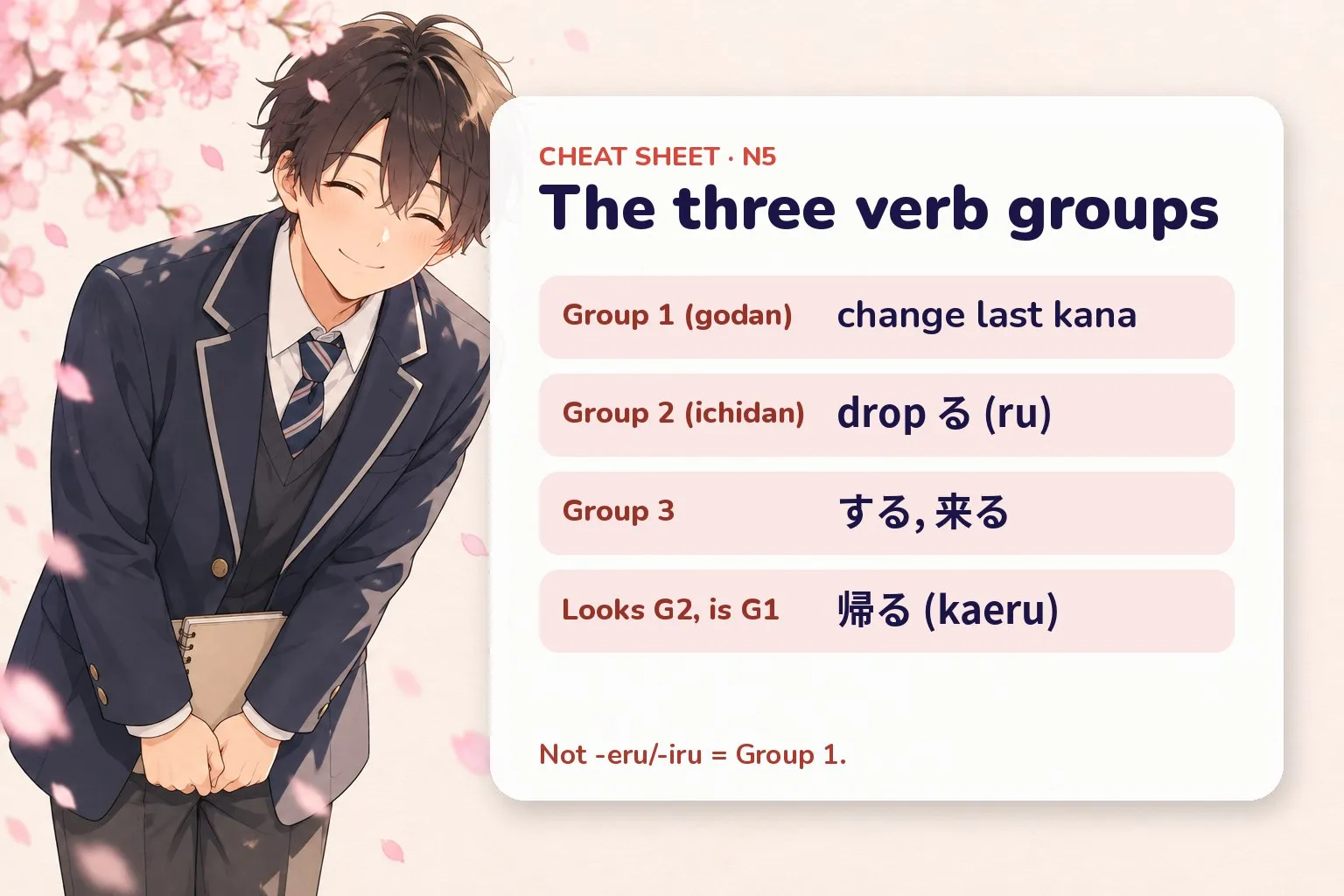
Quick recap before the quiz.
Practice
Verb group practice
Try each one, then press Check. No sign-up, nothing is sent anywhere — it all runs in your browser.
Hint: the sound before る (ru) is -e
Show answer
2 — 食べる (taberu) ends in -eru and is a true ichidan verb: Group 2.
3 Order these from the classification rule: first question to last.
Show answer
does it end in る (ru)? is the vowel before る (ru) -e or -i? — First check for る (ru); only then check the vowel before it.
4 Match each verb to its group.
- 書く (kaku)
- 見る (miru)
- する (suru)
- 帰る (kaeru)
Show answer
- 書く (kaku) → Group 1
- 見る (miru) → Group 2
- する (suru) → Group 3
- 帰る (kaeru) → Group 1 (exception)
帰る (kaeru) looks like Group 2 but is Group 1.
Quiz
Verb group quiz
11 questions · pick an answer and you'll see straight away if it's right.
-
Show answer
three — Group 1 (godan), Group 2 (ichidan) and Group 3 (irregular).
-
Show answer
always Group 1 — If it does not end in る (ru), it is Group 1 (godan).
-
Show answer
the sound before る (ru) is -e and it is ichidan — A -eru/-iru verb that conjugates by dropping る (ru) is Group 2.
-
Show answer
帰る (kaeru) — 帰る (kaeru) is an exception: it looks ichidan but is godan.
-
Show answer
する (suru) and 来る (kuru) — Only する (suru) and 来る (kuru) are Group 3.
-
Show answer
する (suru) — Noun + する (suru) verbs all follow する (suru).
-
Show answer
drop る (ru) — Group 2 (ichidan) verbs drop る (ru) and add the ending.
-
Show answer
change the final kana to another in its column — Group 1 (godan) verbs shift the final u-kana to another row.
-
Show answer
Group 2 — 見る (miru) is a short but true ichidan verb: Group 2.
-
Show answer
shifts across forms (kuru, kimasu, konai) — 来る (kuru) is read kuru, 来ます (kimasu) and 来ない (konai): the sound shifts.
-
Show answer
1 — 話す (hanasu) ends in す (su), an u-kana, so Group 1.
Recap cheat-sheet
| Group | Test | Stem move | Example |
|---|---|---|---|
| 1 (godan) | not -eru/-iru, or an exception | change last kana | 書く (kaku) → 書き (kaki) |
| 2 (ichidan) | ends -eru / -iru | drop る (ru) | 食べる (taberu) → 食べ (tabe) |
| 3 (irregular) | する (suru) / 来る (kuru) | memorise | します (shimasu), 来ます (kimasu) |
Next
- Build the polite form next: the ます (masu) form by group (coming in this section)
- Review the copula first in です (desu): the copula
- Compare how adjectives bend in い-adjectives and な-adjectives
- New here? Start with Start Learning Japanese Here
All Japanese grammar topics
Every grammar point in order, from your first sentence to advanced structures. Pick one and go straight to it. New lessons go live every day, so topics marked Coming soon fill in over the next weeks.
Grammar path
N5 35 topics · 21 ready
- 01 です / だ (desu / da): The Japanese Copula
- 02 は (wa): The Topic Particle
- 03 が (ga): The Subject Particle
- 04 を (o): The Direct Object Particle
- 05 に (ni): Time, Location & Direction Particle
- 06 で (de): Place of Action & Means Particle
- 07 と (to): And / With Particle
- 08 も (mo): Also / Too Particle
- 09 の (no): Possession & Noun Linking
- 10 へ (e): Direction Particle
- 11 から / まで (kara / made): From and Until
- 12 か (ka): The Question Particle
- 13 ね (ne) and よ (yo): Sentence-Ending Particles
- 14 これ / それ / あれ (Demonstrative Pronouns)
- 15 この / その / あの (Demonstrative Adjectives)
- 16 ここ / そこ / あそこ (Here, There)
- 17 い-Adjectives: Conjugation
- 18 な-Adjectives: Conjugation
- 19 Japanese Verb Groups (る/う ru/u, irregular) You are here
- 20 ます (masu) Form: Polite Verbs
- 21 ます (masu) Form: Past & Negative
- 22 Dictionary (Plain Non-Past) Form Coming soon
- 23 て (te) Form: The Connector Form Coming soon
- 24 てください (tekudasai): Making Requests Coming soon
- 25 ています (teimasu): Progressive & States Coming soon
- 26 ない (nai) Form: Plain Negative Coming soon
- 27 た (ta) Form: Plain Past Coming soon
- 28 あります / います (arimasu / imasu): Existence Coming soon
- 29 ましょう / ましょうか (mashō / mashō ka): Let's / Shall We Coming soon
- 30 たい (tai): Wanting to Do Something Coming soon
- 31 がほしい (gahoshii): Wanting a Thing Coming soon
- 32 が好き / が上手 (ga suki / ga jōzu): Likes & Skills Coming soon
- 33 Japanese Counters (枚 mai, 本 hon, 人 nin, つ tsu) Coming soon
- 34 もう (mō) and まだ (mada): Already / Still / Not Yet Coming soon
- 35 Making Adverbs (く ku and に ni Forms) Coming soon
N4 45 topics
- 36 てもいい (temoii): Giving Permission Coming soon
- 37 てはいけません (te wa ikemasen): Prohibition Coming soon
- 38 てから (tekara): After Doing Coming soon
- 39 なければならない (nakerebanaranai): Must / Have To Coming soon
- 40 なくてもいい (nakutemoii): Don't Have To Coming soon
- 41 Potential Form: Being Able To Coming soon
- 42 Volitional Form (よう / おう, yō / ō) Coming soon
- 43 つもり (tsumori): Intending To Coming soon
- 44 たら (tara): The If/When Conditional Coming soon
- 45 ば (ba): The Conditional Form Coming soon
- 46 と (to): Natural Consequence Conditional Coming soon
- 47 なら (nara): Contextual Conditional Coming soon
- 48 Transitive vs Intransitive Verb Pairs Coming soon
- 49 あげる / くれる / もらう (ageru / kureru / morau): Giving & Receiving Coming soon
- 50 ようにする / ようになる (yō ni suru / yō ni naru): Change Coming soon
- 51 ように (yō ni): So That (Purpose) Coming soon
- 52 ために (tameni): For / In Order To Coming soon
- 53 たり~たり (tari tari): Listing Actions Coming soon
- 54 ながら (nagara): While Doing (Simultaneous) Coming soon
- 55 たほうがいい (ta hō ga ii): Giving Advice Coming soon
- 56 より / ほうが (yori / hō ga): Comparisons Coming soon
- 57 そうだ (sō da): Looks Like / Hearsay Coming soon
- 58 らしい (rashii): Seems / I Heard Coming soon
- 59 ようだ / みたいだ (yō da / mitai da): Seems Like Coming soon
- 60 Plain (Casual) Form & Register Coming soon
- 61 Noun Modification (Relative Clauses) Coming soon
- 62 と思う (to omou): Expressing Thoughts Coming soon
- 63 と言う / と (to iu / to): Quotation Coming soon
- 64 という (to iu): The Name/Definition Marker Coming soon
- 65 Passive Form (受身 ukemi) Coming soon
- 66 Causative Form (使役 shieki) Coming soon
- 67 Causative-Passive (させられる saserareru) Coming soon
- 68 すぎる (sugiru): Too Much Coming soon
- 69 やすい / にくい (yasui / nikui): Easy / Hard to Do Coming soon
- 70 方 (kata): Way of Doing Coming soon
- 71 ことができる (kotogadekiru): Can / Be Able To Coming soon
- 72 たことがある (takotogaaru): Have Done Before Coming soon
- 73 前に / 後で (mae ni / atode): Before and After Coming soon
- 74 とき (toki): When (Time Clauses) Coming soon
- 75 は (wa) vs が (ga): Choosing the Right Particle Coming soon
- 76 から / ので (kara / node): Because (Reason) Coming soon
- 77 たがる (tagaru): Third Person Wants To Coming soon
- 78 ないほうがいい (nai hō ga ii): Had Better Not Coming soon
- 79 一番 / 最も (ichiban / mottomo): Superlatives Coming soon
- 80 だろう / でしょう (darō / deshō): Probably / Right? Coming soon
N3 31 topics
- 81 の / こと (no / koto): Nominalising Verbs Coming soon
- 82 Keigo: Polite Language Overview Coming soon
- 83 尊敬語 (sonkeigo): Honorific Language Coming soon
- 84 謙譲語 (kenjōgo): Humble Language Coming soon
- 85 はず (hazu): Expectation / Should Be Coming soon
- 86 べき (beki): Should (Moral/Strong) Coming soon
- 87 わけ (wake): Reason / It Means That Coming soon
- 88 ところ (tokoro): About To / In the Middle / Just Did Coming soon
- 89 たばかり (tabakari): Just Finished Coming soon
- 90 うちに (uchini): While / Before It Changes Coming soon
- 91 間 / 間に (aida / aida ni): During / While Coming soon
- 92 ようとする (yō to suru): Try To / Be About To Coming soon
- 93 てみる (temiru): Try Doing (and See) Coming soon
- 94 ことにする / ことになる (kotonisuru / kotoninaru): Decisions Coming soon
- 95 まま (mama): As It Is / Unchanged State Coming soon
- 96 ても (temo): Even If / Even Though Coming soon
- 97 のに (noni): Although / Despite (Unexpected) Coming soon
- 98 くらい / ぐらい (kurai / gurai): Approximate Extent Coming soon
- 99 ほど (hodo): Extent / The More... Coming soon
- 100 だけ / しか (dake / shika): Only Coming soon
- 101 ばかり (bakari): Only / Nothing But Coming soon
- 102 さえ / でも (sae / demo): Even Coming soon
- 103 ずに / ないで (zuni / naide): Without Doing Coming soon
- 104 について (nitsuite): About / Concerning Coming soon
- 105 に対して (ni taishite): Toward / In Contrast To Coming soon
- 106 にとって (nitotte): For / From the Viewpoint Of Coming soon
- 107 として (toshite): As / In the Role Of Coming soon
- 108 によって (niyotte): By Means Of / Depending On Coming soon
- 109 代わりに (kawari ni): Instead Of / In Return Coming soon
- 110 たびに (tabini): Every Time Coming soon
- 111 場合 (baai): In the Case Of Coming soon
N2 22 topics
- 112 ば~ほど (ba hodo): The More... The More Coming soon
- 113 Compound Verbs: 始める/出す/続ける/終わる (hajimeru/dasu/tsuzukeru/owaru) Coming soon
- 114 Compound Verbs: 切る/かねる/かける (kiru/kaneru/kakeru) Coming soon
- 115 得る / 得ない (eru / enai): Possible / Impossible Coming soon
- 116 に違いない (ni chigai nai): Must Be / No Doubt Coming soon
- 117 ばかりか / だけでなく (bakarika / dakedenaku): Not Only...But Also Coming soon
- 118 上に (ueni): In Addition / On Top Of Coming soon
- 119 反面 (hanmen): On the Other Hand Coming soon
- 120 にもかかわらず (nimokakawarazu): Despite Coming soon
- 121 くせに (kuseni): Even Though (Criticism) Coming soon
- 122 どころか (dokoroka): Far From / Let Alone Coming soon
- 123 たところで (tatokorode): Even If (Futile) Coming soon
- 124 たとたん / やいなや (tatotan / yainaya): As Soon As Coming soon
- 125 さえ~ば (sae ba): If Only / As Long As Coming soon
- 126 わけにはいかない (wake ni wa ikanai): Can't Afford To Coming soon
- 127 限り (kagiri): As Long As / As Far As Coming soon
- 128 に限り / に限って (ni kagiri / ni kagitte): Limited To / Of All Coming soon
- 129 にわたって / にかけて (niwatatte / nikakete): Over / Throughout Coming soon
- 130 を通して / を通じて (o tōshite / o tsūjite): Through / Via Coming soon
- 131 ものだ (monoda): Should / Used To / Nature Coming soon
- 132 ことだ (kotoda): Should (Advice) / Exclamation Coming soon
- 133 Keigo in Practice: Set Verb Pairs Coming soon
N1 16 topics
- 134 だに / すら (dani / sura): Even (Literary) Coming soon
- 135 ごとき / ごとく (gotoki / gotoku): Like / As If (Literary) Coming soon
- 136 といえども (toiedomo): Even Though / Although Coming soon
- 137 ざるを得ない (zaru o enai): Have No Choice But To Coming soon
- 138 べく / べからず (beku / bekarazu): In Order To / Must Not (Formal) Coming soon
- 139 が早いか (ga hayai ka): No Sooner Than Coming soon
- 140 ものなら / ようものなら (mono nara / yō mono nara): If Coming soon
- 141 とは (to wa): Definition / Surprise Coming soon
- 142 ばかりに (bakarini): Just Because (Bad Result) Coming soon
- 143 なり~なり (nari nari): Whether...Or (Choices) Coming soon
- 144 限りだ / 極まりない (kagiri da / kiwamarinai): Extremely Coming soon
- 145 をよそに / をものともせず (o yoso ni / o mono tomo sezu): Despite Coming soon
- 146 ではあるまいし (de wa arumai shi): It's Not As If Coming soon
- 147 なくして(は) / なしに (nakushite wa / nashini): Without Coming soon
- 148 たりとも~ない (taritomo nai): Not Even One Coming soon
- 149 とあって / 以来 (toatte / irai): Given That / Ever Since Coming soon