に (ni): Time, Location & Direction Particle
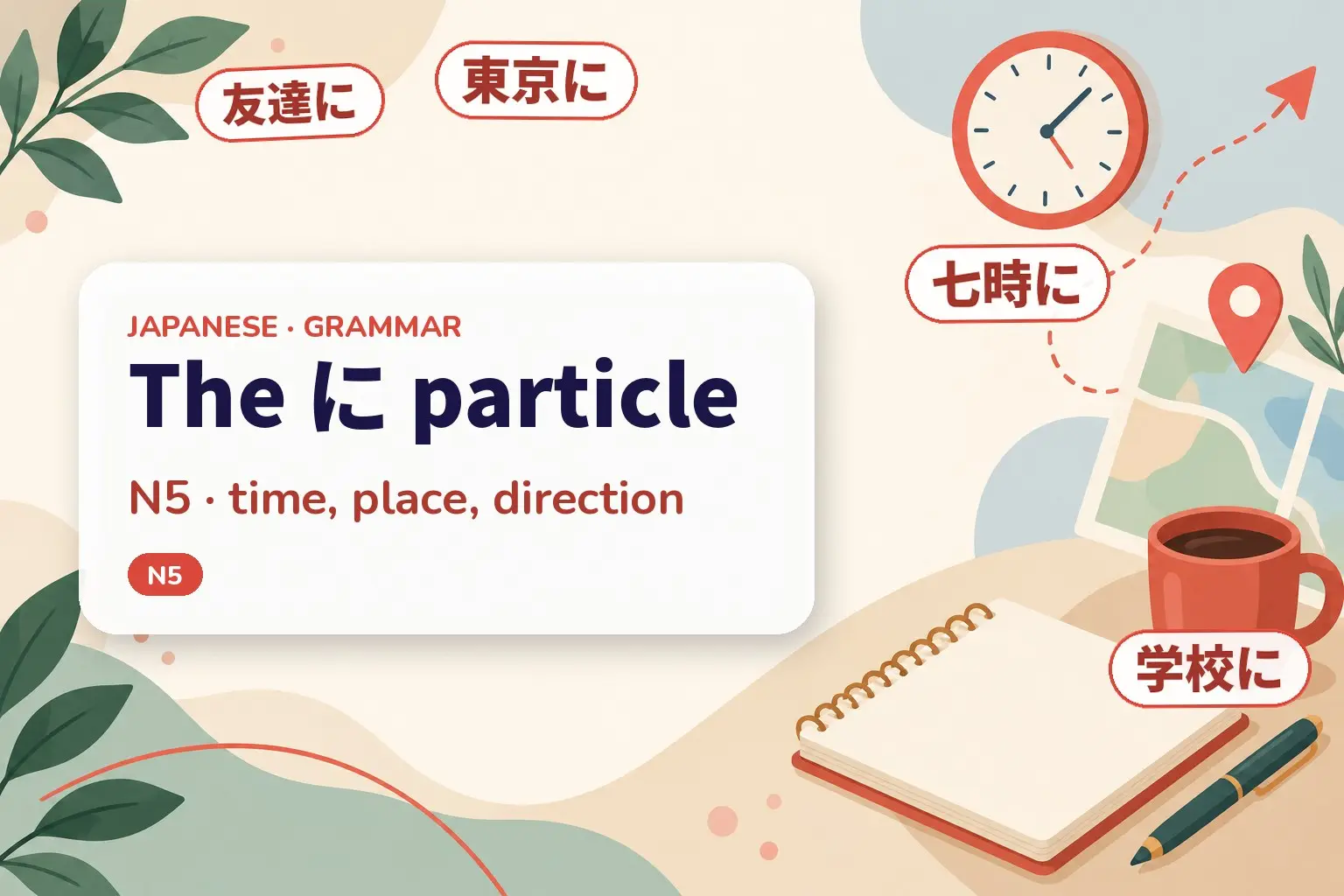
に (ni) is a many-job particle. It marks a point in time (七時に, shichi-ji ni, at seven), where something exists (東京に, Tōkyō ni, in Tokyo), a destination (学校に行く, gakkō ni iku, go to school) and the person who receives an action (友達に, tomodachi ni, to a friend).
Level: N5. (Note: the JLPT publishes no official grammar list; the level shown is the common textbook convention.)
A particle is a short word placed after a noun to show its job in the sentence. に (ni) is one of the busiest particles in Japanese: the same two-letter word points at a time, a place something is, a destination, or the person on the receiving end of an action.
The rule
に (ni) attaches to a noun and gives it one of four core jobs. The noun it follows tells you which job is meant, together with the verb at the end of the sentence.
- A point in time. With a clock time, a date or a day, に (ni) means “at / on”: 七時に起きます (Shichi-ji ni okimasu) = “I get up at seven.”
- Where something exists. With ある (aru), いる (iru) and 住む (sumu), に (ni) marks the place a thing or person simply is: 東京に住んでいます (Tōkyō ni sunde imasu) = “I live in Tokyo.”
- A destination. With motion verbs like 行く (iku), 来る (kuru), 帰る (kaeru) and 乗る (noru), に (ni) marks the end point you move to or onto: 学校に行きます (Gakkō ni ikimasu) = “I go to school.”
- The receiver of an action. With あげる (ageru), 電話する (denwa suru), 教える (oshieru) and 会う (au), に (ni) marks the person something is given to, said to, or done to: 友達に電話します (Tomodachi ni denwa shimasu) = “I phone a friend.”
Core uses of に (ni)
| Use | Example | Reading | English |
|---|---|---|---|
| Point in time | 七時に起きます | Shichi-ji ni okimasu | I get up at seven. |
| Existence (place) | 部屋に猫がいます | Heya ni neko ga imasu | There is a cat in the room. |
| Destination | 学校に行きます | Gakkō ni ikimasu | I go to school. |
| Getting on | 電車に乗ります | Densha ni norimasu | I get on the train. |
| Receiver | 友達に電話します | Tomodachi ni denwa shimasu | I phone a friend. |
Example sentences
Each sentence was written for this lesson, with readings.
- 七時に起きます。Shichi-ji ni okimasu.I get up at seven.point in time
- 月曜日に会議があります。Getsuyōbi ni kaigi ga arimasu.There is a meeting on Monday.
- 三時に学校が終わります。San-ji ni gakkō ga owarimasu.School finishes at three.
- 机の上に本があります。Tsukue no ue ni hon ga arimasu.There is a book on the desk.existence
- 部屋に猫がいます。Heya ni neko ga imasu.There is a cat in the room.
- 東京に住んでいます。Tōkyō ni sunde imasu.I live in Tokyo.
- 学校に行きます。Gakkō ni ikimasu.I go to school.destination
- 日本に来ました。Nihon ni kimashita.I came to Japan.
- 六時に家に帰ります。Roku-ji ni ie ni kaerimasu.I go home at six.time + destination
- 電車に乗ります。Densha ni norimasu.I get on the train.onto
- いすに座ってください。Isu ni suwatte kudasai.Please sit on the chair.
- 友達に電話します。Tomodachi ni denwa shimasu.I phone a friend.receiver
- 先生に質問します。Sensei ni shitsumon shimasu.I ask the teacher a question.
- 母にプレゼントをあげます。Haha ni purezento o agemasu.I give my mother a present.
- 明日、駅で友達に会います。Ashita, eki de tomodachi ni aimasu.Tomorrow I meet a friend at the station.
- 九時に仕事が始まります。Ku-ji ni shigoto ga hajimarimasu.Work starts at nine.
- 壁に絵があります。Kabe ni e ga arimasu.There is a picture on the wall.
- 日曜日に京都に行きます。Nichiyōbi ni Kyōto ni ikimasu.On Sunday I go to Kyoto.
- 子供に本を読みます。Kodomo ni hon o yomimasu.I read a book to the child.
- 八時に家を出て、会社に行きます。Hachi-ji ni ie o dete, kaisha ni ikimasu.I leave home at eight and go to the office.
Common mistakes
- ❌ 公園にあそびます (kōen ni asobimasu) → ✅ 公園で遊びます (Kōen de asobimasu). Playing is an action, so the place takes で (de); に (ni) is for where something exists.
- ❌ 今日に行きます (kyō ni ikimasu) → ✅ 今日行きます (Kyō ikimasu). Relative time words like 今日 (kyō) and 明日 (ashita) take no particle; に (ni) is only for a clock time, date or day.
- ❌ 友達を電話します (tomodachi o denwa shimasu) → ✅ 友達に電話します (Tomodachi ni denwa shimasu). The person you phone is the receiver, marked by に (ni), not the object を (o).
- ❌ 東京で住んでいます (Tōkyō de sunde imasu) → ✅ 東京に住んでいます (Tōkyō ni sunde imasu). 住む (sumu) treats the place as where you exist, so it takes に (ni).
- ❌ 電車で乗ります (densha de norimasu) → ✅ 電車に乗ります (Densha ni norimasu). 乗る (noru) marks the thing you get onto with に (ni); で (densha de) would mean you did something else while on the train.
A short conversation
— 明日は何時に起きますか。 (Ashita wa nan-ji ni okimasu ka.) — “What time will you get up tomorrow?” — 七時に起きて、八時に家を出ます。 (Shichi-ji ni okite, hachi-ji ni ie o demasu.) — “I’ll get up at seven and leave home at eight.” — どこに行きますか。 (Doko ni ikimasu ka.) — “Where are you going?” — 大阪に行って、友達に会います。 (Ōsaka ni itte, tomodachi ni aimasu.) — “I’m going to Osaka and meeting a friend.”
Usage notes
- No に (ni) on relative time words. 今日 (kyō, today), 明日 (ashita, tomorrow), 毎日 (mainichi, every day), 今 (ima, now) and 先週 (senshū, last week) take no particle. Days of the week and clock times do take に (ni).
- に (ni) and へ (e) for destination overlap. 東京に行きます (Tōkyō ni ikimasu) and 東京へ行きます (Tōkyō e ikimasu) are both natural; に (ni) stresses the arrival point, へ (e) the direction travelled.
- Frequency uses に (ni) too. To say “times per period”, use に (ni): 一日に三回 (ichi-nichi ni san-kai) = “three times a day”, 週に一度 (shū ni ichido) = “once a week.”
- Purpose of a trip. With a motion verb, the verb stem + に (ni) marks why you go: 映画を見に行きます (Eiga o mi ni ikimasu) = “I go to watch a film.”
Compared with…
- で (de) marks the place where an action happens or the means used, not where something exists or a destination. 公園で遊びます (Kōen de asobimasu) = “I play in the park” (action), while 公園に木があります (Kōen ni ki ga arimasu) = “There are trees in the park” (existence). See the で (de) particle lesson.
- へ (e) marks direction toward a place and is read “e” though written へ. 東京へ行きます (Tōkyō e ikimasu) highlights the direction; 東京に行きます (Tōkyō ni ikimasu) highlights arriving there. With a receiver or a time, only に (ni) works. See the へ (e) particle lesson.
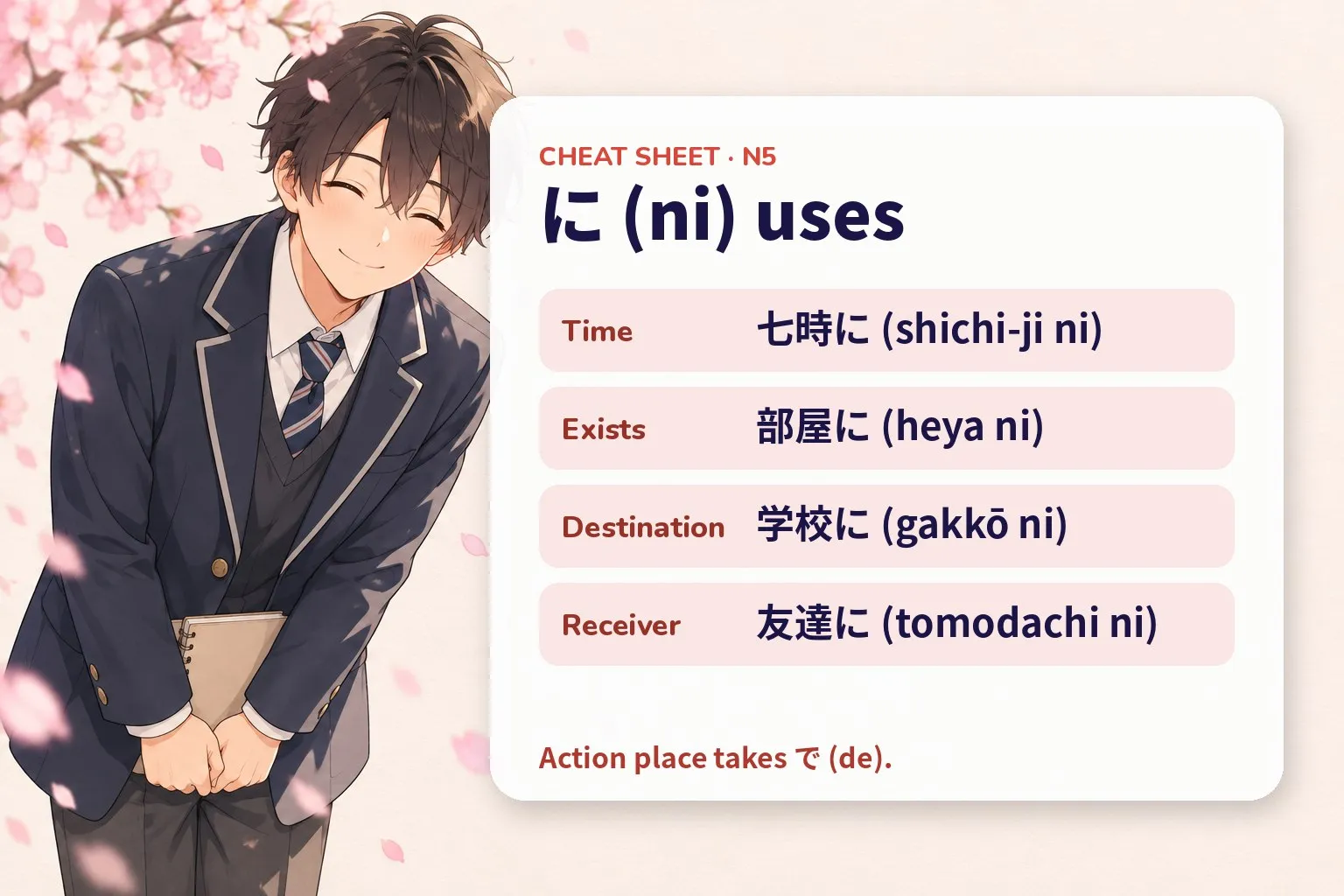
Quick recap before the quiz.
Practice
Ni particle practice
Try each one, then press Check. No sign-up, nothing is sent anywhere — it all runs in your browser.
Hint: Where the cat simply is.
Show answer
ni — Existence with いる (iru) takes に (ni): 部屋に猫がいます (Heya ni neko ga imasu).
3 Build: 'I go to school.'
Show answer
学校 (gakkō) に (ni) 行きます (ikimasu) — Destination 学校 (gakkō) + に (ni) + verb 行きます (ikimasu).
4 Match each に (ni) use with an example.
- point in time
- existence
- destination
- receiver
Show answer
- point in time → 七時に (shichi-ji ni)
- existence → 部屋に (heya ni)
- destination → 学校に (gakkō ni)
- receiver → 友達に (tomodachi ni)
に (ni) covers time, existence, destination and the receiver of an action.
Quiz
Ni particle quiz
12 questions · pick an answer and you'll see straight away if it's right.
-
Show answer
The place an action happens — The place an action happens is で (de); に (ni) covers time, existence, destination and receiver.
-
Show answer
七時に起きます (Shichi-ji ni okimasu) — A clock time takes に (ni).
-
Show answer
今日 (kyō) — Relative time words like 今日 (kyō) take no particle; clock times and days take に (ni).
-
Show answer
部屋に猫がいます (Heya ni neko ga imasu) — Existence with いる (iru) takes に (ni).
-
Show answer
公園で遊びます (Kōen de asobimasu) — Playing is an action, so the place takes で (de).
-
Show answer
東京に住んでいます (Tōkyō ni sunde imasu) — 住む (sumu) treats the place as where you exist, so に (ni).
-
Show answer
友達に電話します (Tomodachi ni denwa shimasu) — The person who receives the action takes に (ni).
-
Show answer
ni — 乗る (noru) marks the thing you get onto with に (ni): 電車に乗ります (Densha ni norimasu).
-
Show answer
へ (e) — へ (e) also marks a destination, stressing direction; に (ni) stresses arrival.
-
Show answer
一日に三回 (ichi-nichi ni san-kai) — Frequency per period uses に (ni): 一日に三回 (ichi-nichi ni san-kai).
-
Show answer
今日に行きます (Kyō ni ikimasu) — 今日 (kyō) is a relative time word and takes no particle: 今日行きます (Kyō ikimasu).
-
Show answer
where someone exists — いる (iru) with に (ni) marks where someone simply is.
Recap cheat-sheet
| Use | Example | Reading |
|---|---|---|
| Point in time | 七時に起きます | Shichi-ji ni okimasu |
| Existence | 部屋に猫がいます | Heya ni neko ga imasu |
| Destination | 学校に行きます | Gakkō ni ikimasu |
| Receiver | 友達に電話します | Tomodachi ni denwa shimasu |
Next
- Review the object particle first: を (o) particle
- Back to the Japanese grammar section
- New here? Start with Start Learning Japanese Here
All Japanese grammar topics
Every grammar point in order, from your first sentence to advanced structures. Pick one and go straight to it. New lessons go live every day, so topics marked Coming soon fill in over the next weeks.
Grammar path
N5 35 topics · 12 ready
- 01 です / だ (desu / da): The Japanese Copula
- 02 は (wa): The Topic Particle
- 03 が (ga): The Subject Particle
- 04 を (o): The Direct Object Particle
- 05 に (ni): Time, Location & Direction Particle You are here
- 06 で (de): Place of Action & Means Particle
- 07 と (to): And / With Particle
- 08 も (mo): Also / Too Particle
- 09 の (no): Possession & Noun Linking
- 10 へ (e): Direction Particle
- 11 から / まで (kara / made): From and Until
- 12 か (ka): The Question Particle
- 13 ね (ne) and よ (yo): Sentence-Ending Particles Coming soon
- 14 これ / それ / あれ (Demonstrative Pronouns) Coming soon
- 15 この / その / あの (Demonstrative Adjectives) Coming soon
- 16 ここ / そこ / あそこ (Here, There) Coming soon
- 17 い-Adjectives: Conjugation Coming soon
- 18 な-Adjectives: Conjugation Coming soon
- 19 Japanese Verb Groups (る/う ru/u, irregular) Coming soon
- 20 ます (masu) Form: Polite Verbs Coming soon
- 21 ます (masu) Form: Past & Negative Coming soon
- 22 Dictionary (Plain Non-Past) Form Coming soon
- 23 て (te) Form: The Connector Form Coming soon
- 24 てください (tekudasai): Making Requests Coming soon
- 25 ています (teimasu): Progressive & States Coming soon
- 26 ない (nai) Form: Plain Negative Coming soon
- 27 た (ta) Form: Plain Past Coming soon
- 28 あります / います (arimasu / imasu): Existence Coming soon
- 29 ましょう / ましょうか (mashō / mashō ka): Let's / Shall We Coming soon
- 30 たい (tai): Wanting to Do Something Coming soon
- 31 がほしい (gahoshii): Wanting a Thing Coming soon
- 32 が好き / が上手 (ga suki / ga jōzu): Likes & Skills Coming soon
- 33 Japanese Counters (枚 mai, 本 hon, 人 nin, つ tsu) Coming soon
- 34 もう (mō) and まだ (mada): Already / Still / Not Yet Coming soon
- 35 Making Adverbs (く ku and に ni Forms) Coming soon
N4 45 topics
- 36 てもいい (temoii): Giving Permission Coming soon
- 37 てはいけません (te wa ikemasen): Prohibition Coming soon
- 38 てから (tekara): After Doing Coming soon
- 39 なければならない (nakerebanaranai): Must / Have To Coming soon
- 40 なくてもいい (nakutemoii): Don't Have To Coming soon
- 41 Potential Form: Being Able To Coming soon
- 42 Volitional Form (よう / おう, yō / ō) Coming soon
- 43 つもり (tsumori): Intending To Coming soon
- 44 たら (tara): The If/When Conditional Coming soon
- 45 ば (ba): The Conditional Form Coming soon
- 46 と (to): Natural Consequence Conditional Coming soon
- 47 なら (nara): Contextual Conditional Coming soon
- 48 Transitive vs Intransitive Verb Pairs Coming soon
- 49 あげる / くれる / もらう (ageru / kureru / morau): Giving & Receiving Coming soon
- 50 ようにする / ようになる (yō ni suru / yō ni naru): Change Coming soon
- 51 ように (yō ni): So That (Purpose) Coming soon
- 52 ために (tameni): For / In Order To Coming soon
- 53 たり~たり (tari tari): Listing Actions Coming soon
- 54 ながら (nagara): While Doing (Simultaneous) Coming soon
- 55 たほうがいい (ta hō ga ii): Giving Advice Coming soon
- 56 より / ほうが (yori / hō ga): Comparisons Coming soon
- 57 そうだ (sō da): Looks Like / Hearsay Coming soon
- 58 らしい (rashii): Seems / I Heard Coming soon
- 59 ようだ / みたいだ (yō da / mitai da): Seems Like Coming soon
- 60 Plain (Casual) Form & Register Coming soon
- 61 Noun Modification (Relative Clauses) Coming soon
- 62 と思う (to omou): Expressing Thoughts Coming soon
- 63 と言う / と (to iu / to): Quotation Coming soon
- 64 という (to iu): The Name/Definition Marker Coming soon
- 65 Passive Form (受身 ukemi) Coming soon
- 66 Causative Form (使役 shieki) Coming soon
- 67 Causative-Passive (させられる saserareru) Coming soon
- 68 すぎる (sugiru): Too Much Coming soon
- 69 やすい / にくい (yasui / nikui): Easy / Hard to Do Coming soon
- 70 方 (kata): Way of Doing Coming soon
- 71 ことができる (kotogadekiru): Can / Be Able To Coming soon
- 72 たことがある (takotogaaru): Have Done Before Coming soon
- 73 前に / 後で (mae ni / atode): Before and After Coming soon
- 74 とき (toki): When (Time Clauses) Coming soon
- 75 は (wa) vs が (ga): Choosing the Right Particle Coming soon
- 76 から / ので (kara / node): Because (Reason) Coming soon
- 77 たがる (tagaru): Third Person Wants To Coming soon
- 78 ないほうがいい (nai hō ga ii): Had Better Not Coming soon
- 79 一番 / 最も (ichiban / mottomo): Superlatives Coming soon
- 80 だろう / でしょう (darō / deshō): Probably / Right? Coming soon
N3 31 topics
- 81 の / こと (no / koto): Nominalising Verbs Coming soon
- 82 Keigo: Polite Language Overview Coming soon
- 83 尊敬語 (sonkeigo): Honorific Language Coming soon
- 84 謙譲語 (kenjōgo): Humble Language Coming soon
- 85 はず (hazu): Expectation / Should Be Coming soon
- 86 べき (beki): Should (Moral/Strong) Coming soon
- 87 わけ (wake): Reason / It Means That Coming soon
- 88 ところ (tokoro): About To / In the Middle / Just Did Coming soon
- 89 たばかり (tabakari): Just Finished Coming soon
- 90 うちに (uchini): While / Before It Changes Coming soon
- 91 間 / 間に (aida / aida ni): During / While Coming soon
- 92 ようとする (yō to suru): Try To / Be About To Coming soon
- 93 てみる (temiru): Try Doing (and See) Coming soon
- 94 ことにする / ことになる (kotonisuru / kotoninaru): Decisions Coming soon
- 95 まま (mama): As It Is / Unchanged State Coming soon
- 96 ても (temo): Even If / Even Though Coming soon
- 97 のに (noni): Although / Despite (Unexpected) Coming soon
- 98 くらい / ぐらい (kurai / gurai): Approximate Extent Coming soon
- 99 ほど (hodo): Extent / The More... Coming soon
- 100 だけ / しか (dake / shika): Only Coming soon
- 101 ばかり (bakari): Only / Nothing But Coming soon
- 102 さえ / でも (sae / demo): Even Coming soon
- 103 ずに / ないで (zuni / naide): Without Doing Coming soon
- 104 について (nitsuite): About / Concerning Coming soon
- 105 に対して (ni taishite): Toward / In Contrast To Coming soon
- 106 にとって (nitotte): For / From the Viewpoint Of Coming soon
- 107 として (toshite): As / In the Role Of Coming soon
- 108 によって (niyotte): By Means Of / Depending On Coming soon
- 109 代わりに (kawari ni): Instead Of / In Return Coming soon
- 110 たびに (tabini): Every Time Coming soon
- 111 場合 (baai): In the Case Of Coming soon
N2 22 topics
- 112 ば~ほど (ba hodo): The More... The More Coming soon
- 113 Compound Verbs: 始める/出す/続ける/終わる (hajimeru/dasu/tsuzukeru/owaru) Coming soon
- 114 Compound Verbs: 切る/かねる/かける (kiru/kaneru/kakeru) Coming soon
- 115 得る / 得ない (eru / enai): Possible / Impossible Coming soon
- 116 に違いない (ni chigai nai): Must Be / No Doubt Coming soon
- 117 ばかりか / だけでなく (bakarika / dakedenaku): Not Only...But Also Coming soon
- 118 上に (ueni): In Addition / On Top Of Coming soon
- 119 反面 (hanmen): On the Other Hand Coming soon
- 120 にもかかわらず (nimokakawarazu): Despite Coming soon
- 121 くせに (kuseni): Even Though (Criticism) Coming soon
- 122 どころか (dokoroka): Far From / Let Alone Coming soon
- 123 たところで (tatokorode): Even If (Futile) Coming soon
- 124 たとたん / やいなや (tatotan / yainaya): As Soon As Coming soon
- 125 さえ~ば (sae ba): If Only / As Long As Coming soon
- 126 わけにはいかない (wake ni wa ikanai): Can't Afford To Coming soon
- 127 限り (kagiri): As Long As / As Far As Coming soon
- 128 に限り / に限って (ni kagiri / ni kagitte): Limited To / Of All Coming soon
- 129 にわたって / にかけて (niwatatte / nikakete): Over / Throughout Coming soon
- 130 を通して / を通じて (o tōshite / o tsūjite): Through / Via Coming soon
- 131 ものだ (monoda): Should / Used To / Nature Coming soon
- 132 ことだ (kotoda): Should (Advice) / Exclamation Coming soon
- 133 Keigo in Practice: Set Verb Pairs Coming soon
N1 16 topics
- 134 だに / すら (dani / sura): Even (Literary) Coming soon
- 135 ごとき / ごとく (gotoki / gotoku): Like / As If (Literary) Coming soon
- 136 といえども (toiedomo): Even Though / Although Coming soon
- 137 ざるを得ない (zaru o enai): Have No Choice But To Coming soon
- 138 べく / べからず (beku / bekarazu): In Order To / Must Not (Formal) Coming soon
- 139 が早いか (ga hayai ka): No Sooner Than Coming soon
- 140 ものなら / ようものなら (mono nara / yō mono nara): If Coming soon
- 141 とは (to wa): Definition / Surprise Coming soon
- 142 ばかりに (bakarini): Just Because (Bad Result) Coming soon
- 143 なり~なり (nari nari): Whether...Or (Choices) Coming soon
- 144 限りだ / 極まりない (kagiri da / kiwamarinai): Extremely Coming soon
- 145 をよそに / をものともせず (o yoso ni / o mono tomo sezu): Despite Coming soon
- 146 ではあるまいし (de wa arumai shi): It's Not As If Coming soon
- 147 なくして(は) / なしに (nakushite wa / nashini): Without Coming soon
- 148 たりとも~ない (taritomo nai): Not Even One Coming soon
- 149 とあって / 以来 (toatte / irai): Given That / Ever Since Coming soon