か (ka): The Question Particle
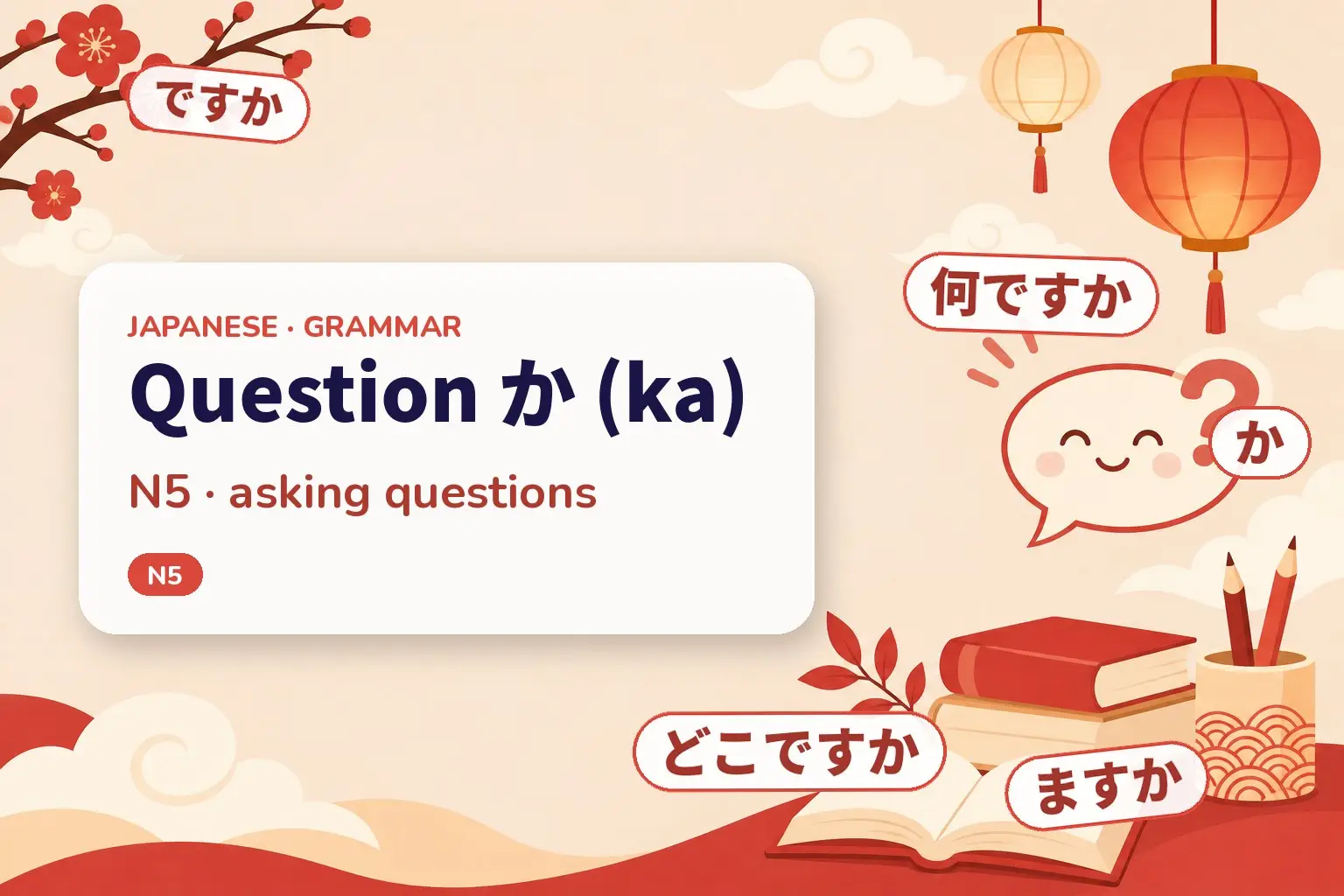
In Japanese you ask a question by adding the particle か (ka) to the end of a sentence — no question mark and no change of word order. 学生です (gakusei desu), 'I am a student', becomes 学生ですか (gakusei desu ka), 'Are you a student?'.
Level: N5. (Note: the JLPT publishes no official grammar list; the level shown is the common textbook convention.)
A particle is a short word that comes after another word to show its job. か (ka) is the question particle: put it at the end of a statement and you have a question. 学生です (gakusei desu) means “I am a student”; 学生ですか (gakusei desu ka) means “Are you a student?”
The rule
To ask a question in Japanese, take a normal sentence and add か (ka) at the very end. Nothing else moves. Unlike English, you do not swap the subject and verb, and in writing you do not need a question mark — the か (ka) already marks it as a question.
か (ka) attaches after the final word, including the polite ending です (desu) or ます (masu): 行きます (ikimasu, “I go”) becomes 行きますか (ikimasu ka, “Do you go?”). It works the same for yes/no questions and for questions with a question word such as 何 (nani, “what”) or どこ (doko, “where”): お名前は何ですか (o-namae wa nan desu ka) = “What is your name?”
か (ka) also works inside a sentence to mean “whether”: 行くかわかりません (iku ka wakarimasen) = “I don’t know whether (I) will go”. This embedded use often pairs with どうか (dō ka) for “whether or not”.
Statement to question at a glance
| Type | Japanese | Reading | English |
|---|---|---|---|
| Statement | 学生です。 | gakusei desu. | I am a student. |
| Yes/no question | 学生ですか。 | gakusei desu ka. | Are you a student? |
| Verb question | 行きますか。 | ikimasu ka. | Do you go? / Will you go? |
| Question word | 何ですか。 | nan desu ka. | What is it? |
| Embedded “whether” | 来るかわかりません。 | kuru ka wakarimasen. | I don’t know whether (he) is coming. |
Example sentences
Each sentence was written for this lesson, with readings.
- 学生ですか。Gakusei desu ka.Are you a student?
- これはペンですか。Kore wa pen desu ka.Is this a pen?
- コーヒーを飲みますか。Kōhī o nomimasu ka.Do you drink coffee?
- 田中さんは先生ですか。Tanaka-san wa sensei desu ka.Is Mr Tanaka a teacher?
- 今日は寒いですか。Kyō wa samui desu ka.Is it cold today?
- お名前は何ですか。O-namae wa nan desu ka.What is your name?question word 何 (nan) still needs か (ka)
- トイレはどこですか。Toire wa doko desu ka.Where is the toilet?
- これはいくらですか。Kore wa ikura desu ka.How much is this?
- 何時に行きますか。Nanji ni ikimasu ka.What time will you go?
- 日本語がわかりますか。Nihongo ga wakarimasu ka.Do you understand Japanese?
- 元気ですか。Genki desu ka.How are you?
- もう食べましたか。Mō tabemashita ka.Have you eaten already?
- お茶とコーヒー、どちらがいいですか。Ocha to kōhī, dochira ga ii desu ka.Which is better, tea or coffee?
- これは本ですか、雑誌ですか。Kore wa hon desu ka, zasshi desu ka.Is this a book, or a magazine?two か (ka) offer a choice
- 明日は雨が降るかわかりません。Ashita wa ame ga furu ka wakarimasen.I don't know whether it will rain tomorrow.embedded か (ka) = whether
- 彼が来るかどうか知りません。Kare ga kuru ka dō ka shirimasen.I don't know whether or not he is coming.かどうか (ka dō ka) = whether or not
- 誰かいますか。Dareka imasu ka.Is anyone there?誰か (dareka) = someone
- 何か食べますか。Nanika tabemasu ka.Will you eat something?何か (nanika) = something
- 日本の方ですか。Nihon no kata desu ka.Are you from Japan?
- 一緒に行きませんか。Issho ni ikimasen ka.Won't you go together (with me)?negative + か (ka) is a polite invitation
Common mistakes
- ❌ です学生か (desu gakusei ka) → ✅ 学生ですか (gakusei desu ka). Keep the normal word order and add か (ka) only at the very end; do not invert like English.
- ❌ 何を食べます (nani o tabemasu) as a polite question → ✅ 何を食べますか (nani o tabemasu ka). A question word such as 何 (nani) still needs か (ka) at the end in polite speech.
- ❌ 学生か (gakusei ka) to a stranger → ✅ 学生ですか (gakusei desu ka). In polite speech keep です (desu) before か (ka); bare 学生か (gakusei ka) is blunt and casual.
- ❌ 行きますかですか (ikimasu ka desu ka) → ✅ 行きますか (ikimasu ka). Use か (ka) once; do not stack it with another ending.
- ❌ assuming 学生です (gakusei desu) needs a “?” to become a question → ✅ 学生ですか (gakusei desu ka). It is か (ka), not punctuation, that asks; a “?” is optional and casual.
A short conversation
— お名前は何ですか。 (O-namae wa nan desu ka.) — “What is your name?” — リンです。学生ですか。 (Rin desu. Gakusei desu ka.) — “I’m Rin. Are you a student?” — はい、学生です。コーヒーを飲みますか。 (Hai, gakusei desu. Kōhī o nomimasu ka.) — “Yes, I’m a student. Will you have coffee?” — いいですね。 (Ii desu ne.) — “That sounds good.”
Usage notes
- Casual speech drops か (ka). Among friends you often just raise your pitch: 学生? (Gakusei?) with a rising tone means “You’re a student?”. The polite written form keeps か (ka).
- か (ka) between nouns means “or”. コーヒーかお茶 (kōhī ka ocha) = “coffee or tea”; 月曜日か火曜日 (getsuyōbi ka kayōbi) = “Monday or Tuesday”.
- Negative + か (ka) is an invitation. 行きませんか (ikimasen ka), literally “won’t you go?”, is a friendly “would you like to go?”.
- Embedded かどうか (ka dō ka) turns a yes/no question into “whether or not”: 来るかどうか (kuru ka dō ka) = “whether or not (he) comes”.
Compared with ね (ne) and よ (yo)
- ね (ne) seeks agreement, like “…, right?”: いい天気ですね (ii tenki desu ne) = “Nice weather, isn’t it?”. It is not a real question — you expect a yes.
- よ (yo) adds new information or emphasis, like “you know”: 時間ですよ (jikan desu yo) = “It’s time, you know.” Where か (ka) asks, ね (ne) and よ (yo) comment. A dedicated ね (ne) and よ (yo) lesson is on the way in the Japanese grammar section.
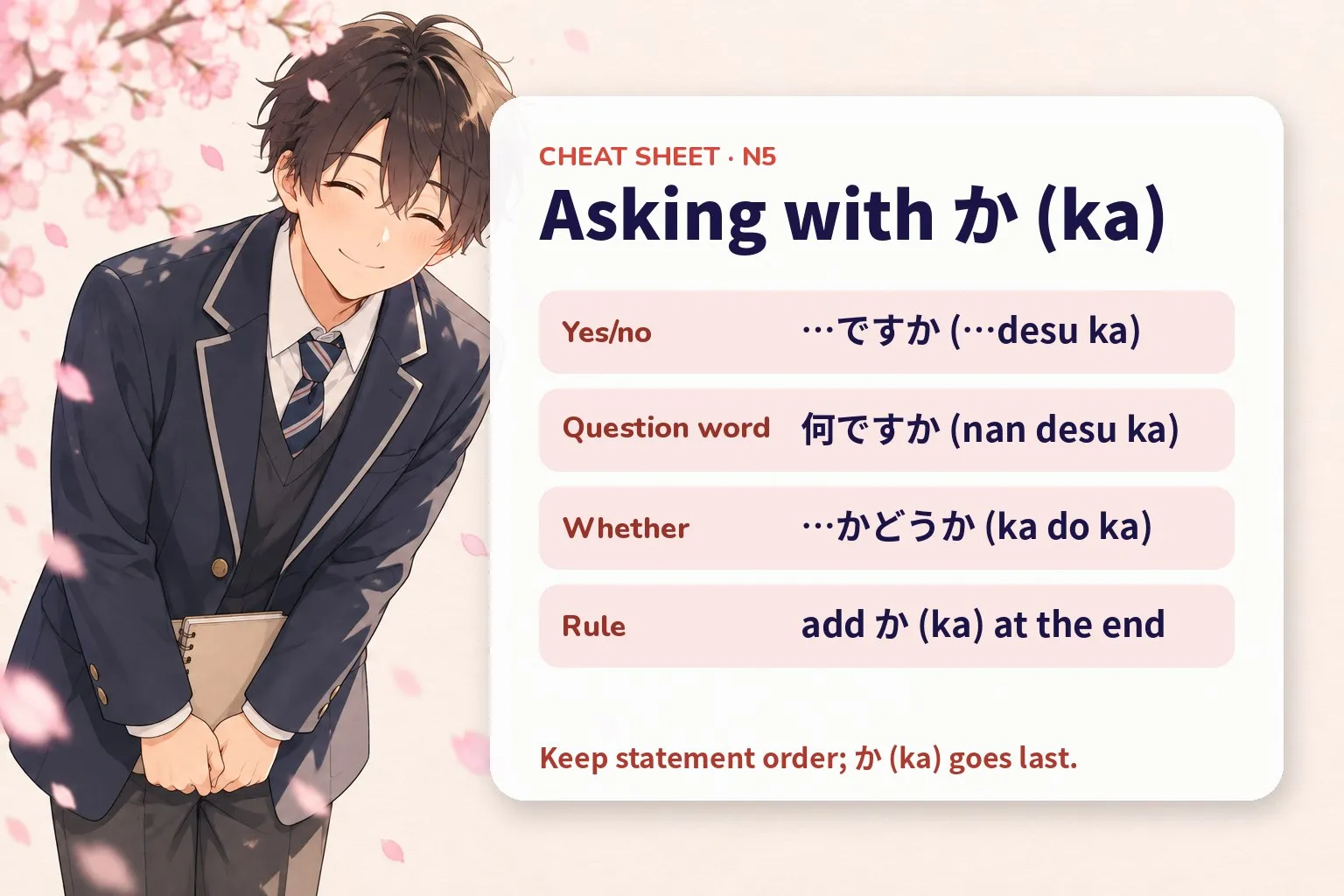
Quick recap before the quiz.
Practice
Question particle practice
Try each one, then press Check. No sign-up, nothing is sent anywhere — it all runs in your browser.
Hint: it goes at the very end
Show answer
ka — か (ka) at the end makes 飲みますか (nomimasu ka), 'do you drink?'.
3 Build: 'What is your name?'
Show answer
お名前は (o-namae wa) 何 (nan) ですか (desu ka) — お名前は何ですか (o-namae wa nan desu ka) — the question word stays in place and か (ka) ends the sentence.
4 Match each sentence-final particle with its job.
- か (ka)
- ね (ne)
- よ (yo)
- かどうか (ka dō ka)
Show answer
- か (ka) → asks a question
- ね (ne) → seeks agreement
- よ (yo) → gives new information
- かどうか (ka dō ka) → whether or not (embedded)
か (ka) questions; ね (ne) says 'right?'; よ (yo) informs; かどうか (ka dō ka) means 'whether or not'.
Quiz
Question particle quiz
12 questions · pick an answer and you'll see straight away if it's right.
-
Show answer
makes it a question — Sentence-final か (ka) turns a statement into a question.
-
Show answer
at the very end — か (ka) attaches at the very end, after です (desu) or ます (masu).
-
Show answer
行きますか (ikimasu ka) — Add か (ka) at the end: 行きますか (ikimasu ka).
-
Show answer
no — it only adds か (ka) — Word order stays the same; か (ka) alone marks the question.
-
Show answer
これは何ですか (kore wa nan desu ka) — A question word still needs か (ka): これは何ですか (kore wa nan desu ka).
-
Show answer
ね (ne) — ね (ne) expects a yes; it is not a true question like か (ka).
-
Show answer
or — コーヒーかお茶 (kōhī ka ocha) = 'coffee or tea'.
-
Show answer
行きませんか (ikimasen ka) — Negative + か (ka), 行きませんか (ikimasen ka), is a friendly 'would you like to go?'.
-
Show answer
someone — A question word plus か (ka) gives a 'some-' word: 誰か (dareka) = someone.
-
Show answer
whether or not — Embedded かどうか (ka dō ka) = 'whether or not'.
-
Show answer
ka — ペンですか (pen desu ka) = 'Is it a pen?'.
-
Show answer
with rising pitch at the end — Friends drop か (ka) and simply raise the pitch: 学生? (Gakusei?).
Recap cheat-sheet
| Use | Example | Reading |
|---|---|---|
| Yes/no question | 学生ですか | gakusei desu ka |
| Question word | 何ですか | nan desu ka |
| “Whether” (embedded) | 来るかどうか | kuru ka dō ka |
| “Or” (between nouns) | お茶かコーヒー | ocha ka kōhī |
Next
- Review the polite ending it attaches to: the です (desu) copula
- Contrast the subject marker: the が (ga) particle
- Back to the Japanese grammar section
- New here? Start with Start Learning Japanese Here
All Japanese grammar topics
Every grammar point in order, from your first sentence to advanced structures. Pick one and go straight to it. New lessons go live every day, so topics marked Coming soon fill in over the next weeks.
Grammar path
N5 35 topics · 12 ready
- 01 です / だ (desu / da): The Japanese Copula
- 02 は (wa): The Topic Particle
- 03 が (ga): The Subject Particle
- 04 を (o): The Direct Object Particle
- 05 に (ni): Time, Location & Direction Particle
- 06 で (de): Place of Action & Means Particle
- 07 と (to): And / With Particle
- 08 も (mo): Also / Too Particle
- 09 の (no): Possession & Noun Linking
- 10 へ (e): Direction Particle
- 11 から / まで (kara / made): From and Until
- 12 か (ka): The Question Particle You are here
- 13 ね (ne) and よ (yo): Sentence-Ending Particles Coming soon
- 14 これ / それ / あれ (Demonstrative Pronouns) Coming soon
- 15 この / その / あの (Demonstrative Adjectives) Coming soon
- 16 ここ / そこ / あそこ (Here, There) Coming soon
- 17 い-Adjectives: Conjugation Coming soon
- 18 な-Adjectives: Conjugation Coming soon
- 19 Japanese Verb Groups (る/う ru/u, irregular) Coming soon
- 20 ます (masu) Form: Polite Verbs Coming soon
- 21 ます (masu) Form: Past & Negative Coming soon
- 22 Dictionary (Plain Non-Past) Form Coming soon
- 23 て (te) Form: The Connector Form Coming soon
- 24 てください (tekudasai): Making Requests Coming soon
- 25 ています (teimasu): Progressive & States Coming soon
- 26 ない (nai) Form: Plain Negative Coming soon
- 27 た (ta) Form: Plain Past Coming soon
- 28 あります / います (arimasu / imasu): Existence Coming soon
- 29 ましょう / ましょうか (mashō / mashō ka): Let's / Shall We Coming soon
- 30 たい (tai): Wanting to Do Something Coming soon
- 31 がほしい (gahoshii): Wanting a Thing Coming soon
- 32 が好き / が上手 (ga suki / ga jōzu): Likes & Skills Coming soon
- 33 Japanese Counters (枚 mai, 本 hon, 人 nin, つ tsu) Coming soon
- 34 もう (mō) and まだ (mada): Already / Still / Not Yet Coming soon
- 35 Making Adverbs (く ku and に ni Forms) Coming soon
N4 45 topics
- 36 てもいい (temoii): Giving Permission Coming soon
- 37 てはいけません (te wa ikemasen): Prohibition Coming soon
- 38 てから (tekara): After Doing Coming soon
- 39 なければならない (nakerebanaranai): Must / Have To Coming soon
- 40 なくてもいい (nakutemoii): Don't Have To Coming soon
- 41 Potential Form: Being Able To Coming soon
- 42 Volitional Form (よう / おう, yō / ō) Coming soon
- 43 つもり (tsumori): Intending To Coming soon
- 44 たら (tara): The If/When Conditional Coming soon
- 45 ば (ba): The Conditional Form Coming soon
- 46 と (to): Natural Consequence Conditional Coming soon
- 47 なら (nara): Contextual Conditional Coming soon
- 48 Transitive vs Intransitive Verb Pairs Coming soon
- 49 あげる / くれる / もらう (ageru / kureru / morau): Giving & Receiving Coming soon
- 50 ようにする / ようになる (yō ni suru / yō ni naru): Change Coming soon
- 51 ように (yō ni): So That (Purpose) Coming soon
- 52 ために (tameni): For / In Order To Coming soon
- 53 たり~たり (tari tari): Listing Actions Coming soon
- 54 ながら (nagara): While Doing (Simultaneous) Coming soon
- 55 たほうがいい (ta hō ga ii): Giving Advice Coming soon
- 56 より / ほうが (yori / hō ga): Comparisons Coming soon
- 57 そうだ (sō da): Looks Like / Hearsay Coming soon
- 58 らしい (rashii): Seems / I Heard Coming soon
- 59 ようだ / みたいだ (yō da / mitai da): Seems Like Coming soon
- 60 Plain (Casual) Form & Register Coming soon
- 61 Noun Modification (Relative Clauses) Coming soon
- 62 と思う (to omou): Expressing Thoughts Coming soon
- 63 と言う / と (to iu / to): Quotation Coming soon
- 64 という (to iu): The Name/Definition Marker Coming soon
- 65 Passive Form (受身 ukemi) Coming soon
- 66 Causative Form (使役 shieki) Coming soon
- 67 Causative-Passive (させられる saserareru) Coming soon
- 68 すぎる (sugiru): Too Much Coming soon
- 69 やすい / にくい (yasui / nikui): Easy / Hard to Do Coming soon
- 70 方 (kata): Way of Doing Coming soon
- 71 ことができる (kotogadekiru): Can / Be Able To Coming soon
- 72 たことがある (takotogaaru): Have Done Before Coming soon
- 73 前に / 後で (mae ni / atode): Before and After Coming soon
- 74 とき (toki): When (Time Clauses) Coming soon
- 75 は (wa) vs が (ga): Choosing the Right Particle Coming soon
- 76 から / ので (kara / node): Because (Reason) Coming soon
- 77 たがる (tagaru): Third Person Wants To Coming soon
- 78 ないほうがいい (nai hō ga ii): Had Better Not Coming soon
- 79 一番 / 最も (ichiban / mottomo): Superlatives Coming soon
- 80 だろう / でしょう (darō / deshō): Probably / Right? Coming soon
N3 31 topics
- 81 の / こと (no / koto): Nominalising Verbs Coming soon
- 82 Keigo: Polite Language Overview Coming soon
- 83 尊敬語 (sonkeigo): Honorific Language Coming soon
- 84 謙譲語 (kenjōgo): Humble Language Coming soon
- 85 はず (hazu): Expectation / Should Be Coming soon
- 86 べき (beki): Should (Moral/Strong) Coming soon
- 87 わけ (wake): Reason / It Means That Coming soon
- 88 ところ (tokoro): About To / In the Middle / Just Did Coming soon
- 89 たばかり (tabakari): Just Finished Coming soon
- 90 うちに (uchini): While / Before It Changes Coming soon
- 91 間 / 間に (aida / aida ni): During / While Coming soon
- 92 ようとする (yō to suru): Try To / Be About To Coming soon
- 93 てみる (temiru): Try Doing (and See) Coming soon
- 94 ことにする / ことになる (kotonisuru / kotoninaru): Decisions Coming soon
- 95 まま (mama): As It Is / Unchanged State Coming soon
- 96 ても (temo): Even If / Even Though Coming soon
- 97 のに (noni): Although / Despite (Unexpected) Coming soon
- 98 くらい / ぐらい (kurai / gurai): Approximate Extent Coming soon
- 99 ほど (hodo): Extent / The More... Coming soon
- 100 だけ / しか (dake / shika): Only Coming soon
- 101 ばかり (bakari): Only / Nothing But Coming soon
- 102 さえ / でも (sae / demo): Even Coming soon
- 103 ずに / ないで (zuni / naide): Without Doing Coming soon
- 104 について (nitsuite): About / Concerning Coming soon
- 105 に対して (ni taishite): Toward / In Contrast To Coming soon
- 106 にとって (nitotte): For / From the Viewpoint Of Coming soon
- 107 として (toshite): As / In the Role Of Coming soon
- 108 によって (niyotte): By Means Of / Depending On Coming soon
- 109 代わりに (kawari ni): Instead Of / In Return Coming soon
- 110 たびに (tabini): Every Time Coming soon
- 111 場合 (baai): In the Case Of Coming soon
N2 22 topics
- 112 ば~ほど (ba hodo): The More... The More Coming soon
- 113 Compound Verbs: 始める/出す/続ける/終わる (hajimeru/dasu/tsuzukeru/owaru) Coming soon
- 114 Compound Verbs: 切る/かねる/かける (kiru/kaneru/kakeru) Coming soon
- 115 得る / 得ない (eru / enai): Possible / Impossible Coming soon
- 116 に違いない (ni chigai nai): Must Be / No Doubt Coming soon
- 117 ばかりか / だけでなく (bakarika / dakedenaku): Not Only...But Also Coming soon
- 118 上に (ueni): In Addition / On Top Of Coming soon
- 119 反面 (hanmen): On the Other Hand Coming soon
- 120 にもかかわらず (nimokakawarazu): Despite Coming soon
- 121 くせに (kuseni): Even Though (Criticism) Coming soon
- 122 どころか (dokoroka): Far From / Let Alone Coming soon
- 123 たところで (tatokorode): Even If (Futile) Coming soon
- 124 たとたん / やいなや (tatotan / yainaya): As Soon As Coming soon
- 125 さえ~ば (sae ba): If Only / As Long As Coming soon
- 126 わけにはいかない (wake ni wa ikanai): Can't Afford To Coming soon
- 127 限り (kagiri): As Long As / As Far As Coming soon
- 128 に限り / に限って (ni kagiri / ni kagitte): Limited To / Of All Coming soon
- 129 にわたって / にかけて (niwatatte / nikakete): Over / Throughout Coming soon
- 130 を通して / を通じて (o tōshite / o tsūjite): Through / Via Coming soon
- 131 ものだ (monoda): Should / Used To / Nature Coming soon
- 132 ことだ (kotoda): Should (Advice) / Exclamation Coming soon
- 133 Keigo in Practice: Set Verb Pairs Coming soon
N1 16 topics
- 134 だに / すら (dani / sura): Even (Literary) Coming soon
- 135 ごとき / ごとく (gotoki / gotoku): Like / As If (Literary) Coming soon
- 136 といえども (toiedomo): Even Though / Although Coming soon
- 137 ざるを得ない (zaru o enai): Have No Choice But To Coming soon
- 138 べく / べからず (beku / bekarazu): In Order To / Must Not (Formal) Coming soon
- 139 が早いか (ga hayai ka): No Sooner Than Coming soon
- 140 ものなら / ようものなら (mono nara / yō mono nara): If Coming soon
- 141 とは (to wa): Definition / Surprise Coming soon
- 142 ばかりに (bakarini): Just Because (Bad Result) Coming soon
- 143 なり~なり (nari nari): Whether...Or (Choices) Coming soon
- 144 限りだ / 極まりない (kagiri da / kiwamarinai): Extremely Coming soon
- 145 をよそに / をものともせず (o yoso ni / o mono tomo sezu): Despite Coming soon
- 146 ではあるまいし (de wa arumai shi): It's Not As If Coming soon
- 147 なくして(は) / なしに (nakushite wa / nashini): Without Coming soon
- 148 たりとも~ない (taritomo nai): Not Even One Coming soon
- 149 とあって / 以来 (toatte / irai): Given That / Ever Since Coming soon