です / だ: The Japanese Copula
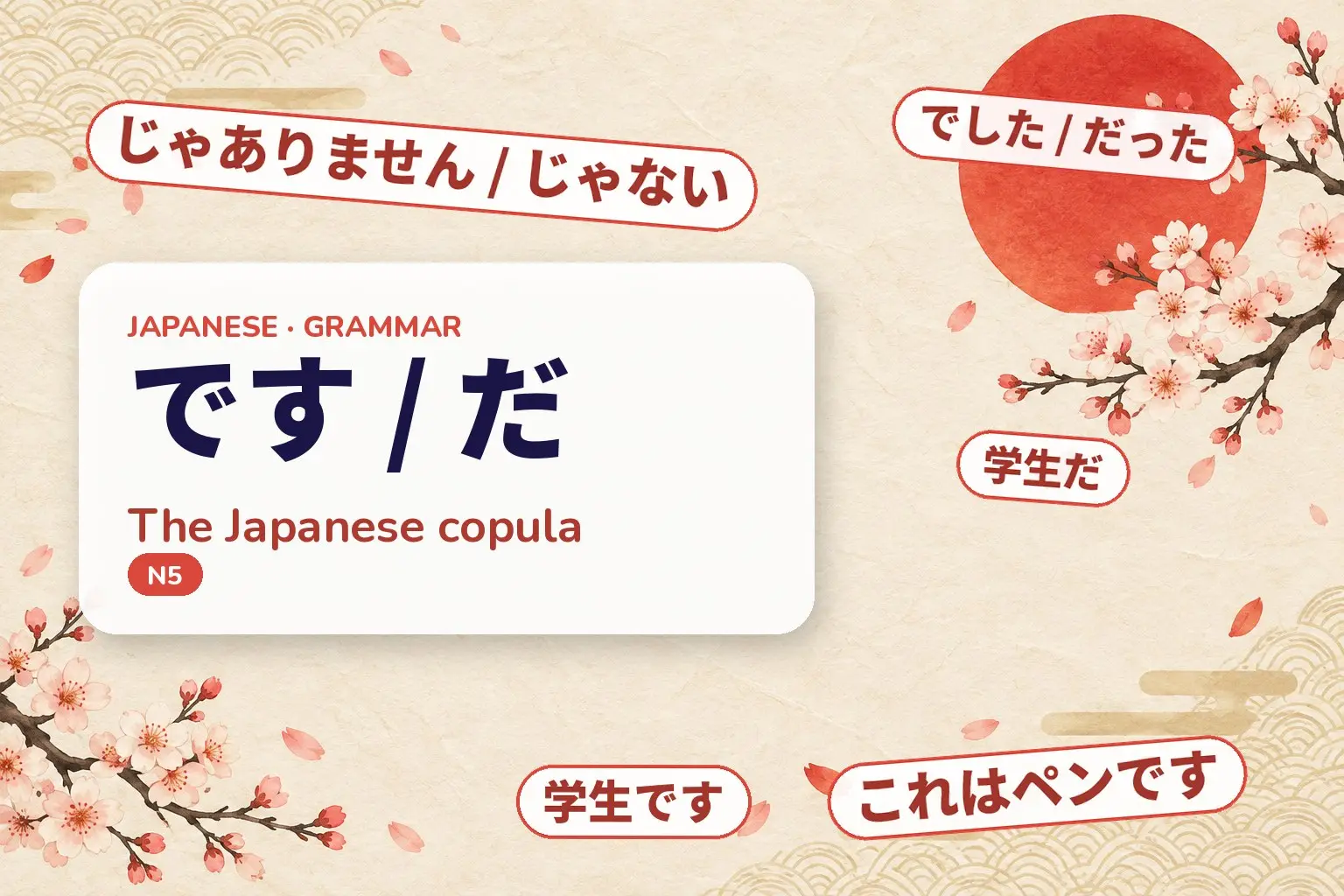
With nouns (and na-adjectives), です (desu) and だ (da) work like English 'am/is/are', linking a topic to a noun. The pattern is X は Y です: 私は学生です (Watashi wa gakusei desu) = 'I am a student.' です is polite; だ is the plain form. The past is でした / だった, and the negative is ではありません / ではない.
Level: N5. (Note: the JLPT publishes no official grammar list; the level shown is the common textbook convention.)
With nouns and na-adjectives, です (desu) and だ (da) — the Japanese copula — often correspond to English “am/is/are”, joining a topic to a noun. (It is not an exact match for every use of “be”.) If you can say 私は学生です (Watashi wa gakusei desu, “I am a student”), you already have the core pattern.
The rule
A copula is a linking word like English “is/am/are”. The everyday copula has two main registers (more formal and literary forms such as である and でございます also exist, and in casual speech the plain だ is often dropped):
- です (desu) — polite. Use it with people you don’t know well, in most learning situations.
- だ (da) — plain. Use it with close friends and in plain-style writing. Sentence-final だ can sound firm, so in relaxed speech it is often dropped: 学生 or 静か instead of 学生だ or 静かだ.
The sentence pattern is topic は noun + copula: 〔topic〕は〔noun〕です.
The particle は (written は but read wa here) marks the topic — see the topic-particle lesson in the Japanese grammar section.
Polite and plain forms
| Plain (だ) | Polite (です) | |
|---|---|---|
| Present (“is”) | だ (da) | です (desu) |
| Past (“was”) | だった (datta) | でした (deshita) |
| Negative (“is not”) | ではない / じゃない (dewa nai / ja nai) | ではありません / じゃありません (dewa arimasen / ja arimasen) |
| Negative past (“was not”) | ではなかった / じゃなかった | ではありませんでした |
じゃ (ja) is the more conversational contraction of では (dewa). The ending sets the politeness: じゃない is plain, じゃありません is polite.
Example sentences
Each sentence was written for this lesson (not copied from a third-party corpus), with readings.
- 私は学生です。 — Watashi wa gakusei desu. — I am a student.
- これはペンです。 — Kore wa pen desu. — This is a pen.
- 彼は先生です。 — Kare wa sensei desu. — He is a teacher.
- 田中さんは日本人です。 — Tanaka-san wa nihonjin desu. — Tanaka is Japanese. (さん is a gender-neutral honorific attached to names; it has no exact English equivalent)
- それは私の本です。 — Sore wa watashi no hon desu. — That is my book.
- 今日は月曜日です。 — Kyō wa getsuyōbi desu. — Today is Monday.
- 明日は休みです。 — Ashita wa yasumi desu. — Tomorrow is a day off.
- あれは猫だ。 — Are wa neko da. — That is a cat. (plain)
- 彼女は学生でした。 — Kanojo wa gakusei deshita. — She was a student. (past)
- これは水ではありません。 — Kore wa mizu dewa arimasen. — This is not water. (negative)
- 私は医者ではありません。 — Watashi wa isha dewa arimasen. — I am not a doctor.
- ここは学校です。 — Koko wa gakkō desu. — This place is a school.
Common mistakes
- ❌ 私は学生だです。 → ✅ 学生です or 学生だ. Use one copula, not both.
- ❌ 忙しいだ。 → ✅ 忙しい / 忙しいです. Don’t put だ after an い-adjective (忙しい = “busy”). After an い-adjective, です only adds politeness.
- ❌ これは水じゃありませんです。 → ✅ これは水ではありません. じゃありません is already the complete polite negative, so don’t add another です. (In conversation you will also hear じゃないです.)
- ❌ (for “was”) 学生です → ✅ 学生でした. Use the past form でした.
Compared with…
- は particle (wa) — marks the topic in front of the copula.
- な-adjectives — these behave like nouns and also take です/だ (静かです = “is quiet”), unlike い-adjectives.
Both are in the Japanese grammar section.
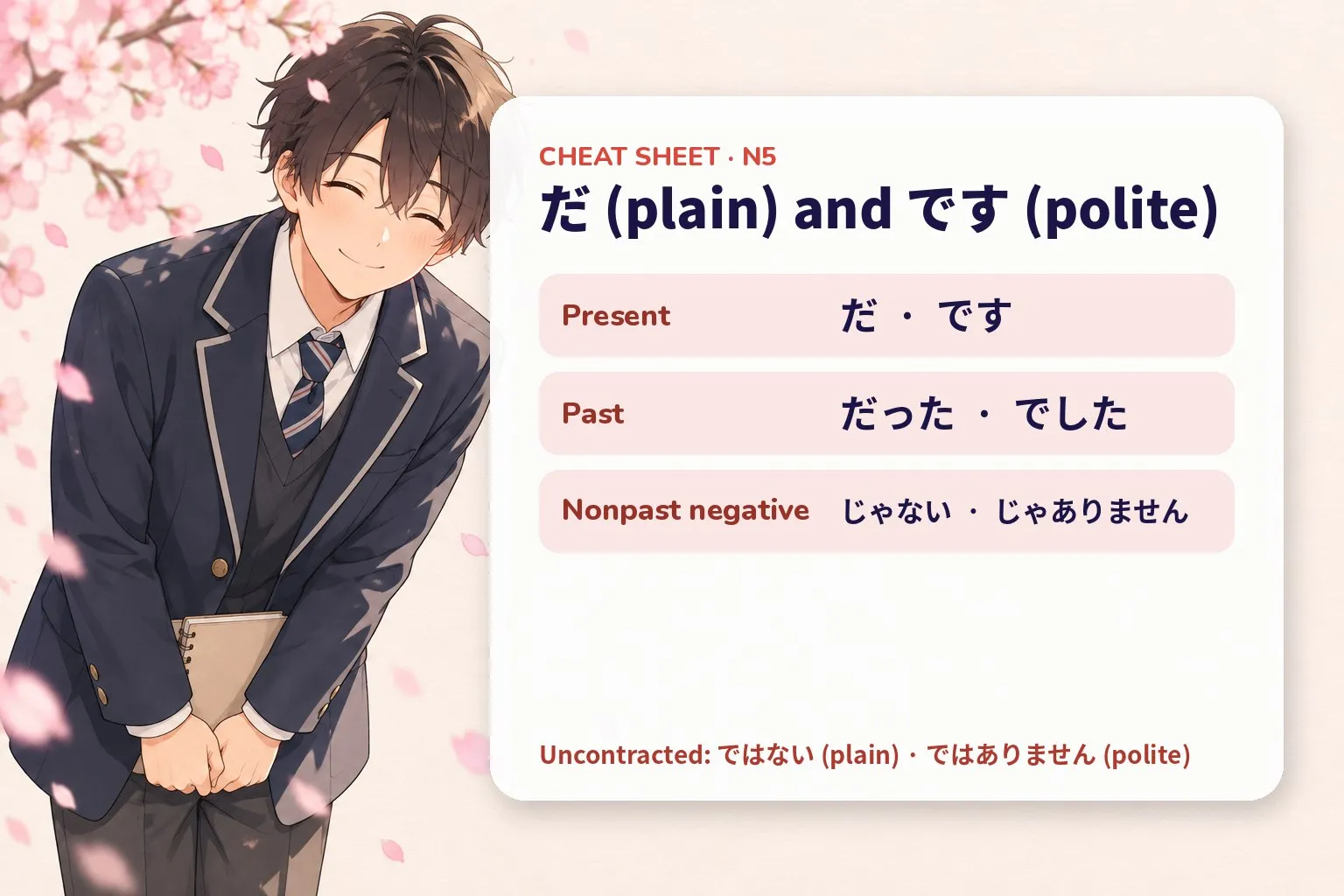
Quick recap before the quiz.
Mini quiz
- 私は学生__。 (polite “I am a student”)
- 彼女は学生__。 (polite “she was a student”)
- これは水______。 (polite “this is not water”)
- True or false: you can say 忙しいだ.
- あれは猫_。 (plain “that is a cat”)
Answers
- です — polite present.
- でした — polite past.
- ではありません (or じゃありません) — polite negative.
- False — い-adjectives don’t take だ; say 忙しい or 忙しいです.
- だ — plain copula.
Sources & licensing
- Forms cross-checked with Wiktionary (CC BY-SA 4.0); readings checked against Jisho.
- Level placement follows the common JLPT textbook convention (N5).
- Example sentences were written for this lesson (no third-party sentences copied), with romaji readings.
Next
- Back to the Japanese grammar section
- New here? Start with Start Learning Japanese Here
Sources
- だ / です — Japanese copula — Wiktionary (CC BY-SA 4.0) (as of October 2026)
- Jisho — Japanese dictionary (readings) — Jisho.org (as of October 2026)
- JLPT level summary (N5) — Japan Foundation & JEES (JLPT) (as of October 2026)