겠 (get): Intention, Conjecture and Politeness in Korean
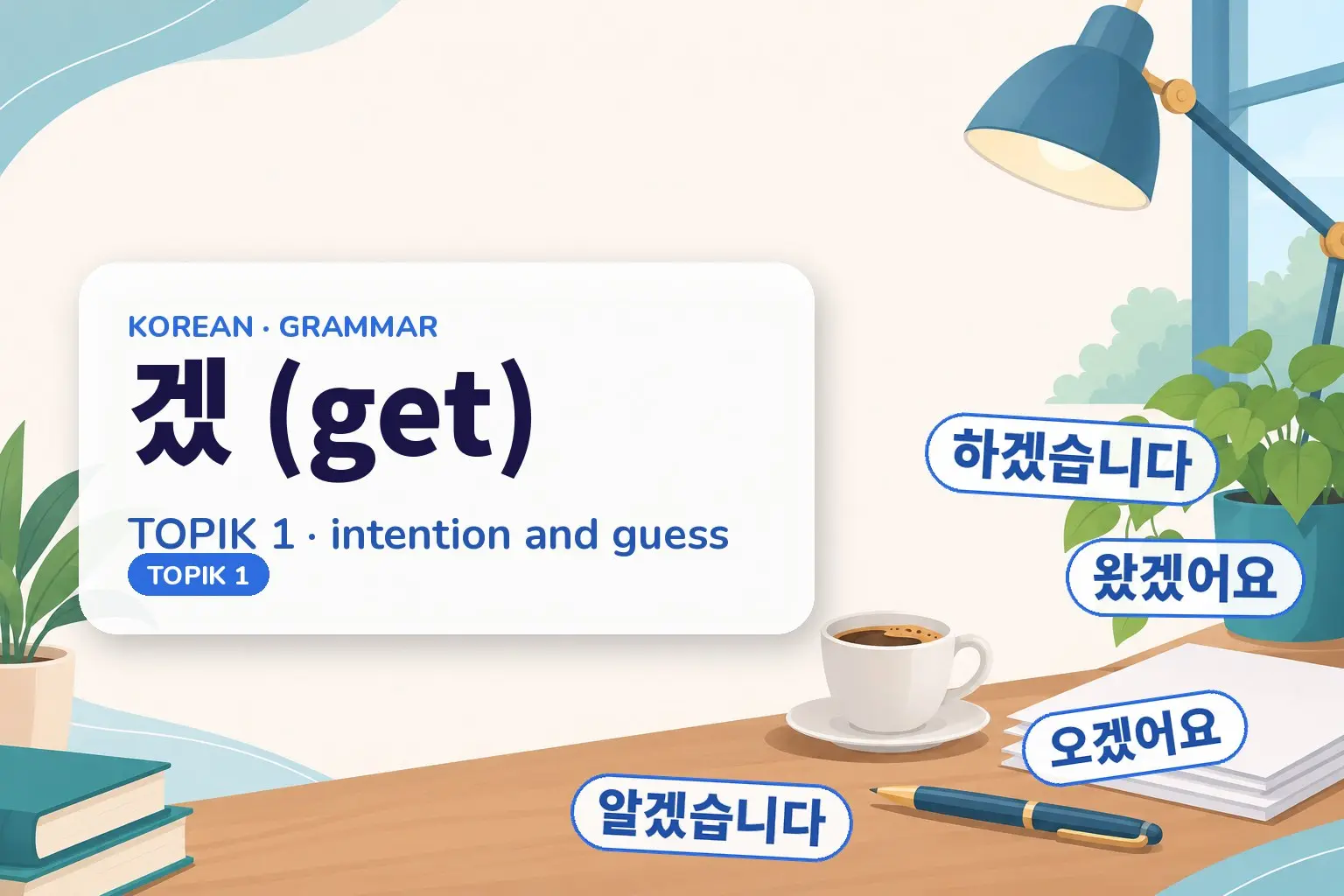
겠 (get) is a pre-final ending: it sits on the verb stem before the final ending. 제가 하겠습니다 (je ga hagesseumnida) means 'I will do it', 비가 오겠어요 (biga ogesseoyo) means 'it looks like rain', and 알겠습니다 (algesseumnida) means 'I understand'.
Level: TOPIK 1. One short ending, three jobs. 겠 (get) is the ending Koreans use to announce a decision, to guess what someone else is feeling, and to say “understood” in an office. Learn the three uses apart and it stops being ambiguous.
The rule
겠 (get) is a pre-final ending: it attaches to a verb stem and then takes the final ending that carries politeness and tense, such as 어요 (eoyo) or 습니다 (seumnida). It does not change the stem, and it does not care whether the stem ends in a vowel or a consonant.
- 가다 (gada, go) → 가겠어요 (gagesseoyo) — “I will go”
- 먹다 (meokda, eat) → 먹겠어요 (meokgesseoyo) — “I will eat”
- 하다 (hada, do) → 하겠습니다 (hagesseumnida) — “I will do it”
The meaning depends on who is doing the action. With 저 (jeo, I) or 제가 (je ga, I, as the subject) it is a statement of intention. With you or he or she or the weather, it is a guess. A small closed set of phrases uses it as pure politeness.
Forms
The ending itself is stable; only the final ending after it changes.
| Stem type | Verb | 겠 form (reading) | Meaning |
|---|---|---|---|
| Vowel stem | 가다 (gada, go) | 가겠어요 (gagesseoyo) | I will go |
| Consonant stem | 먹다 (meokda, eat) | 먹겠어요 (meokgesseoyo) | I will eat |
| ㄹ stem | 살다 (salda, live) | 살겠어요 (salgesseoyo) | I will live |
| 하다 verb | 하다 (hada, do) | 하겠습니다 (hagesseumnida) | I will do it |
| Formal polite | 오다 (oda, come) | 오겠습니다 (ogesseumnida) | I will come |
| Past conjecture | 힘들다 (himdeulda, be hard) | 힘들었겠어요 (himdeureotgesseoyo) | it must have been hard |
The final ending decides the register, not the meaning: 가겠어요 (gagesseoyo) and 가겠습니다 (gagesseumnida) are the same intention at two levels of formality, and 가겠다 (gagessda) is the plain written form a newspaper would use.
The three uses
| Use | Subject | Example (reading) | Meaning |
|---|---|---|---|
| Intention, a decision made now | I | 제가 하겠습니다 (je ga hagesseumnida) | I will do it |
| Intention, a promise | I | 내일 다시 오겠습니다 (naeil dasi ogesseumnida) | I will come again tomorrow |
| Conjecture about a person | you, he, she | 피곤하겠어요 (pigonhagesseoyo) | you must be tired |
| Conjecture about a thing | it, the weather | 비가 오겠어요 (biga ogesseoyo) | it looks like rain |
| Polite formula | I | 알겠습니다 (algesseumnida) | I understand, I will do it |
| Past conjecture | anyone | 힘들었겠어요 (himdeureotgesseoyo) | it must have been hard |
Intention is the use textbooks teach first, and it carries a shade of decision: the speaker is committing at the moment of speaking, often to a superior. That is why it dominates office Korean and service language.
Conjecture is the use that surprises learners. 겠어요 (gesseoyo) after a second-person subject is not a prediction of will but an inference from evidence: the listener looks exhausted, so 피곤하겠어요 (pigonhagesseoyo) means “you must be tired”. The same shape covers the weather, prices and other things the speaker can see but not control.
Politeness formulas are a short list worth memorising whole: 알겠습니다 (algesseumnida, understood), 모르겠어요 (moreugesseoyo, I am not sure), 잘 먹겠습니다 (jal meokgesseumnida, said before a meal) and 잘 다녀오겠습니다 (jal danyeoo-gesseumnida, said when leaving and coming back).
Example sentences
- 제가 하겠습니다.je ga hagesseumnidaI will do it.The office standard for taking a task.
- 내일 다시 오겠습니다.naeil dasi ogesseumnidaI will come again tomorrow.A promise to a superior.
- 잘 먹겠습니다.jal meokgesseumnidaThank you for the meal.Said before eating; a fixed formula.
- 알겠습니다.algesseumnidaI understand.Also the standard yes to an instruction.
- 모르겠어요.moreugesseoyoI am not sure.Softer than 모릅니다 (moreumnida).
- 비가 오겠어요.biga ogesseoyoIt looks like it will rain.Conjecture about the weather.
- 피곤하겠어요.pigonhagesseoyoYou must be tired.Conjecture about the listener, not a future.
- 힘들었겠어요.himdeureotgesseoyoIt must have been hard.Past conjecture: 었 (eot) before 겠 (get).
- 뭐 드시겠어요?mwo deusigesseoyo?What would you like to eat?A polite offer, common in restaurants.
- 저는 비빔밥을 먹겠어요.jeoneun bibimbabeul meokgesseoyoI will have bibimbap.Intention with a first-person subject.
- 내일은 집에 있겠습니다.naeireun jibe itgesseumnidaI will stay at home tomorrow.있다 (itda) takes the ending like any verb.
- 친구가 벌써 도착했겠어요.chinguga beolsseo dochakhaetgesseoyoMy friend must have arrived already.Conjecture about a third person, in the past.
- 이 책은 재미있겠어요.i chaekeun jaemiitgesseoyoThis book looks interesting.겠 works on adjectives too.
- 제가 도와드리겠습니다.je ga dowadeurigesseumnidaI will help you.The humble verb 드리다 (deurida) plus 겠.
- 그분은 아마 모르겠어요.geubuneun ama moreugesseoyoHe probably does not know.The same formula read as a guess about him.
- 다음 주에 시작하겠습니다.daeum jue sijakhagesseumnidaWe will start next week.Announcement style, very common in business.
- 많이 기다리셨겠어요.mani gidarisyeotgesseoyoYou must have waited a long time.Past conjecture with the honorific 시 (si).
- 저는 여기서 기다리겠습니다.jeoneun yeogiseo gidarigesseumnidaI will wait here.Intention, formal register.
Common mistakes
- ✗ 학생겠습니다 (haksaeng-gesseumnida) → ✓ 학생이겠습니다 (haksaeng-igesseumnida). A noun needs the copula 이 (i) before the ending.
- ✗ 친구가 내일 오겠어요 (chinguga naeil ogesseoyo) used for “my friend will come tomorrow” → ✓ 친구가 내일 올 거예요 (chinguga naeil ol geoyeyo). With a third person 겠 (get) reads as “probably will come”.
- ✗ 어제 먹겠어요 (oje meokgesseoyo) → ✓ 어제 먹었어요 (oje meogeosseoyo). The past needs its own ending.
- ✗ 알았습니다 (arasseumnida) when you mean “understood, I will do it” → ✓ 알겠습니다 (algesseumnida). 알았습니다 (arasseumnida) reports that you understood something earlier.
- ✗ Between close friends, 내가 하겠어 (naega hagesseo) as the everyday way to volunteer → ✓ 내가 할게 (naega halge). 겠 (get) is correct Korean but sounds stiff in casual company.
A short conversation
Two colleagues looking at a report that has to go out tonight.
A: 이거 제가 하겠습니다. (igeo je ga hagesseumnida.) — I will do this. B: 괜찮아요. 제가 할게요. (gwaenchanayo. je ga halgeyo.) — It is fine, I will do it. A: 아니에요, 시간도 없겠어요. 제가 빨리 하겠습니다. (anieyo, sigando eopgesseoyo. je ga ppalli hagesseumnida.) — No, you probably have no time. I will do it quickly. B: 그럼 부탁드리겠습니다. (geureom butakdeurigesseumnida.) — Then I will leave it to you.
Usage notes
The 겠습니다 (gesseumnida) ending is the voice of announcements. In business writing, speeches and news reports, a first-person 겠습니다 (gesseumnida) is the normal way to state what the speaker’s side will do. It sounds more decisive than the plan form ㄹ 거예요 (l geoyeyo), which is why press releases are full of it.
In service questions it asks the customer’s intention. 드시겠어요? (deusigesseoyo?, will you eat?) and 가시겠어요? (gasigesseoyo?, will you go?) are polite offers rather than guesses. The subject is the customer, so the same form that guesses elsewhere here simply hands the decision over.
Past conjecture is a sympathy machine. Add 았 (at) or 었 (eot) before 겠 (get) and the guess moves into the past, which lets you acknowledge someone’s effort or difficulty: 고생했겠어요 (gosaenghaetgesseoyo, you must have had a hard time). It is one of the kindest structures in the language and it belongs to this ending.
Compared with the plan form ㄹ 거예요 (l geoyeyo)
Both can talk about the future, and learners mix them constantly. The difference is what kind of statement the speaker is making.
| 겠 (get) | ㄹ 거예요 (l geoyeyo) | |
|---|---|---|
| First person (reading) | decision or promise, formal | plan, neutral |
| Third person (reading) | guess: probably will | prediction or reported plan |
| Past | 았 (at) or 었 (eot) before 겠 (get) | 왔을 거예요 (wasseul geoyeyo) for a past guess |
| Typical setting | office, service, announcements | everyday conversation |
The rule of thumb: if you are committing yourself or inferring something about someone else, use 겠 (get); if you are stating a plan or a prediction as a fact, use ㄹ 거예요 (l geoyeyo). 겠어요 (gesseoyo) about your own plan sounds like a formal decision; ㄹ 거예요 (l geoyeyo) about your own plan sounds like a diary entry.
Practice
겠 (get) practice
Try each one, then press Check. No sign-up, nothing is sent anywhere — it all runs in your browser.
Hint: stem plus 겠 (get) plus 어요 (eoyo)
Show answer
gagesseoyo — 가다 (gada) becomes 가겠어요 (gagesseoyo).
4 Build: 'I will have bibimbap.'
Show answer
저는 (jeoneun) 비빔밥을 (bibimbabeul) 먹겠어요 (meokgesseoyo) — Topic, object with 을, then the verb with 겠 (get).
5 Match each phrase to its meaning.
- 알겠습니다 (algesseumnida)
- 모르겠어요 (moreugesseoyo)
- 힘들었겠어요 (himdeureotgesseoyo)
- 잘 먹겠습니다 (jal meokgesseumnida)
Show answer
- 알겠습니다 (algesseumnida) → understood
- 모르겠어요 (moreugesseoyo) → I am not sure
- 힘들었겠어요 (himdeureotgesseoyo) → it must have been hard
- 잘 먹겠습니다 (jal meokgesseumnida) → thanks for the meal
Four fixed phrases that cover most of daily 겠 (get) use.
Quiz
겠 (get) quiz
12 questions · pick an answer and you'll see straight away if it's right.
-
Show answer
between the stem and the final ending — It is a pre-final ending: stem, then 겠 (get), then the ending such as 어요 (eoyo).
-
Show answer
I will do it — First person plus 겠 (get) is intention.
-
Show answer
you must be tired — With a second-person subject 겠 (get) is a guess from evidence.
-
Show answer
비가 왔겠어요 (biga watgesseoyo) — Past marker first, then 겠: 왔겠어요 (watgesseoyo).
-
Show answer
understood, I will do it — It is the standard acknowledgement of an instruction.
-
Show answer
잘 먹겠습니다 (jal meokgesseumnida) — 잘 먹겠습니다 (jal meokgesseumnida) thanks the host before the meal.
-
Show answer
살겠어요 (salgesseoyo) — The ㄹ stays: 살다 (salda) becomes 살겠어요 (salgesseoyo).
-
Show answer
학생이겠습니다 (haksaeng-igesseumnida) — The copula 이 (i) comes before the ending.
-
Show answer
a polite offer of food or drink — In service questions 겠 (get) hands the decision to the customer.
-
Show answer
ㄹ 거예요 (l geoyeyo) — The plan form is neutral and conversational; 겠 (get) sounds like a formal decision.
-
Show answer
you must have waited a long time — Past conjecture with the honorific 시 (si): a sympathetic guess about the listener.
-
Show answer
meokgesseoyo — 먹다 (meokda) becomes 먹겠어요 (meokgesseoyo).
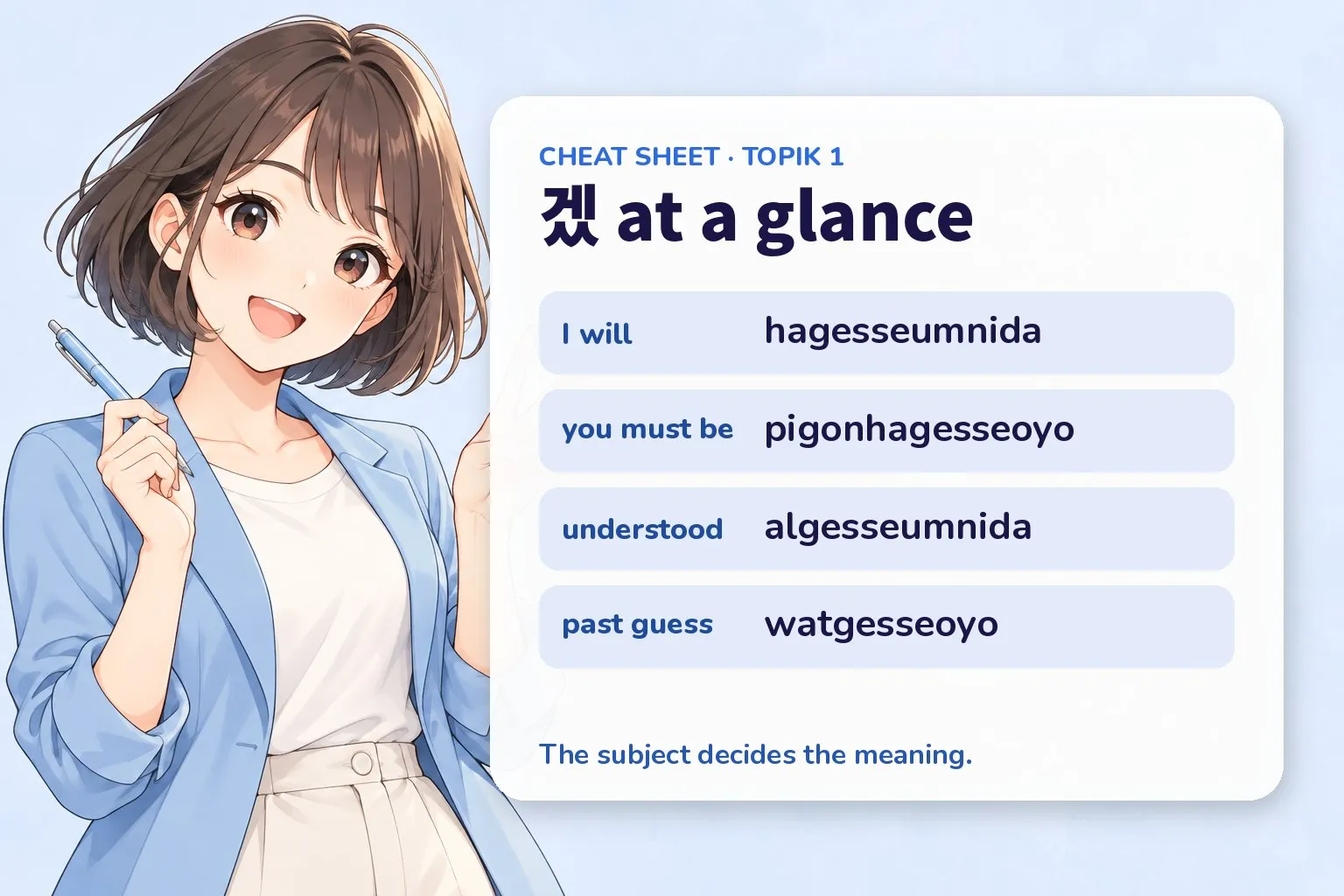
Quick recap before the quiz.
Recap cheat-sheet
| Use | Subject | Example (reading) |
|---|---|---|
| Intention | I | 가겠습니다 (gagesseumnida) |
| Conjecture | you, he, it | 피곤하겠어요 (pigonhagesseoyo) |
| Polite formula | I | 알겠습니다 (algesseumnida) |
| Past conjecture | anyone | 왔겠어요 (watgesseoyo) |
| Form | stem plus 겠 plus ending | 먹겠어요 (meokgesseoyo) |
| Register | final ending decides | 겠어요, 겠습니다, 겠다 |
Next
- The polite present endings that 겠 (get) builds on: 아요/어요 (ayo/eoyo)
- The formal 습니다 (seumnida) register: formal 하십니다 (hasimnida) style
- Nouns and the copula 이다 (ida): 이다 (ida) copula
- New here? Start with Start Learning Korean Here
All Korean grammar topics
Every grammar point in order, from your first sentence to advanced structures. Pick one and go straight to it. New lessons go live every day, so topics marked Coming soon fill in over the next weeks.
Grammar path
TOPIK 1 25 topics · 22 ready
- 01 이다 (ida): The Copula (To Be)
- 02 은/는 (eun/neun): The Topic Particle
- 03 이/가 (i/ga): The Subject Particle
- 04 을/를 (eul/reul): The Object Particle
- 05 에 (e): Location & Time Particle
- 06 에서 (eseo): Place of Action & From
- 07 도 (do): Also / Too
- 08 와/과 (wa/gwa), 하고 (hago), (이)랑 ((i)rang): And / With
- 09 의 (ui): Possessive Particle
- 10 있다 / 없다 (itda/eopda): Existence & Possession
- 11 이 / 그 / 저 (i/geu/jeo): This / That
- 12 여기 / 거기 / 저기 (yeogi/geogi/jeogi): Here / There
- 13 아요/어요 (ayo/eoyo): Polite Present Tense
- 14 ㅂ니다/습니다 (mnida/seumnida): Formal Polite Style
- 15 았/었어요 (at/eosseoyo): Past Tense
- 16 안 / 지 않다 (an/ji anta): Negation (Not)
- 17 못 / 지 못하다 (mot/ji mothada): Cannot (Inability)
- 18 에게/한테/께 (ege/hante/kke): To a Person
- 19 부터 / 까지 (buteo/kkaji): From and Until
- 20 고 싶다 (go sipda): Want to Do
- 21 으러 가다/오다 (eureo gada/oda): Go/Come to Do
- 22 겠 (get): Intention & Conjecture You are here
- 23 (으)ㄹ 거예요 ((eu)l geoyeyo): Future Tense Coming soon
- 24 (으)세요 ((eu)seyo): Honorific Ending & Requests Coming soon
- 25 (으)시 ((eu)si): Subject Honorific Coming soon
TOPIK 2 33 topics
- 26 고 있다 (go itda): Progressive (-ing) Coming soon
- 27 아/어 보다 (a/eo boda): Try Doing Coming soon
- 28 아/어 주다 (a/eo juda): Do For Someone Coming soon
- 29 (으)ㄹ 수 있다/없다 ((eu)l su itda/eopda): Can / Cannot Coming soon
- 30 아야/어야 되다/하다 (aya/eoya doeda/hada): Must / Have To Coming soon
- 31 지 마세요 (ji maseyo): Don't Do That Coming soon
- 32 (으)면 ((eu)myeon): If / When (Conditional) Coming soon
- 33 (으)니까 ((eu)nikka): Because / Since Coming soon
- 34 아서/어서 (aseo/eoseo): Because & Sequence Coming soon
- 35 (으)ㄹ까요 ((eu)lkkayo)?: Shall We / I? Coming soon
- 36 (으)ㅂ시다 / 자 ((eu)psida/ja): Let's Coming soon
- 37 는 것 (neun geot): Nominalising with 것 (geot) Coming soon
- 38 기 (gi): Nominalising with 기 (gi) Coming soon
- 39 기 때문에 (gi ttaemune): Because (Noun Reason) Coming soon
- 40 (으)ㄴ/는/(으)ㄹ ((eu)n/neun/(eu)l): Verb-to-Modifier Endings Coming soon
- 41 보다 (boda): Comparisons (Than) Coming soon
- 42 제일 / 가장 (jeil/gajang): The Most (Superlative) Coming soon
- 43 아도/어도 되다 (ado/eodo doeda): Permission (May) Coming soon
- 44 (으)면 안 되다 ((eu)myeon an doeda): Must Not Coming soon
- 45 기 전에 / (으)ㄴ 후에 (gi jeone/(eu)n hue): Before & After Coming soon
- 46 (으)ㄹ 때 / 았을 때 ((eu)l ttae/asseul ttae): When Coming soon
- 47 (으)ㄹ게요 ((eu)lgeyo): I'll Do (Promise) Coming soon
- 48 지요 / 죠 (jiyo/jyo): Right? (Seeking Agreement) Coming soon
- 49 는데/(으)ㄴ데 (neunde/(eu)nde): Background & Contrast Coming soon
- 50 지만 (jiman): But / However Coming soon
- 51 거나 / (이)나 (geona/(i)na): Or Coming soon
- 52 아지다/어지다 (ajida/eojida): Become (Adjectives) Coming soon
- 53 게 되다 (ge doeda): Come To / Turn Out Coming soon
- 54 고 (go): And (Linking Clauses/Actions) Coming soon
- 55 동안 / 는 동안 (dongan/neun dongan): During / While Coming soon
- 56 게 / 히 (ge/hi): Making Adverbs Coming soon
- 57 은/는 (eun/neun) vs 이/가 (i/ga): Topic vs Subject Coming soon
- 58 네요 / 군요 (neyo/gunyo): Realisation & Exclamation Coming soon
TOPIK 3 20 topics
- 59 (으)ㄴ/는/(으)ㄹ 것 같다 ((eu)n/neun/(eu)l geot gatda): Seems Like Coming soon
- 60 기로 하다 (giro hada): Decide To Coming soon
- 61 (으)려고 하다 ((eu)ryeogo hada): Intend To / About To Coming soon
- 62 (으)려면 ((eu)ryeomyeon): If You Intend To Coming soon
- 63 아/어 있다 (a/eo itda): Resultant State Coming soon
- 64 아/어 버리다 (a/eo beorida): Completely / Regrettably Coming soon
- 65 고 나서 (go naseo): After Finishing Coming soon
- 66 다가 (daga): While / Switching Action Coming soon
- 67 (으)ㄴ 적이 있다 ((eu)n jeogi itda): Have Done Before Coming soon
- 68 자마자 (jamaja): As Soon As Coming soon
- 69 (으)면서 ((eu)myeonseo): While (Simultaneous) Coming soon
- 70 밖에 (bakke): Only (with Negative) Coming soon
- 71 만 (man): Only / Just Coming soon
- 72 처럼 / 같이 (cheoreom/gachi): Like / As Coming soon
- 73 아도/어도 (ado/eodo): Even If / Even Though Coming soon
- 74 (으)ㄹ수록 ((eu)lsurok): The More... The More Coming soon
- 75 든지 / 든가 (deunji/deunga): Whether / Any Coming soon
- 76 는 중이다 / 는 길에 (neun jungida/neun gire): In the Middle / On the Way Coming soon
- 77 (으)ㄴ/는 데다가 ((eu)n/neun dedaga): In Addition Coming soon
- 78 (으)ㄹ 줄 알다/모르다 ((eu)l jul alda/moreuda): Know How To Coming soon
TOPIK 4 20 topics
- 79 더라고요 (deoragoyo): Retrospective Observation Coming soon
- 80 던 / 았던 (deon/atdeon): Recalled Past Modifier Coming soon
- 81 (으)ㄴ/는 반면에 ((eu)n/neun banmyeone): On the Other Hand Coming soon
- 82 (으)ㄹ 뿐만 아니라 ((eu)l ppunman anira): Not Only...But Also Coming soon
- 83 (으)ㄴ/는 데 비해 ((eu)n/neun de bihae): Compared To Coming soon
- 84 (으)로 인해/때문에/덕분에/탓에 ((eu)ro inhae/ttaemune/deokbune/tase) Coming soon
- 85 는 바람에 (neun barame): Because Of (Unexpected Result) Coming soon
- 86 느라고 (neurago): Because (Simultaneous, Negative) Coming soon
- 87 (으)ㄹ 테니까 ((eu)l tenikka): I Will So / Probably So Coming soon
- 88 (으)ㄹ지도 모르다 ((eu)ljido moreuda): Might / May Coming soon
- 89 (으)ㄴ/는 척하다 ((eu)n/neun cheokhada): Pretend To Coming soon
- 90 게 하다 / 시키다 (ge hada/sikida): Make / Let (Causative) Coming soon
- 91 이/히/리/기 (i/hi/ri/gi): Passive & Causative Suffixes Coming soon
- 92 도록 (dorok): So That / Until / To the Extent Coming soon
- 93 게 (ge): Adverbial / So That Coming soon
- 94 (으)ㄹ 정도로 ((eu)l jeongdoro): To the Extent That Coming soon
- 95 다 보니 / 다 보면 (da boni/da bomyeon): As You Keep Doing Coming soon
- 96 (으)ㄴ/는 김에 ((eu)n/neun gime): While You're At It Coming soon
- 97 (으)ㄹ 겸 ((eu)l gyeom): Also For the Purpose Of Coming soon
- 98 아/어 봤자 (a/eo bwatja): Even If (Pointless) Coming soon
TOPIK 5 12 topics
- 99 더니 / 았더니 (deoni/atdeoni): And Then / Change Coming soon
- 100 (으)ㄴ/는 셈이다 ((eu)n/neun semida): As Good As / In Effect Coming soon
- 101 (으)ㄹ 만하다 / 법하다 ((eu)l manhada/beophada): Worth / Likely Coming soon
- 102 (으)ㄹ 리가 없다 ((eu)l riga eopda): No Way / Can't Be Coming soon
- 103 (으)ㄴ/는 마당에 ((eu)n/neun madange): Now That / Given Coming soon
- 104 기 마련이다 / 법이다 (gi maryeonida/beobida): Bound To / Naturally Coming soon
- 105 았/었더라면 (at/eotdeoramyeon): If (Only) I Had Coming soon
- 106 기는커녕 (gineunkeonyeong): Far From / Let Alone Coming soon
- 107 에 따라 / (으)ㅁ에 따라 (e ttara/(eu)me ttara): According To / As Coming soon
- 108 ㄴ다/는다 (nda/neunda): Plain Declarative (Written) Coming soon
- 109 (으)ㄹ지언정 ((eu)ljieonjeong): Even If / Rather Than Coming soon
- 110 (으)ㄹ락 말락 ((eu)llak mallak): On the Verge Of Coming soon
TOPIK 6 7 topics
- 111 (으)ㅁ으로써 ((eu)meurosseo): By Means Of (Formal) Coming soon
- 112 (으)ㄴ 나머지 ((eu)n nameoji): As a Result Of (Excess) Coming soon
- 113 (으)ㄹ 턱이 없다 ((eu)l teogi eopda): There's No Way Coming soon
- 114 는 통에 (neun tonge): Because Of (Chaotic) Coming soon
- 115 고자 (goja): In Order To (Formal) Coming soon
- 116 는 양 / (으)ㄴ 양 (neun yang/(eu)n yang): As If / Pretending Coming soon
- 117 기에 망정이지 (gie mangjeongiji): Luckily / Thank Goodness Coming soon