은/는 (eun/neun): The Topic Particle
은/는 (eun/neun) is the Korean topic particle: it marks what a sentence is about. 저는 학생이에요 (Jeoneun haksaeng-ieyo) means 'As for me, I am a student.' Use 은 after a consonant and 는 after a vowel.
Level: TOPIK 1. A particle is a short ending added to a noun to show its job. 은/는 (eun/neun) is the topic particle: it marks what the sentence is about, like the English “as for…”.
The rule
은/는 (eun/neun) lifts a noun up as the topic and the rest of the sentence comments on it. 저는 학생이에요 (Jeoneun haksaeng-ieyo) = “As for me, I am a student.”
Which form you use depends only on the sound at the end of the noun:
- After a consonant (a final consonant is called a 받침 (batchim)), use 은 (eun): 학생은 (haksaeng-eun).
- After a vowel, use 는 (neun): 저는 (jeoneun).
Beyond naming the topic, 은/는 (eun/neun) does two familiar jobs:
- Marks known information. It frames something already in view, then adds a comment: 오늘은 더워요 (Oneureun deowoyo) = “As for today, it’s hot.”
- Shows contrast. Marking two nouns with 은/는 (eun/neun) sets them against each other: 고양이는 좋아하지만 개는 안 좋아해요 (Goyangineun joahajiman gaeneun an joahaeyo) = “I like cats, but I don’t like dogs.”
Choosing 은 (eun) or 는 (neun)
| Noun ending | Particle | Reading | Example |
|---|---|---|---|
| consonant (받침) | 은 | eun | 학생은 (haksaeng-eun) |
| vowel | 는 | neun | 저는 (jeoneun) |
Topic vs subject at a glance
| Korean | Reading | English and nuance |
|---|---|---|
| 저는 학생이에요. | Jeoneun haksaeng-ieyo. | I am a student. (neutral topic) |
| 제가 학생이에요. | Jega haksaeng-ieyo. | I am the student. (identifies who) |
| 커피는 마셔요. | Keopineun masyeoyo. | Coffee, I do drink. (contrast) |
| 시간은 없어요. | Siganeun eopseoyo. | I have no time. (emphasis on the negative) |
Example sentences
Each sentence was written for this lesson, with readings.
- 저는 학생이에요.Jeoneun haksaeng-ieyo.I am a student.저 ends in a vowel, so 는
- 이것은 책이에요.Igeoseun chaegieyo.This is a book.이것 ends in a consonant, so 은
- 그 사람은 선생님이에요.Geu saram-eun seonsaengnim-ieyo.That person is a teacher.
- 저는 커피를 좋아해요.Jeoneun keopireul joahaeyo.I like coffee.
- 오늘은 더워요.Oneureun deowoyo.Today is hot.
- 고양이는 좋아하지만 개는 안 좋아해요.Goyangineun joahajiman gaeneun an joahaeyo.I like cats, but I don't like dogs.contrast: two topics set against each other
- 한국어는 어려워요.Hangugeoneun eoryeowoyo.Korean is difficult.
- 제 이름은 민수예요.Je ireumeun Minsu-yeyo.My name is Minsu.
- 시간은 없어요.Siganeun eopseoyo.I don't have time.은 adds emphasis to the negative
- 그는 의사예요.Geuneun uisayeyo.He is a doctor.
- 저는 서울에 살아요.Jeoneun Seoure sarayo.I live in Seoul.
- 어머니는 요리를 잘해요.Eomeonineun yorireul jalhaeyo.My mother cooks well.
- 그 책은 재미있어요.Geu chaegeun jaemiisseoyo.That book is interesting.
- 주말에는 집에 있어요.Jumareneun jibe isseoyo.On weekends I stay home.attaches after 에 for contrast
- 저는 고기를 안 먹어요.Jeoneun gogireul an meogeoyo.I don't eat meat.
- 서울은 큰 도시예요.Seoureun keun dosiyeyo.Seoul is a big city.
- 저 사람은 누구예요?Jeo saram-eun nuguyeyo?Who is that person?
- 겨울은 추워요.Gyeoureun chuwoyo.Winter is cold.
Common mistakes
- ❌ 제가 민수예요 (Jega Minsu-yeyo) for a plain self-introduction → ✅ 저는 민수예요 (Jeoneun Minsu-yeyo). 이/가 (i/ga) stresses “I, specifically”; a neutral introduction uses 은/는 (eun/neun).
- ❌ 학생는 (haksaengneun) → ✅ 학생은 (haksaeng-eun). After a consonant use 은 (eun), not 는 (neun).
- ❌ 저은 (jeoeun) → ✅ 저는 (jeoneun). After a vowel use 는 (neun), not 은 (eun).
- ❌ 저는이 학생이에요 (jeoneun-i haksaeng-ieyo) → ✅ 저는 학생이에요 (Jeoneun haksaeng-ieyo). Use one particle after the noun, not 는 (neun) and 이 (i) together.
- ❌ 고양이가 좋고 개가 싫어요 (goyangiga joko gaega sireoyo) for an explicit contrast → ✅ 고양이는…, 개는… (goyangineun…, gaeneun…). Contrast between two items takes 은/는 (eun/neun).
A short conversation
— 이름은 뭐예요? (Ireumeun mwoyeyo?) — “What is your name?” — 저는 린이에요. (Jeoneun Rin-ieyo.) — “I’m Rin.” — 직업은요? (Jigeobeunyo?) — “And your job?” — 저는 학생이에요. (Jeoneun haksaeng-ieyo.) — “I’m a student.”
Usage notes
- It attaches after some particles. For contrast, 은/는 (eun/neun) can follow a location particle: 에는 (eneun), 에서는 (eseoneun). Example: 서울에는 가요 (Seoure-neun gayo) = “To Seoul, I do go.”
- The topic is often dropped. Once it is clear, Korean leaves it out, as in 직업은요? (Jigeobeunyo?) above.
- A second one usually means contrast. Two 은/는 (eun/neun) phrases in a sentence normally set up a contrast rather than two topics.
Compared with other particles
- 이/가 (i/ga) is the subject particle: it marks the grammatical subject and new information, where 은/는 (eun/neun) marks the known topic. See the subject particle lesson.
- For a full side-by-side, read topic versus subject.
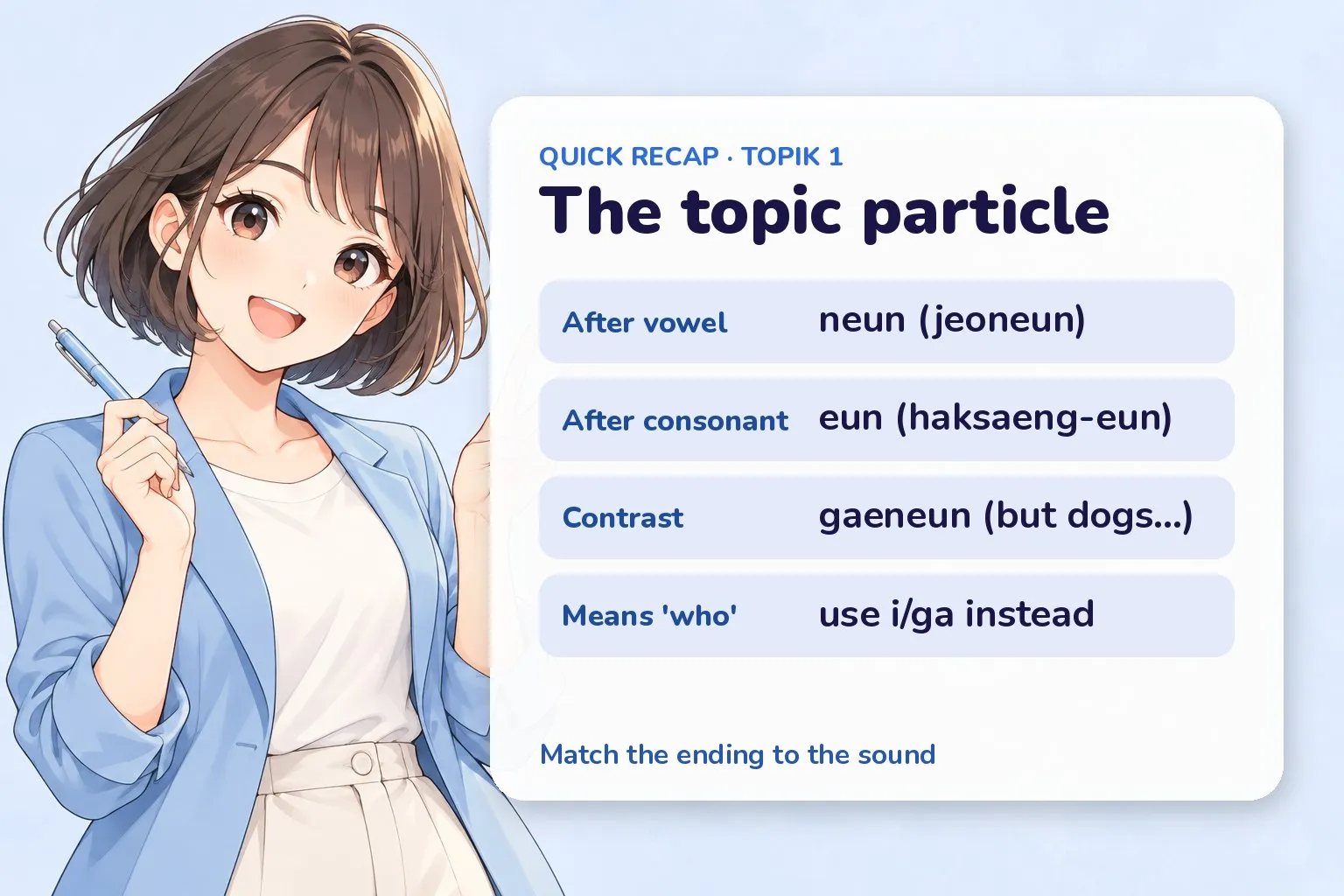
Quick recap before the quiz.
Practice
Topic particle practice
Try each one, then press Check. No sign-up, nothing is sent anywhere — it all runs in your browser.
Hint: Vowel ending.
Show answer
neun — After a vowel use 는, read neun: 저는 (jeoneun).
3 Build: 'I like coffee.'
Show answer
저는 (jeoneun) 커피를 (keopireul) 좋아해요 (joahaeyo) — Topic 저는 (jeoneun) + object 커피를 (keopireul) + verb 좋아해요 (joahaeyo).
4 Match each particle with its job.
- 은/는 (eun/neun)
- 이/가 (i/ga)
- 을/를 (eul/reul)
- 도 (do)
Show answer
- 은/는 (eun/neun) → topic marker
- 이/가 (i/ga) → subject / new info
- 을/를 (eul/reul) → direct object
- 도 (do) → also / too
은/는 (eun/neun) sets the topic; 이/가 (i/ga) marks the subject; 을/를 (eul/reul) marks the object; 도 (do) means too.
Quiz
Topic particle quiz
12 questions · pick an answer and you'll see straight away if it's right.
-
Show answer
The topic — 은/는 (eun/neun) marks the topic — what the sentence is about.
-
Show answer
은 (eun) — A 받침 (batchim), a final consonant, takes 은 (eun).
-
Show answer
는 (neun) — A vowel ending takes 는 (neun): 저는 (jeoneun).
-
Show answer
저는 학생이에요 (Jeoneun haksaeng-ieyo) — 은/는 (eun/neun) gives the neutral topic reading.
-
Show answer
'as for…' — Translating it as 'as for' shows the topic-then-comment shape.
-
Show answer
이/가 (i/ga) — 이/가 (i/ga) identifies the subject and gives new information.
-
Show answer
Contrast — Two 은/는 (eun/neun) phrases set items against each other — contrast.
-
Show answer
학생는 (haksaengneun) — 학생 (haksaeng) ends in a consonant, so it must take 은 (eun), not 는 (neun).
-
Show answer
는 (neun) — 저 (jeo) ends in a vowel, so 는 (neun): 저는 (jeoneun).
-
Show answer
Means 'also / too' and replaces 은/는 (eun/neun) — 도 (do) means 'also' and takes the place of 은/는 (eun/neun).
-
Show answer
eun — 오늘 (oneul) ends in a consonant, so 은, read eun.
-
Show answer
It points to what both speakers already have in mind — 은/는 (eun/neun) frames something already in view, then comments on it.
Recap cheat-sheet
| Use | Example | Reading |
|---|---|---|
| Topic (after vowel) | 저는 | jeoneun |
| Topic (after consonant) | 학생은 | haksaeng-eun |
| Contrast | 개는 안 좋아해요 | gaeneun an joahaeyo |
| Replaced by “too” | 저도 | jeodo |
Next
- Next grammar point: the subject particle i/ga
- Back to the Korean grammar section
- New here? Start with Start Learning Korean Here
All Korean grammar topics
Every grammar point in order, from your first sentence to advanced structures. Pick one and go straight to it. New lessons go live every day, so topics marked Coming soon fill in over the next weeks.
Grammar path
TOPIK 1 25 topics · 2 ready
- 01 이다 (ida): The Copula (To Be)
- 02 은/는 (eun/neun): The Topic Particle You are here
- 03 이/가 (i/ga): The Subject Particle Coming soon
- 04 을/를 (eul/reul): The Object Particle Coming soon
- 05 에 (e): Location & Time Particle Coming soon
- 06 에서 (eseo): Place of Action & From Coming soon
- 07 도 (do): Also / Too Coming soon
- 08 와/과 (wa/gwa), 하고 (hago), (이)랑 ((i)rang): And / With Coming soon
- 09 의 (ui): Possessive Particle Coming soon
- 10 있다 / 없다 (itda/eopda): Existence & Possession Coming soon
- 11 이 / 그 / 저 (i/geu/jeo): This / That Coming soon
- 12 여기 / 거기 / 저기 (yeogi/geogi/jeogi): Here / There Coming soon
- 13 아요/어요 (ayo/eoyo): Polite Present Tense Coming soon
- 14 ㅂ니다/습니다 (mnida/seumnida): Formal Polite Style Coming soon
- 15 았/었어요 (at/eosseoyo): Past Tense Coming soon
- 16 안 / 지 않다 (an/ji anta): Negation (Not) Coming soon
- 17 못 / 지 못하다 (mot/ji mothada): Cannot (Inability) Coming soon
- 18 에게/한테/께 (ege/hante/kke): To a Person Coming soon
- 19 부터 / 까지 (buteo/kkaji): From and Until Coming soon
- 20 고 싶다 (go sipda): Want to Do Coming soon
- 21 으러 가다/오다 (eureo gada/oda): Go/Come to Do Coming soon
- 22 겠 (get): Intention & Conjecture Coming soon
- 23 (으)ㄹ 거예요 ((eu)l geoyeyo): Future Tense Coming soon
- 24 (으)세요 ((eu)seyo): Honorific Ending & Requests Coming soon
- 25 (으)시 ((eu)si): Subject Honorific Coming soon
TOPIK 2 33 topics
- 26 고 있다 (go itda): Progressive (-ing) Coming soon
- 27 아/어 보다 (a/eo boda): Try Doing Coming soon
- 28 아/어 주다 (a/eo juda): Do For Someone Coming soon
- 29 (으)ㄹ 수 있다/없다 ((eu)l su itda/eopda): Can / Cannot Coming soon
- 30 아야/어야 되다/하다 (aya/eoya doeda/hada): Must / Have To Coming soon
- 31 지 마세요 (ji maseyo): Don't Do That Coming soon
- 32 (으)면 ((eu)myeon): If / When (Conditional) Coming soon
- 33 (으)니까 ((eu)nikka): Because / Since Coming soon
- 34 아서/어서 (aseo/eoseo): Because & Sequence Coming soon
- 35 (으)ㄹ까요 ((eu)lkkayo)?: Shall We / I? Coming soon
- 36 (으)ㅂ시다 / 자 ((eu)psida/ja): Let's Coming soon
- 37 는 것 (neun geot): Nominalising with 것 (geot) Coming soon
- 38 기 (gi): Nominalising with 기 (gi) Coming soon
- 39 기 때문에 (gi ttaemune): Because (Noun Reason) Coming soon
- 40 (으)ㄴ/는/(으)ㄹ ((eu)n/neun/(eu)l): Verb-to-Modifier Endings Coming soon
- 41 보다 (boda): Comparisons (Than) Coming soon
- 42 제일 / 가장 (jeil/gajang): The Most (Superlative) Coming soon
- 43 아도/어도 되다 (ado/eodo doeda): Permission (May) Coming soon
- 44 (으)면 안 되다 ((eu)myeon an doeda): Must Not Coming soon
- 45 기 전에 / (으)ㄴ 후에 (gi jeone/(eu)n hue): Before & After Coming soon
- 46 (으)ㄹ 때 / 았을 때 ((eu)l ttae/asseul ttae): When Coming soon
- 47 (으)ㄹ게요 ((eu)lgeyo): I'll Do (Promise) Coming soon
- 48 지요 / 죠 (jiyo/jyo): Right? (Seeking Agreement) Coming soon
- 49 는데/(으)ㄴ데 (neunde/(eu)nde): Background & Contrast Coming soon
- 50 지만 (jiman): But / However Coming soon
- 51 거나 / (이)나 (geona/(i)na): Or Coming soon
- 52 아지다/어지다 (ajida/eojida): Become (Adjectives) Coming soon
- 53 게 되다 (ge doeda): Come To / Turn Out Coming soon
- 54 고 (go): And (Linking Clauses/Actions) Coming soon
- 55 동안 / 는 동안 (dongan/neun dongan): During / While Coming soon
- 56 게 / 히 (ge/hi): Making Adverbs Coming soon
- 57 은/는 (eun/neun) vs 이/가 (i/ga): Topic vs Subject Coming soon
- 58 네요 / 군요 (neyo/gunyo): Realisation & Exclamation Coming soon
TOPIK 3 20 topics
- 59 (으)ㄴ/는/(으)ㄹ 것 같다 ((eu)n/neun/(eu)l geot gatda): Seems Like Coming soon
- 60 기로 하다 (giro hada): Decide To Coming soon
- 61 (으)려고 하다 ((eu)ryeogo hada): Intend To / About To Coming soon
- 62 (으)려면 ((eu)ryeomyeon): If You Intend To Coming soon
- 63 아/어 있다 (a/eo itda): Resultant State Coming soon
- 64 아/어 버리다 (a/eo beorida): Completely / Regrettably Coming soon
- 65 고 나서 (go naseo): After Finishing Coming soon
- 66 다가 (daga): While / Switching Action Coming soon
- 67 (으)ㄴ 적이 있다 ((eu)n jeogi itda): Have Done Before Coming soon
- 68 자마자 (jamaja): As Soon As Coming soon
- 69 (으)면서 ((eu)myeonseo): While (Simultaneous) Coming soon
- 70 밖에 (bakke): Only (with Negative) Coming soon
- 71 만 (man): Only / Just Coming soon
- 72 처럼 / 같이 (cheoreom/gachi): Like / As Coming soon
- 73 아도/어도 (ado/eodo): Even If / Even Though Coming soon
- 74 (으)ㄹ수록 ((eu)lsurok): The More... The More Coming soon
- 75 든지 / 든가 (deunji/deunga): Whether / Any Coming soon
- 76 는 중이다 / 는 길에 (neun jungida/neun gire): In the Middle / On the Way Coming soon
- 77 (으)ㄴ/는 데다가 ((eu)n/neun dedaga): In Addition Coming soon
- 78 (으)ㄹ 줄 알다/모르다 ((eu)l jul alda/moreuda): Know How To Coming soon
TOPIK 4 20 topics
- 79 더라고요 (deoragoyo): Retrospective Observation Coming soon
- 80 던 / 았던 (deon/atdeon): Recalled Past Modifier Coming soon
- 81 (으)ㄴ/는 반면에 ((eu)n/neun banmyeone): On the Other Hand Coming soon
- 82 (으)ㄹ 뿐만 아니라 ((eu)l ppunman anira): Not Only...But Also Coming soon
- 83 (으)ㄴ/는 데 비해 ((eu)n/neun de bihae): Compared To Coming soon
- 84 (으)로 인해/때문에/덕분에/탓에 ((eu)ro inhae/ttaemune/deokbune/tase) Coming soon
- 85 는 바람에 (neun barame): Because Of (Unexpected Result) Coming soon
- 86 느라고 (neurago): Because (Simultaneous, Negative) Coming soon
- 87 (으)ㄹ 테니까 ((eu)l tenikka): I Will So / Probably So Coming soon
- 88 (으)ㄹ지도 모르다 ((eu)ljido moreuda): Might / May Coming soon
- 89 (으)ㄴ/는 척하다 ((eu)n/neun cheokhada): Pretend To Coming soon
- 90 게 하다 / 시키다 (ge hada/sikida): Make / Let (Causative) Coming soon
- 91 이/히/리/기 (i/hi/ri/gi): Passive & Causative Suffixes Coming soon
- 92 도록 (dorok): So That / Until / To the Extent Coming soon
- 93 게 (ge): Adverbial / So That Coming soon
- 94 (으)ㄹ 정도로 ((eu)l jeongdoro): To the Extent That Coming soon
- 95 다 보니 / 다 보면 (da boni/da bomyeon): As You Keep Doing Coming soon
- 96 (으)ㄴ/는 김에 ((eu)n/neun gime): While You're At It Coming soon
- 97 (으)ㄹ 겸 ((eu)l gyeom): Also For the Purpose Of Coming soon
- 98 아/어 봤자 (a/eo bwatja): Even If (Pointless) Coming soon
TOPIK 5 12 topics
- 99 더니 / 았더니 (deoni/atdeoni): And Then / Change Coming soon
- 100 (으)ㄴ/는 셈이다 ((eu)n/neun semida): As Good As / In Effect Coming soon
- 101 (으)ㄹ 만하다 / 법하다 ((eu)l manhada/beophada): Worth / Likely Coming soon
- 102 (으)ㄹ 리가 없다 ((eu)l riga eopda): No Way / Can't Be Coming soon
- 103 (으)ㄴ/는 마당에 ((eu)n/neun madange): Now That / Given Coming soon
- 104 기 마련이다 / 법이다 (gi maryeonida/beobida): Bound To / Naturally Coming soon
- 105 았/었더라면 (at/eotdeoramyeon): If (Only) I Had Coming soon
- 106 기는커녕 (gineunkeonyeong): Far From / Let Alone Coming soon
- 107 에 따라 / (으)ㅁ에 따라 (e ttara/(eu)me ttara): According To / As Coming soon
- 108 ㄴ다/는다 (nda/neunda): Plain Declarative (Written) Coming soon
- 109 (으)ㄹ지언정 ((eu)ljieonjeong): Even If / Rather Than Coming soon
- 110 (으)ㄹ락 말락 ((eu)llak mallak): On the Verge Of Coming soon
TOPIK 6 7 topics
- 111 (으)ㅁ으로써 ((eu)meurosseo): By Means Of (Formal) Coming soon
- 112 (으)ㄴ 나머지 ((eu)n nameoji): As a Result Of (Excess) Coming soon
- 113 (으)ㄹ 턱이 없다 ((eu)l teogi eopda): There's No Way Coming soon
- 114 는 통에 (neun tonge): Because Of (Chaotic) Coming soon
- 115 고자 (goja): In Order To (Formal) Coming soon
- 116 는 양 / (으)ㄴ 양 (neun yang/(eu)n yang): As If / Pretending Coming soon
- 117 기에 망정이지 (gie mangjeongiji): Luckily / Thank Goodness Coming soon