Start Learning Korean Here
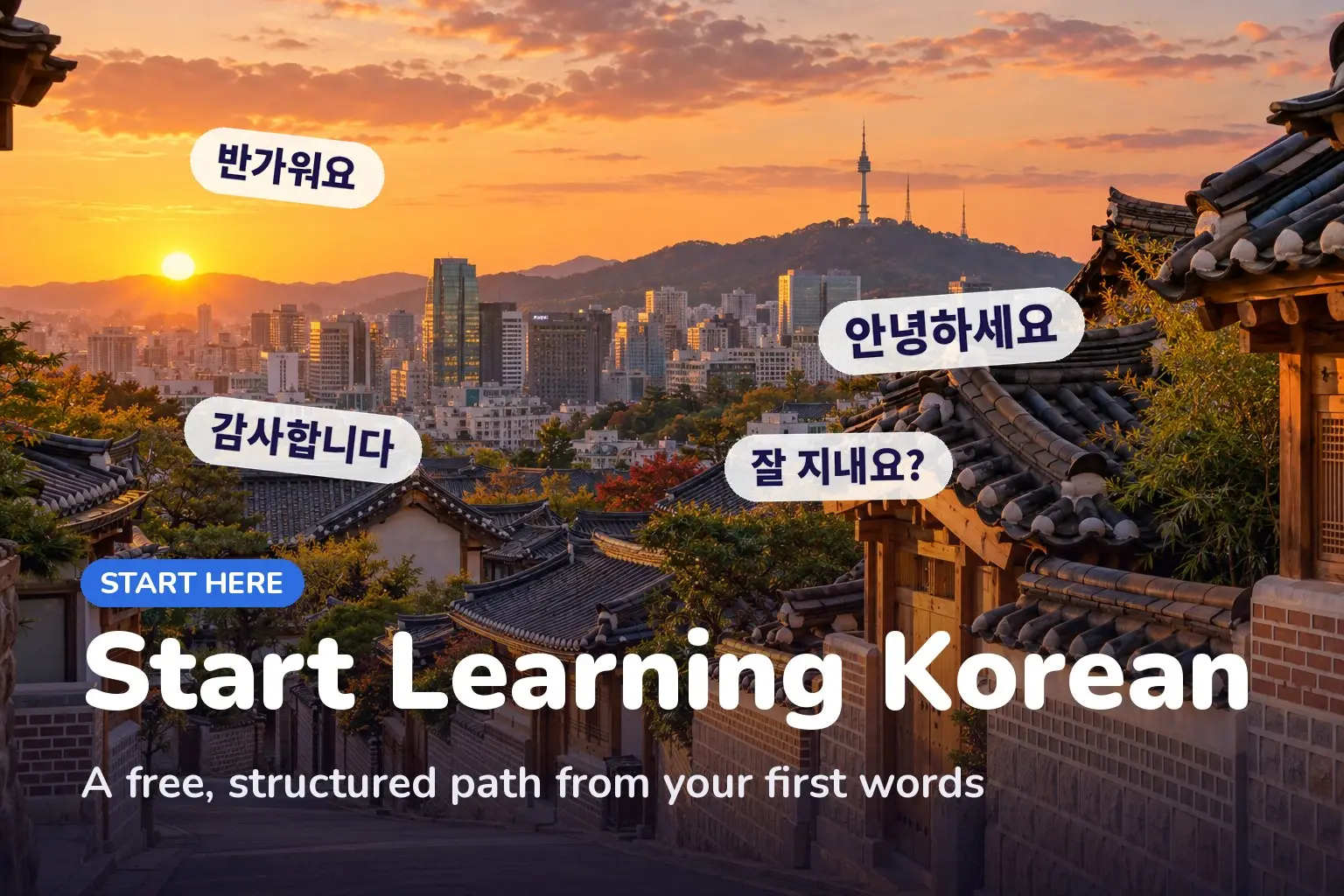
This is your starting point for Korean. Learn in two tracks at once: a grammar backbone (one point at a time, starting with the copula 이다) and general study, beginning with Hangul, then vocabulary and phrases. Keep a small, steady rhythm — about three grammar points and three study items a week — and open your first lesson below.
Level: beginner (TOPIK I band). Welcome — here is how the Korean course fits together and where to begin.
By the end of this page you can…
…understand the course structure, know to learn Hangul first, and open your first lesson.
How the course works
You learn in two tracks at the same time:
- Grammar backbone — one clear point at a time, in order, with a rule, a table, examples (with romanisation), common mistakes and a quiz. You start with the noun copula 이다, used for “X is Y” statements (adjectives and “there is” work differently).
- General study — starting with Hangul, then vocabulary (common words first) and phrases, with short lessons that reuse the grammar.
Learn Hangul first
Hangul is an alphabet, not a large set of word-level characters — it is (often described as featural) designed to be learnable quickly. Each block is built from a small set of consonant and vowel shapes. Once you can read Hangul, everything else opens up. Until it is comfortable, our examples include romanisation so you are never stuck.
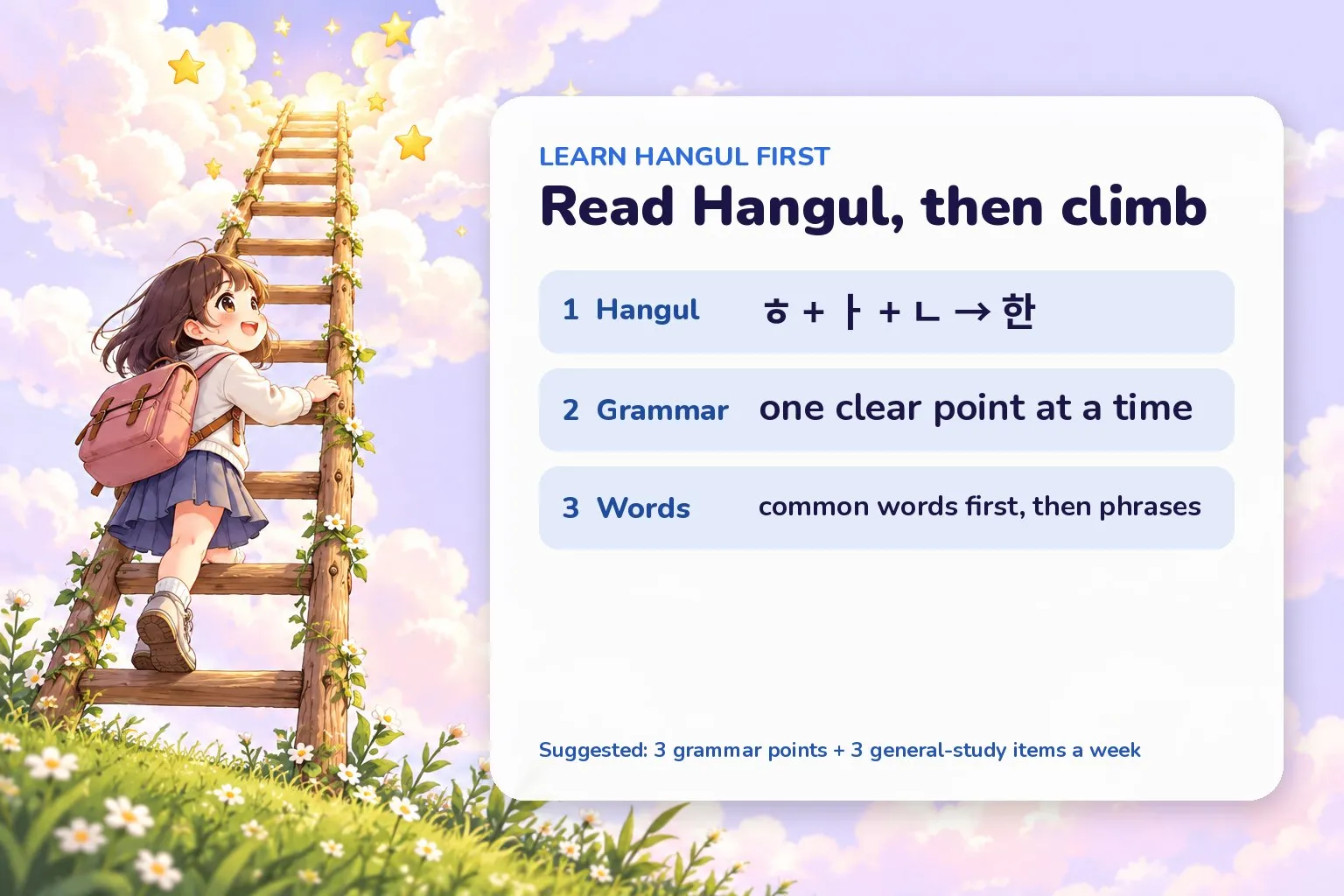
The path at a glance.
A rhythm that sticks
We suggest about three grammar points and three general-study items a week.
Choose your path
- Complete beginner: learn Hangul, then start grammar in order.
- Can read Hangul already: go straight to the grammar points you need.
- Preparing for TOPIK: build the grammar backbone, and practise the exam’s own task types and timing alongside it; exam pages will be added here.
Start now
- Your first grammar lesson: 이다: The Copula (To Be)
- Browse all topics in the Korean grammar section
How this course is put together
Level labels are our own course sequencing, using the TOPIK I/II bands as a broad guide to level. Vocabulary sets start from public word-frequency lists (the FrequencyWords project, built from film and TV subtitles), and will be filtered for beginners (removing names, noise and words common only on screen; word lists licensed CC BY-SA 4.0). Example sentences in the lessons are written for each lesson. If we can’t confirm a point, we leave it out rather than guess.
Sources
- TOPIK (Test of Proficiency in Korean) — NIIED (TOPIK) (as of October 2026)
- Sejong Korean (King Sejong Institute) — King Sejong Institute Foundation (as of October 2026)
- FrequencyWords (word lists) — hermitdave/FrequencyWords (code MIT; word lists CC BY-SA 4.0) (as of October 2026)