이다: The Copula (To Be)
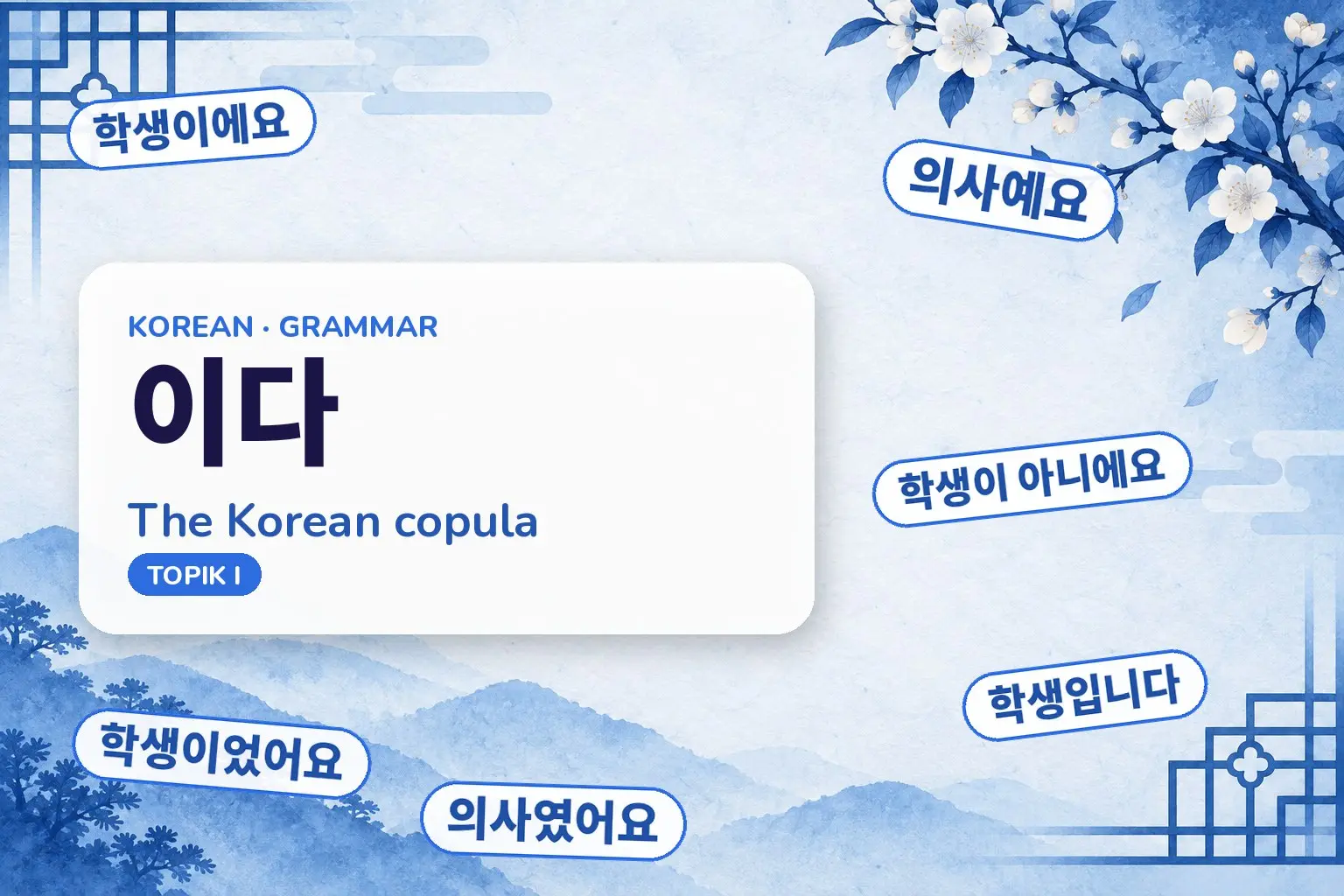
이다 is the Korean copula, attached to a noun to mean 'is/are'. In polite speech it becomes 이에요 after a consonant-final noun and 예요 after a vowel-final noun: 저는 학생이에요 ('I'm a student'), 의사예요 ('(I'm / she's) a doctor', depending on context). The formal form is 입니다, and the negative is 아니다 (…이/가 아니에요).
Level: TOPIK 1. 이다 is the Korean copula — the “is/are” word that attaches directly to a noun. Learn it first, because it lets you introduce yourself and name things: 저는 학생이에요 (Jeoneun haksaeng-ieyo, “I am a student”).
The rule
A copula links a subject to a noun. Unlike English, Korean’s copula is attached to the end of the noun, and its polite ending depends on whether that noun ends in a consonant or a vowel:
- Noun ending in a consonant → 이에요: 학생 → 학생이에요.
- Noun ending in a vowel → 예요: 의사 → 의사예요.
The formal-polite form is 입니다 (pronounced imnida), used in announcements, presentations and polite formal speech.
Forms by register and tense
| Informal polite | Formal | |
|---|---|---|
| Present (“is”) | 이에요 / 예요 | 입니다 |
| Past (“was”) | 이었어요 / 였어요 | 이었습니다 / 였습니다 |
| Negative (“is not”) | …이/가 아니에요 | …이/가 아닙니다 |
The negative uses a separate word, 아니다, with the subject particle 이/가: 학생이 아니에요 (“is not a student”).
Example sentences
Each sentence was written for this lesson (not copied from a third-party corpus), with romanisation.
- 저는 학생이에요. — Jeoneun haksaeng-ieyo. — I am a student. (consonant → 이에요)
- 저는 의사예요. — Jeoneun uisa-yeyo. — I am a doctor. (vowel → 예요)
- 이것은 책이에요. — Igeoseun chaek-ieyo. — This is a book.
- 그는 선생님입니다. — Geuneun seonsaengnim-imnida. — He is a teacher. (formal)
- 저는 한국 사람이에요. — Jeoneun hanguk saram-ieyo. — I am Korean.
- 이것은 물이에요. — Igeoseun mul-ieyo. — This is water.
- 그것은 제 가방이에요. — Geugeoseun je gabang-ieyo. — That is my bag.
- 여기는 학교예요. — Yeogineun hakgyo-yeyo. — This place is a school. (vowel → 예요)
- 이름이 뭐예요? — Ireum-i mwoyeyo? — What is your name?
- 저는 학생이 아니에요. — Jeoneun haksaeng-i anieyo. — I am not a student. (negative)
- 그녀는 의사가 아니에요. — Geunyeoneun uisa-ga anieyo. — She is not a doctor.
- 저는 학생이었어요. — Jeoneun haksaeng-ieosseoyo. — I was a student. (past)
Common mistakes
- ❌ 학생예요 → ✅ 학생이에요. A consonant-final noun needs 이에요.
- After a vowel, 이에요 normally contracts to 예요: 의사예요. The uncontracted 의사이에요 is also standard, but lessons (and most speakers) use 예요. Also note that without 저는, 학생이에요 can mean “I am / you are / he or she is a student” depending on context.
- ❌ 저는 학생 아니에요 → ✅ 저는 학생이 아니에요. In writing and textbooks, keep the particle 이/가 before 아니에요 (it is often dropped in casual speech).
- ❌ 저는 학생이 있어요 (this means “I have a student”) → ✅ 저는 학생이에요. 있다 means “to exist/have”, not “to be a noun”.
Compared with…
- 있다 / 없다 — existence (“there is / isn’t”), not identity. Easy to confuse with 이다.
- Topic particle 은/는 — attaches to the topic noun phrase (not necessarily right before the copula).
Both are listed in the Korean grammar section.
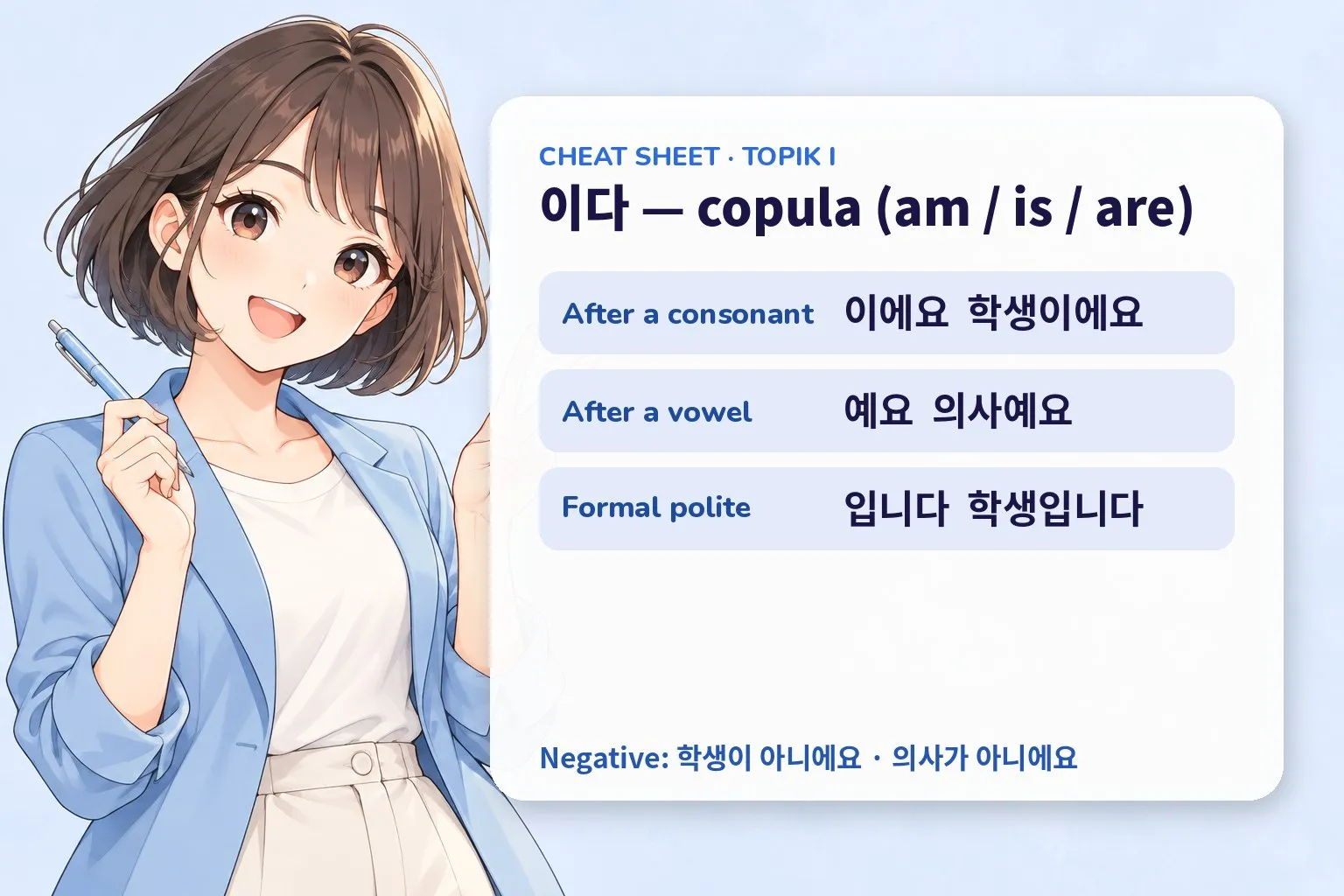
Quick recap before the quiz.
Mini quiz
- 저는 학생___. (polite — consonant noun)
- 저는 의사__. (polite — vowel noun)
- 그는 선생님___. (formal)
- 저는 학생_ 아니에요. (particle)
- 이름이 뭐__? (“What is your name?”)
Answers
- 이에요 — 학생 ends in a consonant.
- 예요 — 의사 ends in a vowel.
- 입니다 — formal copula.
- 이 — subject particle before 아니에요.
- 예요 — 뭐 ends in a vowel.
Sources & licensing
- Forms cross-checked with Wiktionary (CC BY-SA 4.0).
- This is a beginner-level topic; TOPIK I is the beginner exam band (grades 1–2), used here as a general reference, not a per-topic ruling.
- Example sentences were written for this lesson (no third-party sentences copied), with romanisation.
Next
- Back to the Korean grammar section
- New here? Start with Start Learning Korean Here
Sources
- 이다 — Korean copula — Wiktionary (CC BY-SA 4.0) (as of October 2026)
- TOPIK (Test of Proficiency in Korean) — NIIED (TOPIK) (as of October 2026)
- National Institute of Korean Language — National Institute of Korean Language (as of October 2026)