고 싶다 (go sipda): How to Say 'Want To' in Korean
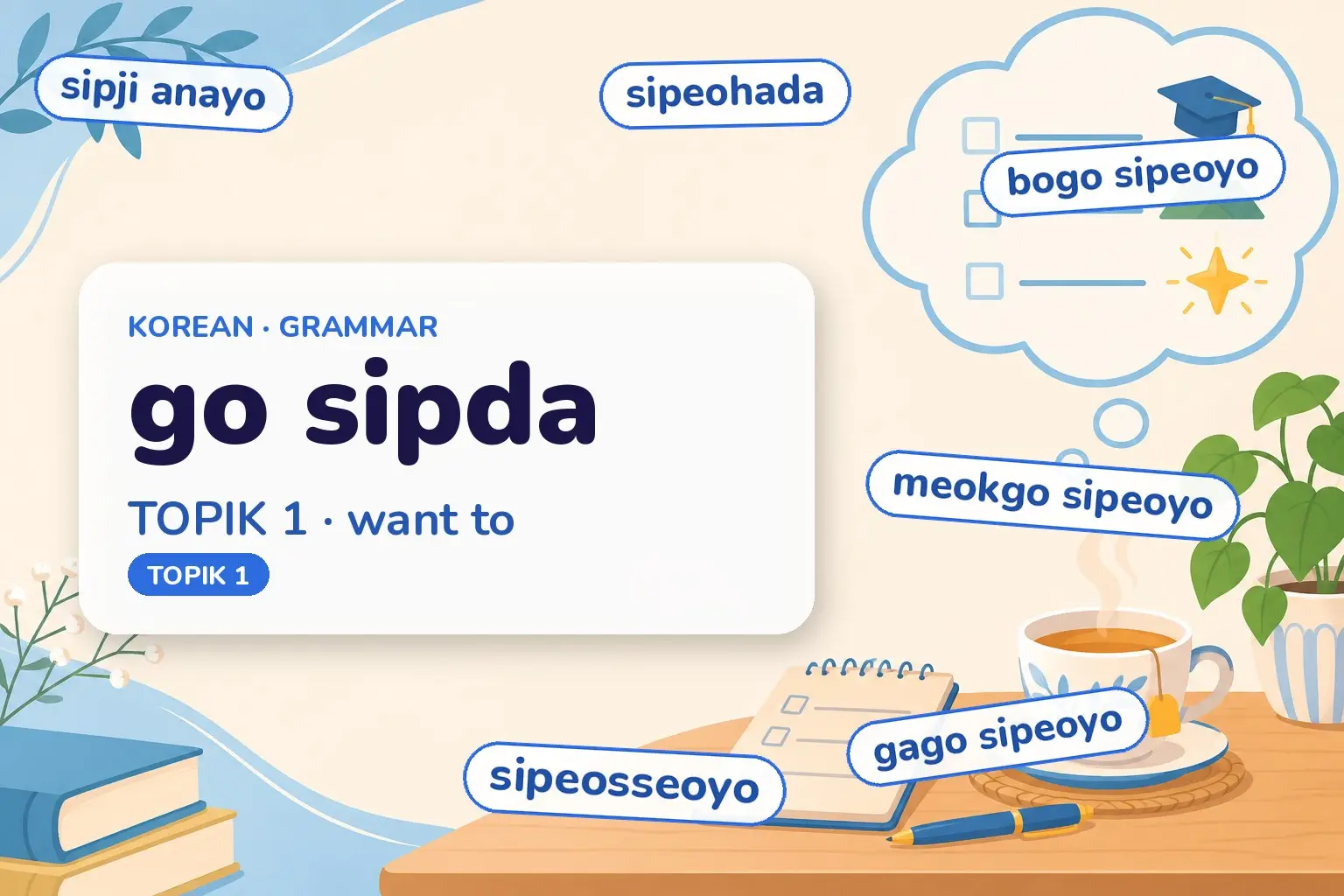
To say you want to do something in Korean, add 고 싶다 (go sipda) to a verb stem: 가다 (gada) becomes 가고 싶어요 (gago sipeoyo), 'I want to go'. Use it for yourself and for questions; for a third person switch to 고 싶어하다 (go sipeohada).
Level: TOPIK 1. Once you can say what you do, the next step is saying what you want to do. Korean handles that with one tidy pattern: verb stem + 고 싶다 (go sipda). It works for any action verb.
The rule
Take a verb’s stem — the dictionary form minus 다 (da) — and attach 고 싶다 (go sipda). 가다 (gada, “to go”) has the stem 가 (ga), so 가 (ga) + 고 싶다 (go sipda) = 가고 싶다 (gago sipda), “to want to go”. 먹다 (meokda, “to eat”) gives 먹고 싶다 (meokgo sipda), “to want to eat”.
The 고 (go) part never changes. What changes is the ending on 싶다 (sipda), because 싶다 (sipda) behaves like a descriptive verb (an adjective): you conjugate it with the ordinary polite present rule from the 아요/어요 (ayo/eoyo) lesson. Its stem 싶 (sip) has the vowel ㅣ (i), so it takes 어요 (eoyo) and contracts to 싶어요 (sipeoyo).
There is one catch learners meet early: 고 싶다 (go sipda) describes your own desire, or asks about the listener’s. To talk about what someone else wants, Korean switches to 고 싶어하다 (go sipeohada).
The forms
Built on 가다 (gada, “to go”):
| Form | Korean | Reading | Meaning |
|---|---|---|---|
| Present polite | 가고 싶어요 | gago sipeoyo | (I) want to go |
| Formal polite | 가고 싶습니다 | gago sipseumnida | (I) want to go (formal) |
| Past | 가고 싶었어요 | gago sipeosseoyo | (I) wanted to go |
| Negative | 가고 싶지 않아요 | gago sipji anayo | (I) don’t want to go |
| Third person | 가고 싶어해요 | gago sipeohaeyo | (he/she) wants to go |
Example sentences
Each sentence was written for this lesson, with Revised Romanization.
- 집에 가고 싶어요.Jibe gago sipeoyo.I want to go home.
- 물을 마시고 싶어요.Mureul masigo sipeoyo.I want to drink water.
- 한국어를 배우고 싶어요.Hangugeoreul baeugo sipeoyo.I want to learn Korean.
- 영화를 보고 싶어요.Yeonghwareul bogo sipeoyo.I want to watch a movie.
- 지금 자고 싶어요.Jigeum jago sipeoyo.I want to sleep now.
- 집에서 쉬고 싶어요.Jibeseo swigo sipeoyo.I want to rest at home.
- 친구를 만나고 싶어요.Chingureul mannago sipeoyo.I want to meet a friend.
- 저는 한국에 살고 싶어요.Jeoneun hanguge salgo sipeoyo.I want to live in Korea.
- 책을 읽고 싶어요.Chaegeul ilkgo sipeoyo.I want to read a book.
- 뭐 먹고 싶어요?Mwo meokgo sipeoyo?What do you want to eat?a question to the listener
- 어디에 가고 싶어요?Eodie gago sipeoyo?Where do you want to go?
- 무엇을 사고 싶어요?Mueoseul sago sipeoyo?What do you want to buy?
- 커피를 마시고 싶지 않아요.Keopireul masigo sipji anayo.I don't want to drink coffee.negative 고 싶지 않다
- 오늘은 일하고 싶지 않아요.Oneureun ilhago sipji anayo.I don't want to work today.
- 지난주에 가고 싶었어요.Jinanjue gago sipeosseoyo.I wanted to go last week.past 고 싶었어요
- 동생이 자고 싶어해요.Dongsaengi jago sipeohaeyo.My younger sibling wants to sleep.third person → 고 싶어하다
- 그는 집에 가고 싶어해요.Geuneun jibe gago sipeohaeyo.He wants to go home.third person
- 저는 너무 쉬고 싶어요.Jeoneun neomu swigo sipeoyo.I really want to rest.
Common mistakes
- ❌ 동생이 자고 싶어요 (dongsaengi jago sipeoyo) → ✅ 동생이 자고 싶어해요 (dongsaengi jago sipeohaeyo). For a third person’s wish, use 고 싶어하다 (go sipeohada).
- ❌ 가 싶어요 (ga sipeoyo) → ✅ 가고 싶어요 (gago sipeoyo). Keep the 고 (go); it links the verb stem to 싶다 (sipda).
- ❌ 먹고 싶다요 (meokgo sipdayo) → ✅ 먹고 싶어요 (meokgo sipeoyo). Never add 요 (yo) to the dictionary form; conjugate 싶다 (sipda) as 싶어요 (sipeoyo).
- ❌ 저는 자고 싶어해요 (jeoneun jago sipeohaeyo) → ✅ 저는 자고 싶어요 (jeoneun jago sipeoyo). Use plain 고 싶다 (go sipda) for yourself, not 고 싶어하다 (go sipeohada).
- ❌ 가고 안 싶어요 (gago an sipeoyo) → ✅ 가고 싶지 않아요 (gago sipji anayo). The natural negative is the long form 고 싶지 않다 (go sipji anta).
A short conversation
— 주말에 뭐 하고 싶어요? (Jumare mwo hago sipeoyo?) — “What do you want to do at the weekend?” — 영화를 보고 싶어요. 민호 씨는요? (Yeonghwareul bogo sipeoyo. Minho ssineunyo?) — “I want to watch a movie. And you, Minho?” — 저는 집에서 쉬고 싶어요. (Jeoneun jibeseo swigo sipeoyo.) — “I want to rest at home.”
Usage notes
- First and second person only, for the plain form. 고 싶다 (go sipda) states your own wish or asks the listener’s: 가고 싶어요 (gago sipeoyo) / 가고 싶어요? (gago sipeoyo?). A third person takes 고 싶어하다 (go sipeohada).
- The object particle can soften to 이/가 (i/ga). Both 물을 마시고 싶어요 (mureul masigo sipeoyo) and 물이 마시고 싶어요 (muri masigo sipeoyo) are used; 을/를 (eul/reul) is the safer standard choice.
- Past tense sits on 싶다 (sipda), not the main verb. “I wanted to go” is 가고 싶었어요 (gago sipeosseoyo) — you conjugate 싶다 (sipda) into the past, not 가다 (gada).
- It attaches to action verbs. You would not add 고 싶다 (go sipda) to an adjective; you want to do something, not to be a quality.
Compared with the plain present
The polite present 아요/어요 (ayo/eoyo) says what you simply do: 가요 (gayo), “I go”. Add 고 싶다 (go sipda) before the ending and it becomes what you want to do: 가고 싶어요 (gago sipeoyo). The ending on 싶다 (sipda) follows the very same harmony rule you learned for the polite present tense; more patterns are listed in the Korean grammar section.
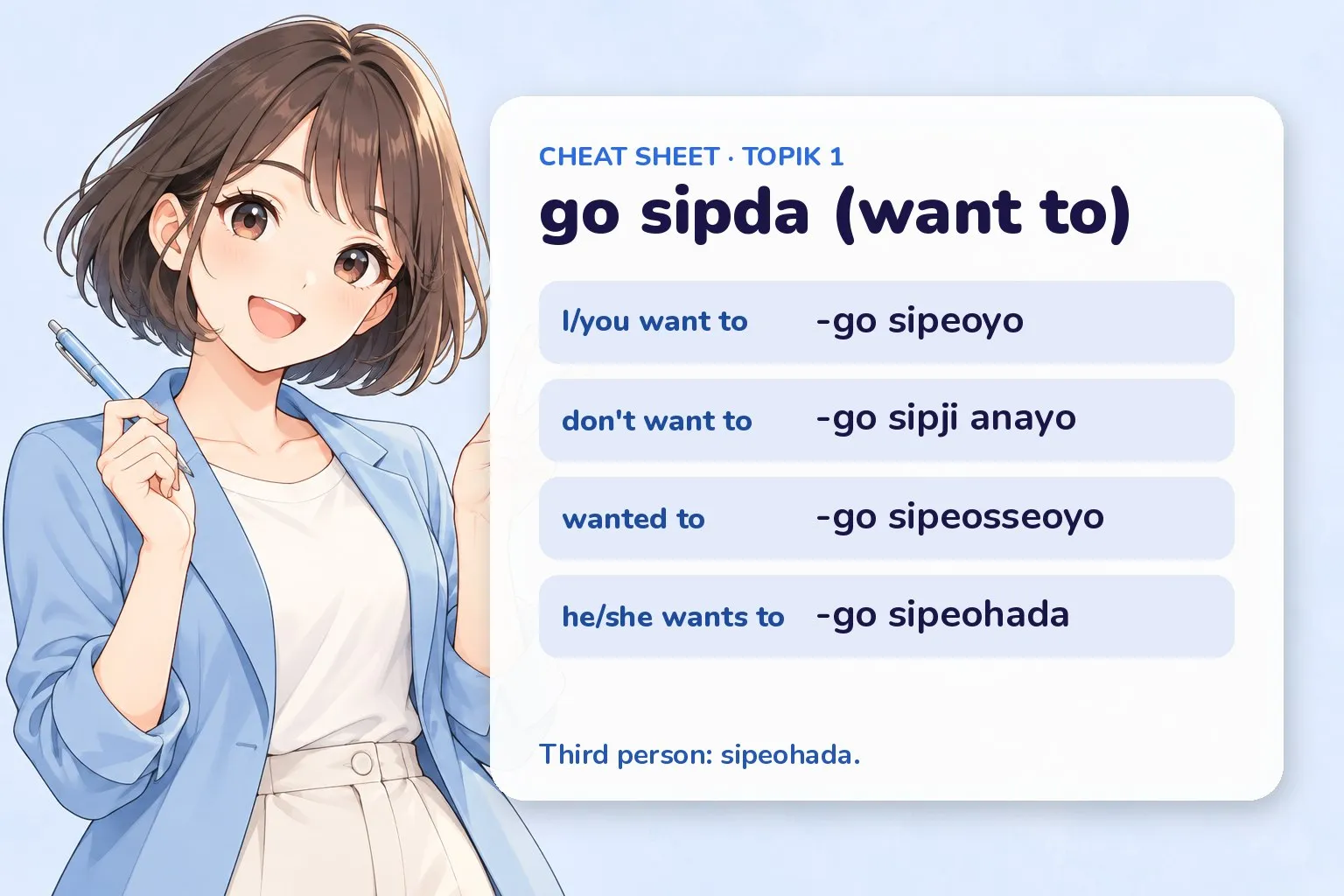
Quick recap before you practise.
Practice
고 싶다 (go sipda) practice
Try each one, then press Check. No sign-up, nothing is sent anywhere — it all runs in your browser.
Hint: the long negative uses 고 싶지 않다 (go sipji anta)
Show answer
싶지 (sipji) — 가고 싶지 않아요 (gago sipji anayo) is 'I don't want to go'.
4 Build: 'I want to drink water.'
Show answer
저는 (jeoneun) 물을 (mureul) 마시고 싶어요 (masigo sipeoyo) — Subject + object + verb: 저는 물을 마시고 싶어요 (jeoneun mureul masigo sipeoyo).
5 Match each form to its meaning.
- 가고 싶어요 (gago sipeoyo)
- 가고 싶었어요 (gago sipeosseoyo)
- 가고 싶지 않아요 (gago sipji anayo)
- 가고 싶어해요 (gago sipeohaeyo)
Show answer
- 가고 싶어요 (gago sipeoyo) → I want to go
- 가고 싶었어요 (gago sipeosseoyo) → I wanted to go
- 가고 싶지 않아요 (gago sipji anayo) → I don't want to go
- 가고 싶어해요 (gago sipeohaeyo) → he/she wants to go
Present, past, negative and third-person forms of 가고 싶다 (gago sipda).
Hint: 싶 (sip) has ㅣ, so 어요
Show answer
싶어요 (sipeoyo) — 보고 싶어요 (bogo sipeoyo), 'I want to watch'.
Quiz
고 싶다 (go sipda) quiz
11 questions · pick an answer and you'll see straight away if it's right.
-
Show answer
'want to' — Verb stem + 고 싶다 (go sipda) means 'want to do'.
-
Show answer
가고 싶어요 (gago sipeoyo) — 가 (ga) + 고 싶어요 (go sipeoyo): 가고 싶어요 (gago sipeoyo).
-
Show answer
it behaves like an adjective — 싶다 (sipda) is a descriptive verb; its stem 싶 (sip) has ㅣ, so 어요 gives 싶어요 (sipeoyo).
-
Show answer
고 싶어하다 (go sipeohada) — A third person's desire uses 고 싶어하다 (go sipeohada).
-
Show answer
동생이 자고 싶어요 (dongsaengi jago sipeoyo) — A third person needs 고 싶어하다 (go sipeohada), so 자고 싶어요 is wrong here.
-
Show answer
가고 싶지 않아요 (gago sipji anayo) — The long negative is 고 싶지 않다 (go sipji anta): 가고 싶지 않아요 (gago sipji anayo).
-
Show answer
싶다 (sipda) — Conjugate 싶다 (sipda) into the past: 가고 싶었어요 (gago sipeosseoyo).
-
Show answer
you can't add 요 (yo) to the dictionary form — Conjugate 싶다 (sipda), not the dictionary form: 먹고 싶어요 (meokgo sipeoyo).
-
Show answer
이/가 (i/ga) as well — Both 을/를 (eul/reul) and 이/가 (i/ga) are heard: 물을 / 물이 마시고 싶어요.
-
Show answer
어디에 가고 싶어요? (eodie gago sipeoyo?) — A question to the listener uses the plain 고 싶다 form: 가고 싶어요? (gago sipeoyo?).
-
Show answer
싶어요 (sipeoyo) — 보고 싶어요 (bogo sipeoyo), 'I want to watch / I miss (it)'.
Recap cheat-sheet
| Use | Pattern | Example | Reading |
|---|---|---|---|
| I/you want to | stem + 고 싶다 | 가고 싶어요 | gago sipeoyo |
| don’t want to | 고 싶지 않다 | 가고 싶지 않아요 | gago sipji anayo |
| wanted to | 고 싶었다 | 가고 싶었어요 | gago sipeosseoyo |
| he/she wants to | 고 싶어하다 | 가고 싶어해요 | gago sipeohaeyo |
Next
- Review the ending it is built on: 아요/어요 (ayo/eoyo) polite present
- Browse more patterns in the Korean grammar section
- New here? Start with Start Learning Korean Here
All Korean grammar topics
Every grammar point in order, from your first sentence to advanced structures. Pick one and go straight to it. New lessons go live every day, so topics marked Coming soon fill in over the next weeks.
Grammar path
TOPIK 1 25 topics · 21 ready
- 01 이다 (ida): The Copula (To Be)
- 02 은/는 (eun/neun): The Topic Particle
- 03 이/가 (i/ga): The Subject Particle
- 04 을/를 (eul/reul): The Object Particle
- 05 에 (e): Location & Time Particle
- 06 에서 (eseo): Place of Action & From
- 07 도 (do): Also / Too
- 08 와/과 (wa/gwa), 하고 (hago), (이)랑 ((i)rang): And / With
- 09 의 (ui): Possessive Particle
- 10 있다 / 없다 (itda/eopda): Existence & Possession
- 11 이 / 그 / 저 (i/geu/jeo): This / That
- 12 여기 / 거기 / 저기 (yeogi/geogi/jeogi): Here / There
- 13 아요/어요 (ayo/eoyo): Polite Present Tense
- 14 ㅂ니다/습니다 (mnida/seumnida): Formal Polite Style
- 15 았/었어요 (at/eosseoyo): Past Tense
- 16 안 / 지 않다 (an/ji anta): Negation (Not)
- 17 못 / 지 못하다 (mot/ji mothada): Cannot (Inability)
- 18 에게/한테/께 (ege/hante/kke): To a Person
- 19 부터 / 까지 (buteo/kkaji): From and Until
- 20 고 싶다 (go sipda): Want to Do You are here
- 21 으러 가다/오다 (eureo gada/oda): Go/Come to Do
- 22 겠 (get): Intention & Conjecture Coming soon
- 23 (으)ㄹ 거예요 ((eu)l geoyeyo): Future Tense Coming soon
- 24 (으)세요 ((eu)seyo): Honorific Ending & Requests Coming soon
- 25 (으)시 ((eu)si): Subject Honorific Coming soon
TOPIK 2 33 topics
- 26 고 있다 (go itda): Progressive (-ing) Coming soon
- 27 아/어 보다 (a/eo boda): Try Doing Coming soon
- 28 아/어 주다 (a/eo juda): Do For Someone Coming soon
- 29 (으)ㄹ 수 있다/없다 ((eu)l su itda/eopda): Can / Cannot Coming soon
- 30 아야/어야 되다/하다 (aya/eoya doeda/hada): Must / Have To Coming soon
- 31 지 마세요 (ji maseyo): Don't Do That Coming soon
- 32 (으)면 ((eu)myeon): If / When (Conditional) Coming soon
- 33 (으)니까 ((eu)nikka): Because / Since Coming soon
- 34 아서/어서 (aseo/eoseo): Because & Sequence Coming soon
- 35 (으)ㄹ까요 ((eu)lkkayo)?: Shall We / I? Coming soon
- 36 (으)ㅂ시다 / 자 ((eu)psida/ja): Let's Coming soon
- 37 는 것 (neun geot): Nominalising with 것 (geot) Coming soon
- 38 기 (gi): Nominalising with 기 (gi) Coming soon
- 39 기 때문에 (gi ttaemune): Because (Noun Reason) Coming soon
- 40 (으)ㄴ/는/(으)ㄹ ((eu)n/neun/(eu)l): Verb-to-Modifier Endings Coming soon
- 41 보다 (boda): Comparisons (Than) Coming soon
- 42 제일 / 가장 (jeil/gajang): The Most (Superlative) Coming soon
- 43 아도/어도 되다 (ado/eodo doeda): Permission (May) Coming soon
- 44 (으)면 안 되다 ((eu)myeon an doeda): Must Not Coming soon
- 45 기 전에 / (으)ㄴ 후에 (gi jeone/(eu)n hue): Before & After Coming soon
- 46 (으)ㄹ 때 / 았을 때 ((eu)l ttae/asseul ttae): When Coming soon
- 47 (으)ㄹ게요 ((eu)lgeyo): I'll Do (Promise) Coming soon
- 48 지요 / 죠 (jiyo/jyo): Right? (Seeking Agreement) Coming soon
- 49 는데/(으)ㄴ데 (neunde/(eu)nde): Background & Contrast Coming soon
- 50 지만 (jiman): But / However Coming soon
- 51 거나 / (이)나 (geona/(i)na): Or Coming soon
- 52 아지다/어지다 (ajida/eojida): Become (Adjectives) Coming soon
- 53 게 되다 (ge doeda): Come To / Turn Out Coming soon
- 54 고 (go): And (Linking Clauses/Actions) Coming soon
- 55 동안 / 는 동안 (dongan/neun dongan): During / While Coming soon
- 56 게 / 히 (ge/hi): Making Adverbs Coming soon
- 57 은/는 (eun/neun) vs 이/가 (i/ga): Topic vs Subject Coming soon
- 58 네요 / 군요 (neyo/gunyo): Realisation & Exclamation Coming soon
TOPIK 3 20 topics
- 59 (으)ㄴ/는/(으)ㄹ 것 같다 ((eu)n/neun/(eu)l geot gatda): Seems Like Coming soon
- 60 기로 하다 (giro hada): Decide To Coming soon
- 61 (으)려고 하다 ((eu)ryeogo hada): Intend To / About To Coming soon
- 62 (으)려면 ((eu)ryeomyeon): If You Intend To Coming soon
- 63 아/어 있다 (a/eo itda): Resultant State Coming soon
- 64 아/어 버리다 (a/eo beorida): Completely / Regrettably Coming soon
- 65 고 나서 (go naseo): After Finishing Coming soon
- 66 다가 (daga): While / Switching Action Coming soon
- 67 (으)ㄴ 적이 있다 ((eu)n jeogi itda): Have Done Before Coming soon
- 68 자마자 (jamaja): As Soon As Coming soon
- 69 (으)면서 ((eu)myeonseo): While (Simultaneous) Coming soon
- 70 밖에 (bakke): Only (with Negative) Coming soon
- 71 만 (man): Only / Just Coming soon
- 72 처럼 / 같이 (cheoreom/gachi): Like / As Coming soon
- 73 아도/어도 (ado/eodo): Even If / Even Though Coming soon
- 74 (으)ㄹ수록 ((eu)lsurok): The More... The More Coming soon
- 75 든지 / 든가 (deunji/deunga): Whether / Any Coming soon
- 76 는 중이다 / 는 길에 (neun jungida/neun gire): In the Middle / On the Way Coming soon
- 77 (으)ㄴ/는 데다가 ((eu)n/neun dedaga): In Addition Coming soon
- 78 (으)ㄹ 줄 알다/모르다 ((eu)l jul alda/moreuda): Know How To Coming soon
TOPIK 4 20 topics
- 79 더라고요 (deoragoyo): Retrospective Observation Coming soon
- 80 던 / 았던 (deon/atdeon): Recalled Past Modifier Coming soon
- 81 (으)ㄴ/는 반면에 ((eu)n/neun banmyeone): On the Other Hand Coming soon
- 82 (으)ㄹ 뿐만 아니라 ((eu)l ppunman anira): Not Only...But Also Coming soon
- 83 (으)ㄴ/는 데 비해 ((eu)n/neun de bihae): Compared To Coming soon
- 84 (으)로 인해/때문에/덕분에/탓에 ((eu)ro inhae/ttaemune/deokbune/tase) Coming soon
- 85 는 바람에 (neun barame): Because Of (Unexpected Result) Coming soon
- 86 느라고 (neurago): Because (Simultaneous, Negative) Coming soon
- 87 (으)ㄹ 테니까 ((eu)l tenikka): I Will So / Probably So Coming soon
- 88 (으)ㄹ지도 모르다 ((eu)ljido moreuda): Might / May Coming soon
- 89 (으)ㄴ/는 척하다 ((eu)n/neun cheokhada): Pretend To Coming soon
- 90 게 하다 / 시키다 (ge hada/sikida): Make / Let (Causative) Coming soon
- 91 이/히/리/기 (i/hi/ri/gi): Passive & Causative Suffixes Coming soon
- 92 도록 (dorok): So That / Until / To the Extent Coming soon
- 93 게 (ge): Adverbial / So That Coming soon
- 94 (으)ㄹ 정도로 ((eu)l jeongdoro): To the Extent That Coming soon
- 95 다 보니 / 다 보면 (da boni/da bomyeon): As You Keep Doing Coming soon
- 96 (으)ㄴ/는 김에 ((eu)n/neun gime): While You're At It Coming soon
- 97 (으)ㄹ 겸 ((eu)l gyeom): Also For the Purpose Of Coming soon
- 98 아/어 봤자 (a/eo bwatja): Even If (Pointless) Coming soon
TOPIK 5 12 topics
- 99 더니 / 았더니 (deoni/atdeoni): And Then / Change Coming soon
- 100 (으)ㄴ/는 셈이다 ((eu)n/neun semida): As Good As / In Effect Coming soon
- 101 (으)ㄹ 만하다 / 법하다 ((eu)l manhada/beophada): Worth / Likely Coming soon
- 102 (으)ㄹ 리가 없다 ((eu)l riga eopda): No Way / Can't Be Coming soon
- 103 (으)ㄴ/는 마당에 ((eu)n/neun madange): Now That / Given Coming soon
- 104 기 마련이다 / 법이다 (gi maryeonida/beobida): Bound To / Naturally Coming soon
- 105 았/었더라면 (at/eotdeoramyeon): If (Only) I Had Coming soon
- 106 기는커녕 (gineunkeonyeong): Far From / Let Alone Coming soon
- 107 에 따라 / (으)ㅁ에 따라 (e ttara/(eu)me ttara): According To / As Coming soon
- 108 ㄴ다/는다 (nda/neunda): Plain Declarative (Written) Coming soon
- 109 (으)ㄹ지언정 ((eu)ljieonjeong): Even If / Rather Than Coming soon
- 110 (으)ㄹ락 말락 ((eu)llak mallak): On the Verge Of Coming soon
TOPIK 6 7 topics
- 111 (으)ㅁ으로써 ((eu)meurosseo): By Means Of (Formal) Coming soon
- 112 (으)ㄴ 나머지 ((eu)n nameoji): As a Result Of (Excess) Coming soon
- 113 (으)ㄹ 턱이 없다 ((eu)l teogi eopda): There's No Way Coming soon
- 114 는 통에 (neun tonge): Because Of (Chaotic) Coming soon
- 115 고자 (goja): In Order To (Formal) Coming soon
- 116 는 양 / (으)ㄴ 양 (neun yang/(eu)n yang): As If / Pretending Coming soon
- 117 기에 망정이지 (gie mangjeongiji): Luckily / Thank Goodness Coming soon