에 (e): Location & Time Particle
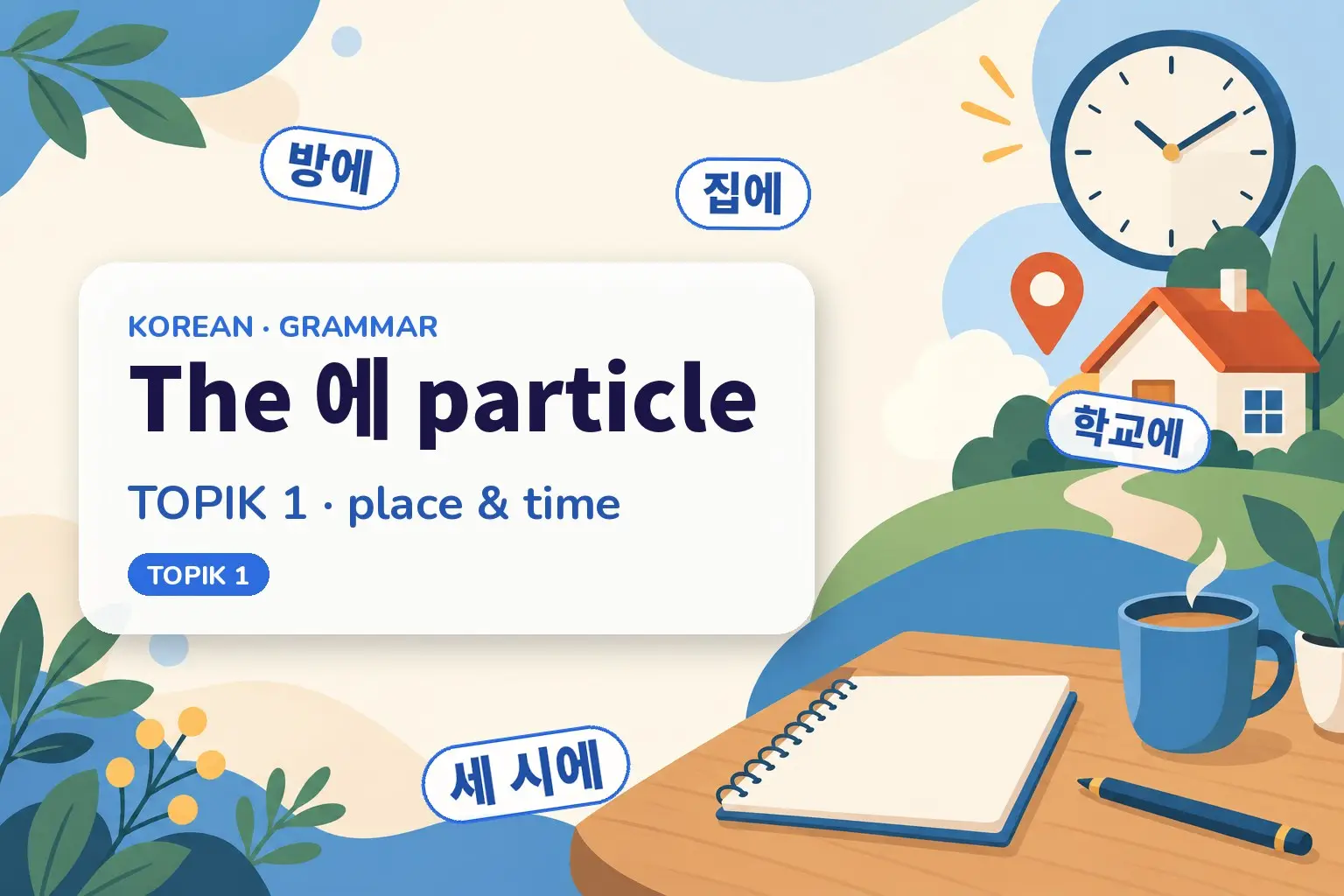
에 (e) is the Korean location and time particle. It marks where something is (집에 있어요, jibe isseoyo, I'm at home), where you are going (학교에 가요, hakgyoe gayo, I go to school) and a point in time (세 시에, se sie, at three o'clock).
On this page10 sections · tap to jump
Level: TOPIK 1. A particle is a short ending added to a noun to show its job. 에 (e) is one of the first particles you meet: it attaches to a place or a time and tells you where something is, where you are heading, or when something happens.
The rule
에 (e) attaches to a noun to mark one of three things. The verb at the end of the sentence tells you which.
- A static location. With 있다 (itda, to be/exist) and 없다 (eopda, to not be), 에 (e) marks where something simply is: 집에 있어요 (Jibe isseoyo) = “I am at home.”
- A destination. With 가다 (gada, to go), 오다 (oda, to come) and 다니다 (danida, to attend), 에 (e) marks the place you move to: 학교에 가요 (Hakgyoe gayo) = “I go to school.”
- A point in time. With a clock time, a day or a part of the day, 에 (e) means “at / on / in”: 세 시에 만나요 (Se sie mannayo) = “Let’s meet at three.”
When to use 에 (e)
| Use | Example | Reading | English |
|---|---|---|---|
| Static location | 집에 있어요 | Jibe isseoyo | I am at home. |
| No / absence | 학교에 없어요 | Hakgyoe eopseoyo | I’m not at school. |
| Destination | 학교에 가요 | Hakgyoe gayo | I go to school. |
| Point in time | 세 시에 만나요 | Se sie mannayo | Let’s meet at three. |
| Day | 월요일에 쉬어요 | Woryoire swieoyo | I rest on Monday. |
Example sentences
Each sentence was written for this lesson, with readings.
- 집에 있어요.Jibe isseoyo.I am at home.static location with 있다 (itda)
- 학교에 없어요.Hakgyoe eopseoyo.I'm not at school.
- 책상 위에 책이 있어요.Chaeksang wie chaegi isseoyo.There is a book on the desk.
- 방에 고양이가 있어요.Bange goyangiga isseoyo.There is a cat in the room.
- 학교에 가요.Hakgyoe gayo.I go to school.destination with 가다 (gada)
- 집에 와요.Jibe wayo.I come home.
- 회사에 다녀요.Hoesae danyeoyo.I go to (attend) work.
- 한국에 가고 싶어요.Hangue gago sipeoyo.I want to go to Korea.
- 세 시에 만나요.Se sie mannayo.Let's meet at three.point in time
- 아침에 커피를 마셔요.Achime keopireul masyeoyo.I drink coffee in the morning.
- 월요일에 쉬어요.Woryoire swieoyo.I rest on Monday.
- 주말에 영화를 봐요.Jumare yeonghwareul bwayo.I watch a movie on the weekend.
- 저녁에 운동해요.Jeonyeoge undonghaeyo.I exercise in the evening.
- 일곱 시에 일어나요.Ilgop sie ireonayo.I get up at seven.
- 도서관에 있어요.Doseogwane isseoyo.I am in the library.being there → 에 (e)
- 가게에 사람이 많아요.Gagee sarami manayo.There are many people in the shop.
- 역에 가요.Yeoge gayo.I go to the station.
- 토요일 아침에 공원에 가요.Toyoil achime gongwone gayo.On Saturday morning I go to the park.
Common mistakes
- ❌ 집에 공부해요 (jibe gongbuhaeyo) → ✅ 집에서 공부해요 (Jibeseo gongbuhaeyo). Studying is an action, so the place takes 에서 (eseo); 에 (e) is only for being somewhere.
- ❌ 오늘에 가요 (oneure gayo) → ✅ 오늘 가요 (Oneul gayo). Relative time words like 오늘 (oneul) and 지금 (jigeum) take no particle; only clock times and days take 에 (e).
- ❌ 친구에 선물을 줘요 (chingue seonmureul jwoyo) → ✅ 친구에게 선물을 줘요 (Chinguege seonmureul jwoyo). A person who receives something takes 에게 (ege) or 한테 (hante), not 에 (e).
- ❌ 학교를 가요 (hakgyoreul gayo) → ✅ 학교에 가요 (Hakgyoe gayo). 가다 (gada) marks its destination with 에 (e), not the object particle 를 (reul).
- ❌ 도서관에서 있어요 (doseogwaneseo isseoyo) → ✅ 도서관에 있어요 (Doseogwane isseoyo). 있다 (itda) marks the place of existence with 에 (e); 에서 (eseo) would need an action verb.
A short conversation
— 지금 어디에 있어요? (Jigeum eodie isseoyo?) — “Where are you now?” — 집에 있어요. (Jibe isseoyo.) — “I’m at home.” — 주말에 뭐 해요? (Jumare mwo haeyo?) — “What do you do on the weekend?” — 토요일에 공원에 가요. (Toyoire gongwone gayo.) — “On Saturday I go to the park.”
Usage notes
- No 에 (e) on relative time words. 오늘 (oneul, today), 지금 (jigeum, now), 어제 (eoje, yesterday), 내일 (naeil, tomorrow) and 매일 (maeil, every day) take no particle. Clock times, days and parts of the day — 아침에 (achime), 저녁에 (jeonyeoge) — do take 에 (e).
- People take 에게 (ege) or 한테 (hante). For the person who receives something, use 에게 (ege) in writing or 한테 (hante) in speech: 친구에게 (chinguege), 친구한테 (chinguhante). 에 (e) is only for places and times.
- 에 (e) can also mean “per”. 하루에 두 번 (harue du beon) = “twice a day”; 한 개에 천 원 (han gaee cheon won) = “a thousand won each.”
- One 에 (e) per place or time. You can stack a time and a place in one sentence — 토요일에 공원에 가요 (Toyoire gongwone gayo) — each with its own 에 (e).
Compared with…
- 에서 (eseo) marks the place where an action happens, or “from” a place, while 에 (e) marks where something is or a destination. 집에서 일해요 (Jibeseo ilhaeyo) = “I work at home” (action), but 집에 있어요 (Jibe isseoyo) = “I am at home” (existence). See the 에서 (eseo) particle lesson.
- 에게 / 한테 (ege / hante) mark the person who receives something. 친구에게 편지를 써요 (Chinguege pyeonjireul sseoyo) = “I write a letter to a friend.” Use these for people; 에 (e) is for places and times. See the 에게 / 한테 (ege / hante) lesson.
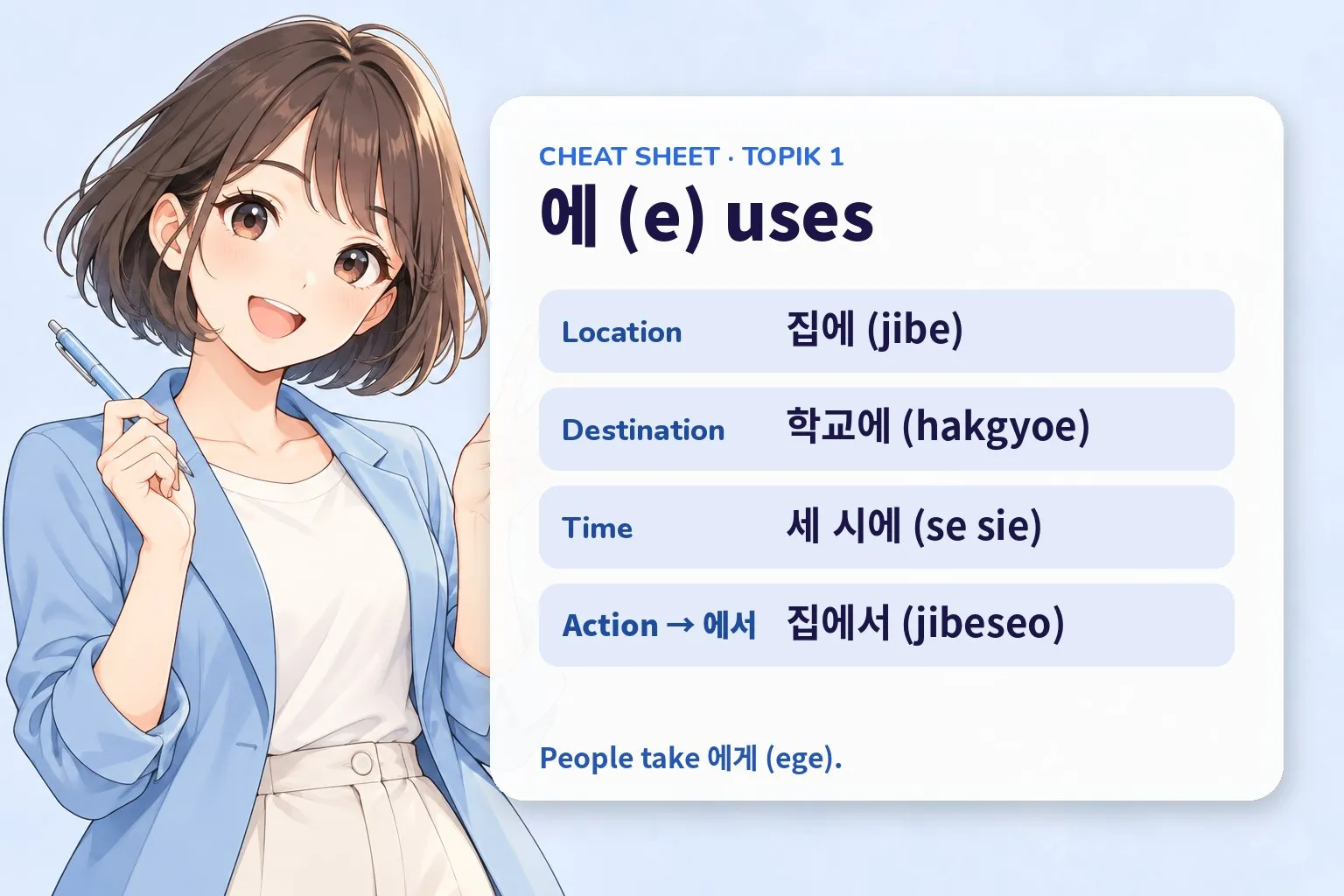
Quick recap before the quiz.
Practice
E particle practice
Try each one, then press Check. No sign-up, nothing is sent anywhere — it all runs in your browser.
Hint: Where you are going.
Show answer
e — 가다 (gada) marks its destination with 에 (e): 학교에 가요 (Hakgyoe gayo).
3 Build: 'Let's meet at three.'
Show answer
세 시에 (se sie) 만나요 (mannayo) — Time 세 시에 (se sie) + verb 만나요 (mannayo); the verb comes last.
4 Match each use with its example.
- static location
- destination
- point in time
- action place
Show answer
- static location → 집에 (jibe)
- destination → 학교에 (hakgyoe)
- point in time → 세 시에 (se sie)
- action place → 집에서 (jibeseo)
에 (e) covers location, destination and time; 에서 (eseo) marks where an action happens.
Quiz
E particle quiz
11 questions · pick an answer and you'll see straight away if it's right.
-
Show answer
The place an action happens — The place an action happens is 에서 (eseo); 에 (e) marks location, destination and time.
-
Show answer
집에 있어요 (Jibe isseoyo) — Existence with 있다 (itda) takes 에 (e).
-
Show answer
학교에 가요 (Hakgyoe gayo) — 가다 (gada) marks its destination with 에 (e).
-
Show answer
세 시에 만나요 (Se sie mannayo) — A clock time takes 에 (e).
-
Show answer
오늘 (oneul) — Relative time words like 오늘 (oneul) take no particle; days, clock times and parts of the day take 에 (e).
-
Show answer
집에서 공부해요 (Jibeseo gongbuhaeyo) — Studying is an action, so the place takes 에서 (eseo).
-
Show answer
친구에게 (chinguege) — A person who receives something takes 에게 (ege) or 한테 (hante), not 에 (e).
-
Show answer
e — Existence with 있다 (itda) takes 에 (e): 방에 고양이가 있어요 (Bange goyangiga isseoyo).
-
Show answer
에서 (eseo) — 일하다 (ilhada) is an action verb, so the place takes 에서 (eseo): 집에서 일해요 (Jibeseo ilhaeyo).
-
Show answer
오늘에 가요 (Oneure gayo) — 오늘 (oneul) is a relative time word and takes no particle: 오늘 가요 (Oneul gayo).
-
Show answer
where someone exists — 있다 (itda) with 에 (e) marks where someone simply is.
Recap cheat-sheet
| Use | Example | Reading |
|---|---|---|
| Static location | 집에 있어요 | Jibe isseoyo |
| Destination | 학교에 가요 | Hakgyoe gayo |
| Point in time | 세 시에 만나요 | Se sie mannayo |
| Action place → 에서 | 집에서 일해요 | Jibeseo ilhaeyo |
Next
- Review the object particle first: 을/를 (eul/reul)
- Back to the Korean grammar section
- New here? Start with Start Learning Korean Here
All Korean grammar topics
Every grammar point in order, from your first sentence to advanced structures. Pick one and go straight to it. New lessons go live every day, so topics marked Coming soon fill in over the next weeks.
Grammar path
TOPIK 1 25 topics · 12 ready
- 01 이다 (ida): The Copula (To Be)
- 02 은/는 (eun/neun): The Topic Particle
- 03 이/가 (i/ga): The Subject Particle
- 04 을/를 (eul/reul): The Object Particle
- 05 에 (e): Location & Time Particle You are here
- 06 에서 (eseo): Place of Action & From
- 07 도 (do): Also / Too
- 08 와/과 (wa/gwa), 하고 (hago), (이)랑 ((i)rang): And / With
- 09 의 (ui): Possessive Particle
- 10 있다 / 없다 (itda/eopda): Existence & Possession
- 11 이 / 그 / 저 (i/geu/jeo): This / That
- 12 여기 / 거기 / 저기 (yeogi/geogi/jeogi): Here / There
- 13 아요/어요 (ayo/eoyo): Polite Present Tense Coming soon
- 14 ㅂ니다/습니다 (mnida/seumnida): Formal Polite Style Coming soon
- 15 았/었어요 (at/eosseoyo): Past Tense Coming soon
- 16 안 / 지 않다 (an/ji anta): Negation (Not) Coming soon
- 17 못 / 지 못하다 (mot/ji mothada): Cannot (Inability) Coming soon
- 18 에게/한테/께 (ege/hante/kke): To a Person Coming soon
- 19 부터 / 까지 (buteo/kkaji): From and Until Coming soon
- 20 고 싶다 (go sipda): Want to Do Coming soon
- 21 으러 가다/오다 (eureo gada/oda): Go/Come to Do Coming soon
- 22 겠 (get): Intention & Conjecture Coming soon
- 23 (으)ㄹ 거예요 ((eu)l geoyeyo): Future Tense Coming soon
- 24 (으)세요 ((eu)seyo): Honorific Ending & Requests Coming soon
- 25 (으)시 ((eu)si): Subject Honorific Coming soon
TOPIK 2 33 topics
- 26 고 있다 (go itda): Progressive (-ing) Coming soon
- 27 아/어 보다 (a/eo boda): Try Doing Coming soon
- 28 아/어 주다 (a/eo juda): Do For Someone Coming soon
- 29 (으)ㄹ 수 있다/없다 ((eu)l su itda/eopda): Can / Cannot Coming soon
- 30 아야/어야 되다/하다 (aya/eoya doeda/hada): Must / Have To Coming soon
- 31 지 마세요 (ji maseyo): Don't Do That Coming soon
- 32 (으)면 ((eu)myeon): If / When (Conditional) Coming soon
- 33 (으)니까 ((eu)nikka): Because / Since Coming soon
- 34 아서/어서 (aseo/eoseo): Because & Sequence Coming soon
- 35 (으)ㄹ까요 ((eu)lkkayo)?: Shall We / I? Coming soon
- 36 (으)ㅂ시다 / 자 ((eu)psida/ja): Let's Coming soon
- 37 는 것 (neun geot): Nominalising with 것 (geot) Coming soon
- 38 기 (gi): Nominalising with 기 (gi) Coming soon
- 39 기 때문에 (gi ttaemune): Because (Noun Reason) Coming soon
- 40 (으)ㄴ/는/(으)ㄹ ((eu)n/neun/(eu)l): Verb-to-Modifier Endings Coming soon
- 41 보다 (boda): Comparisons (Than) Coming soon
- 42 제일 / 가장 (jeil/gajang): The Most (Superlative) Coming soon
- 43 아도/어도 되다 (ado/eodo doeda): Permission (May) Coming soon
- 44 (으)면 안 되다 ((eu)myeon an doeda): Must Not Coming soon
- 45 기 전에 / (으)ㄴ 후에 (gi jeone/(eu)n hue): Before & After Coming soon
- 46 (으)ㄹ 때 / 았을 때 ((eu)l ttae/asseul ttae): When Coming soon
- 47 (으)ㄹ게요 ((eu)lgeyo): I'll Do (Promise) Coming soon
- 48 지요 / 죠 (jiyo/jyo): Right? (Seeking Agreement) Coming soon
- 49 는데/(으)ㄴ데 (neunde/(eu)nde): Background & Contrast Coming soon
- 50 지만 (jiman): But / However Coming soon
- 51 거나 / (이)나 (geona/(i)na): Or Coming soon
- 52 아지다/어지다 (ajida/eojida): Become (Adjectives) Coming soon
- 53 게 되다 (ge doeda): Come To / Turn Out Coming soon
- 54 고 (go): And (Linking Clauses/Actions) Coming soon
- 55 동안 / 는 동안 (dongan/neun dongan): During / While Coming soon
- 56 게 / 히 (ge/hi): Making Adverbs Coming soon
- 57 은/는 (eun/neun) vs 이/가 (i/ga): Topic vs Subject Coming soon
- 58 네요 / 군요 (neyo/gunyo): Realisation & Exclamation Coming soon
TOPIK 3 20 topics
- 59 (으)ㄴ/는/(으)ㄹ 것 같다 ((eu)n/neun/(eu)l geot gatda): Seems Like Coming soon
- 60 기로 하다 (giro hada): Decide To Coming soon
- 61 (으)려고 하다 ((eu)ryeogo hada): Intend To / About To Coming soon
- 62 (으)려면 ((eu)ryeomyeon): If You Intend To Coming soon
- 63 아/어 있다 (a/eo itda): Resultant State Coming soon
- 64 아/어 버리다 (a/eo beorida): Completely / Regrettably Coming soon
- 65 고 나서 (go naseo): After Finishing Coming soon
- 66 다가 (daga): While / Switching Action Coming soon
- 67 (으)ㄴ 적이 있다 ((eu)n jeogi itda): Have Done Before Coming soon
- 68 자마자 (jamaja): As Soon As Coming soon
- 69 (으)면서 ((eu)myeonseo): While (Simultaneous) Coming soon
- 70 밖에 (bakke): Only (with Negative) Coming soon
- 71 만 (man): Only / Just Coming soon
- 72 처럼 / 같이 (cheoreom/gachi): Like / As Coming soon
- 73 아도/어도 (ado/eodo): Even If / Even Though Coming soon
- 74 (으)ㄹ수록 ((eu)lsurok): The More... The More Coming soon
- 75 든지 / 든가 (deunji/deunga): Whether / Any Coming soon
- 76 는 중이다 / 는 길에 (neun jungida/neun gire): In the Middle / On the Way Coming soon
- 77 (으)ㄴ/는 데다가 ((eu)n/neun dedaga): In Addition Coming soon
- 78 (으)ㄹ 줄 알다/모르다 ((eu)l jul alda/moreuda): Know How To Coming soon
TOPIK 4 20 topics
- 79 더라고요 (deoragoyo): Retrospective Observation Coming soon
- 80 던 / 았던 (deon/atdeon): Recalled Past Modifier Coming soon
- 81 (으)ㄴ/는 반면에 ((eu)n/neun banmyeone): On the Other Hand Coming soon
- 82 (으)ㄹ 뿐만 아니라 ((eu)l ppunman anira): Not Only...But Also Coming soon
- 83 (으)ㄴ/는 데 비해 ((eu)n/neun de bihae): Compared To Coming soon
- 84 (으)로 인해/때문에/덕분에/탓에 ((eu)ro inhae/ttaemune/deokbune/tase) Coming soon
- 85 는 바람에 (neun barame): Because Of (Unexpected Result) Coming soon
- 86 느라고 (neurago): Because (Simultaneous, Negative) Coming soon
- 87 (으)ㄹ 테니까 ((eu)l tenikka): I Will So / Probably So Coming soon
- 88 (으)ㄹ지도 모르다 ((eu)ljido moreuda): Might / May Coming soon
- 89 (으)ㄴ/는 척하다 ((eu)n/neun cheokhada): Pretend To Coming soon
- 90 게 하다 / 시키다 (ge hada/sikida): Make / Let (Causative) Coming soon
- 91 이/히/리/기 (i/hi/ri/gi): Passive & Causative Suffixes Coming soon
- 92 도록 (dorok): So That / Until / To the Extent Coming soon
- 93 게 (ge): Adverbial / So That Coming soon
- 94 (으)ㄹ 정도로 ((eu)l jeongdoro): To the Extent That Coming soon
- 95 다 보니 / 다 보면 (da boni/da bomyeon): As You Keep Doing Coming soon
- 96 (으)ㄴ/는 김에 ((eu)n/neun gime): While You're At It Coming soon
- 97 (으)ㄹ 겸 ((eu)l gyeom): Also For the Purpose Of Coming soon
- 98 아/어 봤자 (a/eo bwatja): Even If (Pointless) Coming soon
TOPIK 5 12 topics
- 99 더니 / 았더니 (deoni/atdeoni): And Then / Change Coming soon
- 100 (으)ㄴ/는 셈이다 ((eu)n/neun semida): As Good As / In Effect Coming soon
- 101 (으)ㄹ 만하다 / 법하다 ((eu)l manhada/beophada): Worth / Likely Coming soon
- 102 (으)ㄹ 리가 없다 ((eu)l riga eopda): No Way / Can't Be Coming soon
- 103 (으)ㄴ/는 마당에 ((eu)n/neun madange): Now That / Given Coming soon
- 104 기 마련이다 / 법이다 (gi maryeonida/beobida): Bound To / Naturally Coming soon
- 105 았/었더라면 (at/eotdeoramyeon): If (Only) I Had Coming soon
- 106 기는커녕 (gineunkeonyeong): Far From / Let Alone Coming soon
- 107 에 따라 / (으)ㅁ에 따라 (e ttara/(eu)me ttara): According To / As Coming soon
- 108 ㄴ다/는다 (nda/neunda): Plain Declarative (Written) Coming soon
- 109 (으)ㄹ지언정 ((eu)ljieonjeong): Even If / Rather Than Coming soon
- 110 (으)ㄹ락 말락 ((eu)llak mallak): On the Verge Of Coming soon
TOPIK 6 7 topics
- 111 (으)ㅁ으로써 ((eu)meurosseo): By Means Of (Formal) Coming soon
- 112 (으)ㄴ 나머지 ((eu)n nameoji): As a Result Of (Excess) Coming soon
- 113 (으)ㄹ 턱이 없다 ((eu)l teogi eopda): There's No Way Coming soon
- 114 는 통에 (neun tonge): Because Of (Chaotic) Coming soon
- 115 고자 (goja): In Order To (Formal) Coming soon
- 116 는 양 / (으)ㄴ 양 (neun yang/(eu)n yang): As If / Pretending Coming soon
- 117 기에 망정이지 (gie mangjeongiji): Luckily / Thank Goodness Coming soon