와/과, 하고, (이)랑: And / With in Korean
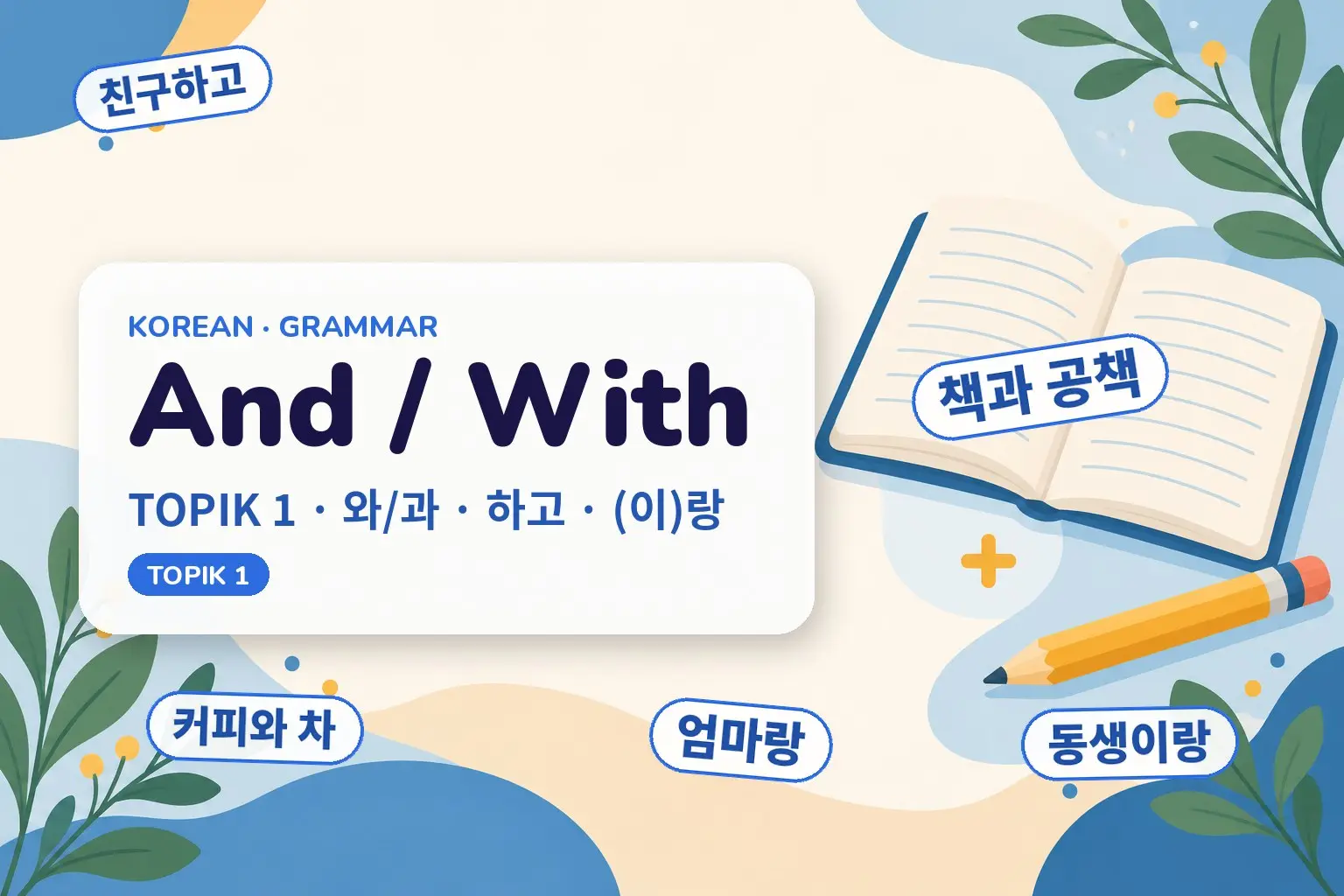
와/과 (wa/gwa), 하고 (hago) and (이)랑 ((i)rang) all join nouns ('A and B') and mark 'with'. They differ by register: 와/과 is formal, 하고 is neutral, (이)랑 is casual. 와 (wa) follows a vowel, 과 (gwa) a consonant: 사과와 (sagwa-wa), 책과 (chaek-gwa).
Level: TOPIK 1. Korean has three everyday ways to say “and” between nouns and to say “with”: 와/과 (wa/gwa), 하고 (hago) and 이랑/랑 (irang/rang). They mean the same thing — the difference is register (how formal it sounds) and one small spelling rule.
The rule
A particle attaches to the end of a noun to show its role. These three “and / with” particles connect one noun to another — 커피와 차 (keopi-wa cha), “coffee and tea” — or mark the person you do something with — 친구하고 (chingu-hago), “with a friend”.
They differ in two ways:
- Register. 와/과 (wa/gwa) is formal and common in writing. 하고 (hago) is neutral and the safe choice in everyday speech. 이랑/랑 (irang/rang) is casual, used with friends.
- Spelling after the noun. 와/과 (wa/gwa) and 이랑/랑 (irang/rang) change shape depending on the last sound of the noun; 하고 (hago) never changes.
The vowel/consonant rule: use 와 (wa) and 랑 (rang) after a noun ending in a vowel; use 과 (gwa) and 이랑 (irang) after a noun ending in a consonant (a final consonant is called a batchim).
The three particles by register
| Register | After a vowel | After a consonant |
|---|---|---|
| Formal (written) | 와 (wa) | 과 (gwa) |
| Neutral (speech) | 하고 (hago) | 하고 (hago) |
| Casual (friends) | 랑 (rang) | 이랑 (irang) |
All three work for both meanings: “A and B” — 커피와 차 (keopi-wa cha), “coffee and tea” — and “with” — 친구하고 (chingu-hago), “with a friend”.
Example sentences
Each sentence was written for this lesson, with romanisation.
- 커피와 차를 좋아해요.Keopi-wa cha-reul joahaeyo.I like coffee and tea.와 after the vowel-final 커피 (keopi)
- 책과 공책을 샀어요.Chaek-gwa gongchaek-eul sasseoyo.I bought a book and a notebook.과 after the consonant-final 책 (chaek)
- 사과와 바나나를 먹어요.Sagwa-wa banana-reul meogeoyo.I eat apples and bananas.
- 저는 친구하고 영화를 봤어요.Jeoneun chingu-hago yeonghwa-reul bwasseoyo.I watched a movie with a friend.하고 = 'with'
- 학생하고 선생님이 있어요.Haksaeng-hago seonsaengnim-i isseoyo.There are a student and a teacher.
- 엄마랑 시장에 갔어요.Eomma-rang sijang-e gasseoyo.I went to the market with my mum.랑 after the vowel-final 엄마 (eomma)
- 동생이랑 같이 놀았어요.Dongsaeng-irang gachi norasseoyo.I played together with my younger sibling.이랑 after the consonant-final 동생 (dongsaeng)
- 저와 같이 가요.Jeo-wa gachi gayo.Come with me.와 + 같이 (gachi) = '(together) with'
- 빵과 우유를 주세요.Ppang-gwa uyu-reul juseyo.Please give me bread and milk.
- 친구랑 밥을 먹었어요.Chingu-rang bap-eul meogeosseoyo.I ate a meal with a friend.
- 가족과 여행을 했어요.Gajok-gwa yeohaeng-eul haesseoyo.I travelled with my family.
- 물하고 커피 중에 뭐가 좋아요?Mul-hago keopi jung-e mwoga joayo?Between water and coffee, which do you prefer?하고 does not change after 물 (mul)
- 선생님과 이야기했어요.Seonsaengnim-gwa iyagihaesseoyo.I talked with the teacher.
- 저는 고양이랑 강아지를 키워요.Jeoneun goyangi-rang gangaji-reul kiwoyo.I keep a cat and a dog.
- 누구하고 갔어요?Nuguhago gasseoyo?Who did you go with?누구하고 (nuguhago) = 'with whom'
- 언니랑 쇼핑했어요.Eonni-rang syopinghaesseoyo.I went shopping with my older sister.
- 김치와 밥을 먹어요.Kimchi-wa bap-eul meogeoyo.I eat kimchi and rice.
- 부모님하고 살아요.Bumonim-hago sarayo.I live with my parents.
Common mistakes
- ❌ 책와 공책 (chaek-wa gongchaek) → ✅ 책과 공책 (chaek-gwa gongchaek). 책 (chaek) ends in a consonant, so use 과 (gwa).
- ❌ 친구과 (chingu-gwa) → ✅ 친구와 (chingu-wa). 친구 (chingu) ends in a vowel, so use 와 (wa).
- ❌ 친구이랑 (chingu-irang) → ✅ 친구랑 (chingu-rang). After the vowel-final 친구 (chingu), use 랑 (rang), not 이랑 (irang).
- ❌ 선생님랑 (seonsaengnim-rang) → ✅ 선생님이랑 (seonsaengnim-irang). After the consonant-final 선생님 (seonsaengnim), use 이랑 (irang).
- ❌ 커피고 차 (keopi-go cha) for “coffee and tea” → ✅ 커피와 차 (keopi-wa cha). The connective 고 (go) links verbs and clauses, never two nouns.
A short conversation
— 주말에 누구하고 갔어요? (Jumare nuguhago gasseoyo?) — “Who did you go with on the weekend?” — 친구랑 갔어요. (Chingu-rang gasseoyo.) — “I went with a friend.” — 뭐 먹었어요? (Mwo meogeosseoyo?) — “What did you eat?” — 김치와 밥을 먹었어요. (Kimchi-wa bap-eul meogeosseoyo.) — “I ate kimchi and rice.”
Usage notes
- Speech leans on 하고 (hago) and 이랑/랑 (irang/rang). 와/과 (wa/gwa) is correct anywhere but sounds formal or written when spoken; 하고 (hago) is the everyday neutral choice, and 이랑/랑 (irang/rang) is friendly and casual.
- “With whom” is 누구하고 (nuguhago) or 누구랑 (nugurang). The question word 누구 (nugu), “who”, takes the same particles.
- Each pair in a list is usually marked. For three items, Korean often repeats the particle: 책과 공책과 펜 (chaek-gwa gongchaek-gwa pen), “a book, a notebook and a pen”.
- Keep one register per sentence. Mixing 와/과 (wa/gwa) with 이랑/랑 (irang/rang) in the same breath sounds odd; match the formality of the rest of your sentence.
Compared with…
- The connective 고 (go) also translates as “and”, but it joins verbs and clauses, not nouns: 밥을 먹고 자요 (bap-eul meokgo jayo), “I eat and (then) sleep”. If you are connecting two things (nouns), use 와/과 (wa/gwa), 하고 (hago) or 이랑/랑 (irang/rang); if you are connecting two actions, use 고 (go). Browse the full Korean grammar section for the clause connectors, and make sure you have the location particle 에 (e) first.
Practice
And / with particles practice
Try each one, then press Check. No sign-up, nothing is sent anywhere — it all runs in your browser.
Hint: vowel takes the short casual form
Show answer
rang — After a vowel use 랑 (rang): 엄마랑 (eomma-rang).
3 Build: 'I watched a movie with a friend.' (neutral register)
Show answer
친구하고 (chingu-hago) 영화를 봤어요 (yeonghwa-reul bwasseoyo) — 하고 (hago) means 'with' and never changes form: 친구하고 (chingu-hago).
4 Match each register with its particle.
- formal / written
- neutral / everyday
- casual / friends
- links verbs, not nouns
Show answer
- formal / written → 와/과 (wa/gwa)
- neutral / everyday → 하고 (hago)
- casual / friends → 이랑/랑 (irang/rang)
- links verbs, not nouns → 고 (go)
와/과 (wa/gwa), 하고 (hago) and 이랑/랑 (irang/rang) join nouns by register; 고 (go) links clauses.
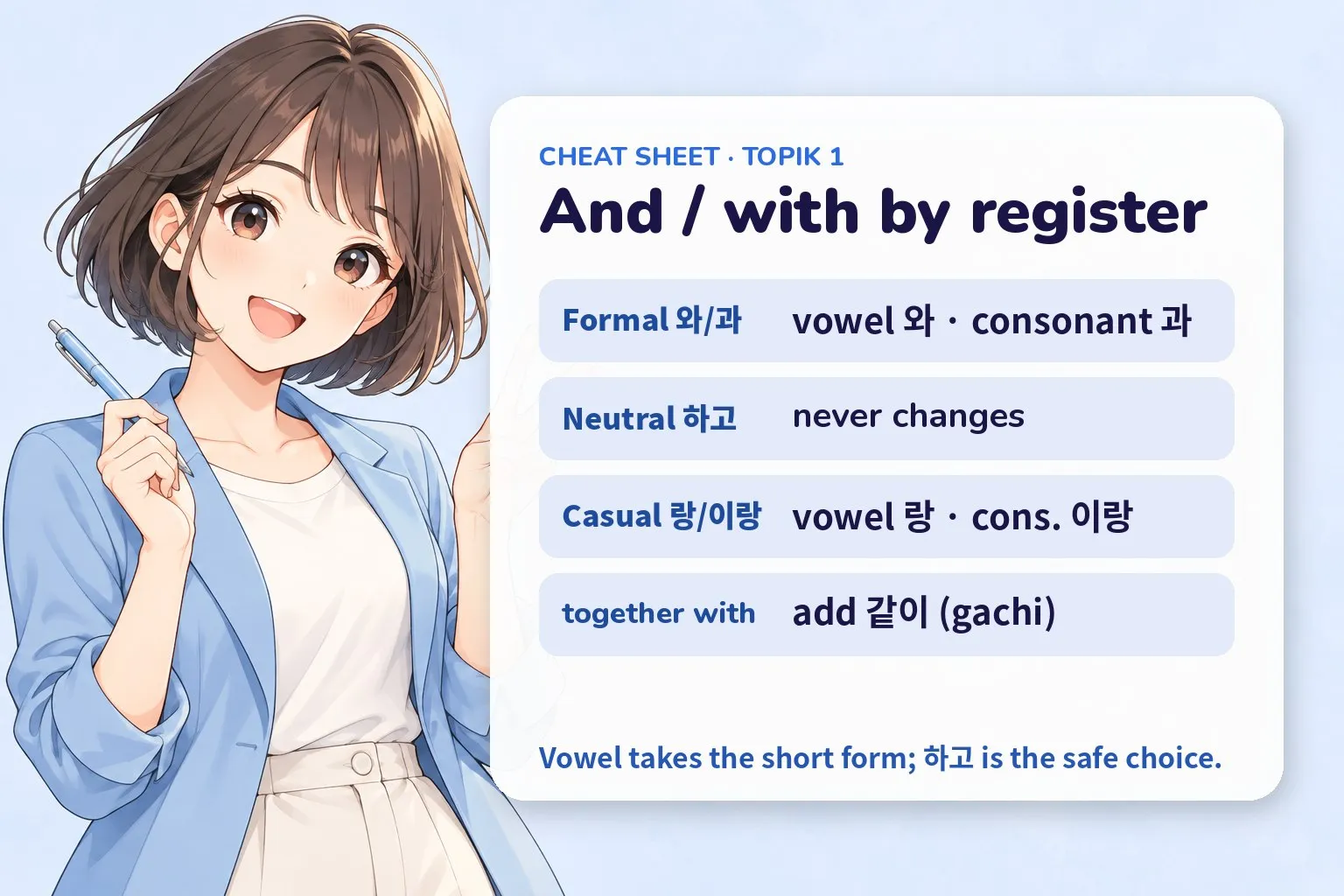
Quick recap before the quiz.
Quiz
And / with particles quiz
11 questions · pick an answer and you'll see straight away if it's right.
-
Show answer
they all mean 'and / with' between nouns — All three join nouns ('A and B') and mark 'with'.
-
Show answer
와 (wa) — 와 (wa) follows a vowel; 과 (gwa) follows a consonant.
-
Show answer
책과 공책 (chaek-gwa gongchaek) — 책 (chaek) ends in a consonant, so use 과 (gwa).
-
Show answer
하고 (hago) — 하고 (hago) attaches to any noun, vowel or consonant.
-
Show answer
동생이랑 (dongsaeng-irang) — After a consonant, use 이랑 (irang): 동생이랑 (dongsaeng-irang).
-
Show answer
와/과 (wa/gwa) — 와/과 (wa/gwa) is the formal, bookish choice.
-
Show answer
같이 (gachi) after the particle — 친구와 같이 (chingu-wa gachi) = '(together) with a friend'.
-
Show answer
wa — 사과 (sagwa) ends in a vowel, so use 와 (wa): 사과와 (sagwa-wa).
-
Show answer
고 (go) links verbs/clauses, not nouns — The connective 고 (go) joins actions, not two nouns; use 와 (wa): 커피와 차 (keopi-wa cha).
-
Show answer
누구랑 (nugu-rang) — 누구랑 (nugurang) is the casual 'with whom'; 누구하고 (nuguhago) is neutral.
-
Show answer
하고 (hago) — 하고 (hago) is neutral and the safest everyday spoken choice.
Recap cheat-sheet
| Register | Vowel-final | Consonant-final |
|---|---|---|
| Formal | 와 (wa) | 과 (gwa) |
| Neutral | 하고 (hago) | 하고 (hago) |
| Casual | 랑 (rang) | 이랑 (irang) |
| “together with” | 같이 (gachi) | 같이 (gachi) |
Next
- Make sure you have the location particle 에 (e) first
- Back to the Korean grammar section
- New here? Start with Start Learning Korean Here
All Korean grammar topics
Every grammar point in order, from your first sentence to advanced structures. Pick one and go straight to it. New lessons go live every day, so topics marked Coming soon fill in over the next weeks.
Grammar path
TOPIK 1 25 topics · 12 ready
- 01 이다 (ida): The Copula (To Be)
- 02 은/는 (eun/neun): The Topic Particle
- 03 이/가 (i/ga): The Subject Particle
- 04 을/를 (eul/reul): The Object Particle
- 05 에 (e): Location & Time Particle
- 06 에서 (eseo): Place of Action & From
- 07 도 (do): Also / Too
- 08 와/과 (wa/gwa), 하고 (hago), (이)랑 ((i)rang): And / With You are here
- 09 의 (ui): Possessive Particle
- 10 있다 / 없다 (itda/eopda): Existence & Possession
- 11 이 / 그 / 저 (i/geu/jeo): This / That
- 12 여기 / 거기 / 저기 (yeogi/geogi/jeogi): Here / There
- 13 아요/어요 (ayo/eoyo): Polite Present Tense Coming soon
- 14 ㅂ니다/습니다 (mnida/seumnida): Formal Polite Style Coming soon
- 15 았/었어요 (at/eosseoyo): Past Tense Coming soon
- 16 안 / 지 않다 (an/ji anta): Negation (Not) Coming soon
- 17 못 / 지 못하다 (mot/ji mothada): Cannot (Inability) Coming soon
- 18 에게/한테/께 (ege/hante/kke): To a Person Coming soon
- 19 부터 / 까지 (buteo/kkaji): From and Until Coming soon
- 20 고 싶다 (go sipda): Want to Do Coming soon
- 21 으러 가다/오다 (eureo gada/oda): Go/Come to Do Coming soon
- 22 겠 (get): Intention & Conjecture Coming soon
- 23 (으)ㄹ 거예요 ((eu)l geoyeyo): Future Tense Coming soon
- 24 (으)세요 ((eu)seyo): Honorific Ending & Requests Coming soon
- 25 (으)시 ((eu)si): Subject Honorific Coming soon
TOPIK 2 33 topics
- 26 고 있다 (go itda): Progressive (-ing) Coming soon
- 27 아/어 보다 (a/eo boda): Try Doing Coming soon
- 28 아/어 주다 (a/eo juda): Do For Someone Coming soon
- 29 (으)ㄹ 수 있다/없다 ((eu)l su itda/eopda): Can / Cannot Coming soon
- 30 아야/어야 되다/하다 (aya/eoya doeda/hada): Must / Have To Coming soon
- 31 지 마세요 (ji maseyo): Don't Do That Coming soon
- 32 (으)면 ((eu)myeon): If / When (Conditional) Coming soon
- 33 (으)니까 ((eu)nikka): Because / Since Coming soon
- 34 아서/어서 (aseo/eoseo): Because & Sequence Coming soon
- 35 (으)ㄹ까요 ((eu)lkkayo)?: Shall We / I? Coming soon
- 36 (으)ㅂ시다 / 자 ((eu)psida/ja): Let's Coming soon
- 37 는 것 (neun geot): Nominalising with 것 (geot) Coming soon
- 38 기 (gi): Nominalising with 기 (gi) Coming soon
- 39 기 때문에 (gi ttaemune): Because (Noun Reason) Coming soon
- 40 (으)ㄴ/는/(으)ㄹ ((eu)n/neun/(eu)l): Verb-to-Modifier Endings Coming soon
- 41 보다 (boda): Comparisons (Than) Coming soon
- 42 제일 / 가장 (jeil/gajang): The Most (Superlative) Coming soon
- 43 아도/어도 되다 (ado/eodo doeda): Permission (May) Coming soon
- 44 (으)면 안 되다 ((eu)myeon an doeda): Must Not Coming soon
- 45 기 전에 / (으)ㄴ 후에 (gi jeone/(eu)n hue): Before & After Coming soon
- 46 (으)ㄹ 때 / 았을 때 ((eu)l ttae/asseul ttae): When Coming soon
- 47 (으)ㄹ게요 ((eu)lgeyo): I'll Do (Promise) Coming soon
- 48 지요 / 죠 (jiyo/jyo): Right? (Seeking Agreement) Coming soon
- 49 는데/(으)ㄴ데 (neunde/(eu)nde): Background & Contrast Coming soon
- 50 지만 (jiman): But / However Coming soon
- 51 거나 / (이)나 (geona/(i)na): Or Coming soon
- 52 아지다/어지다 (ajida/eojida): Become (Adjectives) Coming soon
- 53 게 되다 (ge doeda): Come To / Turn Out Coming soon
- 54 고 (go): And (Linking Clauses/Actions) Coming soon
- 55 동안 / 는 동안 (dongan/neun dongan): During / While Coming soon
- 56 게 / 히 (ge/hi): Making Adverbs Coming soon
- 57 은/는 (eun/neun) vs 이/가 (i/ga): Topic vs Subject Coming soon
- 58 네요 / 군요 (neyo/gunyo): Realisation & Exclamation Coming soon
TOPIK 3 20 topics
- 59 (으)ㄴ/는/(으)ㄹ 것 같다 ((eu)n/neun/(eu)l geot gatda): Seems Like Coming soon
- 60 기로 하다 (giro hada): Decide To Coming soon
- 61 (으)려고 하다 ((eu)ryeogo hada): Intend To / About To Coming soon
- 62 (으)려면 ((eu)ryeomyeon): If You Intend To Coming soon
- 63 아/어 있다 (a/eo itda): Resultant State Coming soon
- 64 아/어 버리다 (a/eo beorida): Completely / Regrettably Coming soon
- 65 고 나서 (go naseo): After Finishing Coming soon
- 66 다가 (daga): While / Switching Action Coming soon
- 67 (으)ㄴ 적이 있다 ((eu)n jeogi itda): Have Done Before Coming soon
- 68 자마자 (jamaja): As Soon As Coming soon
- 69 (으)면서 ((eu)myeonseo): While (Simultaneous) Coming soon
- 70 밖에 (bakke): Only (with Negative) Coming soon
- 71 만 (man): Only / Just Coming soon
- 72 처럼 / 같이 (cheoreom/gachi): Like / As Coming soon
- 73 아도/어도 (ado/eodo): Even If / Even Though Coming soon
- 74 (으)ㄹ수록 ((eu)lsurok): The More... The More Coming soon
- 75 든지 / 든가 (deunji/deunga): Whether / Any Coming soon
- 76 는 중이다 / 는 길에 (neun jungida/neun gire): In the Middle / On the Way Coming soon
- 77 (으)ㄴ/는 데다가 ((eu)n/neun dedaga): In Addition Coming soon
- 78 (으)ㄹ 줄 알다/모르다 ((eu)l jul alda/moreuda): Know How To Coming soon
TOPIK 4 20 topics
- 79 더라고요 (deoragoyo): Retrospective Observation Coming soon
- 80 던 / 았던 (deon/atdeon): Recalled Past Modifier Coming soon
- 81 (으)ㄴ/는 반면에 ((eu)n/neun banmyeone): On the Other Hand Coming soon
- 82 (으)ㄹ 뿐만 아니라 ((eu)l ppunman anira): Not Only...But Also Coming soon
- 83 (으)ㄴ/는 데 비해 ((eu)n/neun de bihae): Compared To Coming soon
- 84 (으)로 인해/때문에/덕분에/탓에 ((eu)ro inhae/ttaemune/deokbune/tase) Coming soon
- 85 는 바람에 (neun barame): Because Of (Unexpected Result) Coming soon
- 86 느라고 (neurago): Because (Simultaneous, Negative) Coming soon
- 87 (으)ㄹ 테니까 ((eu)l tenikka): I Will So / Probably So Coming soon
- 88 (으)ㄹ지도 모르다 ((eu)ljido moreuda): Might / May Coming soon
- 89 (으)ㄴ/는 척하다 ((eu)n/neun cheokhada): Pretend To Coming soon
- 90 게 하다 / 시키다 (ge hada/sikida): Make / Let (Causative) Coming soon
- 91 이/히/리/기 (i/hi/ri/gi): Passive & Causative Suffixes Coming soon
- 92 도록 (dorok): So That / Until / To the Extent Coming soon
- 93 게 (ge): Adverbial / So That Coming soon
- 94 (으)ㄹ 정도로 ((eu)l jeongdoro): To the Extent That Coming soon
- 95 다 보니 / 다 보면 (da boni/da bomyeon): As You Keep Doing Coming soon
- 96 (으)ㄴ/는 김에 ((eu)n/neun gime): While You're At It Coming soon
- 97 (으)ㄹ 겸 ((eu)l gyeom): Also For the Purpose Of Coming soon
- 98 아/어 봤자 (a/eo bwatja): Even If (Pointless) Coming soon
TOPIK 5 12 topics
- 99 더니 / 았더니 (deoni/atdeoni): And Then / Change Coming soon
- 100 (으)ㄴ/는 셈이다 ((eu)n/neun semida): As Good As / In Effect Coming soon
- 101 (으)ㄹ 만하다 / 법하다 ((eu)l manhada/beophada): Worth / Likely Coming soon
- 102 (으)ㄹ 리가 없다 ((eu)l riga eopda): No Way / Can't Be Coming soon
- 103 (으)ㄴ/는 마당에 ((eu)n/neun madange): Now That / Given Coming soon
- 104 기 마련이다 / 법이다 (gi maryeonida/beobida): Bound To / Naturally Coming soon
- 105 았/었더라면 (at/eotdeoramyeon): If (Only) I Had Coming soon
- 106 기는커녕 (gineunkeonyeong): Far From / Let Alone Coming soon
- 107 에 따라 / (으)ㅁ에 따라 (e ttara/(eu)me ttara): According To / As Coming soon
- 108 ㄴ다/는다 (nda/neunda): Plain Declarative (Written) Coming soon
- 109 (으)ㄹ지언정 ((eu)ljieonjeong): Even If / Rather Than Coming soon
- 110 (으)ㄹ락 말락 ((eu)llak mallak): On the Verge Of Coming soon
TOPIK 6 7 topics
- 111 (으)ㅁ으로써 ((eu)meurosseo): By Means Of (Formal) Coming soon
- 112 (으)ㄴ 나머지 ((eu)n nameoji): As a Result Of (Excess) Coming soon
- 113 (으)ㄹ 턱이 없다 ((eu)l teogi eopda): There's No Way Coming soon
- 114 는 통에 (neun tonge): Because Of (Chaotic) Coming soon
- 115 고자 (goja): In Order To (Formal) Coming soon
- 116 는 양 / (으)ㄴ 양 (neun yang/(eu)n yang): As If / Pretending Coming soon
- 117 기에 망정이지 (gie mangjeongiji): Luckily / Thank Goodness Coming soon