에게 / 한테 / 께: To a Person in Korean
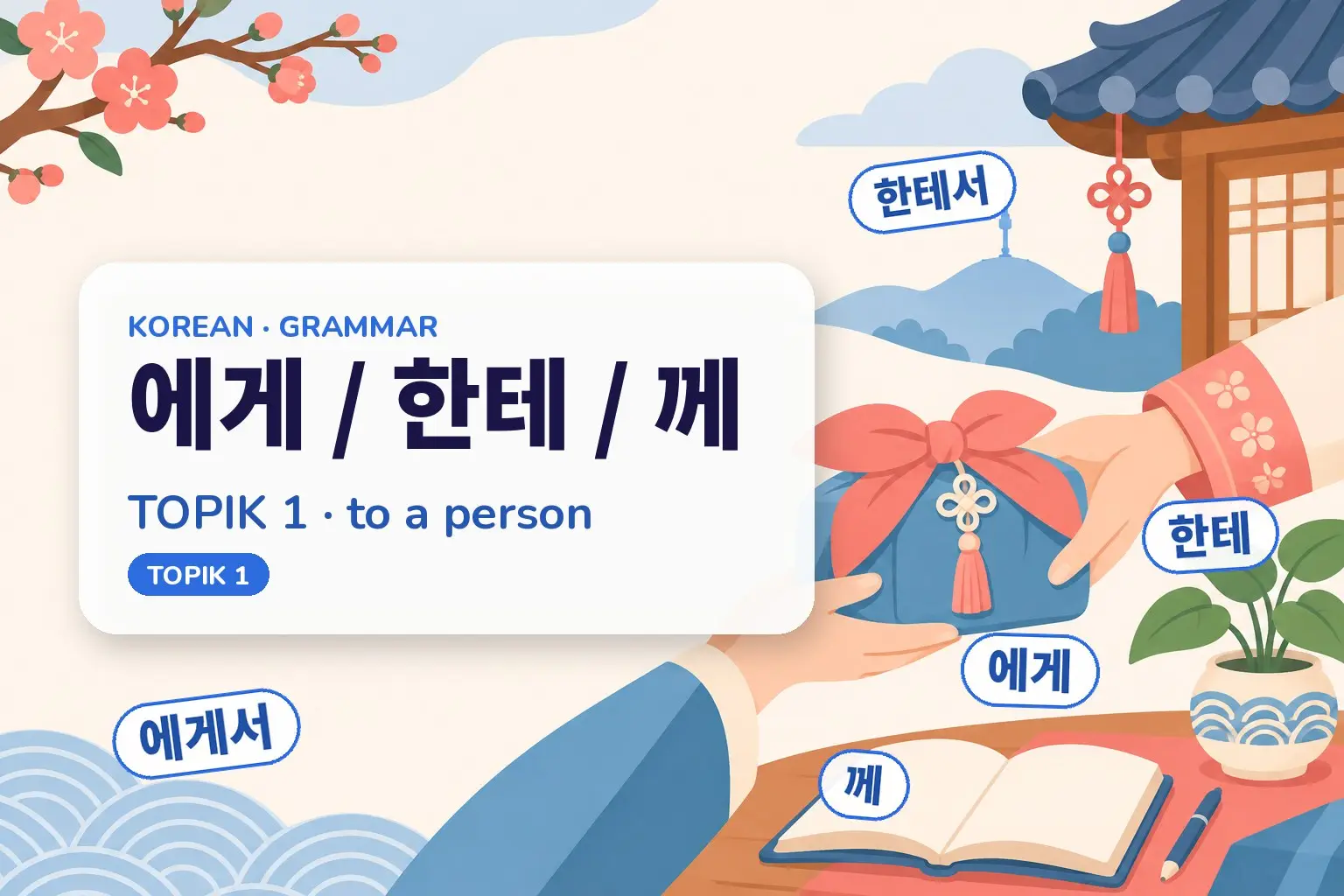
To mark the person something is given, said or sent to, Korean adds 에게 (ege, written), 한테 (hante, spoken) or the honorific 께 (kke) to that person. For 'from a person', use 에게서 (egeseo) or 한테서 (hanteseo).
On this page10 sections · tap to jump
Level: TOPIK 1. A particle is a short ending added to a noun to show its job in the sentence. When the noun is a person who receives something — a gift, a phone call, a letter, a question — Korean marks it with 에게 (ege), 한테 (hante) or the honorific 께 (kke).
The rule
These three particles all mean roughly “to” or “for” a person (grammar books call this the dative or indirect object). They attach straight to the person’s name or title: 친구 (chingu, “friend”) plus 한테 (hante) gives 친구한테 (chingu-hante), “to a friend”.
The choice between them is about register, not meaning:
- 에게 (ege) is the neutral, written form. You see it in books, letters and formal speech.
- 한테 (hante) means exactly the same but sounds natural in everyday conversation.
- 께 (kke) is the honorific form, used when the receiver is someone you respect — a teacher, a parent, a boss, an elder.
To say something comes from a person, add 서 (seo): 에게서 (egeseo) and 한테서 (hanteseo) mean “from a person”.
The forms
| Particle | Reading | Register | Meaning |
|---|---|---|---|
| 에게 | ege | written / formal | to a person |
| 한테 | hante | spoken / casual | to a person |
| 께 | kke | honorific | to a respected person |
| 에게서 | egeseo | written | from a person |
| 한테서 | hanteseo | spoken | from a person |
Because 께 (kke) is honorific, it travels with humble or honorific verbs: you give to a teacher with 드리다 (deurida, the humble “to give”), not the plain 주다 (juda).
Example sentences
Each sentence was written for this lesson, with romanisation.
- 친구에게 선물을 줬어요.Chingu-ege seonmureul jwosseoyo.I gave a present to a friend.written 에게
- 친구한테 선물을 줬어요.Chingu-hante seonmureul jwosseoyo.I gave a present to a friend.spoken 한테, same meaning
- 동생한테 전화했어요.Dongsaeng-hante jeonhwahaesseoyo.I called my younger sibling.casual 한테
- 선생님께 질문했어요.Seonsaengnim-kke jilmunhaesseoyo.I asked the teacher a question.honorific 께
- 어머니께 편지를 드렸어요.Eomeoni-kke pyeonjireul deuryeosseoyo.I gave a letter to my mother.께 with humble 드리다
- 친구에게서 편지를 받았어요.Chingu-egeseo pyeonjireul badasseoyo.I received a letter from a friend.from: 에게서
- 동생한테서 그 이야기를 들었어요.Dongsaeng-hanteseo geu iyagireul deureosseoyo.I heard that story from my younger sibling.from: 한테서
- 저는 아이에게 책을 읽어 줘요.Jeoneun aie-ge chaegeul ilgeo jwoyo.I read a book to the child.에게 after 아이
- 할머니께 꽃을 드렸어요.Halmeoni-kke kkocheul deuryeosseoyo.I gave flowers to my grandmother.honorific receiver
- 고양이한테 밥을 줬어요.Goyangi-hante babeul jwosseoyo.I fed the cat.animals take 에게/한테 too
- 선생님께서 저에게 책을 주셨어요.Seonsaengnim-kkeseo jeoege chaegeul jusyeosseoyo.The teacher gave me a book.께서 marks the doer, 에게 the receiver
- 친구에게 이메일을 보냈어요.Chingu-ege imeireul bonaesseoyo.I sent an email to a friend.
- 부모님께 자주 전화해요.Bumonim-kke jaju jeonhwahaeyo.I often call my parents.께 for parents
- 누구한테 말했어요?Nugu-hante malhaesseoyo?Who did you tell?question word + 한테
- 동생에게 한국어를 가르쳐요.Dongsaeng-ege hangugeoreul gareuchyeoyo.I teach Korean to my younger sibling.
- 의사한테 물어봤어요.Uisa-hante mureobwasseoyo.I asked the doctor.casual 한테
- 선생님께 이메일을 보냈어요.Seonsaengnim-kke imeireul bonaesseoyo.I sent an email to the teacher.honorific
- 친구한테서 돈을 빌렸어요.Chingu-hanteseo doneul billyeosseoyo.I borrowed money from a friend.from: 한테서
Common mistakes
- ❌ 친구에 선물을 줬어요 (chingu-e…) → ✅ 친구에게 / 친구한테 (chingu-ege / chingu-hante). 에 (e) is for places and times, not people.
- ❌ 선생님에게 질문했어요 (seonsaengnim-ege…) → ✅ 선생님께 (seonsaengnim-kke). A teacher is a respected receiver, so use the honorific 께 (kke).
- ❌ 어머니께 선물을 줬어요 (eomeoni-kke … jwosseoyo) → ✅ 어머니께 … 드렸어요 (eomeoni-kke … deuryeosseoyo). With 께 (kke), use the humble verb 드리다 (deurida), not 주다 (juda).
- ❌ 친구에게 편지를 받았어요 (chingu-ege pyeonjireul badasseoyo) for “from a friend” → ✅ 친구에게서 / 친구한테서 (chingu-egeseo / chingu-hanteseo). “From” needs the extra 서 (seo).
- ❌ 선생님께 오셨어요 (seonsaengnim-kke osyeosseoyo) for “the teacher came” → ✅ 선생님께서 오셨어요 (seonsaengnim-kkeseo osyeosseoyo). The doer takes 께서 (kkeseo); 께 (kke) only marks the receiver.
A short conversation
— 생일 선물을 누구한테 줬어요? (Saeng-il seonmureul nugu-hante jwosseoyo?) — “Who did you give the birthday present to?” — 동생한테 줬어요. (Dongsaeng-hante jwosseoyo.) — “I gave it to my younger sibling.” — 부모님께는요? (Bumonim-kke-neun-yo?) — “And to your parents?” — 부모님께는 꽃을 드렸어요. (Bumonim-kke-neun kkocheul deuryeosseoyo.) — “To my parents I gave flowers.”
Notice that the friend and sibling take 한테 (hante), but the parents take the honorific 께 (kke) with the humble verb 드리다 (deurida).
Usage notes
- Animals and things. Living receivers — people and animals — take 에게 (ege) or 한테 (hante): 고양이한테 (goyangi-hante), “to the cat”. An inanimate place takes 에 (e) instead.
- 께 (kke) pairs with humble verbs. The honorific often appears with 드리다 (deurida, “to give”), 여쭈다 (yeojjuda, “to ask”) and 보내 드리다 (bonae deurida, “to send”), which lower the speaker before the respected receiver.
- Topic and other particles stack after it. You can add 는 (neun) or 도 (do): 친구한테도 (chingu-hante-do), “to a friend as well”; 부모님께는 (bumonim-kke-neun), “as for my parents”.
- 에게 (ege) in speech sounds bookish. It is not wrong, but in casual talk 한테 (hante) is far more common; keep 에게 (ege) for writing and formal settings.
Compared with…
- 에 (e) marks places and times, never people: 학교에 가요 (hakgyo-e gayo), “I go to school”, but 친구에게 가요 (chingu-ege gayo), “I go to a friend”. Use the person particles here and 에 (e) for destinations and clock times — see 에 (e): location and time particle.
- The object particle 을 / 를 (eul / reul) marks the thing given, while 에게 / 한테 / 께 (ege / hante / kke) mark the person it goes to; the two often appear together, as in the object particle 을 / 를 (eul / reul). Explore more in the Korean grammar section.
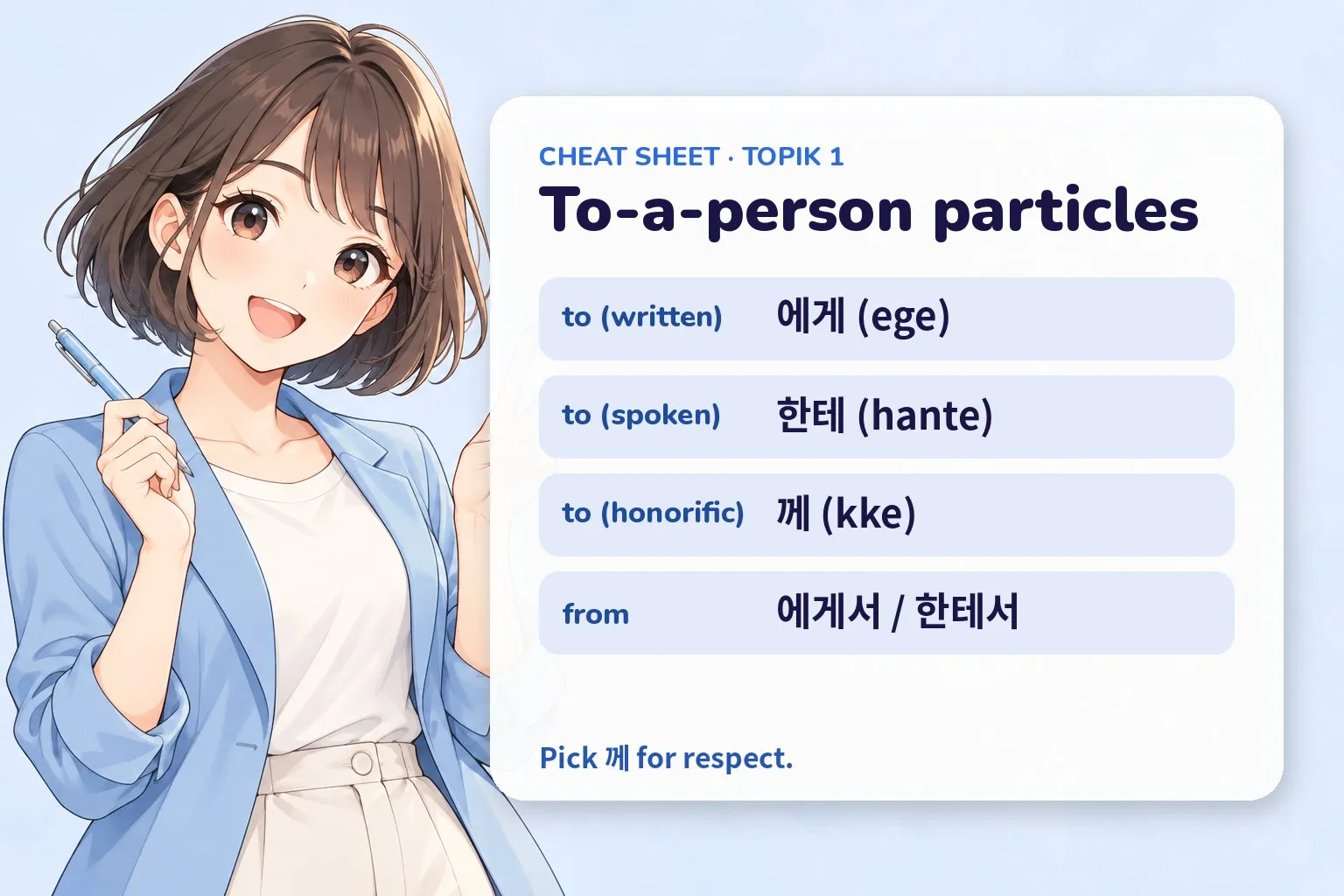
Quick recap before the quiz.
Practice
To-a-person particle practice
Try each one, then press Check. No sign-up, nothing is sent anywhere — it all runs in your browser.
Hint: the honorific dative
Show answer
kke — A respected receiver takes 께 (kke): 선생님께 (seonsaengnim-kke).
4 Build: 'I gave a present to a friend.'
Show answer
친구한테 (chingu-hante) 선물을 (seonmureul) 줬어요 (jwosseoyo) — The person 친구한테 (chingu-hante) comes before the object 선물을 (seonmureul) and the verb.
5 Match each particle to its register.
- 에게 (ege)
- 한테 (hante)
- 께 (kke)
- 한테서 (hanteseo)
Show answer
- 에게 (ege) → written / formal
- 한테 (hante) → spoken / casual
- 께 (kke) → honorific receiver
- 한테서 (hanteseo) → from (spoken)
에게/한테 (ege/hante) differ only by register; 께 (kke) is honorific; add 서 (seo) for 'from'.
Hint: destination, not a person
Show answer
e — A destination takes 에 (e): 학교에 가요 (hakgyo-e gayo).
Quiz
To-a-person particle quiz
12 questions · pick an answer and you'll see straight away if it's right.
-
Show answer
register (writing vs speech) — They mean the same; 에게 (ege) is written, 한테 (hante) is spoken.
-
Show answer
께 (kke) — 께 (kke) is used for a respected receiver.
-
Show answer
고양이한테 (goyangi-hante) — Animals take 에게/한테: 고양이한테 (goyangi-hante).
-
Show answer
친구한테서 (chingu-hanteseo) — Add 서 (seo) for 'from': 한테서 (hanteseo).
-
Show answer
드리다 (deurida) — The honorific receiver takes the humble 드리다 (deurida).
-
Show answer
친구에 (chingu-e) — 친구에 is wrong: 에 (e) is for places and times, not people.
-
Show answer
honorific subject (the doer) — 께서 (kkeseo) is the honorific subject marker; 께 (kke) marks the receiver.
-
Show answer
동생한테 전화했어요 (dongsaeng-hante...) — In casual speech to a younger sibling, 한테 (hante) is natural.
-
Show answer
부모님께 (bumonim-kke) — Parents are respected receivers, so use 께 (kke).
-
Show answer
에게 (ege) — 에게 (ege) is the written, formal choice.
-
Show answer
seo — 에게서 / 한테서 (egeseo / hanteseo) add 서 (seo) for 'from'.
-
Show answer
attached to the person, before the object and verb — It attaches to the person and comes before the object and the verb.
Recap cheat-sheet
| Meaning | Particle | Reading | Example |
|---|---|---|---|
| to (written) | 에게 | ege | 친구에게 (chingu-ege) |
| to (spoken) | 한테 | hante | 친구한테 (chingu-hante) |
| to (honorific) | 께 | kke | 선생님께 (seonsaengnim-kke) |
| from | 에게서 / 한테서 | egeseo / hanteseo | 친구한테서 (chingu-hanteseo) |
Next
- Contrast these with 에 (e): location and time particle
- Mark the thing given with the object particle 을 / 를 (eul / reul)
- New here? Start with Start Learning Korean Here
All Korean grammar topics
Every grammar point in order, from your first sentence to advanced structures. Pick one and go straight to it. New lessons go live every day, so topics marked Coming soon fill in over the next weeks.
Grammar path
TOPIK 1 25 topics · 21 ready
- 01 이다 (ida): The Copula (To Be)
- 02 은/는 (eun/neun): The Topic Particle
- 03 이/가 (i/ga): The Subject Particle
- 04 을/를 (eul/reul): The Object Particle
- 05 에 (e): Location & Time Particle
- 06 에서 (eseo): Place of Action & From
- 07 도 (do): Also / Too
- 08 와/과 (wa/gwa), 하고 (hago), (이)랑 ((i)rang): And / With
- 09 의 (ui): Possessive Particle
- 10 있다 / 없다 (itda/eopda): Existence & Possession
- 11 이 / 그 / 저 (i/geu/jeo): This / That
- 12 여기 / 거기 / 저기 (yeogi/geogi/jeogi): Here / There
- 13 아요/어요 (ayo/eoyo): Polite Present Tense
- 14 ㅂ니다/습니다 (mnida/seumnida): Formal Polite Style
- 15 았/었어요 (at/eosseoyo): Past Tense
- 16 안 / 지 않다 (an/ji anta): Negation (Not)
- 17 못 / 지 못하다 (mot/ji mothada): Cannot (Inability)
- 18 에게/한테/께 (ege/hante/kke): To a Person You are here
- 19 부터 / 까지 (buteo/kkaji): From and Until
- 20 고 싶다 (go sipda): Want to Do
- 21 으러 가다/오다 (eureo gada/oda): Go/Come to Do
- 22 겠 (get): Intention & Conjecture Coming soon
- 23 (으)ㄹ 거예요 ((eu)l geoyeyo): Future Tense Coming soon
- 24 (으)세요 ((eu)seyo): Honorific Ending & Requests Coming soon
- 25 (으)시 ((eu)si): Subject Honorific Coming soon
TOPIK 2 33 topics
- 26 고 있다 (go itda): Progressive (-ing) Coming soon
- 27 아/어 보다 (a/eo boda): Try Doing Coming soon
- 28 아/어 주다 (a/eo juda): Do For Someone Coming soon
- 29 (으)ㄹ 수 있다/없다 ((eu)l su itda/eopda): Can / Cannot Coming soon
- 30 아야/어야 되다/하다 (aya/eoya doeda/hada): Must / Have To Coming soon
- 31 지 마세요 (ji maseyo): Don't Do That Coming soon
- 32 (으)면 ((eu)myeon): If / When (Conditional) Coming soon
- 33 (으)니까 ((eu)nikka): Because / Since Coming soon
- 34 아서/어서 (aseo/eoseo): Because & Sequence Coming soon
- 35 (으)ㄹ까요 ((eu)lkkayo)?: Shall We / I? Coming soon
- 36 (으)ㅂ시다 / 자 ((eu)psida/ja): Let's Coming soon
- 37 는 것 (neun geot): Nominalising with 것 (geot) Coming soon
- 38 기 (gi): Nominalising with 기 (gi) Coming soon
- 39 기 때문에 (gi ttaemune): Because (Noun Reason) Coming soon
- 40 (으)ㄴ/는/(으)ㄹ ((eu)n/neun/(eu)l): Verb-to-Modifier Endings Coming soon
- 41 보다 (boda): Comparisons (Than) Coming soon
- 42 제일 / 가장 (jeil/gajang): The Most (Superlative) Coming soon
- 43 아도/어도 되다 (ado/eodo doeda): Permission (May) Coming soon
- 44 (으)면 안 되다 ((eu)myeon an doeda): Must Not Coming soon
- 45 기 전에 / (으)ㄴ 후에 (gi jeone/(eu)n hue): Before & After Coming soon
- 46 (으)ㄹ 때 / 았을 때 ((eu)l ttae/asseul ttae): When Coming soon
- 47 (으)ㄹ게요 ((eu)lgeyo): I'll Do (Promise) Coming soon
- 48 지요 / 죠 (jiyo/jyo): Right? (Seeking Agreement) Coming soon
- 49 는데/(으)ㄴ데 (neunde/(eu)nde): Background & Contrast Coming soon
- 50 지만 (jiman): But / However Coming soon
- 51 거나 / (이)나 (geona/(i)na): Or Coming soon
- 52 아지다/어지다 (ajida/eojida): Become (Adjectives) Coming soon
- 53 게 되다 (ge doeda): Come To / Turn Out Coming soon
- 54 고 (go): And (Linking Clauses/Actions) Coming soon
- 55 동안 / 는 동안 (dongan/neun dongan): During / While Coming soon
- 56 게 / 히 (ge/hi): Making Adverbs Coming soon
- 57 은/는 (eun/neun) vs 이/가 (i/ga): Topic vs Subject Coming soon
- 58 네요 / 군요 (neyo/gunyo): Realisation & Exclamation Coming soon
TOPIK 3 20 topics
- 59 (으)ㄴ/는/(으)ㄹ 것 같다 ((eu)n/neun/(eu)l geot gatda): Seems Like Coming soon
- 60 기로 하다 (giro hada): Decide To Coming soon
- 61 (으)려고 하다 ((eu)ryeogo hada): Intend To / About To Coming soon
- 62 (으)려면 ((eu)ryeomyeon): If You Intend To Coming soon
- 63 아/어 있다 (a/eo itda): Resultant State Coming soon
- 64 아/어 버리다 (a/eo beorida): Completely / Regrettably Coming soon
- 65 고 나서 (go naseo): After Finishing Coming soon
- 66 다가 (daga): While / Switching Action Coming soon
- 67 (으)ㄴ 적이 있다 ((eu)n jeogi itda): Have Done Before Coming soon
- 68 자마자 (jamaja): As Soon As Coming soon
- 69 (으)면서 ((eu)myeonseo): While (Simultaneous) Coming soon
- 70 밖에 (bakke): Only (with Negative) Coming soon
- 71 만 (man): Only / Just Coming soon
- 72 처럼 / 같이 (cheoreom/gachi): Like / As Coming soon
- 73 아도/어도 (ado/eodo): Even If / Even Though Coming soon
- 74 (으)ㄹ수록 ((eu)lsurok): The More... The More Coming soon
- 75 든지 / 든가 (deunji/deunga): Whether / Any Coming soon
- 76 는 중이다 / 는 길에 (neun jungida/neun gire): In the Middle / On the Way Coming soon
- 77 (으)ㄴ/는 데다가 ((eu)n/neun dedaga): In Addition Coming soon
- 78 (으)ㄹ 줄 알다/모르다 ((eu)l jul alda/moreuda): Know How To Coming soon
TOPIK 4 20 topics
- 79 더라고요 (deoragoyo): Retrospective Observation Coming soon
- 80 던 / 았던 (deon/atdeon): Recalled Past Modifier Coming soon
- 81 (으)ㄴ/는 반면에 ((eu)n/neun banmyeone): On the Other Hand Coming soon
- 82 (으)ㄹ 뿐만 아니라 ((eu)l ppunman anira): Not Only...But Also Coming soon
- 83 (으)ㄴ/는 데 비해 ((eu)n/neun de bihae): Compared To Coming soon
- 84 (으)로 인해/때문에/덕분에/탓에 ((eu)ro inhae/ttaemune/deokbune/tase) Coming soon
- 85 는 바람에 (neun barame): Because Of (Unexpected Result) Coming soon
- 86 느라고 (neurago): Because (Simultaneous, Negative) Coming soon
- 87 (으)ㄹ 테니까 ((eu)l tenikka): I Will So / Probably So Coming soon
- 88 (으)ㄹ지도 모르다 ((eu)ljido moreuda): Might / May Coming soon
- 89 (으)ㄴ/는 척하다 ((eu)n/neun cheokhada): Pretend To Coming soon
- 90 게 하다 / 시키다 (ge hada/sikida): Make / Let (Causative) Coming soon
- 91 이/히/리/기 (i/hi/ri/gi): Passive & Causative Suffixes Coming soon
- 92 도록 (dorok): So That / Until / To the Extent Coming soon
- 93 게 (ge): Adverbial / So That Coming soon
- 94 (으)ㄹ 정도로 ((eu)l jeongdoro): To the Extent That Coming soon
- 95 다 보니 / 다 보면 (da boni/da bomyeon): As You Keep Doing Coming soon
- 96 (으)ㄴ/는 김에 ((eu)n/neun gime): While You're At It Coming soon
- 97 (으)ㄹ 겸 ((eu)l gyeom): Also For the Purpose Of Coming soon
- 98 아/어 봤자 (a/eo bwatja): Even If (Pointless) Coming soon
TOPIK 5 12 topics
- 99 더니 / 았더니 (deoni/atdeoni): And Then / Change Coming soon
- 100 (으)ㄴ/는 셈이다 ((eu)n/neun semida): As Good As / In Effect Coming soon
- 101 (으)ㄹ 만하다 / 법하다 ((eu)l manhada/beophada): Worth / Likely Coming soon
- 102 (으)ㄹ 리가 없다 ((eu)l riga eopda): No Way / Can't Be Coming soon
- 103 (으)ㄴ/는 마당에 ((eu)n/neun madange): Now That / Given Coming soon
- 104 기 마련이다 / 법이다 (gi maryeonida/beobida): Bound To / Naturally Coming soon
- 105 았/었더라면 (at/eotdeoramyeon): If (Only) I Had Coming soon
- 106 기는커녕 (gineunkeonyeong): Far From / Let Alone Coming soon
- 107 에 따라 / (으)ㅁ에 따라 (e ttara/(eu)me ttara): According To / As Coming soon
- 108 ㄴ다/는다 (nda/neunda): Plain Declarative (Written) Coming soon
- 109 (으)ㄹ지언정 ((eu)ljieonjeong): Even If / Rather Than Coming soon
- 110 (으)ㄹ락 말락 ((eu)llak mallak): On the Verge Of Coming soon
TOPIK 6 7 topics
- 111 (으)ㅁ으로써 ((eu)meurosseo): By Means Of (Formal) Coming soon
- 112 (으)ㄴ 나머지 ((eu)n nameoji): As a Result Of (Excess) Coming soon
- 113 (으)ㄹ 턱이 없다 ((eu)l teogi eopda): There's No Way Coming soon
- 114 는 통에 (neun tonge): Because Of (Chaotic) Coming soon
- 115 고자 (goja): In Order To (Formal) Coming soon
- 116 는 양 / (으)ㄴ 양 (neun yang/(eu)n yang): As If / Pretending Coming soon
- 117 기에 망정이지 (gie mangjeongiji): Luckily / Thank Goodness Coming soon