German Intonation & Rhythm: Sentence Melody
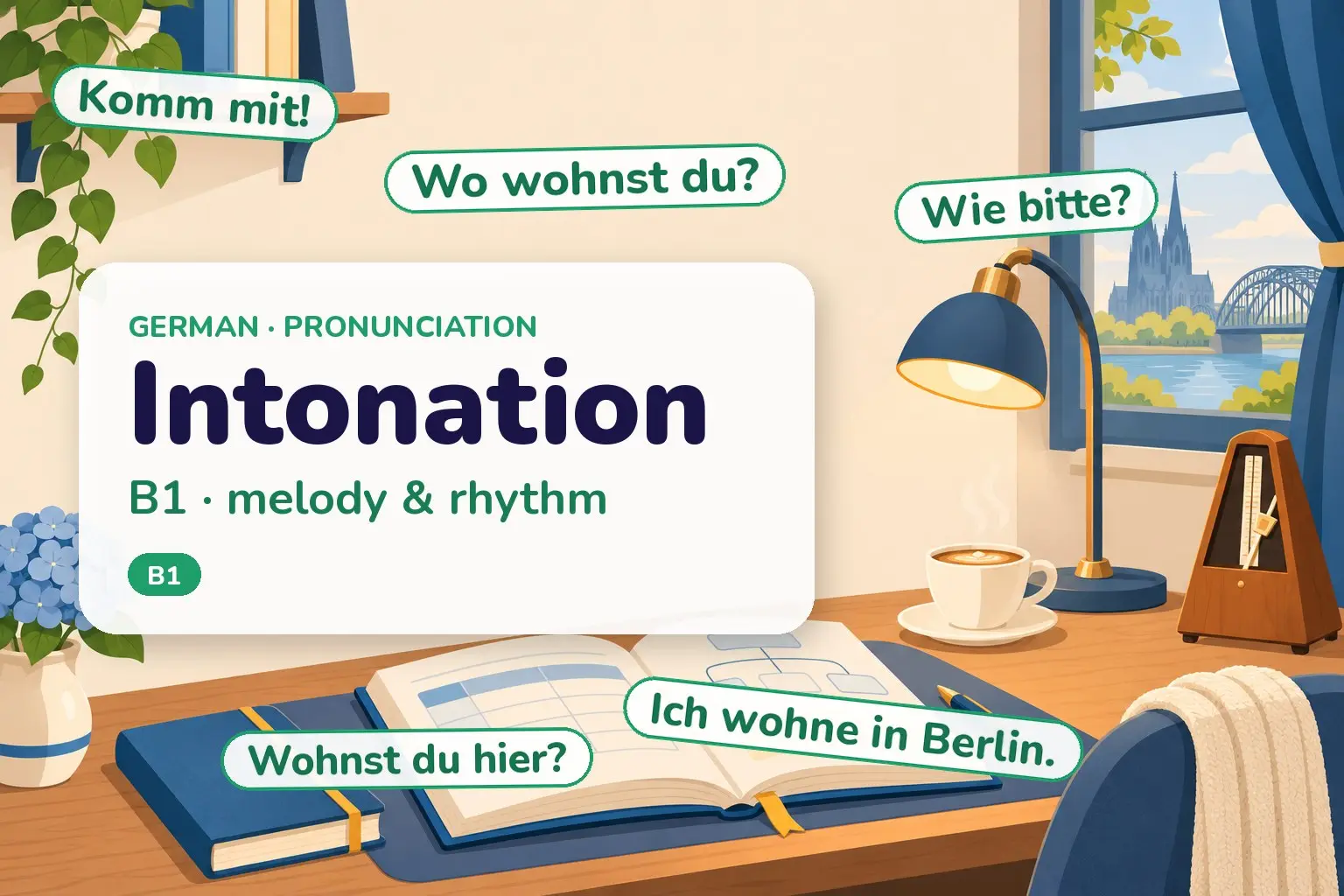
German statements and W-questions fall at the end (Ich wohne in Berlin. Wo wohnst du?), while yes/no questions rise (Wohnst du in Berlin?). Each phrase carries one main accent, and the words around it stay light.
Level: B1. By this point your German word order is doing real work: the verb’s position already tells a listener whether they are hearing a statement or a question. Intonation is the layer on top — the melody that confirms the sentence type, chooses which word matters, and tells people where one idea ends and the next begins.
The rule
Intonation is everything in a spoken line beyond the individual sounds: the movement of pitch, how loud you are, how long syllables last, and where you stop. German is not a tone language — pitch never changes what a single word means — but grammis treats intonation as a core property of the language, and names one of its jobs as marking the sentence mode together with the position of the finite verb and the tone patterns used.
So two systems run in parallel. Word order says this is a question: the finite verb moves to the front for a yes/no question (Wohnst du in Berlin?) and a question word opens a W-question (Wo wohnst du?). The final pitch movement says the same thing again in sound — the boundary tone at the end of the phrase.
The practical test is what the ending promises. A fall closes the line, and grammis lists only falling boundary tones among the patterns that can end an exchange. A rise leaves it open: an answer fits, or the speaker is not finished.
Above the individual words sits the sentence accent, one strongest syllable per intonation phrase. grammis defines the accent as the relative prominence of a syllable compared with its neighbours; the strongest accent in a phrase is the weighting accent, and it is what tells a listener which piece of information is in the foreground.
The last piece is phrasing. German is spoken in short groups — grammis calls them Takte inside an intonation phrase — and the boundary of a group can show up as a lengthened syllable or a pause. Not every pause is a boundary, though, and a boundary is not always a pause: a hesitation in the middle of a group sounds like a stumble, while the same silence before a subordinate clause sounds like structure.
Melody by sentence type
The table follows the boundary-tone system grammis gives for German sentence types. Where two contours are possible, the first is the usual one.
| Sentence type | Example | Final contour |
|---|---|---|
| Statement (Aussagesatz) | Ich wohne in Berlin. | falling ↘ |
| W-question (Ergänzungsfrage) | Wo wohnst du? | falling ↘, sometimes rising |
| Yes/no question (Entscheidungsfrage) | Wohnst du in Berlin? | rising ↗, sometimes falling |
| Follow-up question (Nachfrage) | Wie bitte? | rising-rising ↗↗ |
| Command (Aufforderungssatz) | Komm bitte her! | falling ↘ |
| Exclamation (Exklamativsatz) | Das ist ja unglaublich! | falling ↘ |
Two of these surprise learners. A W-question falls, because the question word has already announced the question; English keeps its W-questions falling too, but many learners over-correct and raise them. And the follow-up question takes a double rise — a single rise there can sound like a fresh yes/no question instead of I did not catch that.
Where the sentence accent goes
In a neutral statement the accent sits on the last content word, the newest piece of information. Change what you are contrasting and the accent moves to it — this is the same mechanism English uses, so your instinct transfers.
| You want to… | Accent on | Example |
|---|---|---|
| state something plainly | the last content word | Ich fahre morgen nach Hamburg. |
| correct the day | the time word | Ich fahre MORGEN nach Hamburg, nicht heute. |
| correct the verb | the verb | Ich FAHRE morgen, ich fliege nicht. |
| correct the person | the subject | ICH habe das gesagt, nicht er. |
Articles, pronouns and prepositions stay light. When one of them is accented, listeners hear a correction, not a neutral sentence — so Ich habe das BUCH gelesen and ICH habe das Buch gelesen are two different remarks, not two pronunciations of one.
How to say it
Four details in this lesson’s words that English habits get wrong:
| Point | How to say it |
|---|---|
| Unstressed -e | a weak “uh”: bitte = “BIT-tuh”, habe = “HAH-buh”. Never a full “ay”. |
| -en at the end | the vowel nearly disappears: wohnen = “VOH-nen”, haben = “HAH-ben”, sprechen = “SHPREH-shen”. |
| ch after i/e | soft, like a hissed “h”: ich = “ish”, nicht = “nisht”, sprechen = “SHPREH-shen”. |
| Vowel-initial words | German starts them with a small catch in the throat: ein Abend has a clean break, not the English linking “ay-nabent”. |
Example sentences
Read each line aloud twice: once flat, then with the contour in the note. The difference is the lesson.
- Ich wohne in Berlin.I live in Berlin.statement: land on the last syllable
- Wo wohnst du?Where do you live?W-question: falls
- Wohnst du in Berlin?Do you live in Berlin?yes/no question: rises on Berlin
- Sprichst du Deutsch?Do you speak German?single rise, answer expected
- Ich spreche ein bisschen Deutsch.I speak a little German.level start, fall at the end
- Wie bitte?Sorry, what was that?follow-up question: double rise
- Kommst du mit?Are you coming along?an offer, so the rise is soft
- Komm mit!Come along!command: sharp fall
- Das ist ja unglaublich!That's incredible!exclamation: wide fall
- Ich fahre MORGEN nach Hamburg, nicht heute.I'm driving to Hamburg tomorrow, not today.accent corrects the day
- ICH habe das gesagt, nicht er.I said that, not him.accent corrects the person
- Ich habe das nicht gesagt.I didn't say that.whole-sentence negation, fall at the end
- Ich stehe um sechs AUF.I get up at six.the accented prefix closes the line
- Der Zug fährt um acht, der Bus um neun.The train leaves at eight, the bus at nine.two phrases, pause after acht
- Wenn es morgen regnet, bleiben wir zu Hause.If it rains tomorrow, we'll stay home.the clause forms its own phrase
- Entschuldigung, wo ist der Bahnhof?Excuse me, where is the station?apology as a separate phrase, then a falling question
- Ich hätte gern einen Kaffee, bitte.I'd like a coffee, please.polite: level, then a gentle fall
- Wir sehen uns morgen, oder?We'll see each other tomorrow, right?confirmation question rises
- Das kann ich dir nicht sagen.I can't tell you that.the second verb part ends the bracket
- Er hat gesagt, dass er später kommt.He said he'd come later.dass-clause: its own phrase, fall inside it
Common mistakes
- ❌ Wo wohnst du?↗ → ✅ Wo wohnst du?↘ The question word already marks the question; a rise sounds as if you suspect you misheard.
- ❌ Wohnst du in Berlin?↘ with no rise → ✅ Wohnst du in Berlin?↗ Yes/no questions normally rise; a flat fall reads as a statement of fact.
- ❌ Ich komme aus Singapur.↗ → ✅ Ich komme aus Singapur.↘ A rising statement sounds uncertain or unfinished, and listeners wait for the rest of the sentence.
- ❌ Accent on nearly every word (Ich HABE das BUCH geLESen) → ✅ accent one word per phrase and let the others run light. Even stress is what makes a German sentence sound memorised rather than meant.
- ❌ Ich // wohne // in // Berlin. → ✅ Ich wohne in Berlin. Word-by-word pauses break the phrase into fragments; group the words and pause at the seams of ideas.
- ❌ Wie bitte?↗ with one rise → ✅ Wie bitte?↗↗ The double rise is what marks a follow-up question rather than a new yes/no question.
A short conversation
Am Empfang: — Guten Tag! Kann ich Ihnen helfen? (rising — an offer, an answer invited) — Ja, ich suche das Büro von Frau Weber. (falling — finished) — Im dritten Stock, Zimmer 312. (two phrases; the second one falls) — Dritter Stock? (double rise — I did not catch that) — Genau, dritter Stock. (falling — confirmation, conversation closed)
Usage notes
- The rising statement. grammis notes that a statement can be given a rising boundary tone only under particular conditions. In practice it turns the line into a check or an invitation — Sie kommen mit?↗ is an offer, not a plain question about a fact.
- Two question types, two contours. Entscheidungsfrage (yes/no) rises; Ergänzungsfrage (W-question) falls. Both contours can appear on both types, but the usual pairing is the one in the table, and the usual pairing is what learners should drill first.
- Continuing contour. A phrase that is not the end of the sentence ends mid-level instead of falling, so the listener knows a second part is coming. Without it, every clause sounds like a separate announcement.
- Pauses carry grammar. In Der Zug fährt um acht, der Bus um neun the comma is a real phrase boundary. Reading the comma as a full stop makes two sentences; reading past it makes one confusing list.
- Rhythm, not volume. Loudness helps an accent, but German foregrounds information mainly with pitch movement and length. Shouting every accent flattens the contrast you wanted.
Compared with word stress
Word stress is fixed per word: FENster, verGEHen, StuDENT. Sentence accent is chosen per utterance and can land on any stressed syllable of any word. A word keeps its own stress when it is not accented — you do not move the stress inside Hamburg when you accent something else, you simply accent less. The fixed patterns are covered in German word stress; this page is about choosing the accent.
| Layer | Fixed or chosen? | Example |
|---|---|---|
| Word stress | fixed by the word | verGEHen, ANkommen |
| Sentence accent | chosen by meaning | Ich fahre MORGEN nach Hamburg. |
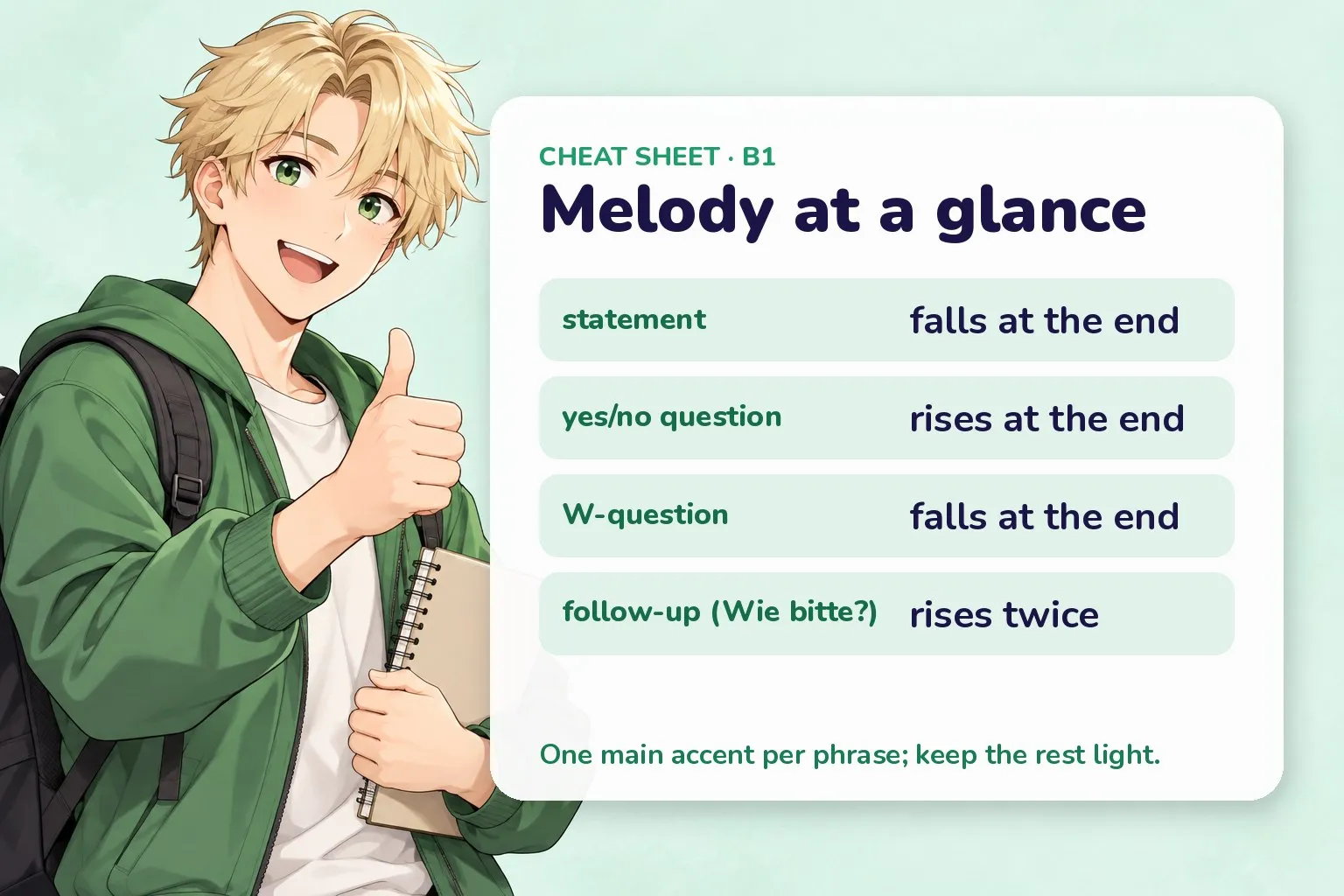
Quick recap before the quiz.
Practice
German intonation practice
Try each one, then press Check. No sign-up, nothing is sent anywhere — it all runs in your browser.
Hint: the verb comes first in a yes/no question
Show answer
Wohnst — Verb-first order marks the yes/no question, and the voice rises at the end.
4 Build the sentence: 'I'm driving to Hamburg tomorrow.'
Show answer
Ich fahre morgen nach Hamburg — Verb second, then time before place: Ich fahre morgen nach Hamburg.
5 Match each sentence type to its usual final contour.
- Statement
- Yes/no question
- W-question
- Follow-up question
Show answer
- Statement → falling ↘
- Yes/no question → rising ↗
- W-question → falling ↘ at the end
- Follow-up question → double rise ↗↗
Only the yes/no question normally rises; the follow-up question rises twice.
Hint: the day word, now accented
Show answer
MORGEN — The accent moves to morgen because morgen is the information being corrected.
Quiz
German intonation and rhythm
12 questions · pick an answer and you'll see straight away if it's right.
-
Show answer
with a fall — The falling boundary tone marks a finished statement.
-
Show answer
a final fall — The W-word already marks the question, so the contour falls.
-
Show answer
rising — Yes/no questions take the rising boundary tone.
-
Show answer
Wie bitte? — Wie bitte? is the follow-up question, with a double rise.
-
Show answer
rises twice — A follow-up question takes the double rise.
-
Show answer
the last content word — Unmarked information structure accents the newest content word, normally the last one.
-
Show answer
the day — The contrast with nicht heute puts the accent on the day word.
-
Show answer
articles and prepositions — Function words stay light unless they are being corrected.
-
Show answer
falling — Commands take the falling boundary tone.
-
Show answer
in short phrases with one accent each — Speakers group words into intonation phrases, each with one weighting accent.
-
Show answer
a phrase boundary — The comma is a real boundary between two intonation phrases.
-
Show answer
auf — The separable prefix closes the clause and carries the accent.
Recap cheat-sheet
| Sentence type | Contour | Model line |
|---|---|---|
| Statement | fall ↘ | Ich wohne in Berlin. |
| Yes/no question | rise ↗ | Wohnst du in Berlin? |
| W-question | fall ↘ | Wo wohnst du? |
| Follow-up question | double rise ↗↗ | Wie bitte? |
| Command | fall ↘ | Komm her! |
| Habit | Rule |
|---|---|
| Accent | one main accent per phrase, on the new or corrected word |
| Function words | light, unless corrected |
| Phrasing | short groups; pause at the seams of ideas |
| Separable prefix | stressed, and it ends the clause |
Next
- The fixed stress inside words: German word stress
- Build the questions this melody carries: German yes/no questions and German W-questions
- Where the verb goes: German sentence word order
- Rhythm drills that use this page: shadowing technique
- Back to the German pronunciation section, or start at Start Learning German Here
All German pronunciation & writing topics
Vocabulary, pronunciation, phrases, practice and exam help, ordered by level. Pick a topic and go straight to it. New lessons go live every day, so topics marked Coming soon fill in over the next weeks.
Pronunciation & writing
A1 4 topics · 4 ready
A2 4 topics · 4 ready
B1 2 topics · 2 ready
- 09 German Final Devoicing (Auslautverhärtung)
- 10 German Intonation & Rhythm You are here