The German Alphabet and Umlauts (ä, ö, ü, ß)
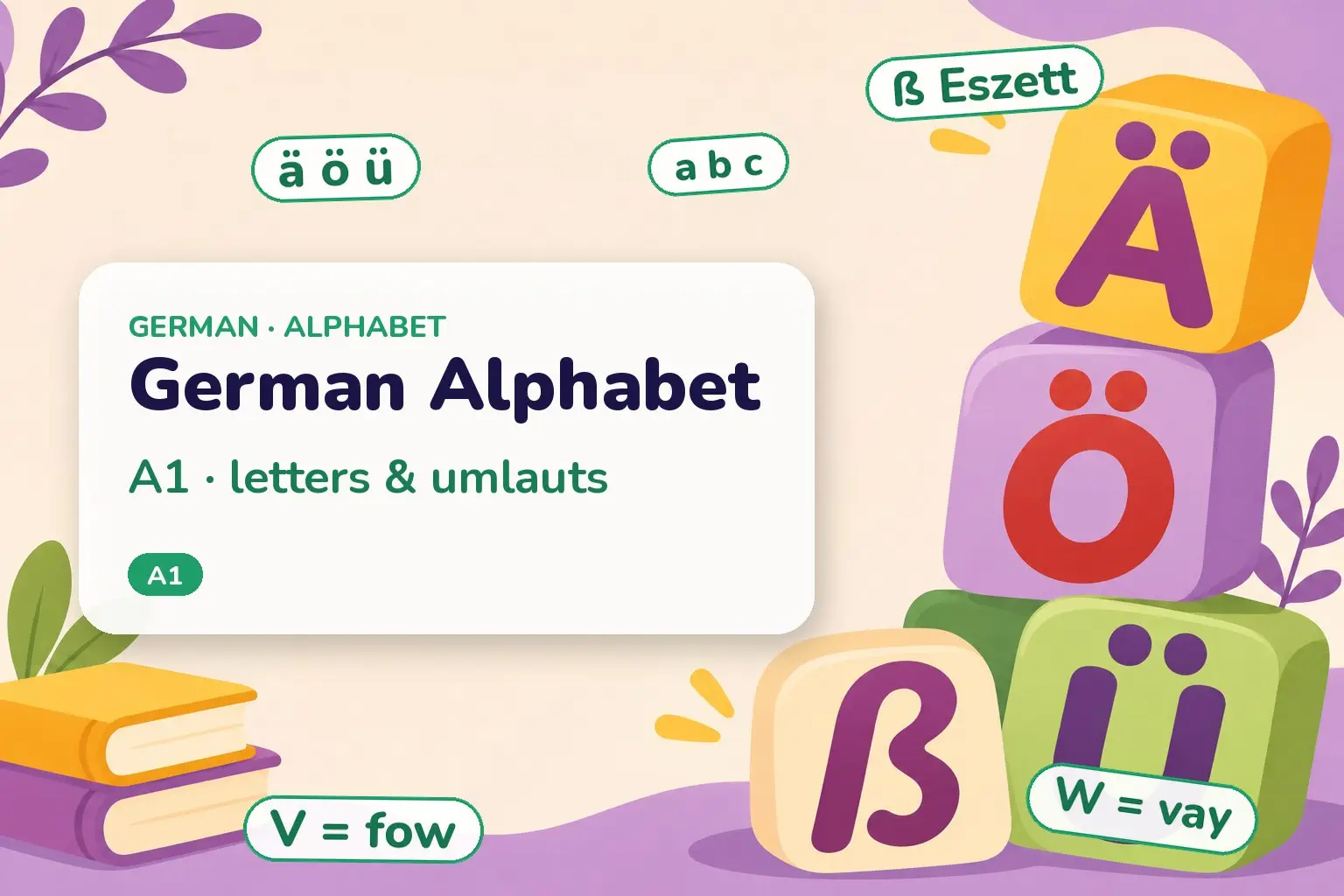
German uses the 26 Latin letters plus three umlauts (ä, ö, ü) and the ß (Eszett). ä, ö, ü can be written ae, oe, ue when the keys are missing, and ß stands only after a long vowel or diphthong, never at the start of a word.
Level: A1 (beginner). The German alphabet is the same 26 Latin letters you already know, plus four special ones: the umlauts ä, ö, ü and the ß. Learn the letter names and you can spell your name on the phone, read a sign, and follow the rest of the course.
By the end of this page you can…
…name every German letter, spell a word aloud, and use the umlauts and ß correctly — including the ae / oe / ue swap when you cannot type the dots.
The 26 base letters
German uses the full Latin alphabet, A to Z. What changes is the names of the letters, which you need when spelling aloud. The ones English speakers get wrong most often:
| Letter | German name (say it like) |
|---|---|
| E | “ay” |
| G | “gay” |
| I | “ee” |
| J | “yot” |
| V | “fow” (rhymes with “cow”) |
| W | “vay” |
| Y | “üpsilon” |
| Z | “tsett” |
The vowel names line up neatly: A = “ah”, E = “ay”, I = “ee”, O = “oh”, U = “oo”. The trap is the pair V (“fow”) and W (“vay”): they feel swapped to an English speaker, because German w sounds like English v.
The four special letters
| Letter | Name | Note |
|---|---|---|
| ä | a-Umlaut | like the e in “bet” |
| ö | o-Umlaut | round your lips for “oh”, say “eh” |
| ü | u-Umlaut | round your lips for “oo”, say “ee” |
| ß | Eszett / scharfes S | a sharp “s”, never a “z” sound |
The three umlauts (ä, ö, ü) are full letters, not accents you can ignore. When a keyboard cannot produce the dots, write them as ae, oe, ue — Müller becomes Mueller, schön becomes schoen. Just dropping the dots (writing schon for schön) is wrong and changes the word.
The ß (Eszett, also called scharfes S) is a single letter that spells a sharp “s”. Two rules make it easy:
- It appears only after a long vowel or a diphthong — Straße (street), weiß (white), groß (big). After a short vowel you write ss instead — Wasser, muss.
- It never starts a word, so there is no capital ß at the beginning of anything. In all-capitals it becomes SS, or the capital ẞ, which was made an official letter in 2017.
How to say it
Four sounds decide whether your spelling sounds German:
- ä — the “e” in bet: Mädchen (girl).
- ö — say “oh”, then “eh” with rounded lips: schön (beautiful).
- ü — say “oo”, then “ee” with rounded lips: über (over), für (for).
- ß — a short, sharp “s” (never a buzzing “z”): Straße (street), weiß (white).
Example words
- ApfelappleA as in 'ah'
- VogelbirdV sounds like English f: 'FOH-gel'
- WasserwaterW sounds like English v; ss after a short vowel
- JahryearJ sounds like English y: 'yar'
- ZeittimeZ sounds like ts: 'tsyte'
- Mädchengirlä like the e in 'bet'
- schönbeautifulö = rounded 'eh'
- überover / aboveü = rounded 'ee'
- fürforanother ü word
- Straßestreetß after the long a; a sharp s
- weißwhiteß after the diphthong ei
- großbigß after a long o
- Müller(a surname / miller)write 'Mueller' without the umlaut keys
- ÖsterreichAustriastarts with ö; write 'Oesterreich' if needed
Spelling a word aloud
To spell Müller on the phone you say: “em – u-Umlaut (or u-e) – el – el – e – er”. For groß: “ge – er – o – Eszett”. Germans often use first names as a spelling alphabet — Anton, Berta, Cäsar… — but letter names alone are enough at A1.
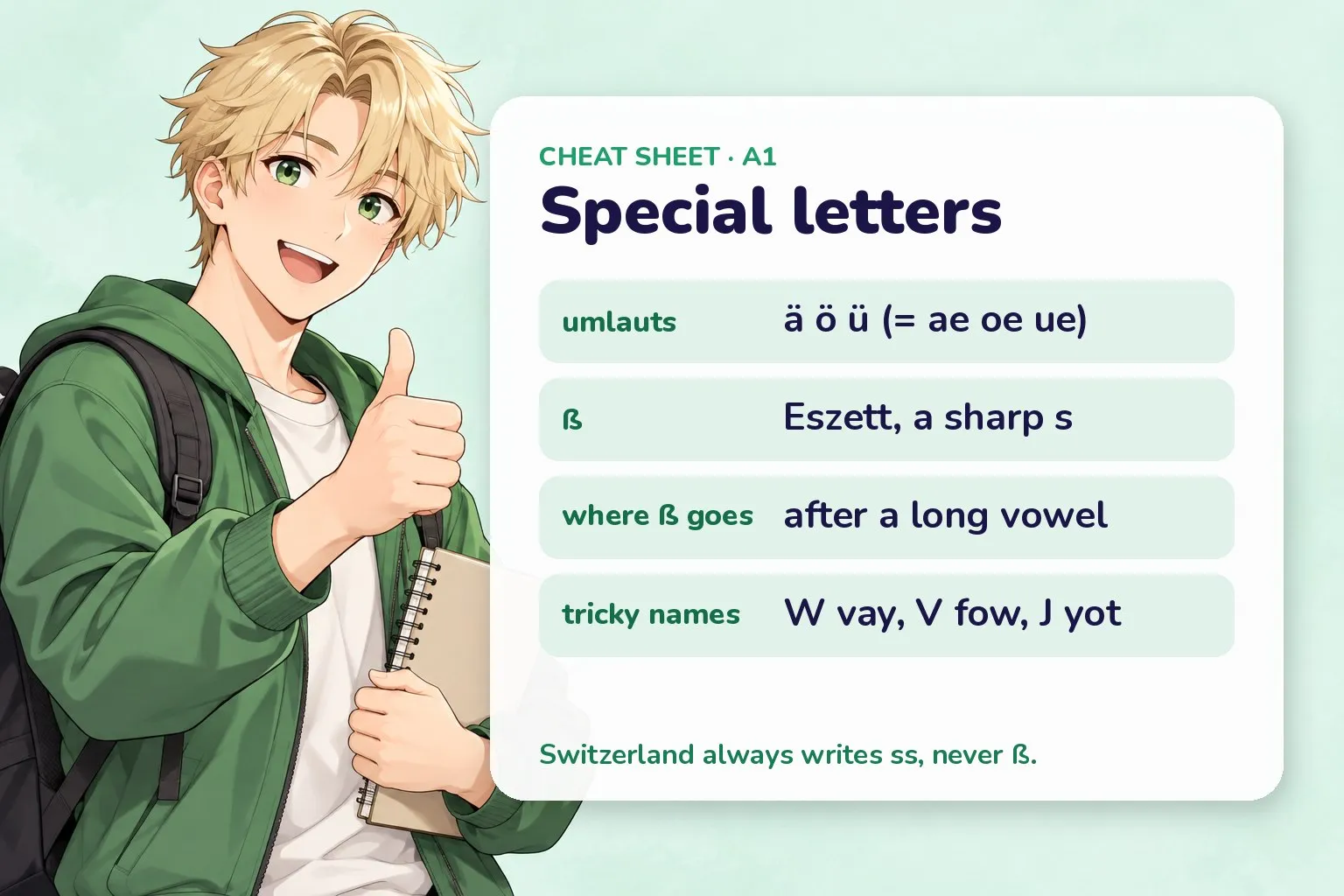
Quick recap before the quiz.
Practice
German alphabet practice
Try each one, then press Check. No sign-up, nothing is sent anywhere — it all runs in your browser.
Hint: ü becomes two letters
Show answer
ue — ü is written ue when the dots are unavailable: Mueller.
4 Match each letter to its German name.
- J
- V
- Z
- ß
Show answer
- J → yot
- V → fow
- Z → tsett
- ß → Eszett
These four names trip up English speakers most.
Quiz
The German alphabet
8 questions · pick an answer and you'll see straight away if it's right.
-
Show answer
26 — The 26 Latin letters, plus the special ä, ö, ü, ß.
-
Show answer
'fow' — V is 'fow'; W is 'vay'.
-
Show answer
ß — ß is the Eszett, not an umlaut; the umlauts are ä, ö, ü.
-
Show answer
Eszett / scharfes S — Its names are Eszett and scharfes S.
-
Show answer
ue — Write ue (Müller to Mueller); dropping the dots is wrong.
-
Show answer
only after a long vowel or diphthong — ß follows a long vowel/diphthong and never starts a word.
-
Show answer
ss or the capital ẞ — All-caps uses SS or the capital ẞ (official since 2017).
-
Show answer
wrong — it is a different word (already vs beautiful) — Umlauts are real letters: schon = already, schön = beautiful.
Next
- Get the sounds in order: German pronunciation overview
- Start the course: Start Learning German Here
- Your first grammar: Der, Die, Das and the German grammar section
All German pronunciation & writing topics
Vocabulary, pronunciation, phrases, practice and exam help, ordered by level. Pick a topic and go straight to it. New lessons go live every day, so topics marked Coming soon fill in over the next weeks.
Pronunciation & writing
A1 4 topics · 2 ready
- 01 German Pronunciation Overview
- 02 The German Alphabet & Umlauts You are here
- 03 German Vowels: Long vs Short Coming soon
- 04 German Umlauts (ä ö ü) & ß Coming soon
A2 4 topics
- 05 Tricky German Consonants (ch, r, z, w, v) Coming soon
- 06 German Consonant Clusters (sch, sp, st, pf) Coming soon
- 07 German Word Stress Coming soon
- 08 German Spelling & Capitalisation Rules Coming soon
B1 2 topics
- 09 German Final Devoicing (Auslautverhärtung) Coming soon
- 10 German Intonation & Rhythm Coming soon