Tricky German Consonants: ch, r, z, w, v
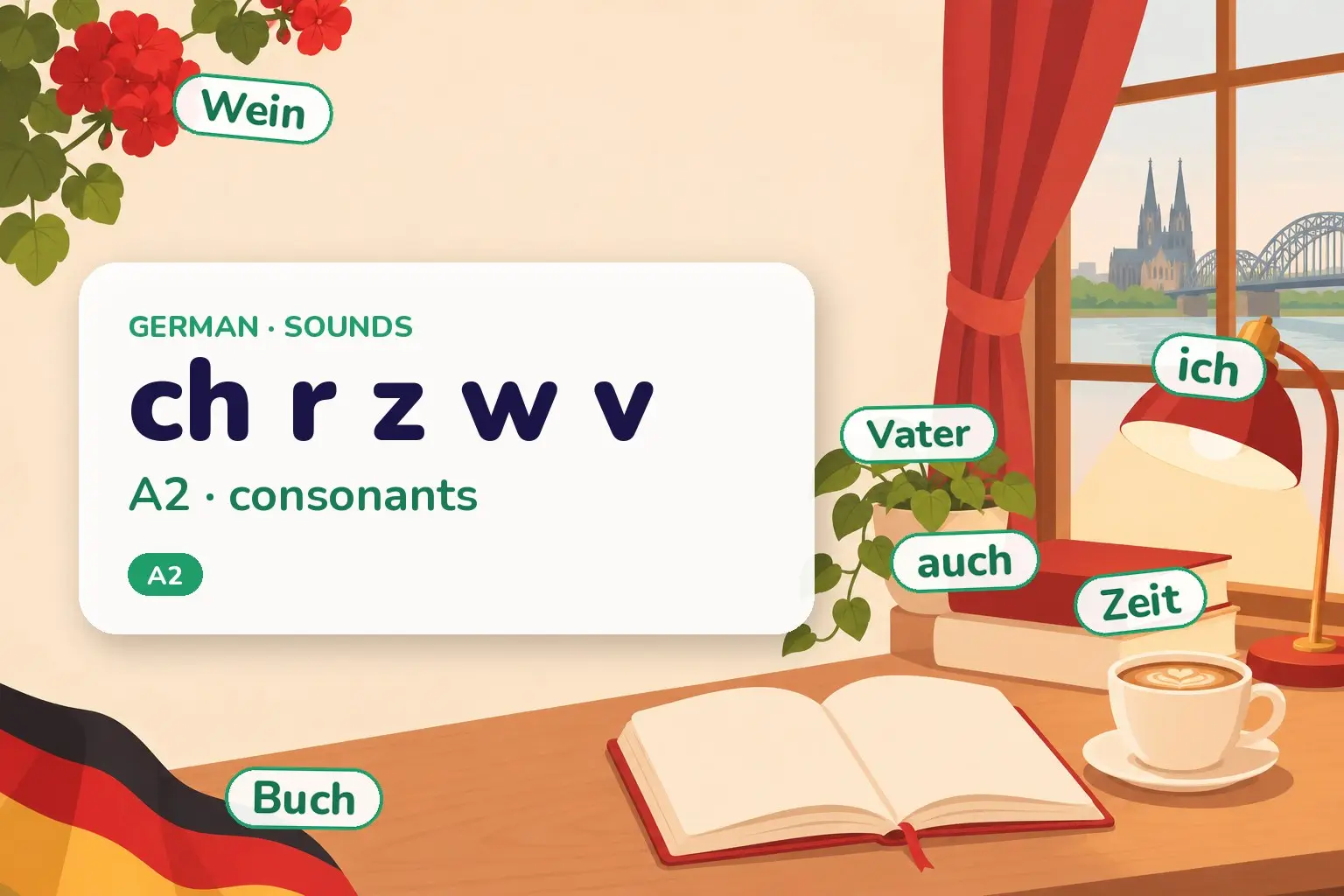
Five German consonants surprise English speakers: ch has two sounds (soft ich, hard ach), r is made in the throat and fades to an 'uh' at the end of a word, z is always 'ts', w sounds like English 'v', and v usually sounds like 'f'.
Level: A2. Most German consonants are read exactly as an English speaker expects. Five are not: ch, r, z, w and v. Each one follows a clear rule, and once you know the rule there are almost no exceptions. This page takes them one at a time.
By the end of this page you can…
…make both ch sounds and know which to use, pronounce the German r in the throat and at the end of a word, and read z, w and v with their real German values instead of their English ones.
ch — one spelling, two sounds
The letters ch stand for two different sounds, and a single rule tells them apart: look at the vowel just before the ch.
- The soft ch (the ich-Laut) is a gentle hiss, like an exaggerated “h” in huge. Use it after the front vowels e, i, ä, ö, ü and after the consonants l, n, r: ich, nicht, Milch, durch.
- The hard ch (the ach-Laut) is a rougher scrape at the back of the mouth, like the “ch” in Scottish loch. Use it after the back vowels a, o, u and the diphthong au: Buch, auch, noch, Bach.
Two small extras: the ending -chen is always the soft sound, even after a back vowel (Mädchen, bisschen), and chs inside a word is usually read as “ks” (sechs = “zeks”, Fuchs = “fooks”).
r — a throat sound that fades at the end
The German r is not the English r. In careful standard German it is made at the back of the throat, close to a light gargle, when it comes before a vowel: rot, Reise, Frau, fahren.
At the end of a syllable the r almost disappears and turns into a short “uh” sound (a vowel, written [ɐ] by linguists). So Vater sounds like “FAH-tuh”, aber like “AH-buh”, and Uhr like “oor” with no hard r.
z — always “ts”
The letter z is always pronounced “ts”, the sound at the end of English cats, never a buzzing English z. It keeps that value everywhere in the word: Zeit (“tsait”), zwei (“tsvai”), Katze (“KAT-se”), Salz (“zalts”). The combination tz is the same “ts”, just written after a short vowel: Platz, jetzt.
w and v — the pair that swap
These two are the classic trap, because German uses them almost opposite to English.
- w is pronounced like the English “v”: Wasser (“VAS-ser”), wie (“vee”), Wein (“vine”), Woche (“VO-khe”).
- v is usually pronounced like the English “f” in native German words: Vater (“FAH-tuh”), viel (“feel”), vier (“feer”), von (“fon”).
How to say it
- ch (soft) — a light hiss with the tongue high and forward: ich ≈ “ikh” said gently, no “k”.
- ch (hard) — a rough scrape at the back: Buch ≈ “bookh”, like Scottish loch.
- r — a throaty sound before a vowel (rot); a soft “uh” at the end (Vater ≈ “FAH-tuh”).
- z — “ts” as in cats: Zeit ≈ “tsait”.
- w / v — w = English v (Wein ≈ “vine”); v = f (Vater ≈ “FAH-tuh”).
Example words
- ichIsoft ch after i
- nichtnotsoft ch after i
- Milchmilksoft ch after l
- durchthroughsoft ch after r
- Buchbookhard ch after u
- auchalsohard ch after au
- nochstill / yethard ch after o
- Mädchengirl-chen is always soft
- sechssixchs = ks, 'zeks'
- rotredthroaty r before a vowel
- Vaterfatherv = f; final -er = 'uh'
- aberbutfinal -er fades to 'uh'
- Zeittimez = ts, 'tsait'
- zweitwoz = ts, 'tsvai'
- Katzecattz = ts
- Wasserwaterw = English v
- Weinwinew = v, 'vine'
- vielmuch / a lotv = f, 'feel'
- Vasevaseloanword: v stays 'v'
- NovemberNovemberloanword: v stays 'v'
A worked contrast: Wein, viel, Zeit
Read the three together and you cover four of the five rules at once: Wein starts with w (“v”), viel starts with native v (“f”), and Zeit starts with z (“ts”). Say “vine — feel — tsait”. If those three feel natural, the rest is detail.
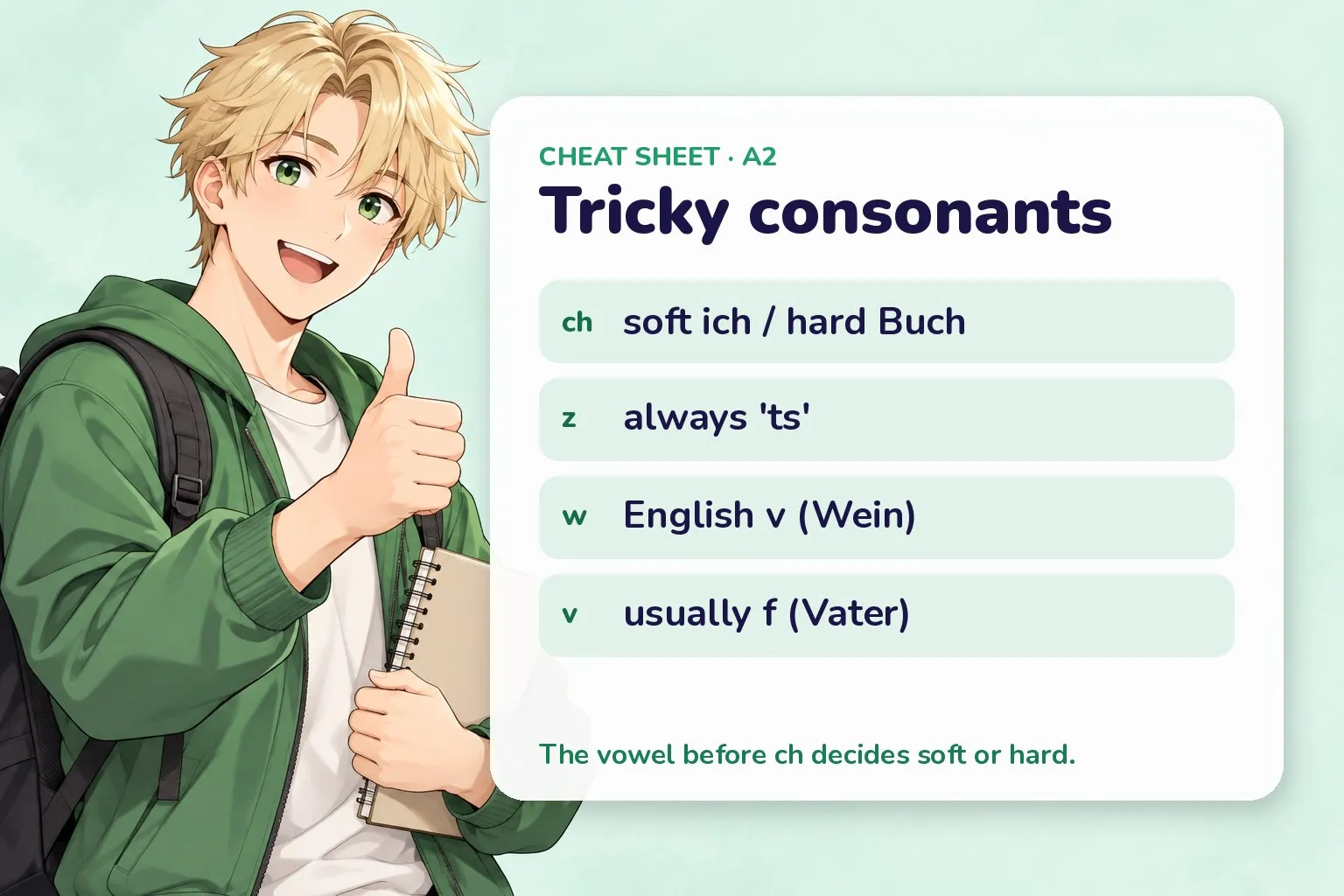
Quick recap before the quiz.
Practice
Tricky German consonants practice
Try each one, then press Check. No sign-up, nothing is sent anywhere — it all runs in your browser.
Hint: Wasser, Wein
Show answer
v — w is pronounced like English v: Wasser = 'VAS-ser'.
4 Match each letter to its usual German sound.
- w
- v
- z
- soft ch
Show answer
- w → English v
- v → f
- z → ts
- soft ch → hiss as in 'huge'
w = v, native v = f, z = ts, and the soft ch is a light hiss.
Hint: Vater = 'FAH-tuh'
Show answer
f — In native words v is pronounced 'f'; only loanwords keep 'v'.
Quiz
Tricky German consonants
12 questions · pick an answer and you'll see straight away if it's right.
-
Show answer
e, i, ä, ö, ü and l/n/r — Front vowels and l/n/r give the soft ch; back vowels give the hard one.
-
Show answer
ich — ich has a front vowel (i) before ch, so the ch is soft.
-
Show answer
the soft ch — -chen (Mädchen, bisschen) is always the soft ich-sound.
-
Show answer
'zeks' — chs is read as 'ks': sechs = 'zeks'.
-
Show answer
at the back of the throat — Standard German r before a vowel is a throaty (uvular) sound.
-
Show answer
a short 'uh' — A final -er weakens to a short 'uh': Vater = 'FAH-tuh'.
-
Show answer
'ts' — z = 'ts' everywhere: Zeit, zwei, Katze.
-
Show answer
v — German w is pronounced like English v, so Wein sounds like 'vine'.
-
Show answer
f — Native German v is 'f': Vater = 'FAH-tuh'.
-
Show answer
Vase — Vase is a loanword, so the v stays 'v'; native viel/Vater/von use 'f'.
-
Show answer
ts — z is 'ts', as at the end of English 'cats'.
-
Show answer
'ts' — tz is just 'ts' after a short vowel: Katze = 'KAT-se'.
Next
- The vowels behind these words: German vowel sounds
- The extra letters ä, ö, ü and ß: German umlauts and ß
- Spell any word aloud: the German alphabet
- See the whole sound system: German pronunciation overview
All German pronunciation & writing topics
Vocabulary, pronunciation, phrases, practice and exam help, ordered by level. Pick a topic and go straight to it. New lessons go live every day, so topics marked Coming soon fill in over the next weeks.
Pronunciation & writing
A1 4 topics · 4 ready
A2 4 topics · 4 ready
- 05 Tricky German Consonants (ch, r, z, w, v) You are here
- 06 German Consonant Clusters (sch, sp, st, pf)
- 07 German Word Stress
- 08 German Spelling & Capitalisation Rules
B1 2 topics · 1 ready
- 09 German Final Devoicing (Auslautverhärtung)
- 10 German Intonation & Rhythm Coming soon