German Spelling and Capitalisation Rules
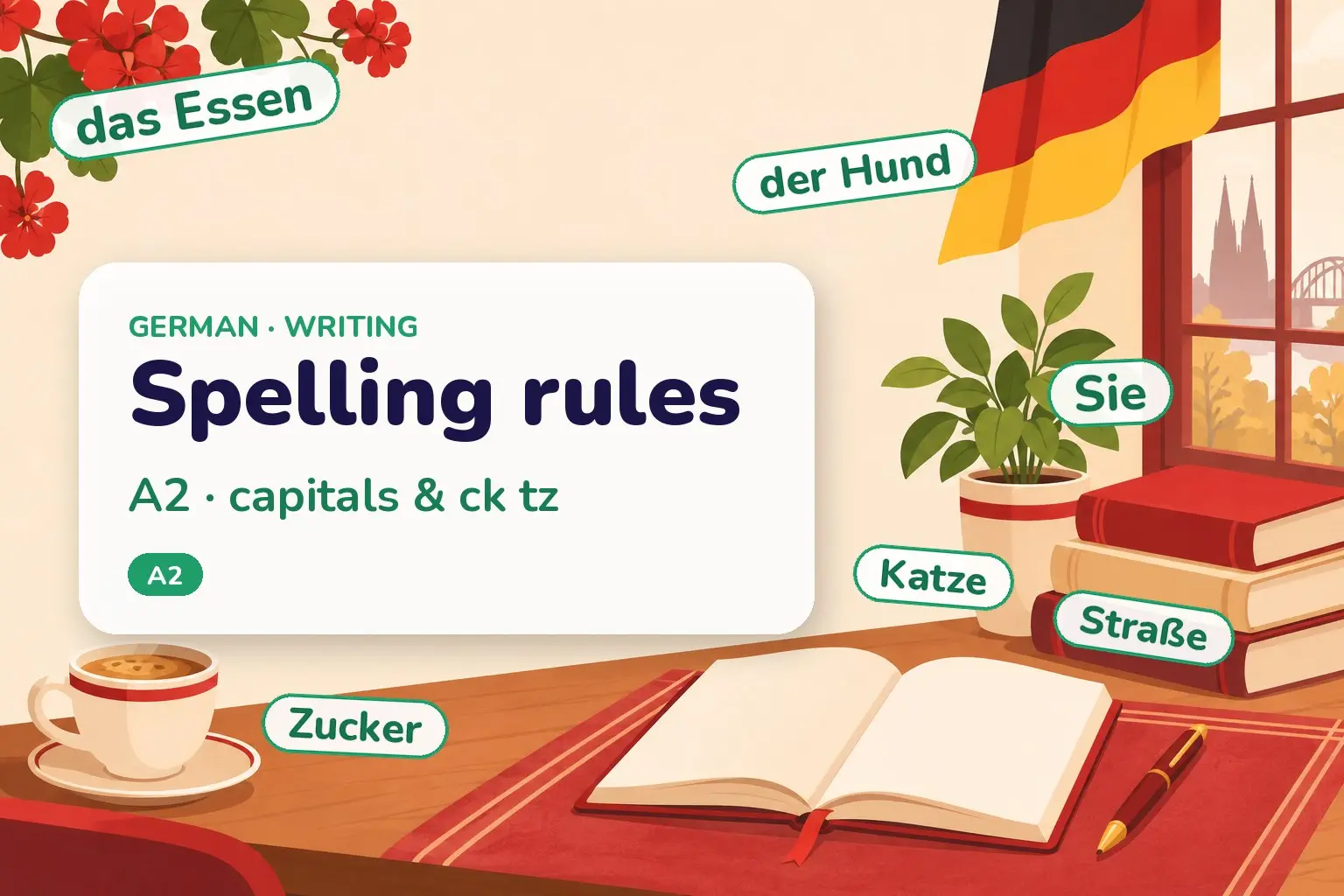
German capitalises every noun, not only names: der Hund, die Freiheit, das Essen. It also capitalises words used as nouns (das Lesen) and the polite Sie. Spelling follows sound: ß or ss after a vowel's length, ck after a short vowel, tz for a short-vowel 'ts'.
Level: A2. German writing has one rule no other major European language keeps: it gives every noun a capital letter. Add a few sound-based spellings — ß versus ss, ck and tz — and you have almost everything you need to write German words the way Germans do.
By the end of this page you can…
…capitalise nouns correctly, spot when a verb or adjective has become a noun and needs a capital, capitalise the polite Sie, and choose between ß/ss, ck/k and tz/z by the sound of the word.
Every noun is capitalised
In German, all nouns take a capital letter, wherever they sit in the sentence — not just names and not just the first word. A noun is a word for a thing, person, idea or place: der Hund (the dog), die Stadt (the city), die Freiheit (freedom), das Glück (luck/happiness).
- Der Mann kauft einen Apfel im Supermarkt. — The man buys an apple in the supermarket.
- Die Liebe und die Hoffnung sind stark. — Love and hope are strong.
The easiest signal is an article (der, die, das, ein, eine) or a possessive (mein, dein): whatever follows it and names a thing is a noun and gets a capital.
When verbs and adjectives become nouns
German often turns a verb or an adjective into a noun — called nominalisation — and the new noun is capitalised. The giveaway is a little word in front: an article, a preposition+article, or a quantity word.
- Verb → noun: essen (to eat) → das Essen (the food/meal); lesen (to read) → beim Lesen (while reading).
- Adjective → noun: gut (good) → das Gute (the good); neu (new) → etwas Neues (something new).
| Lower-case (ordinary word) | Capitalised (used as a noun) |
|---|---|
| essen (to eat) | das Essen (the meal) |
| laufen (to run) | das Laufen (running) |
| gut (good) | das Gute (the good) |
| deutsch (German, adj.) | auf Deutsch (in German) |
Capitalise the polite Sie
German capitalises the formal “you” — Sie, Ihnen, Ihr — in every position, so a reader can tell it from sie (“she/they”). The informal du, ihr, dein, euer are written lower-case in ordinary text.
- Können Sie mir helfen? — Can you (formal) help me?
- Ich danke Ihnen. — I thank you (formal).
- Hast du Zeit? — Do you (informal) have time? (lower-case du)
Sound-based spellings: ß, ck and tz
Three spellings follow the sound of the word, especially the length of the vowel in front.
- ß or ss — write ß after a long vowel or a diphthong (Straße, groß, heißen) and ss after a short vowel (Fluss, muss, Wasser). The full rule, with the Swiss exception, is in German umlauts and ß.
- ck — stands for a “k” sound and appears only after a short, stressed vowel: Zucker (sugar), backen (to bake), dick (thick). After a long vowel or a consonant you write a single k: Haken (hook), Werk (work).
- tz — stands for a “ts” sound after a short, stressed vowel: Katze (cat), sitzen (to sit), Platz (place). After a long vowel or a consonant you write z: Salz (salt), duzen (to say du).
| Short vowel → double | Long vowel / consonant → single |
|---|---|
| Zucker (ck) | Haken (k) |
| Katze (tz) | Salz (z) |
| Fluss (ss) | Fuß (ß after long u) |
| backen (ck) | Werk (k) |
How to say it
These letters map to sounds an English speaker should know:
- ck — a plain “k”: Zucker ≈ “TSOO-ker”, dick ≈ “dik”.
- tz and z — both “ts”: Katze ≈ “KAT-se”, Salz ≈ “zalts”.
- ß and ss — the same hissed “s”: Straße ≈ “SHTRAA-se”, Fluss ≈ “floos”.
- st / sp at the start — “sht / shp”: Straße ≈ “SHTRAA-se”, Sport ≈ “shport”.
Example words and sentences
- der Hundthe dogcommon noun → capital
- die Freiheitfreedomabstract noun → capital
- das Essenthe meal/foodverb essen made into a noun
- beim Lesenwhile readingnominalised verb after a preposition+article
- etwas Neuessomething newadjective neu used as a noun
- Können Sie mir helfen?Can you (formal) help me?polite Sie capitalised
- Ich danke Ihnen.I thank you (formal).Ihnen capitalised
- Hast du Zeit?Do you (informal) have time?du stays lower-case
- Der Zucker ist süß.The sugar is sweet.ck after short u; ß after long ü
- Die Katze sitzt auf dem Platz.The cat sits on the square.tz after short vowels
- Wir backen einen Kuchen.We bake a cake.ck in backen (short a)
- Das Salz ist in der Küche.The salt is in the kitchen.z after consonant l: Salz
- Die Straße ist breit.The street is wide.ß after long a
- Der Fluss ist tief.The river is deep.ss after short u
- Ich lese gern Bücher.I like reading books.verb lese lower-case; noun Bücher capital
- Das Gute siegt am Ende.Good wins in the end.adjective gut nominalised → das Gute
- Er spricht gut Deutsch.He speaks German well.language name Deutsch capitalised
- Die Mütze liegt auf dem Tisch.The cap is on the table.tz after short ü; Tisch capital
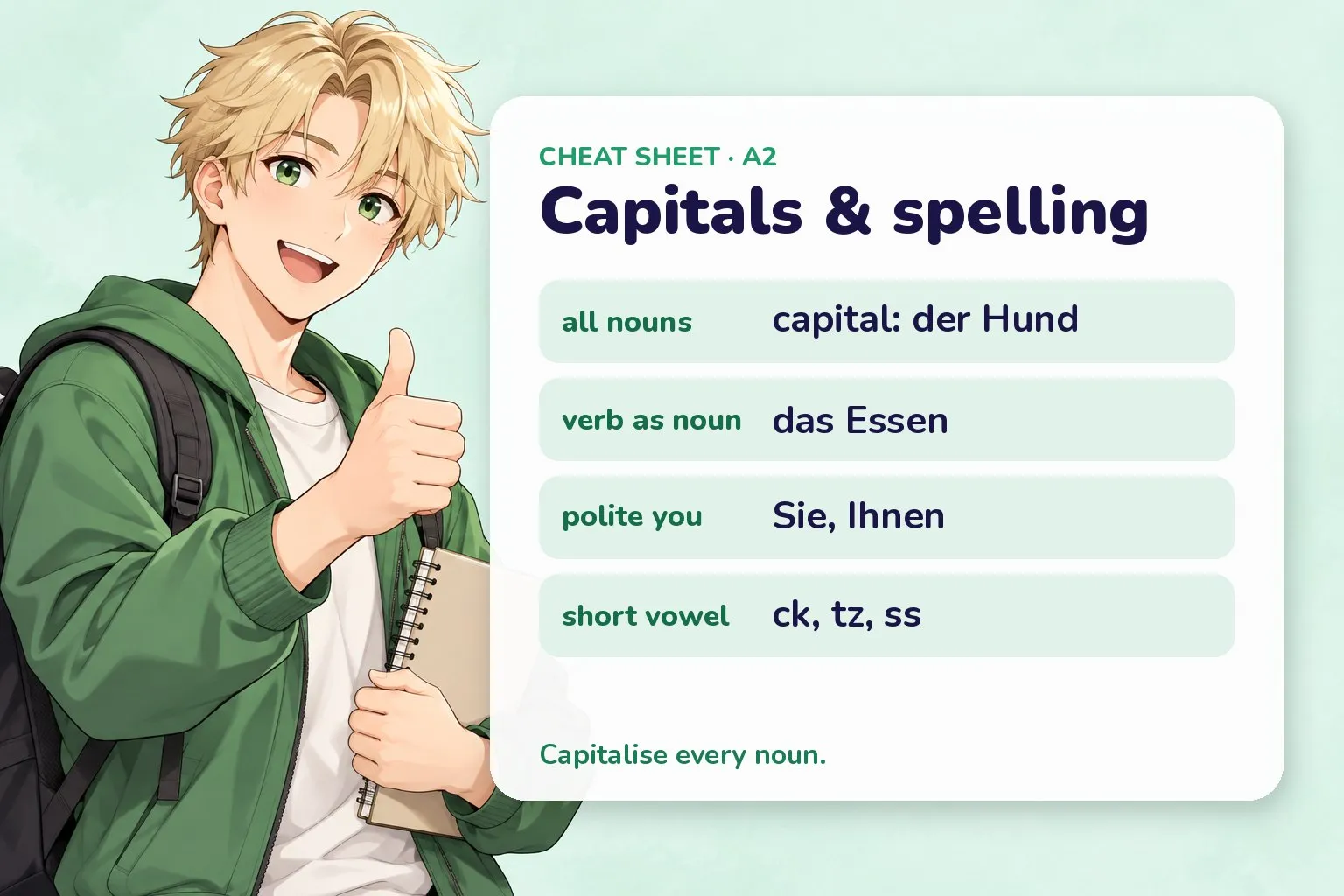
Quick recap before the quiz.
Practice
Spelling and capitalisation practice
Try each one, then press Check. No sign-up, nothing is sent anywhere — it all runs in your browser.
Hint: short vowel
Show answer
ck — After a short stressed vowel you write ck: Zucker.
Hint: short vowel
Show answer
tz — tz follows a short stressed vowel: Katze.
5 Match each word to its spelling reason.
- Straße
- Fluss
- Zucker
- Salz
Show answer
- Straße → ß after a long vowel
- Fluss → ss after a short vowel
- Zucker → ck after a short vowel
- Salz → z after a consonant
The spelling follows the sound before it.
Hint: it's a noun
Show answer
Wasser — Wasser is a noun, so it takes a capital W.
Quiz
German spelling and capitalisation
10 questions · pick an answer and you'll see straight away if it's right.
-
Show answer
all nouns — Every noun takes a capital, wherever it is in the sentence.
-
Show answer
Freiheit — Freiheit ('freedom') is a noun; the others are an adjective, a verb and a conjunction.
-
Show answer
it is a verb used as a noun — beim (bei + dem) turns lesen into a noun: das Lesen.
-
Show answer
Sie — Formal Sie (and Ihnen, Ihr) is capitalised to tell it from sie 'she/they'.
-
Show answer
a short stressed vowel — ck follows a short stressed vowel: Zucker, dick.
-
Show answer
a short stressed vowel — tz follows a short stressed vowel: Katze, Platz.
-
Show answer
Salz — After the consonant l you write z, not tz: Salz.
-
Show answer
a long vowel or a diphthong — ß follows a long vowel or a diphthong; ss follows a short vowel.
-
Show answer
Die Katze sitzt auf dem Platz — Capitalise the first word and every noun: Die Katze … Platz.
-
Show answer
ck — Short stressed a → ck: backen.
Recap cheat-sheet
| Rule | Spelling |
|---|---|
| Every noun | capital: der Hund, die Freiheit |
| Verb/adjective as noun | capital: das Essen, das Gute |
| Polite you | Sie, Ihnen, Ihr (capital) |
| ß / ss | long vowel → ß; short → ss |
| ck / k | short vowel → ck; else k |
| tz / z | short vowel → tz; else z |
Next
- The full ß and umlaut rules: German umlauts and ß
- Spell it out loud: the German alphabet
- Where the stress falls: German word stress
- New here? Start Learning German Here
All German pronunciation & writing topics
Vocabulary, pronunciation, phrases, practice and exam help, ordered by level. Pick a topic and go straight to it. New lessons go live every day, so topics marked Coming soon fill in over the next weeks.
Pronunciation & writing
A1 4 topics · 4 ready
A2 4 topics · 4 ready
- 05 Tricky German Consonants (ch, r, z, w, v)
- 06 German Consonant Clusters (sch, sp, st, pf)
- 07 German Word Stress
- 08 German Spelling & Capitalisation Rules You are here
B1 2 topics · 1 ready
- 09 German Final Devoicing (Auslautverhärtung)
- 10 German Intonation & Rhythm Coming soon