German Vowels: Long vs Short
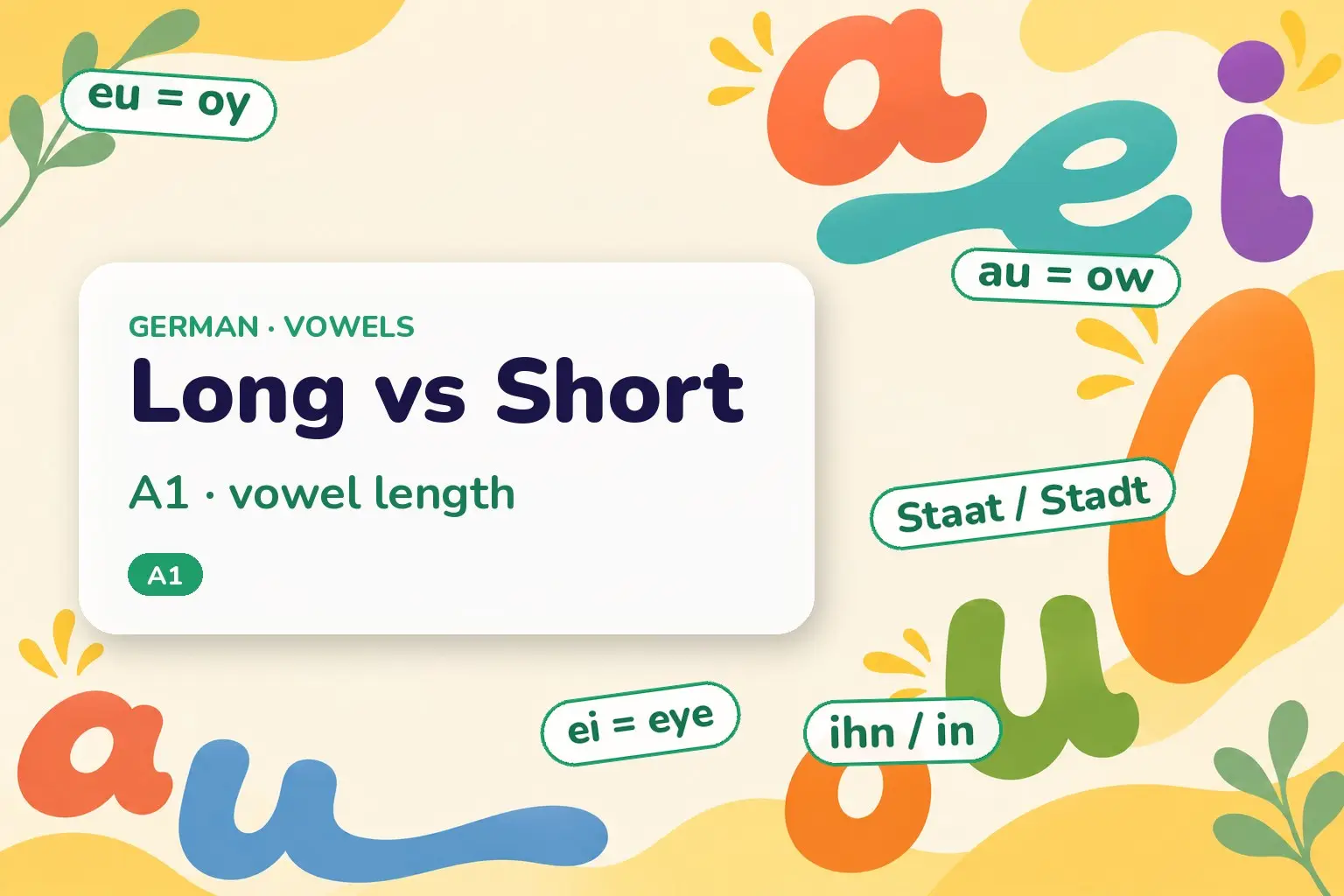
German vowels come in long and short versions, and the length changes the word: Staat (long a) means state, Stadt (short a) means city. A doubled vowel or a following h marks length; a doubled consonant marks a short vowel.
Level: A1. German has the same vowel letters as English — a, e, i, o, u, plus the umlauts ä, ö, ü — but each can be long or short, and the length can change the meaning of a word. Once you learn the spelling clues for length, German reads out loud very reliably.
By the end of this page you can…
…hear the difference between a long and a short vowel, use the spelling clues (double vowel, silent h, double consonant) to predict length, and pronounce the three German diphthongs ei, au and eu.
Long or short — the spelling clues
Vowel length is phonemic in German: it can be the only difference between two words, so it is worth getting right. Three spelling clues tell you which length to use:
| Clue | Means | Examples |
|---|---|---|
| doubled vowel (aa, ee, oo) | long | Staat, Meer, Boot |
| vowel + h (silent “stretch h”) | long | ihn, Bahn, Sohn |
| vowel + single consonant | usually long | Tag, Weg, gut |
| vowel + double consonant | short | Stadt, Sonne, muss |
| vowel + consonant cluster | short | Herbst, Wind |
The doubled vowel and the silent h are pure length markers — the second letter is not pronounced on its own; it just lengthens the vowel. A double consonant after a vowel is the clearest sign the vowel is short.
Minimal pairs
The fastest way to train your ear is with minimal pairs — two words that differ only in vowel length:
| Long vowel | Short vowel |
|---|---|
| Staat (state) | Stadt (city) |
| Miete (rent) | Mitte (middle) |
| ihn (him) | in (in) |
| Ofen (oven) | offen (open) |
| Beet (flower bed) | Bett (bed) |
| Rate (instalment) | Ratte (rat) |
Say each pair back to back: the long vowel is held clearly longer and is a touch more “closed” (tense); the short vowel is clipped and more open.
The umlauts
The umlauts ä, ö and ü are also long or short, following the same spelling clues:
- ä sounds like the “e” in bet: Bär (bear, long), Männer (men, short).
- ö — round your lips for “oh” and say “eh”: schön (beautiful, long), können (can, short).
- ü — round your lips for “oo” and say “ee”: für (for, long), fünf (five, short).
The diphthongs
A diphthong is two vowel sounds glided together in one syllable. German has three, and each has two spellings:
| Diphthong | Sound (like) | Examples |
|---|---|---|
| ei / ai | English “eye” | mein, drei, Mai |
| au | English “ow” | Haus, Frau, blau |
| eu / äu | English “oy” | neu, Häuser, Deutsch |
The pair ei and ie is the one beginners mix up: ei = “eye” (mein = “mine”), but ie = long “ee” (die = “dee”).
How to say it
- long vs short — hold the long vowel clearly longer: Staat (“Shtaat”) vs Stadt (“Shtatt”).
- ei / ai — “eye”: drei = “dry”, Mai = “my”.
- au — “ow” as in cow: Haus = “howss”.
- eu / äu — “oy” as in boy: neu = “noy”, Häuser = “HOY-zer”.
- final -e — a weak “uh”: bitte = “BIT-tuh”, not “BIT-tee”.
Example words
- Staatstatelong a (doubled aa)
- Stadtcityshort a (double consonant tt)
- Mieterentlong ie = 'ee'
- Mittemiddleshort i before tt
- ihnhimlong i, silent h
- ininshort i
- Ofenovenlong o before a single consonant
- offenopenshort o before ff
- gutgoodlong u before a single t
- Muttermothershort u before tt
- schönbeautifullong ö, rounded 'eh'
- fürforlong ü, rounded 'ee'
- meinmy / mineei = 'eye'
- Haushouseau = 'ow'
- neuneweu = 'oy'
- Häuserhousesäu = 'oy', same as eu
- Liebeloveie = long 'ee', one sound
- bittepleasefinal -e = weak 'uh'
Spotting length as you read
When you meet a new word, scan the vowel: Is it doubled or followed by h? Long. Is the next consonant doubled or part of a cluster? Short. A single consonant after the vowel is usually long (Tag, Weg, Zug). This one habit lets you pronounce most German words correctly on first sight.
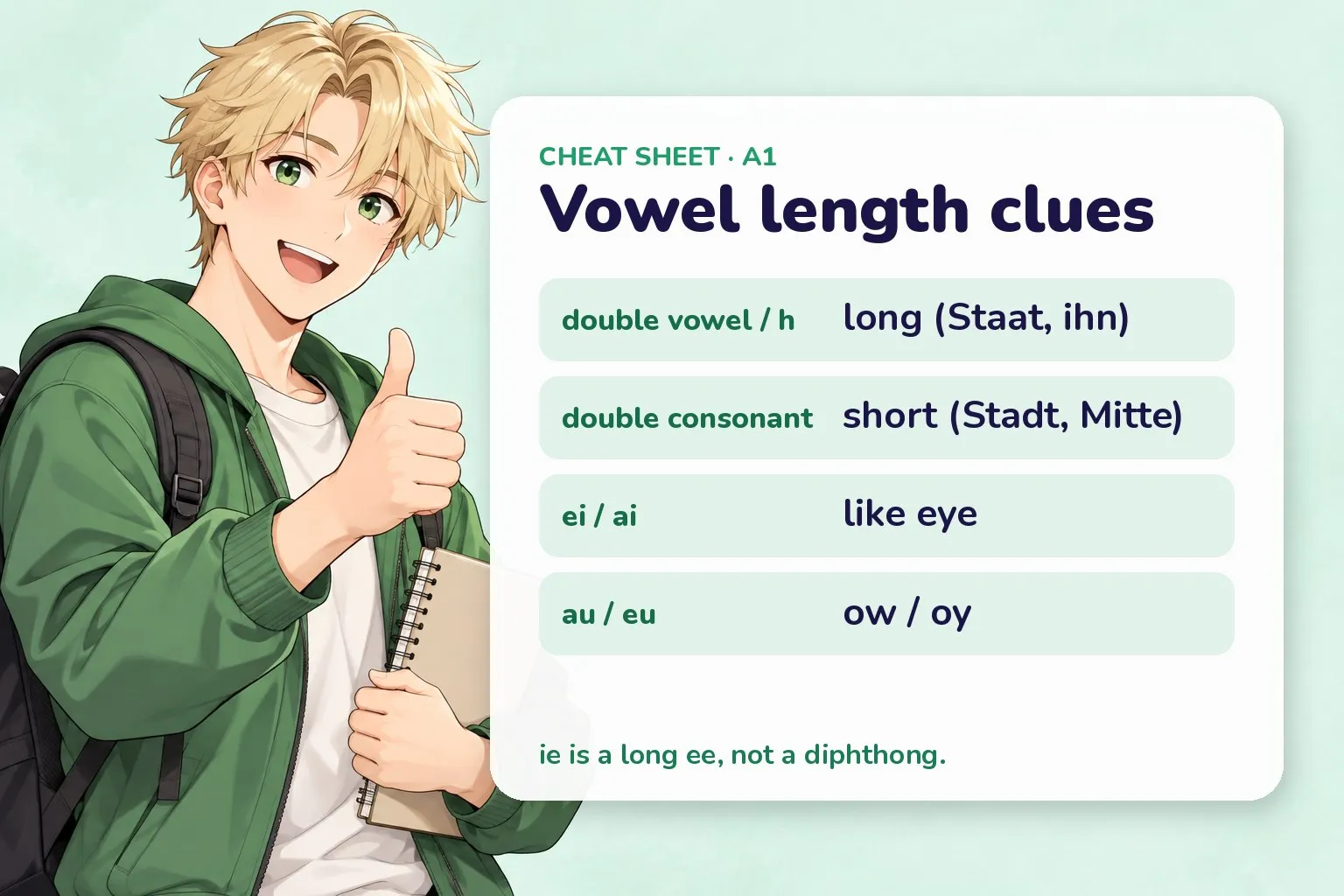
Quick recap before the quiz.
Practice
German vowels practice
Try each one, then press Check. No sign-up, nothing is sent anywhere — it all runs in your browser.
Hint: Stadt, Sonne, muss
Show answer
short — Double consonants signal a short vowel.
4 Match each diphthong to its sound.
- ei
- au
- eu
- ie
Show answer
- ei → eye
- au → ow
- eu → oy
- ie → long ee
ei = eye, au = ow, eu = oy; ie is not a diphthong but a long ee.
Quiz
German long and short vowels
8 questions · pick an answer and you'll see straight away if it's right.
-
Show answer
can change the meaning of a word — Length is phonemic: Staat vs Stadt, Miete vs Mitte.
-
Show answer
lengthens the vowel — The 'stretch h' is silent and lengthens the vowel.
-
Show answer
Bett — Bett has tt, so the e is short; Boot/Beet/Bahn are long.
-
Show answer
eye — ei (and ai) = English 'eye': mein, Mai.
-
Show answer
ow (cow) — au = 'ow': Haus, Frau.
-
Show answer
the same, like 'oy' — Both sound like English 'oy': neu, Häuser.
-
Show answer
saying 'ee' with rounded lips — Round your lips for 'oo' and say 'ee' — that is ü.
-
Show answer
a weak 'uh' — Unstressed final -e is a weak 'uh': BIT-tuh.
Next
- Spell it out first: The German Alphabet and Umlauts
- Get the full sound picture: German pronunciation overview
- Start the course: Start Learning German Here
All German pronunciation & writing topics
Vocabulary, pronunciation, phrases, practice and exam help, ordered by level. Pick a topic and go straight to it. New lessons go live every day, so topics marked Coming soon fill in over the next weeks.
Pronunciation & writing
A1 4 topics · 4 ready
- 01 German Pronunciation Overview
- 02 The German Alphabet & Umlauts
- 03 German Vowels: Long vs Short You are here
- 04 German Umlauts (ä ö ü) & ß
A2 4 topics · 4 ready
B1 2 topics · 1 ready
- 09 German Final Devoicing (Auslautverhärtung)
- 10 German Intonation & Rhythm Coming soon