German Final Devoicing (Auslautverhärtung)
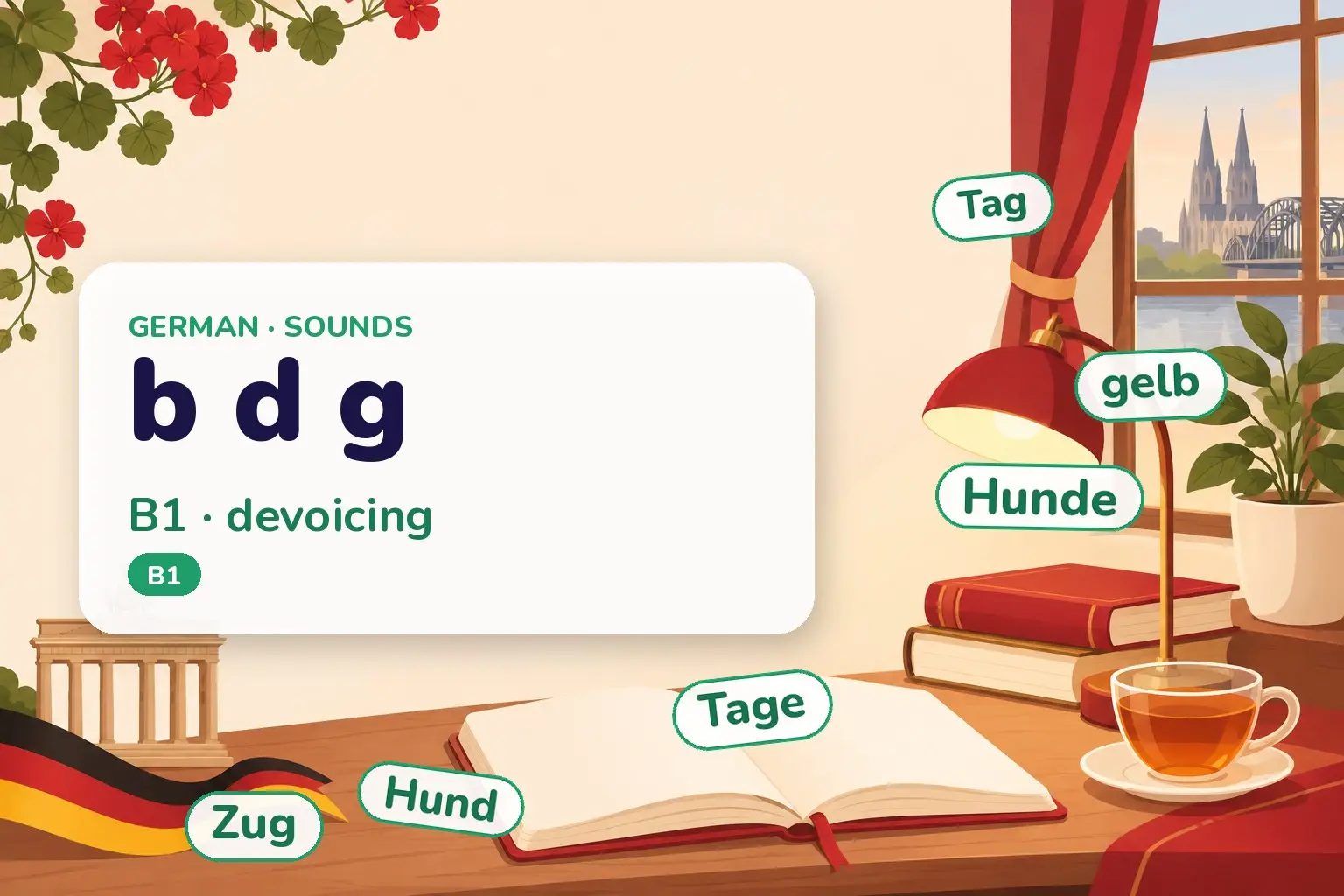
German hardens voiced consonants at the end of a syllable: b, d, g, s and v are said as p, t, k, s and f. So Tag sounds like 'Tak' and Hund like 'Hunt'. Add a vowel ending and the soft sound returns.
Level: B1. One quiet rule explains why Tag sounds like “Tak” and Hund like “Hunt”: German hardens voiced consonants at the end of a syllable. Learn it once and a whole set of words that looked irregular starts to make sense.
By the end of this page you can…
…pronounce word-final b, d, g, s and v correctly, hear why a word written with d can sound like t, use a plural or verb ending to recover the real consonant, and avoid the most common spelling traps the rule creates.
What final devoicing is
Final devoicing (German Auslautverhärtung, “hardening of the final sound”) means that a voiced consonant — one you make with the voice box buzzing, like b, d, g — turns into its voiceless partner at the end of a syllable. The voiceless partners are p, t, k: the mouth makes the same shape, but the voice switches off.
So b becomes p, d becomes t, g becomes k, s becomes a hissed voiceless s, and v (in loanwords; native German v is already f) becomes f. Crucially, the spelling does not change. You still write Tag with a g, but you say the g as a k: “Tak”.
The hardening happens at the end of a syllable, not only the end of a word. In Abfahrt (“departure”) the b closes the first syllable, so it is said as p: “AP-fahrt”. The rule is completely regular in standard German — there are no exceptions to memorise, only the pairs to learn.
The five pairs
| Spelling (voiced) | Said as (voiceless) | Example | Pronounced |
|---|---|---|---|
| b | p | gelb | “gelp” |
| d | t | Hund | “Hunt” |
| g | k | Tag | “Tak” |
| s | s (hissed, voiceless) | Haus | “Hows” |
| v | f | aktiv | “ak-TEEF” |
And here is how adding an ending brings the voiced sound back, because the consonant is no longer at the syllable’s end:
| End of word (hard) | With ending (soft) |
|---|---|
| Tag “Tak” | Tage “TAA-ge” (g voiced) |
| Hund “Hunt” | Hunde “HUN-de” (d voiced) |
| gelb “gelp” | gelbe “GEL-be” (b voiced) |
| lieb “leep” | liebe “LEE-be” (b voiced) |
| brav “braaf” | brave “BRAA-ve” (v voiced) |
The -ig ending
The suffix -ig has its own standard pronunciation: at the end of a word it is usually said like -ich (a soft “ish” sound), not “-ik”. So König (“king”) is “KÖ-nich” and wichtig (“important”) is “VISH-tish”. When an ending follows, it becomes a hard g again: Könige is “KÖ-ni-ge”. (In parts of southern Germany and Austria you will hear “-ik”; the Duden standard is “-ich”.)
Example words and sentences
- der Tagthe dayfinal g → k: 'Tak'
- die Tagethe daysending added → g stays voiced: 'TAA-ge'
- der Hundthe dogfinal d → t: 'Hunt'
- die Hundethe dogsd voiced again: 'HUN-de'
- gelbyellowfinal b → p: 'gelp'
- ein gelbes Autoa yellow carb voiced before the ending: 'GEL-bes'
- das Radthe wheel/bikefinal d → t: 'Raat'; plural Räder shows the d
- der Ratthe advicereally a t: plural Räte keeps t
- das Hausthe housefinal s is voiceless: 'Hows'
- die Häuserthe housess now voiced between vowels: 'HOY-zer'
- liebdear/kindfinal b → p: 'leep'
- liebe Grüßekind regardsb voiced: 'LEE-be'
- der Zugthe trainfinal g → k: 'Tsook'
- halbhalffinal b → p: 'halp'
- der Königthe king-ig said '-ich': 'KÖ-nich'
- wichtigimportant-ig said '-ich': 'VISH-tish'
- Guten Abend!Good evening!final d of Abend → t: 'AA-bent'
- Der Zug nach Berlin ist weg.The train to Berlin is gone.Zug 'Tsook', weg 'vek' — both g → k
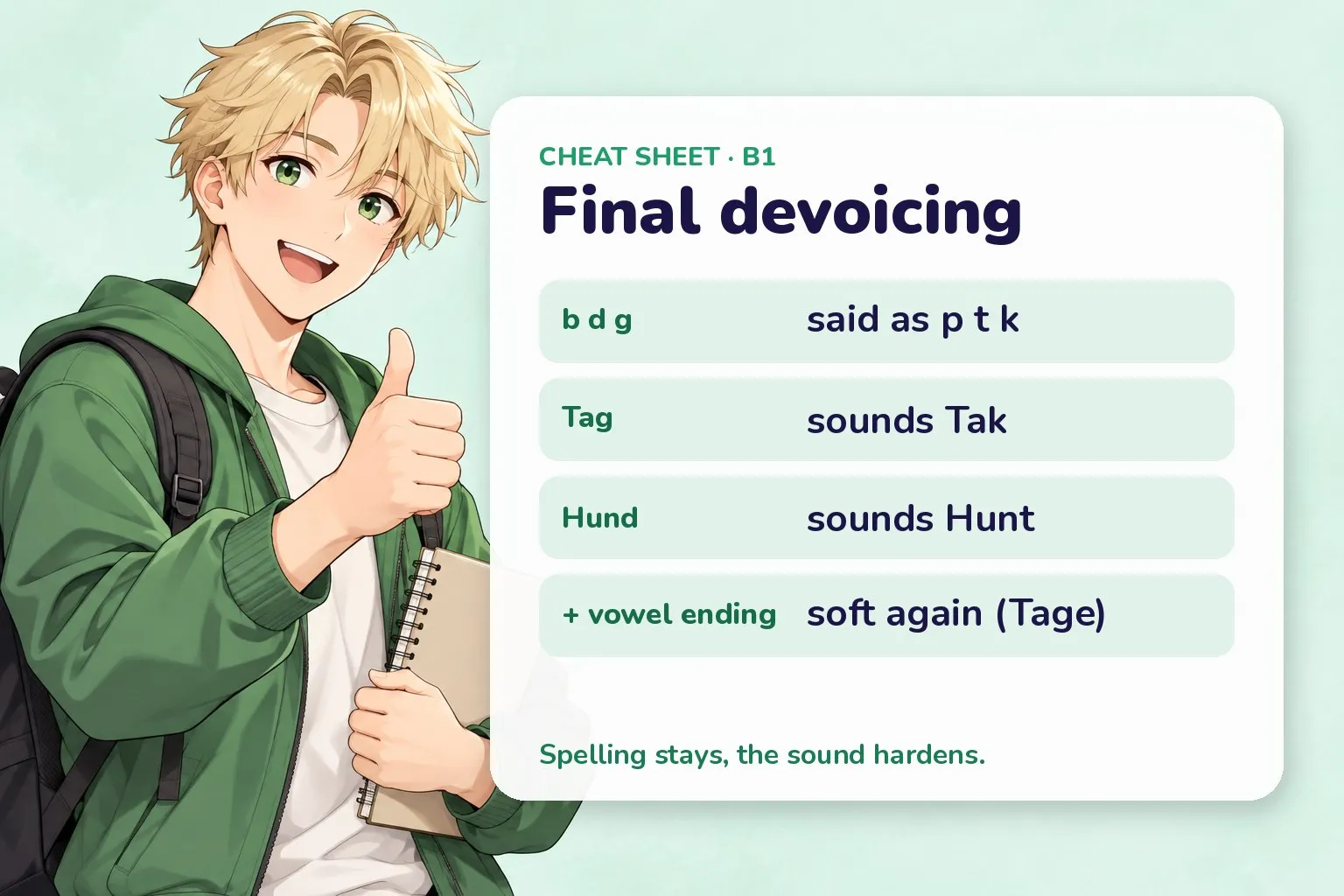
Quick recap before the quiz.
How to say it
- final -b — a clean “p”: gelb ≈ “gelp”, halb ≈ “halp”.
- final -d — a clean “t”: Hund ≈ “hunt”, Abend ≈ “AA-bent”.
- final -g — a “k”: Tag ≈ “taak”, Zug ≈ “tsook”.
- final -ig — a soft “ish”: wichtig ≈ “VISH-tish”.
- the soft sound returns before a vowel ending: Tage ≈ “TAA-ge”, Hunde ≈ “HUN-de”.
Practice
Final devoicing practice
Try each one, then press Check. No sign-up, nothing is sent anywhere — it all runs in your browser.
Hint: add -es
Show answer
gelbes — With an ending the b is no longer final, so it stays voiced: gelbes.
4 Match each final letter to its spoken sound.
- b
- d
- g
- v
Show answer
- b → p
- d → t
- g → k
- v → f
The voiced consonants harden to their voiceless partners at a syllable's end.
Hint: Räder
Show answer
d — Räder has a d, so the singular is Rad (said 'Raat'), not Rat.
Quiz
German final devoicing
10 questions · pick an answer and you'll see straight away if it's right.
-
Show answer
its voiceless partner — b→p, d→t, g→k, etc.: the voice switches off.
-
Show answer
Tak — Final g becomes k: 'Tak'.
-
Show answer
Hunt — Final d becomes t: 'Hunt'.
-
Show answer
The ending -e moves the g away from the syllable end — With a vowel ending the g is no longer final, so devoicing does not apply.
-
Show answer
Rad (Räder) — Räder shows a d, so Rad is spelled with d; Rat (Räte) has a t.
-
Show answer
p — Final b hardens to p: 'gelp'.
-
Show answer
f — In loanwords final v becomes f: aktiv ≈ 'ak-TEEF', brav ≈ 'braaf' (native v, as in Vater, is already f).
-
Show answer
stays the same — Spelling is kept constant (Hund, not Hunt) to link related forms.
-
Show answer
VISH-tish — The -ig ending is said '-ich': 'VISH-tish'.
-
Show answer
k — Final g → k: Zug sounds like 'Tsook'.
Recap cheat-sheet
| Spelling | Final sound | Example |
|---|---|---|
| b | p | gelb “gelp” |
| d | t | Hund “Hunt” |
| g | k | Tag “Tak” |
| s | voiceless s | Haus “Hows” |
| v (loanword) | f | brav “braaf” |
| -ig | -ich | König “KÖ-nich” |
| + vowel ending | voiced again | Tage, Hunde |
Next
- Spell the letters out loud: the German alphabet
- The ß and umlaut rules: German umlauts and ß
- Capitals and sound-based spelling: German spelling and capitalisation
- New here? Start Learning German Here
All German pronunciation & writing topics
Vocabulary, pronunciation, phrases, practice and exam help, ordered by level. Pick a topic and go straight to it. New lessons go live every day, so topics marked Coming soon fill in over the next weeks.
Pronunciation & writing
A1 4 topics · 4 ready
A2 4 topics · 4 ready
B1 2 topics · 1 ready
- 09 German Final Devoicing (Auslautverhärtung) You are here
- 10 German Intonation & Rhythm Coming soon