German Consonant Clusters: sch, sp, st, pf
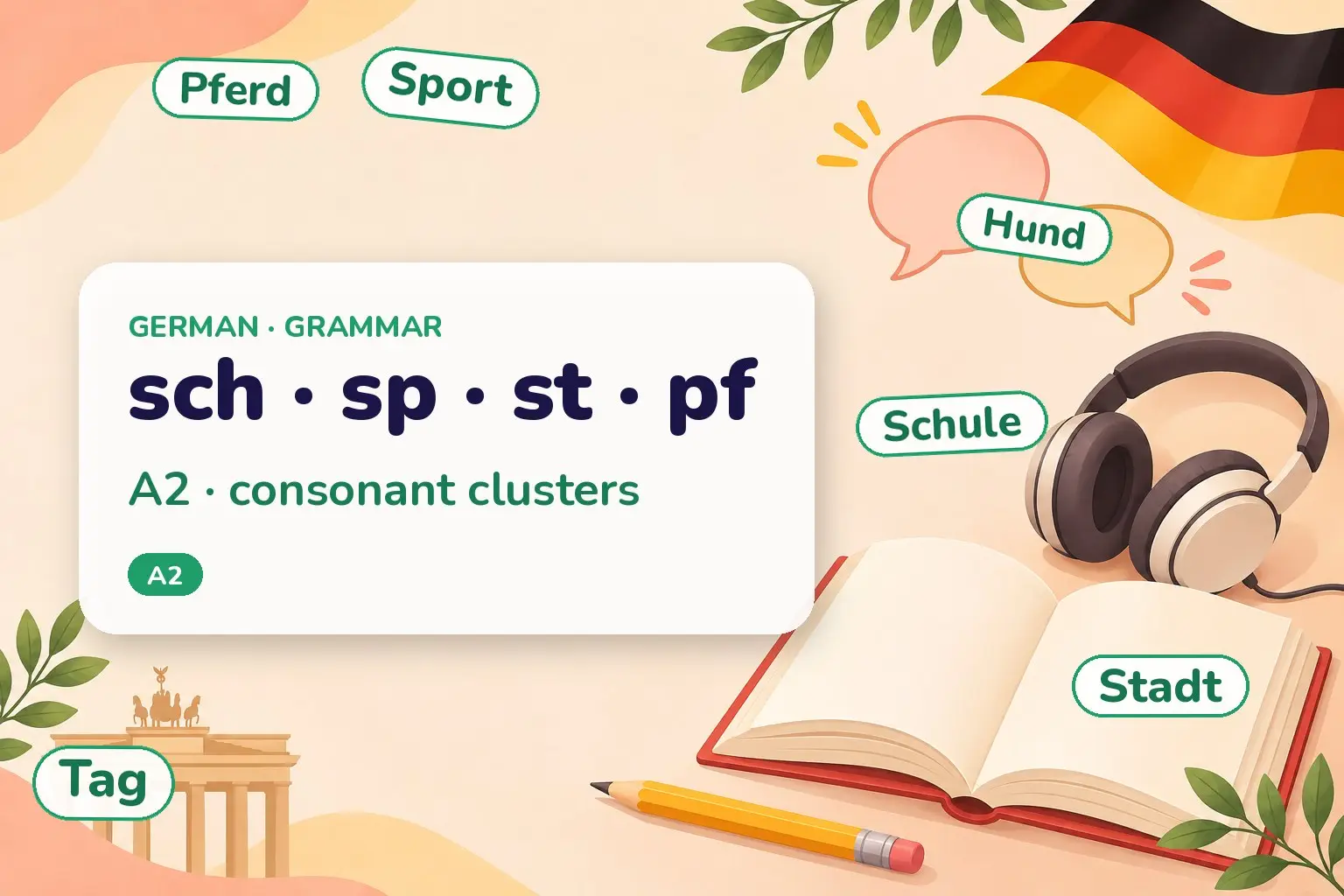
German has a few consonant combinations English speakers misread: sch is a single 'sh' sound, an initial sp or st starts with 'sh' (shp, sht), pf is a p and f pressed together, and a final b, d or g hardens to p, t, k.
On this page10 sections · tap to jump
Level: A2. German stacks consonants in clusters that look intimidating but follow clear rules. Four patterns cover almost all of them: sch, the sp/st start, the pf blend, and the final hardening of b, d and g. Learn these and long words like Geschwindigkeitsbegrenzung stop being scary.
By the end of this page you can…
…read sch as a single sound, start a word with “shp” and “sht” the way Germans do, press p and f together in pf, and harden a final b, d or g to p, t, k — all with the right example words.
sch — one sound, three letters
The three letters sch spell a single sound: the English “sh” in shoe. It is never “s-ch” as two pieces. You meet it at the start, middle and end of words: Schule (“shoo-le”, school), waschen (“VASH-en”, to wash), Tisch (“tish”, table).
The same “sh” hides in the blends schn, schw, schm, schl, schr, where it simply runs into the next consonant: schnell (“shnell”, fast), Schwein (“shvine”, pig), schmal (“shmahl”, narrow). The adjective ending -isch is also this sound: typisch (“TUU-pish”, typical).
sp and st — “shp” and “sht” at the start
Here is the rule that surprises everyone: at the beginning of a word or word stem, sp is pronounced “shp” and st is pronounced “sht”.
- Sport → “SHPORT”
- sprechen → “SHPRECH-en” (to speak)
- Stadt → “SHTAT” (city)
- Student → “shtoo-DENT”
- verstehen → “fer-SHTAY-en” (to understand) — the st is at the start of the stem steh
Inside or at the end of a word, sp and st are the plain English sounds “sp” and “st”: Wespe (“VES-pe”, wasp), Fenster (“FENS-ter”, window), fast (“fast”, almost), Post (“post”, post office).
pf — press p and f into one push
The cluster pf is a single “affricate”: you close your lips for a p and release straight into an f, with no vowel between. English has nothing quite like it, so it takes practice: Pferd (“pfairt”, horse), Apfel (“AP-fel”, apple), Kopf (“kopf”, head), Pflanze (“PFLAN-tse”, plant).
Start by exaggerating — a tiny “puh” then “f” — and then speed it up until the two fuse. Say Apfel slowly as “ap–fel”, then faster until the pf is one movement.
Final hardening — b, d, g go hard at the end
When b, d or g falls at the end of a word or syllable, it loses its voice and hardens:
- b → p: halb (“halp”, half), Dieb (“deep”, thief)
- d → t: Hund (“hunt”, dog), und (“unt”, and), Abend (“AH-bent”, evening)
- g → k: Tag (“tahk”, day), Zug (“tsook”, train), Weg (“vayk”, way)
The spelling never changes — you still write Hund — but the sound does. Add an ending and the soft sound returns, because the letter is no longer final: Tag → Tage (“TAH-ge”), Hund → Hunde (“HUN-de”).
How to say it
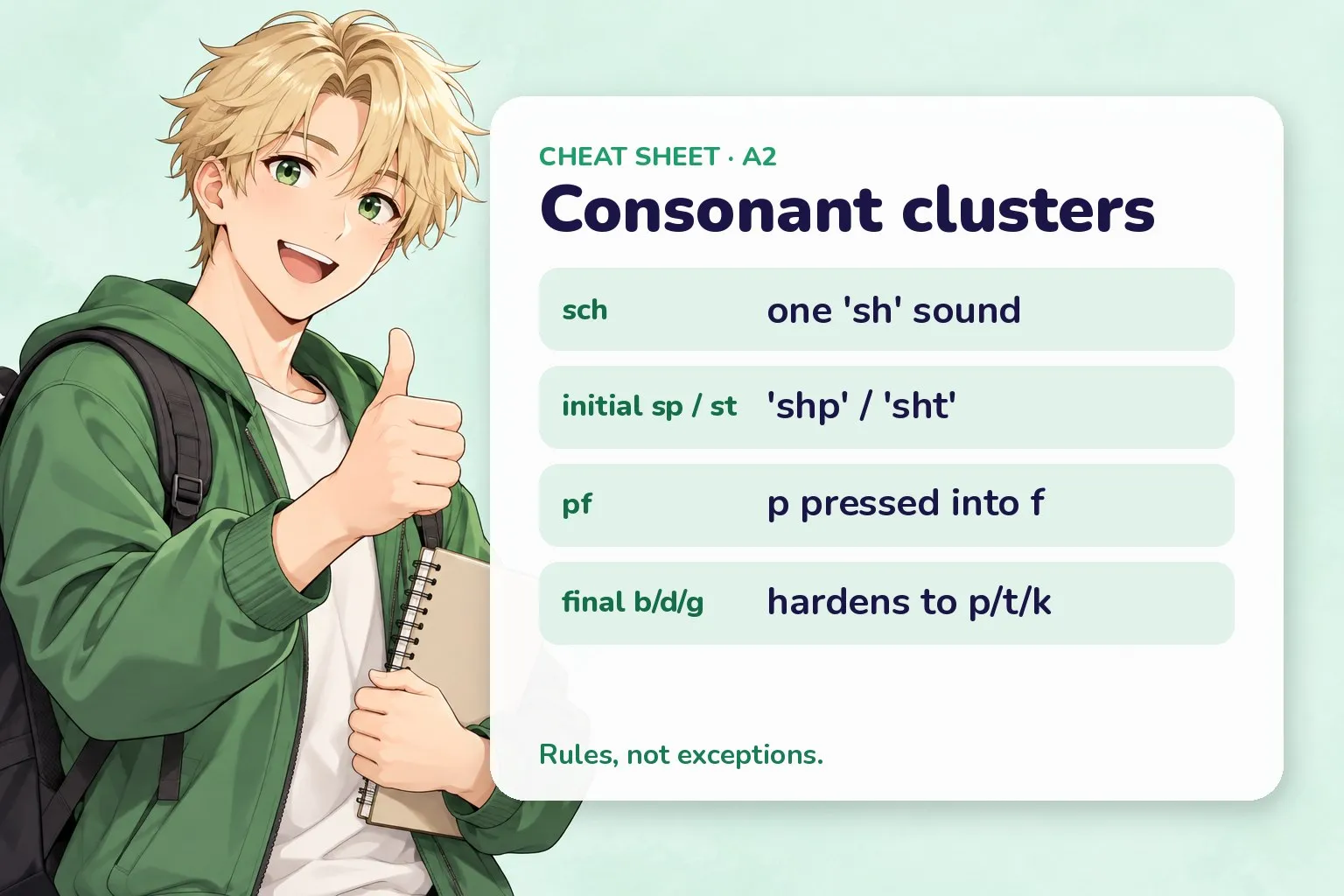
- sch — one “sh” as in shoe: Schule ≈ “SHOO-le”.
- initial sp / st — “shp” / “sht”: Sport ≈ “SHPORT”, Stadt ≈ “SHTAT”.
- pf — p released into f, no gap: Apfel ≈ “AP-fel”.
- final b/d/g — hardened to p/t/k: Tag ≈ “tahk”, Hund ≈ “hunt”.
Example words
- Schuleschoolsch = one 'sh'
- waschento washsch in the middle
- Tischtablesch at the end: 'tish'
- schnellfastschn = 'shn'
- Schweinpigschw = 'shv'
- Sportsportinitial sp = 'shp'
- sprechento speakspr = 'shpr'
- Stadtcityinitial st = 'sht'
- Studentstudentst = 'sht'
- verstehento understandst starts the stem: 'fer-SHTAY-en'
- Fensterwindowst inside a word = plain 'st'
- Wespewaspsp inside a word = plain 'sp'
- Pferdhorsepf blend: 'pfairt'
- Apfelapplepf in the middle
- Kopfheadpf at the end
- halbhalffinal b → 'p': 'halp'
- Hunddogfinal d → 't': 'hunt'
- Tagdayfinal g → 'k': 'tahk'
- Zugtrainfinal g → 'k': 'tsook'
- Tagedaysending added → soft g returns
A worked word: Geschwindigkeit
The long word Geschwindigkeit (“speed”) hides three of today’s patterns. Break it up: Ge-schwin-dig-keit. The schw is “shv”, the -ig before a consonant softens, and you read the whole thing “ge-SHVIN-dikh-ksite”. Clusters only look hard when they are glued into one block; split them and each piece is a rule you already know.
Quick recap before the quiz.
Practice
German consonant clusters practice
Try each one, then press Check. No sign-up, nothing is sent anywhere — it all runs in your browser.
Hint: Tag = 'tahk'
Show answer
k — A final g hardens to 'k': Tag = 'tahk'.
4 Match each cluster to its sound.
- sch
- initial st
- pf
- final d
Show answer
- sch → sh
- initial st → sht
- pf → p+f pressed
- final d → t
sch = sh, initial st = sht, pf = a p released into f, final d = t.
Hint: Hund = 'hunt'
Show answer
t — A final d hardens to 't': Hund = 'hunt'.
Quiz
German consonant clusters
12 questions · pick an answer and you'll see straight away if it's right.
-
Show answer
one 'sh' — sch is a single 'sh' sound (Schule, Tisch).
-
Show answer
'shp' — Initial sp = 'shp': Sport = 'SHPORT'.
-
Show answer
'sht' — Initial st = 'sht': Stadt = 'SHTAT'.
-
Show answer
Fenster — In Fenster the st is inside the word, so it is a plain 'st'.
-
Show answer
a p released into an f — pf is one affricate: a p closed and released straight into an f.
-
Show answer
'tahk' — A final g hardens to 'k': Tag = 'tahk'.
-
Show answer
't' — A final d hardens to 't': Hund = 'hunt'.
-
Show answer
The g is no longer at the end — Adding -e moves the g away from the end, so it stays soft.
-
Show answer
'shn' — schn is 'sh' running into n: 'shnell'.
-
Show answer
'-ish' — -isch ends in the 'sh' sound: typisch = 'TUU-pish'.
-
Show answer
p — A final b hardens to 'p': halb = 'halp'.
-
Show answer
Schwein — schw = 'shv': Schwein = 'shvine'.
Next
- The single tricky consonants: tricky German consonants ch, r, z, w, v
- The vowels behind these words: German vowel sounds
- The extra letters ä, ö, ü and ß: German umlauts and ß
- See the whole sound system: German pronunciation overview
All German pronunciation & writing topics
Vocabulary, pronunciation, phrases, practice and exam help, ordered by level. Pick a topic and go straight to it. New lessons go live every day, so topics marked Coming soon fill in over the next weeks.
Pronunciation & writing
A1 4 topics · 4 ready
A2 4 topics · 4 ready
- 05 Tricky German Consonants (ch, r, z, w, v)
- 06 German Consonant Clusters (sch, sp, st, pf) You are here
- 07 German Word Stress
- 08 German Spelling & Capitalisation Rules
B1 2 topics · 1 ready
- 09 German Final Devoicing (Auslautverhärtung)
- 10 German Intonation & Rhythm Coming soon