German Umlauts (ä ö ü) and ß Explained
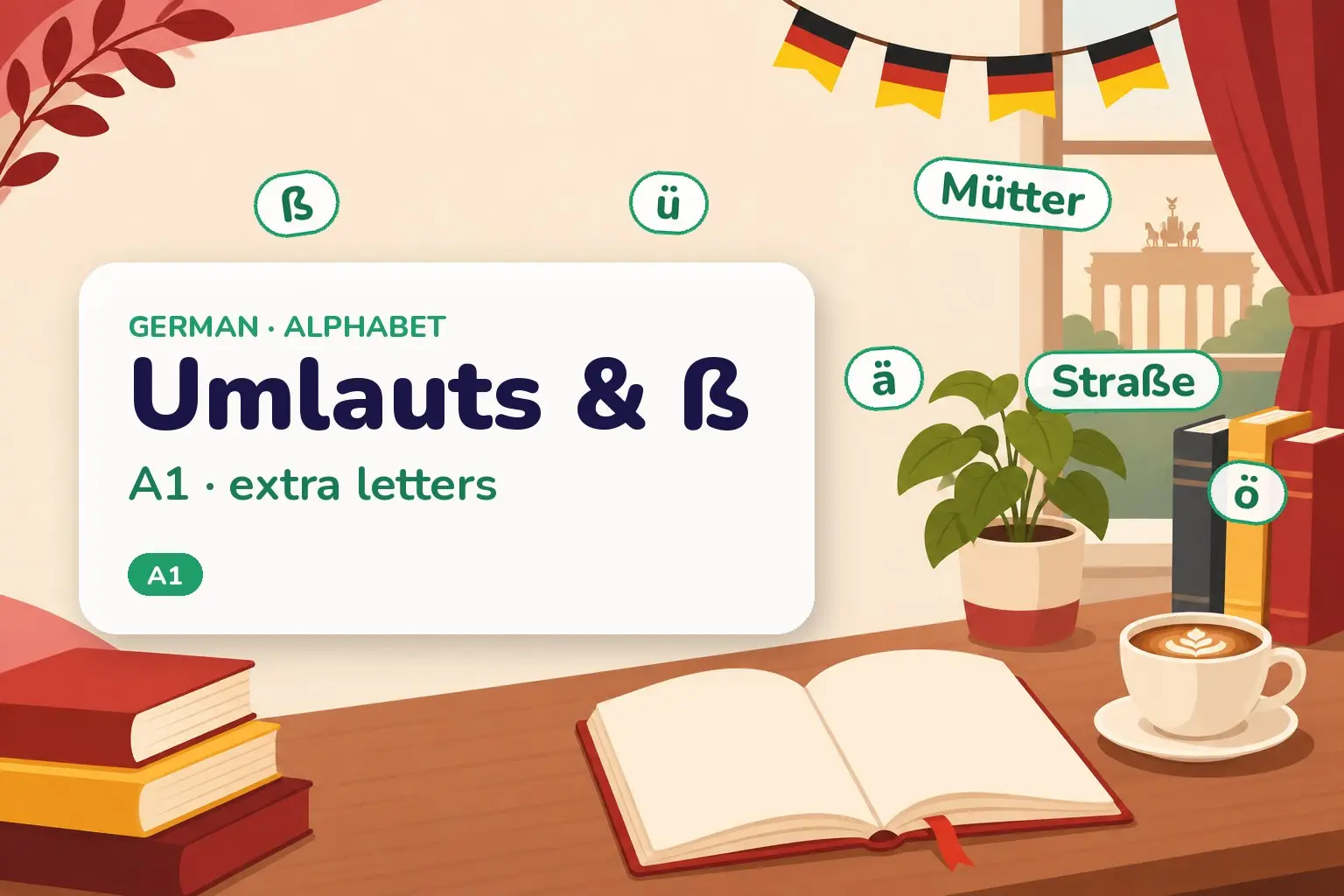
German has three umlauts — ä, ö and ü — which change both the sound and often the meaning of a word, plus the letter ß (eszett), a sharp s. You write ß after a long vowel or a diphthong, and ss after a short one.
Level: A1. German adds four special letters to the Latin alphabet: three vowels with two dots on top — ä, ö, ü, called umlauts — and one extra consonant, ß, the sharp s. None of them is decorative. The dots change a vowel into a brand-new sound, and swapping ß for ss (or the reverse) is as wrong as any other spelling slip.
By the end of this page you can…
…pronounce ä, ö and ü, hear how an umlaut changes a word’s meaning, know when to write ß and when to write ss, and type all four letters even on an English keyboard.
The three umlauts
An umlaut is one of the vowels a, o or u written with two dots: ä, ö, ü. The dots tell you to pronounce a different sound, not a decorated version of the plain vowel.
- ä sounds like the “e” in bed. Long, it is simply a drawn-out version of the same sound.
- ö has no English twin. Say the “ay” in day, freeze your tongue there, then round your lips as if to whistle. The French eu in deux is the same sound.
- ü also has no English twin. Say “ee” as in see, keep your tongue forward, then push your lips into a tight circle. It matches the French u in tu.
Umlauts do real grammatical work. They mark many plurals, the comparative of adjectives, and several verb forms, so hearing and spelling them correctly changes what you actually mean.
| Plain | Umlaut | Why it matters |
|---|---|---|
| Mutter (mother) | Mütter (mothers) | plural |
| Apfel (apple) | Äpfel (apples) | plural |
| schon (already) | schön (beautiful) | different word |
| groß (big) | größer (bigger) | comparative |
| du fahrst… no | du fährst (you drive) | verb form |
ß versus ss — the sharp s
The letter ß is called Eszett or scharfes s (“sharp s”). It is always a voiceless, hissed s, like the “s” in see, and it never appears at the start of a word. The choice between ß and ss follows one sound rule from the official spelling (Duden D 159):
- Write ß after a long vowel or a diphthong (a two-vowel glide such as au, ei, eu): Straße, Fuß, groß, heißen, außen, weiß.
- Write ss after a short, stressed vowel: Fluss, muss, dass, Wasser, küssen, Kuss.
So the vowel in front tells you which to use. In Fuß the “u” is long, so ß; in Fluss the “u” is short, so ss.
How to say it
- ä — “e” in bed: Bäcker (baker) ≈ “BECK-er”.
- ö — round your lips on an “ay”: schön ≈ roughly “shern” with no r.
- ü — round your lips on an “ee”: über ≈ “UU-ber”, lips tight.
- ß — a plain hissed “s”: Straße ≈ “SHTRAA-se”, one clean s.
Example words
- Mädchengirlä = e in bed
- spätlatelong ä
- schönbeautifulrounded ö; compare schon = already
- Löffelspoonshort ö
- überover / aboveü = rounded ee
- Türdoorlong ü
- fünffiveshort ü
- Müttermothersplural of Mutter by umlaut
- Äpfelapplesplural of Apfel
- Straßestreetlong a, so ß
- Fußfootlong u, so ß
- großbiglong o, so ß
- weißwhite / knowsdiphthong ei, so ß
- heißento be calleddiphthong ei, so ß
- Flussrivershort u, so ss
- mussmustshort u, so ss
- Wasserwatershort a, so ss
- dassthat (conjunction)short a; old spelling was daß
Typing the special letters
You do not need a German keyboard. Every umlaut has a two-letter substitute that Germans themselves accept in forms, emails and crosswords: ä = ae, ö = oe, ü = ue, ß = ss. So Müller can be written Mueller and Straße as Strasse. Use the real letters when you can — in names and careful writing they are expected — but the substitutes are never considered a spelling error.
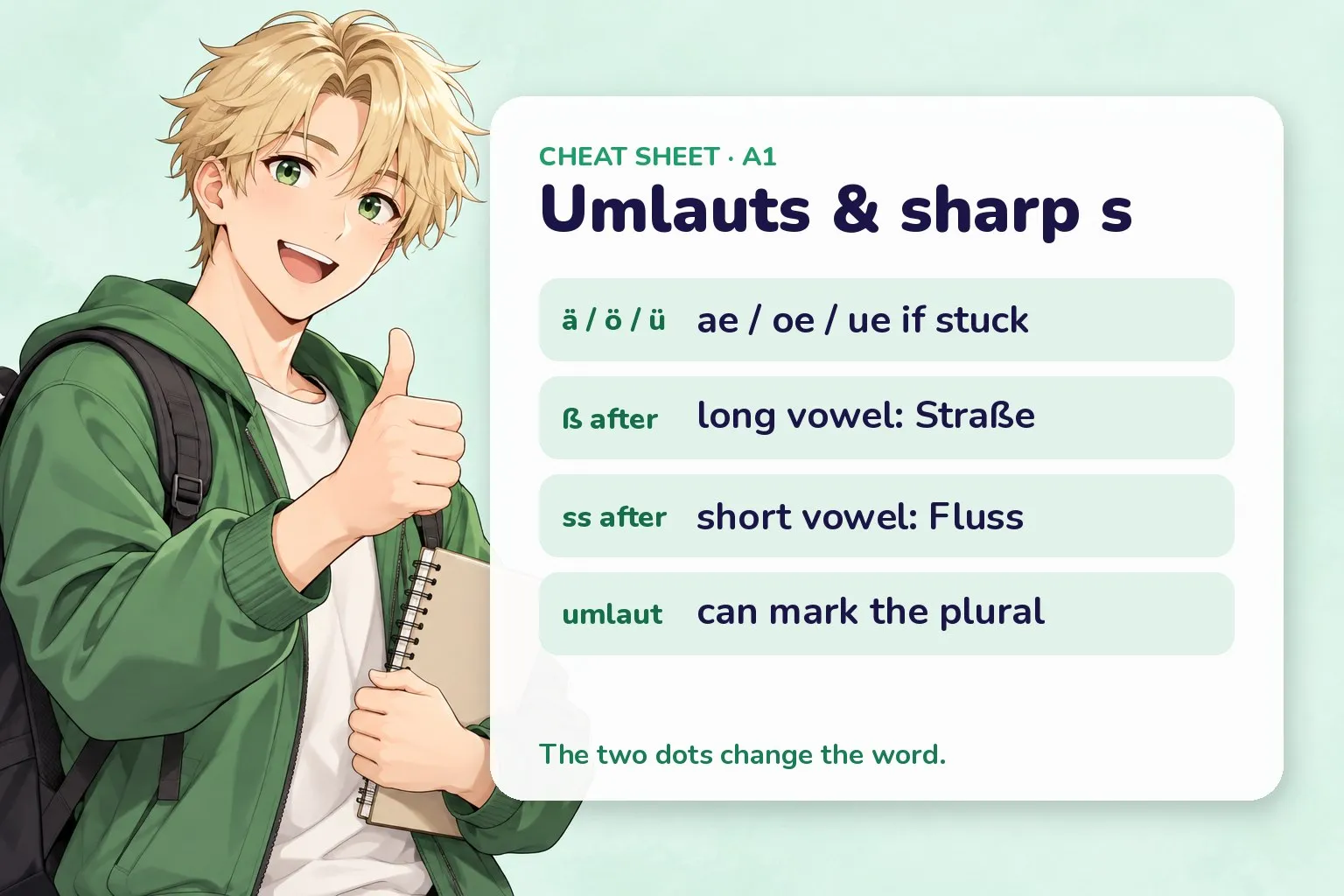
Quick recap before the quiz.
Practice
Umlauts and ß practice
Try each one, then press Check. No sign-up, nothing is sent anywhere — it all runs in your browser.
Hint: Straße, Fuß
Show answer
ß — After a long vowel or a diphthong, German uses ß: Straße, Fuß.
3 Match each umlaut to a hint.
- ä
- ö
- ü
- ß
Show answer
- ä → e in bed
- ö → rounded ay (French eu)
- ü → rounded ee (French u)
- ß → a hissed s, never ss
ä = e in bed; ö and ü are rounded front vowels; ß is a sharp s.
Hint: vowel + e
Show answer
oe — ö becomes oe: schoen is the accepted substitute.
Quiz
German umlauts and ß
10 questions · pick an answer and you'll see straight away if it's right.
-
Show answer
Three — Three: ä, ö and ü.
-
Show answer
Eszett / sharp s — ß is the Eszett or scharfes s.
-
Show answer
a long vowel or a diphthong — ß follows a long vowel or a diphthong; ss follows a short vowel.
-
Show answer
muss — The u is short, so it is muss (the old daß/muß spelling was dropped in 1996).
-
Show answer
beautiful — schön = beautiful; schon (no umlaut) = already.
-
Show answer
the plural of Mutter — Many German plurals are marked by an umlaut: Mutter to Mütter.
-
Show answer
ue — ü = ue (and ä = ae, ö = oe, ß = ss).
-
Show answer
Strasse — Switzerland and Liechtenstein use ss instead of ß: Strasse.
-
Show answer
say ay, then round your lips — Set the tongue for 'ay', then round the lips: that is ö.
-
Show answer
weiß — weiß has the diphthong ei, so ß is correct.
Next
- Spell it out first: the German alphabet
- The plain vowels behind the umlauts: German vowel sounds
- See the whole sound system: German pronunciation overview
- New here? Start Learning German Here
All German pronunciation & writing topics
Vocabulary, pronunciation, phrases, practice and exam help, ordered by level. Pick a topic and go straight to it. New lessons go live every day, so topics marked Coming soon fill in over the next weeks.
Pronunciation & writing
A1 4 topics · 4 ready
- 01 German Pronunciation Overview
- 02 The German Alphabet & Umlauts
- 03 German Vowels: Long vs Short
- 04 German Umlauts (ä ö ü) & ß You are here
A2 4 topics · 4 ready
B1 2 topics · 1 ready
- 09 German Final Devoicing (Auslautverhärtung)
- 10 German Intonation & Rhythm Coming soon