Top Mistakes French Learners Make
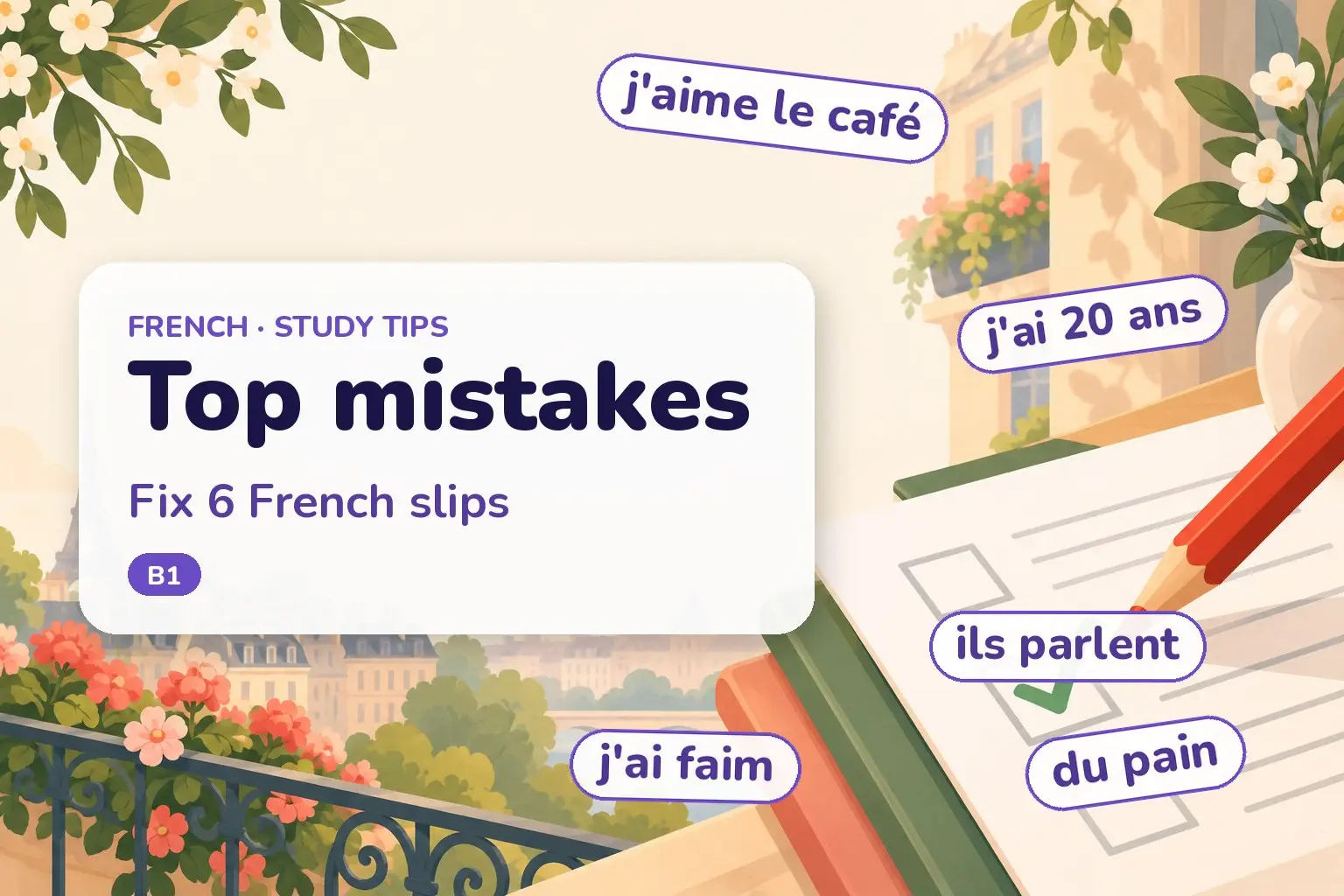
The most common French mistakes are carried over from English: guessing a noun's gender, using être for age instead of avoir, dropping the silent verb endings in writing, and confusing le/la with du/de la. Each has a simple, learnable fix.
On this page10 sections · tap to jump
Level: B1. Most French errors are not exotic — they are the same English habits applied to French. Fix these six early and your speaking and writing jump a level. Each comes with a before-and-after and a link to the lesson that drills it.
By the end of this page you can…
…recognise the six most common French errors and apply the fix for each.
1. Guessing a noun’s gender
Every French noun is masculine or feminine, and the gender decides the article (le/la, un/une) and the adjective ending. There is no reliable way to guess it from meaning, so learners who skip it get a cascade of small errors.
- ❌ la problème → ✅ le problème (“the problem” is masculine).
- ❌ un belle maison → ✅ une belle maison (feminine noun, feminine article and adjective).
The fix: never learn a noun alone — store it as le or la + noun. Drill the patterns in the noun gender lesson.
2. Using être for age and feelings
English says “I am 20”, “I am hungry”. French uses avoir (“to have”) for age, hunger, thirst, fear and being cold or hot.
- ❌ je suis 20 ans → ✅ j’ai 20 ans (“I am 20”).
- ❌ je suis faim → ✅ j’ai faim (“I am hungry”).
Learn the set — avoir faim, soif, froid, chaud, peur, raison — alongside the verb in the avoir lesson. For true states of being, use être.
3. Dropping the silent verb endings
Because -e, -es, -ent (and the -s, -t of finis, finit) are silent, learners leave them off in writing. The spoken form hides the spelling, but the written ending still has to be there.
- ❌ ils parle → ✅ ils parlent (said “parl”, written with -ent).
- ❌ tu parle → ✅ tu parles (the -s is silent but required).
Review the endings for the -ER verbs and the -IR verbs.
4. Confusing le/la with du/de la
Use the definite article (le, la, les) for a thing in general or a specific thing; use the partitive (du, de la, des) for some of something uncountable.
- ❌ je mange le pain when you mean “some bread” → ✅ je mange du pain (“I’m eating some bread”).
- ✅ j’aime le pain (“I like bread” — in general, so definite).
The rule of thumb: “like/love/prefer” take the definite article; “eat/drink/buy some” take the partitive. See the partitive articles lesson.
5. Treating every -ir verb like finir
Regular -IR verbs (finir, choisir) add -iss- in the plural, but a whole set of common -ir verbs (partir, sortir, dormir, venir) are irregular and do not.
- ❌ je partis for “I leave” → ✅ je pars (and nous partons, not partissons).
Learn which verbs take -iss- in the -IR verbs lesson.
6. Forgetting elision and liaison
Before a vowel, je, le, la, de, ne, que drop their vowel: je aime becomes j’aime. And nous, vous, les link with a “z” sound to a following vowel.
- ❌ je aime → ✅ j’aime.
- ❌ saying “nous avons” with a gap → ✅ link it: nous_avons = “noo-za-VON”.
How to fix mistakes for good
- Flashcard the gender, not just the word. Put le or la on the front with the noun.
- Memorise the avoir expressions as chunks. avoir faim, avoir 20 ans — learn them whole.
- Write out full conjugations by hand. It fixes the silent endings far better than reading does.
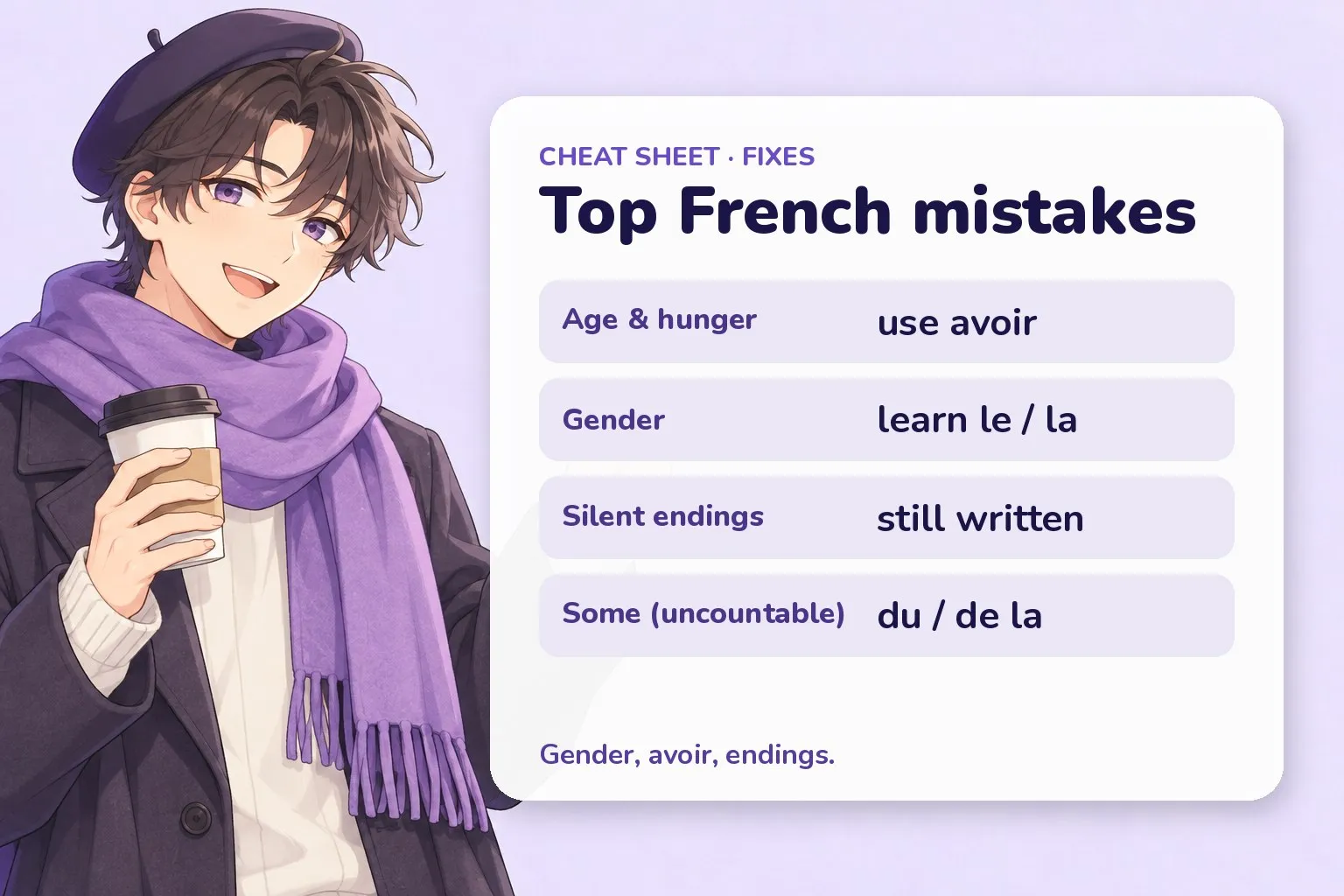
Quick recap before you practise.
Practice
Fix the common French mistakes
Try each one, then press Check. No sign-up, nothing is sent anywhere — it all runs in your browser.
Hint: the -ent is silent but written
Show answer
ils parlent — ils parlent — the -ent ending is silent but must be written.
4 Match each mistake to its fix.
- je suis faim
- je mange le pain (= some)
- je aime
- je partis (= I leave)
Show answer
- je suis faim → j'ai faim
- je mange le pain (= some) → je mange du pain
- je aime → j'aime
- je partis (= I leave) → je pars
avoir for hunger, partitive for 'some', elision before a vowel, partir is irregular.
Quiz
Top French mistakes quiz
8 questions · pick an answer and you'll see straight away if it's right.
-
Show answer
gender (masculine or feminine) — Gender decides the article and adjective, so learn le/la with each noun.
-
Show answer
j'ai faim — French uses avoir: j'ai faim.
-
Show answer
j'ai 25 ans — Age uses avoir: j'ai 25 ans ('I have 25 years').
-
Show answer
the -ent ending is silent but required in writing — The -ent is silent but must still be written for ils/elles.
-
Show answer
je mange du pain — 'Some' of an uncountable noun uses the partitive: du pain.
-
Show answer
j'aime la musique — Like/love take the definite article: j'aime la musique.
-
Show answer
partir — partir is irregular: je pars, nous partons — no -iss-.
-
Show answer
j' — Elision: je aime → j'aime.
Next
- Fix gender with the noun gender lesson
- Learn the avoir expressions in the avoir lesson
- Back to Start Learning French Here
All French study topics
Vocabulary, pronunciation, phrases, practice and exam help, ordered by level. Pick a topic and go straight to it. New lessons go live every day, so topics marked Coming soon fill in over the next weeks.
Study topics
Start here 5 topics · 5 ready
- 01 Start Learning French Here
- 02 French Level Self-Test (A1-C1 Guide)
- 03 How to Use Flashcards for French
- 04 Top Mistakes French Learners Make You are here
- 05 Building a Daily French Habit
Lessons 56 topics
See the lessons page →- 06 French: Greetings & Introductions Coming soon
- 07 French: Numbers 0 to 100 Coming soon
- 08 French: Introducing Yourself Coming soon
- 09 French: Days, Months & Dates Coming soon
- 10 French: Telling the Time Coming soon
- 11 French: Giving Personal Information Coming soon
- 12 French: Family Members Coming soon
- 13 French: Describing People Coming soon
- 14 French: Colours & Shapes Coming soon
- 15 French: Food & Drink Basics Coming soon
- 16 French: Ordering at a Cafe Coming soon
- 17 French: Shopping & Prices Coming soon
- 18 French: Clothing & Sizes Coming soon
- 19 French: Asking for Directions Coming soon
- 20 French: Using Public Transport Coming soon
- 21 French: At the Hotel Coming soon
- 22 French: Weather & Seasons Coming soon
- 23 French: Hobbies & Free Time Coming soon
- 24 French: Daily Routine Coming soon
- 25 French: Housing & Rooms Coming soon
- 26 French: Household Chores Coming soon
- 27 French: At the Doctor Coming soon
- 28 French: Parts of the Body Coming soon
- 29 French: Emotions & Feelings Coming soon
- 30 French: Making Appointments Coming soon
- 31 French: Making Plans & Invitations Coming soon
- 32 French: Phone & Messaging Coming soon
- 33 French: Expressing Opinions Coming soon
- 34 French: Talking About Past Experiences Coming soon
- 35 French: Future Plans & Goals Coming soon
- 36 French: School & Education Coming soon
- 37 French: Jobs & Professions Coming soon
- 38 French: At the Office Coming soon
- 39 French: The Job Interview Coming soon
- 40 French: Formal Writing & Emails Coming soon
- 41 French: Money & Banking Coming soon
- 42 French: Restaurant & Dining Out Coming soon
- 43 French: Supermarket & Groceries Coming soon
- 44 French: Travel & the Airport Coming soon
- 45 French: Sightseeing & Tourism Coming soon
- 46 French: Emergencies & Safety Coming soon
- 47 French: Technology & the Internet Coming soon
- 48 French: News & Current Affairs Coming soon
- 49 French: Environment & Nature Coming soon
- 50 French: Health & Lifestyle Coming soon
- 51 French: Culture & Traditions Coming soon
- 52 French: Describing Trends & Data Coming soon
- 53 French: Debating & Argumentation Coming soon
- 54 French: Idioms & Colloquialisms Coming soon
- 55 French: Formal vs Informal Register Coming soon
- 56 French: Storytelling & Narration Coming soon
- 57 French: Complaints & Solving Problems Coming soon
- 58 French: Giving a Short Presentation Coming soon
- 59 French: Small Talk & Networking Coming soon
- 60 Writing Formal Letters in French Coming soon
- 61 Quebec vs France French (Overview) Coming soon
Vocabulary 43 topics
See the vocabulary page →- 62 100 Most Common French Words Coming soon
- 63 French Words 101-250 (Frequency) Coming soon
- 64 French Words 251-500 (Frequency) Coming soon
- 65 French Words 501-1000 (Frequency) Coming soon
- 66 French Words 1001-1500 (Frequency) Coming soon
- 67 French Words 1501-2000 (Frequency) Coming soon
- 68 French Words 2001-3000 (Frequency) Coming soon
- 69 100 Essential French Verbs Coming soon
- 70 Common French Adjectives Coming soon
- 71 Everyday French Adverbs Coming soon
- 72 French Connectors & Linking Words Coming soon
- 73 French Question Words & Phrases Coming soon
- 74 French Time Expressions Coming soon
- 75 French Food & Cooking Vocabulary Coming soon
- 76 French Animals Vocabulary Coming soon
- 77 French Body & Health Vocabulary Coming soon
- 78 French Clothing Vocabulary Coming soon
- 79 French House & Furniture Vocabulary Coming soon
- 80 French Kitchen & Tableware Vocabulary Coming soon
- 81 French Transport & Travel Vocabulary Coming soon
- 82 French Places in Town Vocabulary Coming soon
- 83 French Nature & Geography Vocabulary Coming soon
- 84 French Weather Vocabulary Coming soon
- 85 French Jobs & Professions Vocabulary Coming soon
- 86 French Technology & Internet Vocabulary Coming soon
- 87 French Money & Shopping Vocabulary Coming soon
- 88 French Emotions & Feelings Vocabulary Coming soon
- 89 French Sports & Exercise Vocabulary Coming soon
- 90 French Education & School Vocabulary Coming soon
- 91 French Business & Work Vocabulary Coming soon
- 92 French Family & Relationships Vocabulary Coming soon
- 93 French Colours Vocabulary Coming soon
- 94 French Verbs of Motion Coming soon
- 95 French Opinion & Attitude Vocabulary Coming soon
- 96 French Academic Vocabulary Coming soon
- 97 French Medical & Pharmacy Vocabulary Coming soon
- 98 French Admin & Paperwork Vocabulary Coming soon
- 99 French Environment & Climate Vocabulary Coming soon
- 100 French Arts, Music & Film Vocabulary Coming soon
- 101 French-English False Friends (Faux Amis) Coming soon
- 102 French Numbers, Dates & Money Coming soon
- 103 French Noun Gender Patterns Coming soon
- 104 French Connectors for Writing Coming soon
Pronunciation & writing 10 topics · 1 ready
See the pronunciation & writing page →- 105 French Pronunciation Overview
- 106 The French Alphabet Coming soon
- 107 French Vowel Sounds Coming soon
- 108 French Nasal Vowels Coming soon
- 109 French Silent Letters Coming soon
- 110 French Liaison Coming soon
- 111 French Accents & Diacritics Coming soon
- 112 French Elision (l', j', d') Coming soon
- 113 French H: Mute vs Aspirate Coming soon
- 114 French Intonation & Rhythm Coming soon
Practice 13 topics · 6 ready
See the practice page →- 115 Shadowing to Improve French Speaking
- 116 How to Practise French Listening
- 117 French Reading Practice: Beginner
- 118 French Reading Practice: Elementary
- 119 French Reading Practice: Intermediate
- 120 French Reading Practice: Upper-Intermediate
- 121 How to Practise French Writing Coming soon
- 122 French Verb Conjugation Drills Coming soon
- 123 Passe Compose vs Imparfait Practice Coming soon
- 124 French Subjunctive Practice Set Coming soon
- 125 French Liaison Practice Coming soon
- 126 French Object Pronoun Practice Coming soon
- 127 French Past Participle Agreement Practice Coming soon
Phrases 20 topics
See the phrases page →- 128 50 French Survival Phrases Coming soon
- 129 French Greetings & Goodbyes Coming soon
- 130 French Politeness & Please/Thank-You Coming soon
- 131 French Travel Phrases Coming soon
- 132 French Restaurant Phrases Coming soon
- 133 French Hotel Phrases Coming soon
- 134 French Shopping Phrases Coming soon
- 135 French Asking Directions Phrases Coming soon
- 136 French Emergency Phrases Coming soon
- 137 French Small Talk Phrases Coming soon
- 138 French Phone & Call Phrases Coming soon
- 139 French Business Meeting Phrases Coming soon
- 140 French Social & Making-Friends Phrases Coming soon
- 141 French Airport Phrases Coming soon
- 142 French Doctor & Pharmacy Phrases Coming soon
- 143 French Opinion & Discussion Phrases Coming soon
- 144 French Agreeing & Disagreeing Phrases Coming soon
- 145 French Texting & Chat Phrases Coming soon
- 146 French Classroom Phrases Coming soon
- 147 French Complaint & Problem Phrases Coming soon
Exams 9 topics
See the exams page →- 148 French Exams: Which One & How to Prepare Coming soon
- 149 DELF/DALF Exams Overview Coming soon
- 150 DELF A1: Format & Prep Coming soon
- 151 DELF A2: Format & Prep Coming soon
- 152 DELF B1: Format & Prep Coming soon
- 153 DELF B2: Format & Prep Coming soon
- 154 DALF C1: Format & Prep Coming soon
- 155 DALF C2: Format & Prep Coming soon
- 156 TCF Test Overview Coming soon