French Reading Practice: Beginner
This beginner French reading gives a short text about a student's day. Read it once for the gist, again to guess new words, use the glossed word list if you get stuck, then answer the comprehension questions.
Level: A1. Reading short texts is one of the fastest ways to lock in the words and grammar you have met. This page gives one simple text about a student’s day and a clear method to work through it — a few focused minutes that build real reading confidence.
By the end of this page you can…
…read a short beginner French text, guess new words from context, and answer questions about what it says.
How to read a beginner French text
Do not translate word by word. Work in passes, each with its own goal:
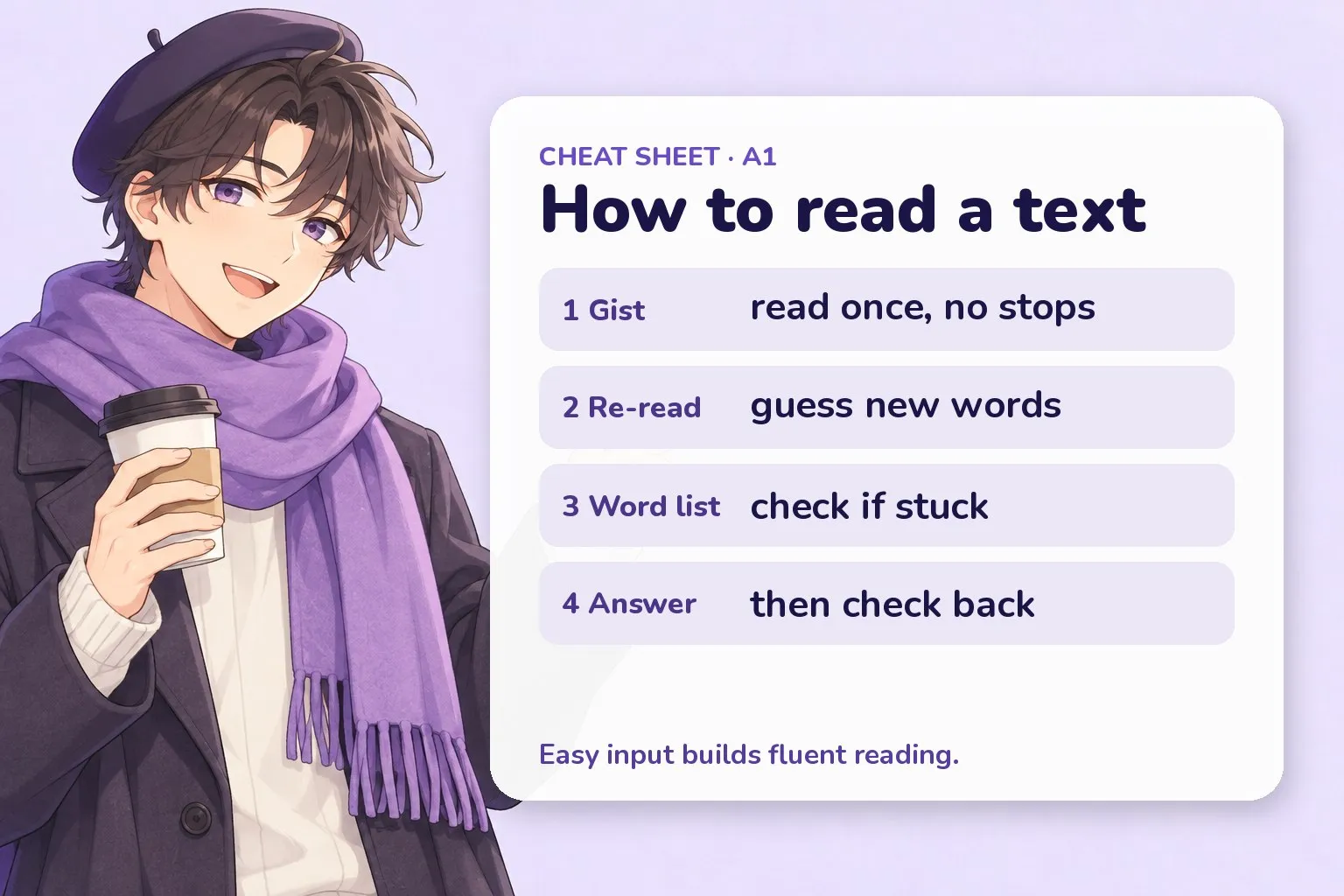
- First read — the gist. Read the whole text once without stopping. What is it about? Who is speaking?
- Second read — guess. Read again and try to work out new words from the words around them before you check anything.
- Word list. Only now look at the glossed words below for anything still unclear.
- Answer, then check back. Do the comprehension questions, returning to the text to confirm each answer.
The text: A student’s day
Bonjour ! Je m’appelle Marie. — Hello! My name is Marie. Je suis étudiante. — I am a student. J’habite à Lyon. — I live in Lyon. Le matin, je bois un café. — In the morning, I drink a coffee. Puis je vais à l’école. — Then I go to school. L’école est grande. — The school is big. J’étudie le français. — I study French. Le français est intéressant. — French is interesting. Le soir, je rentre à la maison. — In the evening, I go home.
New words
| French | English |
|---|---|
| je m’appelle | my name is |
| étudiante | student (female) |
| habiter | to live |
| le matin | the morning |
| boire | to drink |
| l’école | the school |
| étudier | to study |
| intéressant | interesting |
| le soir | the evening |
| rentrer | to go back / home |
How to say it
French spelling and speech diverge. Watch these in the text’s words:
| Sound | How to say it |
|---|---|
| é | “ay”: café = “ka-FAY”, étudiante = “ay-tu-DYANT”. |
| Silent final letters | Most final consonants are silent: français = “frahn-SEH”, grande final -e is silent. |
| je / j’ | the soft j in “measure”: je = “zhuh”; before a vowel it elides: j’habite = “zha-BEET”. |
| Nasal vowels | in / an / on go through the nose: matin = “ma-TAN”, intéressant = “an-tay- reh-SAHN”. |
Listen and repeat
Play each line, then say it aloud before you read on.
- Je m'appelle Marie.My name is Marie.
- Je suis étudiante.I am a student.
- J'habite à Lyon.I live in Lyon.
- Le matin, je bois un café.In the morning, I drink a coffee.
- Puis je vais à l'école.Then I go to school.
- L'école est grande.The school is big.
- J'étudie le français.I study French.
- Le français est intéressant.French is interesting.
- Le soir, je rentre à la maison.In the evening, I go home.
- Bonjour !Hello!
Quick recap before you answer the questions.
Comprehension practice
Reading comprehension practice
Try each one, then press Check. No sign-up, nothing is sent anywhere — it all runs in your browser.
Hint: the language on this site
Show answer
français — le français is 'French'.
4 Order the words: 'I am a student.' (female)
Show answer
Je suis étudiante — Subject + être + noun: Je suis étudiante.
5 Match each word to its meaning.
- l'école
- le soir
- rentrer
- intéressant
Show answer
- l'école → the school
- le soir → the evening
- rentrer → to go home
- intéressant → interesting
l'école school; le soir evening; rentrer go home; intéressant interesting.
Quiz
French reading comprehension quiz
8 questions · pick an answer and you'll see straight away if it's right.
-
Show answer
a student named Marie — Je suis étudiante — the speaker is a student named Marie.
-
Show answer
Lyon — J'habite à Lyon — 'I live in Lyon'.
-
Show answer
big (grande) — L'école est grande — 'the school is big'.
-
Show answer
French (le français) — J'étudie le français.
-
Show answer
goes home — Le soir, je rentre à la maison — 'in the evening, I go home'.
-
Show answer
read once for the gist — The first pass is for the gist — the overall meaning — not the details.
-
Show answer
only after trying to guess from context — Guess from context first; use the glossary for what stays unclear.
-
Show answer
because silent letters make words look harder than they sound — French drops many letters in speech, so reading aloud often reveals a word you already know.
Next
- Train your ear with How to Practise French Listening
- Build the grammar behind the text in the French grammar section
- New here? Start with Start Learning French Here
All French practice topics
Vocabulary, pronunciation, phrases, practice and exam help, ordered by level. Pick a topic and go straight to it. New lessons go live every day, so topics marked Coming soon fill in over the next weeks.
Practice
A1 1 topics · 1 ready
- 01 French Reading Practice: Beginner You are here
A2 3 topics · 2 ready
- 02 How to Practise French Listening
- 03 French Reading Practice: Elementary
- 04 French Verb Conjugation Drills Coming soon
B1 6 topics · 2 ready
- 05 Shadowing to Improve French Speaking
- 06 French Reading Practice: Intermediate
- 07 How to Practise French Writing Coming soon
- 08 Passe Compose vs Imparfait Practice Coming soon
- 09 French Liaison Practice Coming soon
- 10 French Object Pronoun Practice Coming soon
B2 3 topics · 1 ready
- 11 French Reading Practice: Upper-Intermediate
- 12 French Subjunctive Practice Set Coming soon
- 13 French Past Participle Agreement Practice Coming soon