French Reading Practice: Intermediate
This intermediate (B1) French reading gives a first-person text about moving to a new city, mixing past, present and future. Read for the gist, track the time markers, use the glossary last, then answer the comprehension and discussion questions.
Level: B1 (intermediate). At B1 a text no longer stays in one tense: it moves between what happened, what is true now, and what will happen. This page gives one short B1 text about moving to a new city and a clear method to work through it — a few focused minutes that push your reading forward.
By the end of this page you can…
…read a short intermediate French text that mixes tenses, follow it through its time markers, pick out the writer’s opinion, and answer comprehension and discussion questions about it.
How to read an intermediate French text
Do not translate word by word. Work in passes, each with its own goal:
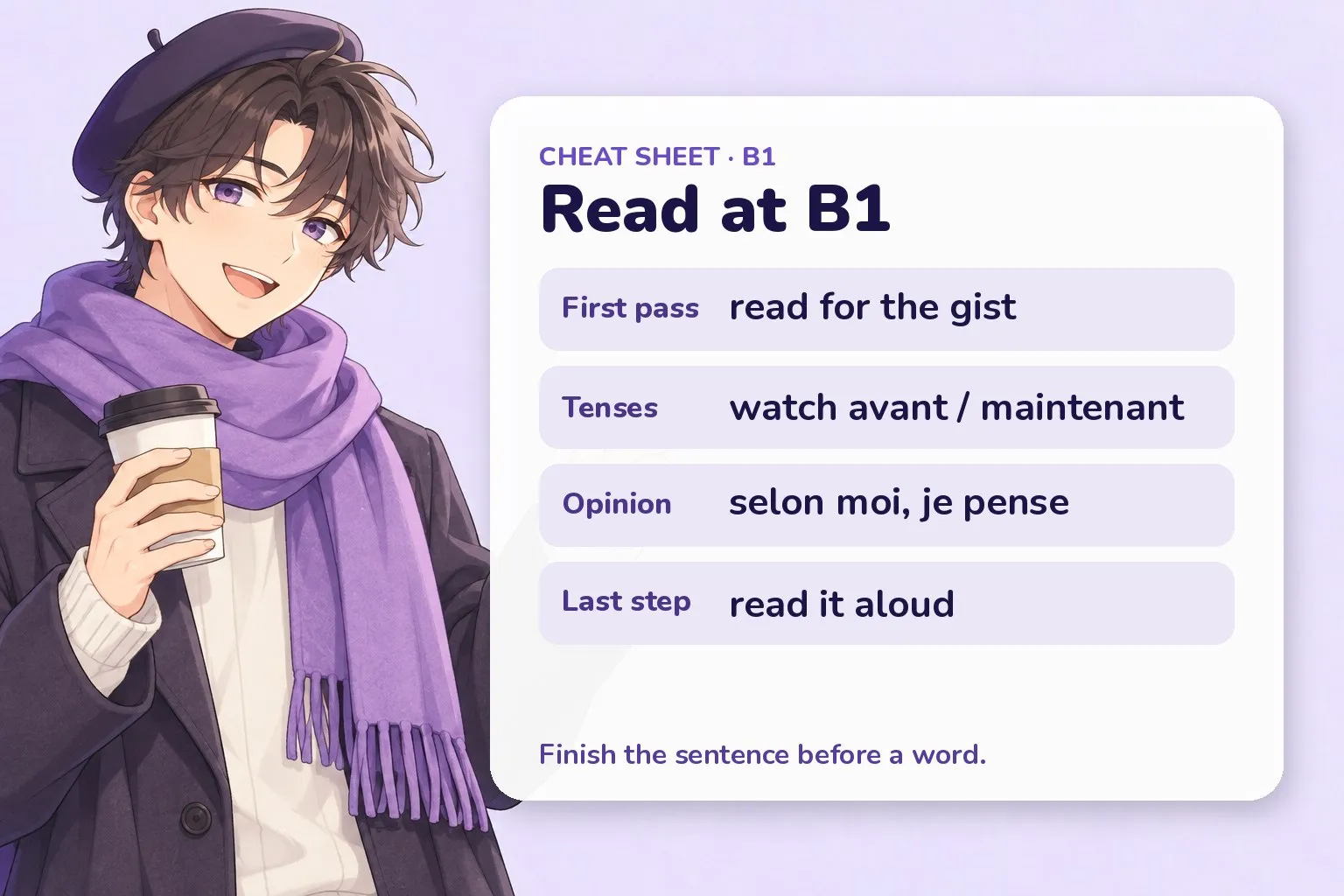
- First read — the gist. Read the whole text once without stopping. Who is speaking, and what is the situation?
- Second read — the timeline. Read again and underline the time markers (avant, l’année dernière, maintenant, bientôt, l’année prochaine); they tell you whether each sentence is past, present or future.
- Third read — the opinion. Find where the writer gives a view (je pense que, selon moi, le plus difficile, j’espère). B1 questions often ask what the writer feels, not only what happened.
- Word list, then answer. Only now look at the glossed words below, then do the questions, returning to the text to confirm each answer.
The text: A new city
L’année dernière, j’ai quitté mon village pour m’installer à Lyon. — Last year, I left my village to settle in Lyon. Au début, tout me semblait difficile : je ne connaissais personne. — At first, everything seemed hard to me: I knew no one. Maintenant, je travaille dans une petite entreprise et je me sens chez moi. — Now I work in a small company and I feel at home. Selon moi, le plus difficile n’était pas la langue, mais la solitude. — In my view, the hardest part was not the language, but the loneliness. Je pense que la vie en ville a changé mes habitudes. — I think that life in the city has changed my habits. Je sors plus souvent et j’ai rencontré beaucoup de gens. — I go out more often and I have met a lot of people. L’année prochaine, j’espère déménager dans un quartier plus calme. — Next year, I hope to move to a quieter neighbourhood. Bientôt, ma sœur va venir habiter près de chez moi. — Soon, my sister is going to come and live near me.
New words
| French | English |
|---|---|
| s’installer | to settle / move in |
| au début | at first |
| une entreprise | a company |
| se sentir chez soi | to feel at home |
| selon moi | in my view |
| la solitude | loneliness |
| les habitudes | habits |
| déménager | to move house |
| un quartier | a neighbourhood |
| j’espère | I hope |
How to say it
French spelling and speech diverge; watch these in the text’s words:
| Sound | How to say it |
|---|---|
| -é / -er endings | “ay”: entreprise keeps a clear final “eez”, but déménager ends “- zhay”. |
| Silent final letters | Most final consonants are silent: beaucoup = “boh-KOO” (final -p silent), plus often “ploo”. |
| eu | rounded “uh”: sœur = “sur”, gens has a soft g = “zhah(n)”. |
| Nasal vowels | in / an / on go through the nose: install er → installer “a(n)-sta-LAY”, quartier = “kar-TYAY”. |
| j / ge | soft “zh”: j’espère = “zhes-PAIR”, gens = “zhah(n)”. |
Listen and repeat
Play each line, then say it aloud before you read on.
- L'année dernière, j'ai quitté mon village.Last year, I left my village.
- Je me suis installé à Lyon.I settled in Lyon.
- Au début, je ne connaissais personne.At first, I knew no one.
- Maintenant, je travaille dans une entreprise.Now I work in a company.
- Je me sens chez moi.I feel at home.
- Selon moi, le plus difficile était la solitude.In my view, the hardest part was the loneliness.
- Je pense que la ville a changé mes habitudes.I think the city has changed my habits.
- J'ai rencontré beaucoup de gens.I have met a lot of people.
- L'année prochaine, j'espère déménager.Next year, I hope to move house.
- Bientôt, ma sœur va venir.Soon, my sister is going to come.
Comprehension practice
Reading comprehension practice
Try each one, then press Check. No sign-up, nothing is sent anywhere — it all runs in your browser.
Hint: the word for 'now'
Show answer
Maintenant — Maintenant means 'now' and marks the present.
4 Order the words: 'Next year, I hope to move house.'
Show answer
L'année prochaine, j'espère déménager — L'année prochaine, j'espère déménager.
5 Match each word to its meaning.
- s'installer
- un quartier
- au début
- déménager
Show answer
- s'installer → to settle / move in
- un quartier → a neighbourhood
- au début → at first
- déménager → to move house
s'installer settle; un quartier neighbourhood; au début at first; déménager move house.
Quick recap before you answer.
Quiz
French reading comprehension quiz
8 questions · pick an answer and you'll see straight away if it's right.
-
Show answer
Lyon — pour m'installer à Lyon — the writer moved to Lyon.
-
Show answer
at home (chez moi) — Maintenant… je me sens chez moi — 'I feel at home'.
-
Show answer
their habits (mes habitudes) — la vie en ville a changé mes habitudes.
-
Show answer
move to a quieter neighbourhood — L'année prochaine, j'espère déménager dans un quartier plus calme.
-
Show answer
the writer's sister (ma sœur) — Bientôt, ma sœur va venir habiter près de chez moi.
-
Show answer
past — 'Last year' is a past time marker.
-
Show answer
the writer's opinion — Selon moi = 'in my view' — it signals an opinion.
-
Show answer
read once for the gist — The first pass is for the gist — the overall meaning.
Discussion
Try answering these aloud or in writing, in simple French: Et vous ? Have you ever moved to a new city? Quel a été le plus difficile ? What was hardest for you — the language, the people, or something else? Que ferez-vous l’année prochaine ? There is no single right answer; reuse the text’s words (s’installer, se sentir chez moi, les habitudes) to build your own sentences.
Next
- Go back over the elementary text: French Reading Practice: Elementary
- Build the grammar behind the text in the French grammar section
- New here? Start with Start Learning French Here
All French practice topics
Vocabulary, pronunciation, phrases, practice and exam help, ordered by level. Pick a topic and go straight to it. New lessons go live every day, so topics marked Coming soon fill in over the next weeks.
Practice
A1 1 topics · 1 ready
A2 3 topics · 2 ready
- 02 How to Practise French Listening
- 03 French Reading Practice: Elementary
- 04 French Verb Conjugation Drills Coming soon
B1 6 topics · 2 ready
- 05 Shadowing to Improve French Speaking
- 06 French Reading Practice: Intermediate You are here
- 07 How to Practise French Writing Coming soon
- 08 Passe Compose vs Imparfait Practice Coming soon
- 09 French Liaison Practice Coming soon
- 10 French Object Pronoun Practice Coming soon
B2 3 topics · 1 ready
- 11 French Reading Practice: Upper-Intermediate
- 12 French Subjunctive Practice Set Coming soon
- 13 French Past Participle Agreement Practice Coming soon