Reading Arabic Without Vowels
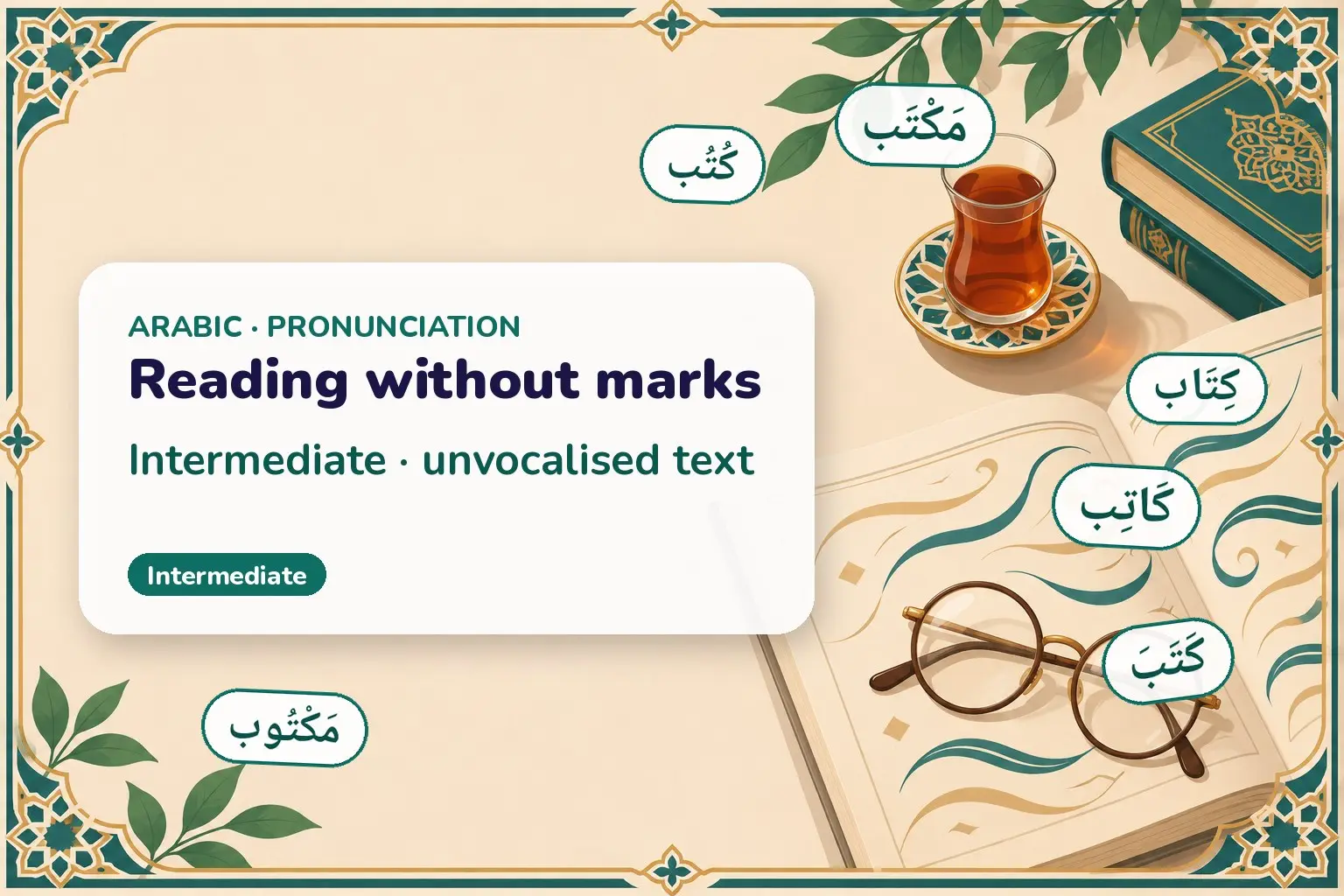
Printed Arabic drops the short vowels, so you read from cues you can still see: function words such as فِي (fī) and مِن (min), three-letter roots in a known pattern such as فَاعِل (fāʿil), and the letters that mark the verb's person.
On this page13 sections · tap to jump
- 01Why everyday Arabic has no vowel marks
- 02Step 1: find the function words first
- 03Step 2: fit each content word to a pattern
- 04Step 3: read the verb’s person from its letters
- 05Step 4: use the shape of the sentence
- 06Walking through one unvocalised line
- 07Example sentences
- 08Common mistakes
- 09A short conversation
- 10Usage notes
- 11Practice
- 12Quiz
- 13Recap cheat-sheet
Level: Intermediate. You can already read a fully marked Arabic sentence aloud. Real Arabic — a newspaper page, a shop sign, a message on a phone — takes those marks away, and the same letters can then spell more than one word. Reading it is a prediction skill, and it rests on four cues that the unvocalised text still gives you.
Why everyday Arabic has no vowel marks
Arabic letters spell the consonants and the three long vowels. The short vowels — the a, i and u sounds — are a separate layer of small marks above and below the line, called حَرَكَات (ḥarakāt). A fully marked word such as كَتَبَ (kataba, he wrote) shows three of them. The same word in print appears as كتب (k-t-b), with nothing but the letter skeleton, which is called رَسْم (rasm).
Writers leave the marks out because fluent readers do not need them: the sentence supplies the vowels on its own. The marks stay where guessing would be unsafe or where the reader is still learning — the Qurʾan, classical poetry, children’s books, dictionary headwords and material written for learners.
The practical consequence for you is blunt: waiting until a text is marked means never reading real Arabic. The four cues below do the work the marks would have done.
Step 1: find the function words first
Function words are the short, high-frequency words that carry the grammar: prepositions, pronouns, particles, question words. The list is small and closed, the same words appear several times on every page, and they are the easiest thing to pick out without vowels. Use them as anchors and work outwards from them.
| Function word | Reading | Meaning |
|---|---|---|
| مِن | min | from |
| فِي | fī | in |
| عَلَى | ʿalā | on |
| إِلَى | ilā | to |
| عَنْ | ʿan | about |
| مَعَ | maʿa | with |
| بَيْنَ | bayn | between |
| لَا | lā | no, not |
| مَا | mā | what; not |
| هَذَا | hādhā | this |
| الَّذِي | alladhī | who, which |
| كَانَ | kāna | he was |
| ثُمَّ | thumma | then |
| كُلّ | kull | every, all |
With those in hand the bones of the sentence appear even when every content word is new. A preposition such as فِي (fī, in) says that a place is coming and that the noun after it stands in the genitive. The relative pronoun الَّذِي (alladhī, who, which) says a clause is starting and that the verb in it describes the noun just before. The particle ثُمَّ (thumma, then) tells you the order of two events.
Step 2: fit each content word to a pattern
Arabic builds most words from a three-letter root — جَذْر (jadhr) — fitted into a pattern, وَزْن (wazn), plural أَوْزَان (awzān). The root carries the core meaning and the pattern carries the grammar. Take the root k-t-b, which has to do with writing:
| Pattern | Reading | Usually means | Example | Reading |
|---|---|---|---|---|
| فَعَلَ | faʿala | past verb | كَتَبَ | kataba (he wrote) |
| فَاعِل | fāʿil | the one who does it | كَاتِب | kātib (writer) |
| مَفْعُول | mafʿūl | the thing done | مَكْتُوب | maktūb (something written) |
| مَفْعَل | mafʿal | a place | مَكْتَب | maktab (office, desk) |
| فِعَال | fiʿāl | the thing itself | كِتَاب | kitāb (book) |
| فُعُل | fuʿul | a plural | كُتُب | kutub (books) |
A word you have never met is then half known. كِتَاب (kitāb) on the fiʿāl pattern is a thing, and the root says it belongs to writing, so a book. مَكْتَب (maktab) on mafʿal is a place for writing, so a desk or an office. You will sometimes guess wrong — the rest of the sentence corrects you, and that is faster than stopping at every unfamiliar word.
Step 3: read the verb’s person from its letters
The present tense wears its subject on the front of the word; the past tense wears it on the end. Those are consonants, so they survive when the short vowels disappear. That is why an unvocalised verb can still tell you who is doing the action.
| Verb | Reading | Person | Cue |
|---|---|---|---|
| كَتَبَ | kataba | he wrote | no ending |
| كَتَبَتْ | katabat | she wrote | -t |
| كَتَبْتَ | katabta | you wrote (m.) | -ta |
| كَتَبْتُ | katabtu | I wrote | -tu |
| كَتَبُوا | katabū | they wrote | -ū |
| يَكْتُبُ | yaktubu | he writes | ya- |
| تَكْتُبُ | taktubu | she writes; you write | ta- |
| أَكْتُبُ | aktubu | I write | ʾa- |
| نَكْتُبُ | naktubu | we write | na- |
What is left to guess is the stem vowel. يَكْتُبُ (yaktubu, he writes) and يَشْرَبُ (yashrabu, he drinks) have the same visible shape — yāʾ plus three root letters — and only the vowel after the second root letter (u against a) is missing from the page. The root, which you can see, carries the meaning, so the guess is a small one.
Step 4: use the shape of the sentence
Two sentence types cover most modern prose. In a nominal sentence the first noun is the topic and what follows describes it, with no word for is: البَيْتُ كَبِيرٌ (al-baytu kabīrun, the house is big). In a verbal sentence the verb comes first and the doer follows it: شَرِبَ الوَلَدُ الحَلِيبَ (shariba al-waladu al-ḥalība, the boy drank the milk).
| Signal | Reading | What it tells you |
|---|---|---|
| الـ | al- | the noun is definite |
| ة | -a | feminine |
| ـات | -āt | feminine plural |
| ـون | -ūn | masculine plural |
| ـه | -hu | his, him |
| سـ | sa- | future |
Two nouns in a row, the second one definite, mean X of Y: بَابُ البَيْتِ (bābu al-bayti, the door of the house). The first noun of that chain never carries الـ (al-), so a bare noun followed by a definite one is your cue that an of-chain has started.
Walking through one unvocalised line
Here is a line from a news page, exactly as it prints — ذهب الطلاب إلى المكتبة صباح اليوم (dhahaba aṭ-ṭullābu ilā al-maktabati ṣabāḥa al-yawmi). Read it in four passes.
- Function words. إِلَى (ilā, to) points at a destination, and صَبَاح (ṣabāḥ, morning) joined to اليَوْم (al-yawm, the day) means this morning.
- The verb. ذَهَبَ (dhahaba) has the faʿala shape with no ending, so it is past tense and its subject is he or they.
- The doer. الطُّلَّاب (aṭ-ṭullāb) carries الـ (al-) and the plural pattern فُعَّال (fuʿʿāl), so it is the students. The verb stays singular because it comes before a plural subject.
- The rest. إِلَى (ilā) plus المَكْتَبَة (al-maktaba, the library) closes the clause.
Read in that order, the line means: the students went to the library this morning.
Example sentences
The first six are fully marked, so you can check the mapping. The rest are printed the way you will meet them, with no marks at all; the reading under each one is what your eye should produce.
- كَتَبَ الوَلَدُ الدَّرْسَ.kataba al-waladu ad-darsa.The boy wrote the lesson.Marked: three short a vowels.
- البَيْتُ كَبِيرٌ.al-baytu kabīrun.The house is big.Nominal sentence: no word for is.
- هَذَا كِتَابٌ جَدِيدٌ.hādhā kitābun jadīdun.This is a new book.tanwin -un marks an indefinite noun.
- الطَّالِبُ فِي المَكْتَبَةِ.aṭ-ṭālibu fī al-maktabati.The student is in the library.fī takes the genitive -i.
- ذَهَبْتُ إِلَى السُّوقِ.dhahabtu ilā as-sūqi.I went to the market.-tu on a past verb means I.
- المُعَلِّمَةُ تَقْرَأُ الجَرِيدَةَ.al-muʿallimatu taqraʾu al-jarīdata.The teacher reads the newspaper.ta- prefix: she.
- كتب الولد الدرسkataba al-waladu ad-darsaThe boy wrote the lessonThe same sentence unmarked: four words, no vowels.
- سافر أخي إلى مصر بالطائرةsāfara akhī ilā miṣra bi-ṭ-ṭāʾiratiMy brother travelled to Egypt by planebi- glued to the front means by.
- أنا أقرأ الكتاب كل يومanā aqraʾu al-kitāba kulla yawminI read the book every dayʾa- prefix: I.
- هل عندك قلم؟hal ʿindaka qalamun?Do you have a pen?hal opens a yes-no question.
- هذا بيتيhādhā baytīThis is my house-ī at the end: my.
- المدير يعمل في مكتبهal-mudīru yaʿmalu fī maktabihiThe manager works in his officemaktab plus -hi: his office.
- لم أذهب إلى السوق أمسlam adhhab ilā as-sūqi amsiI did not go to the market yesterdaylam takes a jussive verb: lam adhhab.
- الكتاب الذي قرأته ممتازal-kitābu alladhī qaraʾtuhu mumtāzunThe book that I read is excellentalladhī starts the relative clause.
- سيصل القطار في السادسةsa-yaṣilu al-qiṭāru fī as-sādisatiThe train will arrive at sixsa- at the front: future.
- الطالبات يكتبن الواجبaṭ-ṭālibātu yaktubna al-wājibaThe female students write the homework-na ending: they, feminine.
- نحن نتكلم العربية في البيتnaḥnu natakallamu al-ʿarabiyyata fī al-baytiWe speak Arabic at homena- prefix: we.
- أحب القهوة بلا سكرuḥibbu al-qahwata bilā sukkarinI like coffee without sugarbilā means without.
- ماذا تريد أن تأكل؟mādhā turīdu an taʾkula?What do you want to eat?an plus a subjunctive verb: to eat.
- كان الجو حارا أمسkāna al-jawwu ḥārran amsiThe weather was hot yesterdaykāna takes a predicate in -an.
Common mistakes
- ✗ reading every كتب (k-t-b) as kataba → ✅ the same skeleton can be kataba (he wrote), kutiba (it was written), kutub (books) or katb (writing); the subject and the pattern settle it.
- ✗ stopping dead at the first unmarked word → ✅ read to the end of the clause, because a preposition two words later usually fixes the meaning of what came before.
- ✗ turning مَكْتَب (maktab, office) into مَكْتُوب (maktūb, written) → ✅ look for the و (wāw) inside the word; its presence is the whole difference.
- ✗ reading ـه (hu) as a separate word → ✅ it is a suffix glued to the noun: كِتَابُهُ (kitābuhu, his book) is one word, not two.
- ✗ pushing English vowels into the pattern (ki-taab, ku-toob) → ✅ learn the pattern pair: فِعَال (fiʿāl) gives kitāb, فُعُل (fuʿul) gives kutub.
- ✗ treating الـ (al-) as a word of its own → ✅ it is written onto the noun, and its job is to make that noun definite.
A short conversation
— ماذا تقرأ؟ — Mādhā taqraʾ? — What are you reading? — لافتة على الباب. — Lāfiṭa ʿalā al-bāb. — A sign on the door. — هل تفهمها بلا حركات؟ — Hal tafhamuhā bilā ḥarakāt? — Do you understand it without the vowel marks? — نعم، لأن الكلمات مألوفة. — Naʿam, li-anna al-kalimāt maʾlūfa. — Yes, because the words are familiar.
Usage notes
- Names do not follow patterns. لندن (Landan, London) gives you nothing to predict from, so learn the vowels of a name the way you learn the name itself.
- Numbers and place names are anchors. A digit, a price or a recognisable city narrows the sentence even when every vowel around it is gone, so hunt for them first in an unfamiliar paragraph.
- Read aloud, slowly. Supplying the vowels out loud is the check: if the clause stops making sense at the third word, the pattern guess was wrong, and backing up one clause is faster than restarting the paragraph.
- Dialects change the vowels, not the letters. The same written word read aloud in a dialect shifts its short vowels, so write MSA vowels and expect a dialect speaker to move them.
- Add the marks when you write for beginners. Omitting harakat is a choice made for fluent readers, not a rule of the script.
Practice
Reading without vowels practice
Try each one, then press Check. No sign-up, nothing is sent anywhere — it all runs in your browser.
Hint: The ya- prefix marks he.
Show answer
yaktubu — يَكْتُبُ (yaktubu) — ya- for he, and the stem vowel u after the k.
Hint: Long ā after the first consonant.
Show answer
kātib — كَاتِب (kātib) — the alif gives the long ā of the fāʿil pattern.
5 Match each function word to its meaning.
- من (min)
- إلى (ilā)
- على (ʿalā)
- بلا (bilā)
Show answer
- من (min) → from
- إلى (ilā) → to
- على (ʿalā) → on
- بلا (bilā) → without
These four anchors tell you the direction and the relation before you know any content word.
6 Put the words in sentence order: The manager works in his office.
Show answer
المدير (al-mudīr) يعمل (yaʿmal) في (fī) مكتبه (maktabihi) — Topic first here, then the verb, then the prepositional phrase: المدير يعمل في مكتبه (al-mudīr yaʿmal fī maktabihi).
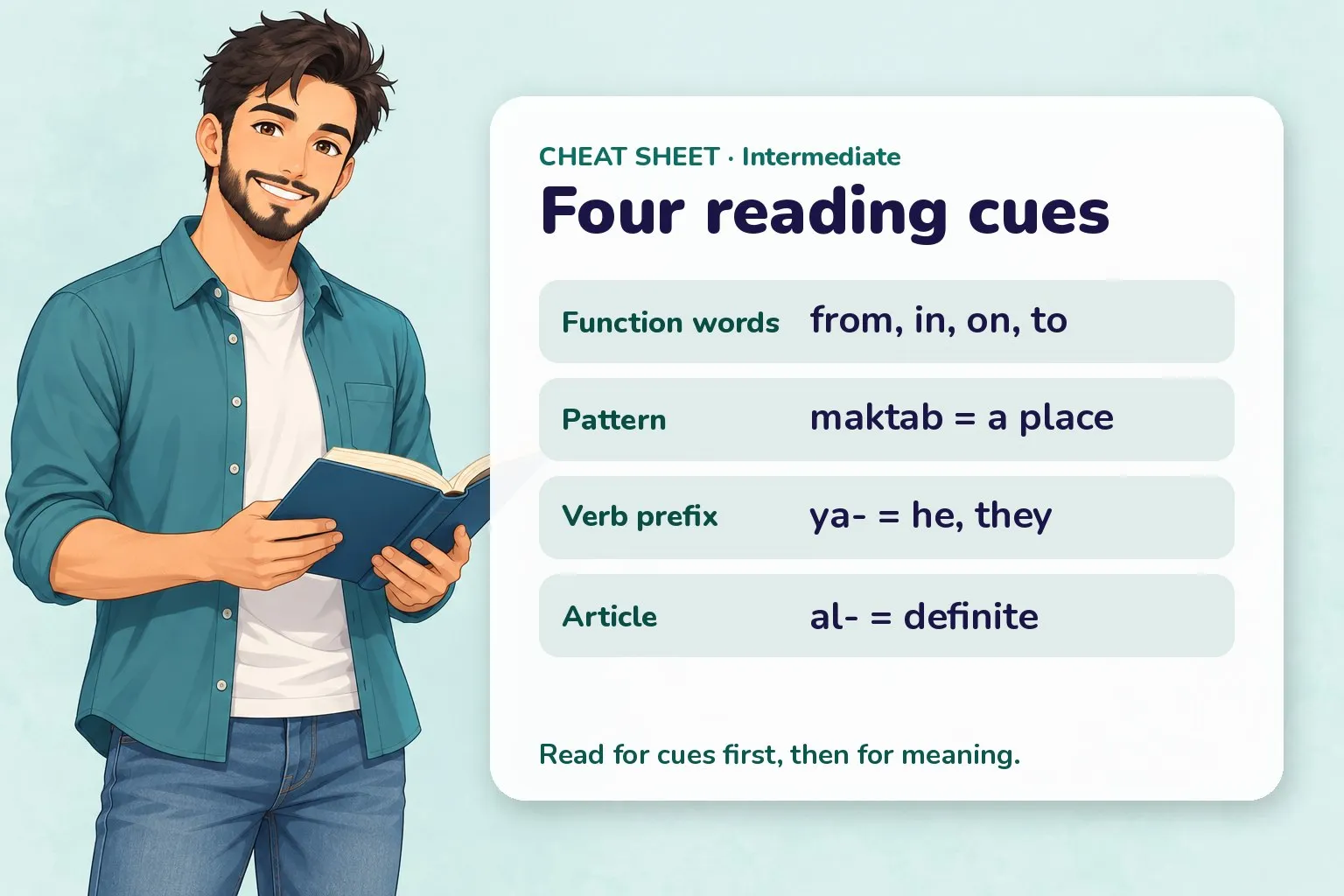
Quick recap before you practise.
Quiz
Reading without vowels quiz
13 questions · pick an answer and you'll see straight away if it's right.
-
Show answer
consonants and long vowels — Letters spell consonants and the three long vowels; the short vowels are supplied by the reader.
-
Show answer
harakat — حَرَكَات (ḥarakāt) are the short-vowel marks; the letter skeleton itself is rasm.
-
Show answer
the doer of the action — fāʿil is the active participle: كَاتِب (kātib) is a writer.
-
Show answer
mafʿūl, something written — The و (wāw) before the last letter marks mafʿūl, the thing done.
-
Show answer
a relative clause about the book — alladhī is the relative pronoun: the clause after it describes the book.
-
Show answer
he or they (m.) — ya- marks the third person masculine: يَكْتُبُ (yaktubu) is he writes.
-
Show answer
she writes or you (m.) write — ta- serves both the feminine third person and the masculine second person; context picks one.
-
Show answer
the short vowels are not written — كتب (k-t-b) can be kataba, kutiba, kutub or katb; only the vowels separate them, and they are absent.
-
Show answer
are inferred, or dropped in pausing form — They are not shown, so readers supply them from syntax or pause on the word instead.
-
Show answer
من (min) — مِن (min, from) is a preposition; the other three are content words built from the k-t-b root.
-
Show answer
the Qurʾan and children's books — Fully marked text is kept for recitation, teaching and reference, where guessing would be unsafe.
-
Show answer
a place — mafʿal builds nouns of place, as in مَكْتَب (maktab, desk, office); instruments take the مِـ prefix, as in مِفْتَاح (miftāḥ, key).
-
Show answer
dhahaba — ذَهَبَ (dhahaba) is the past tense, and with no ending its subject is he or they.
Recap cheat-sheet
| Cue | Example | Reading | What it gives you |
|---|---|---|---|
| Function word | من | min | the relation and role of the next noun |
| Pattern | مَكْتَب | maktab | a place, or a word the root builds |
| Verb prefix | يَكْتُبُ | yaktubu | who does the action |
| Definite article | الـ | al- | the noun is specific |
| Suffix | ـه | -hu | his, attached to the noun |
Next
- Go back to the marks themselves in Arabic harakat and short vowels and Arabic long vowels, which are what unvocalised text always keeps.
- The article is the cue you will use most, so read the Arabic definite article al- and sun and moon letters.
- Practise on real text next with Arabic reading practice A2, then the Arabic pronunciation overview.
All Arabic pronunciation & writing topics
Vocabulary, pronunciation, phrases, practice and exam help, ordered by level. Pick a topic and go straight to it. New lessons go live every day, so topics marked Coming soon fill in over the next weeks.
Pronunciation & writing
Beginner 10 topics · 8 ready
- 01 Arabic Pronunciation Overview
- 02 The Arabic Script & Abjad
- 03 Arabic Letters: Connecting Forms
- 04 Harakat: Short Vowels & Sukun
- 05 Arabic Long Vowels (alif, waw, ya)
- 06 Sun & Moon Letters
- 07 Ta Marbuta & Alif Maqsura
- 08 Arabic Handwriting & Numerals
- 09 How to Type Arabic (Keyboard Guide) Coming soon
- 10 Arabic Transliteration Systems & Limits Coming soon
Elementary 2 topics · 2 ready
Intermediate 1 topics · 1 ready
- 13 Reading Arabic Without Vowels You are here