Ta Marbuta & Alif Maqsura
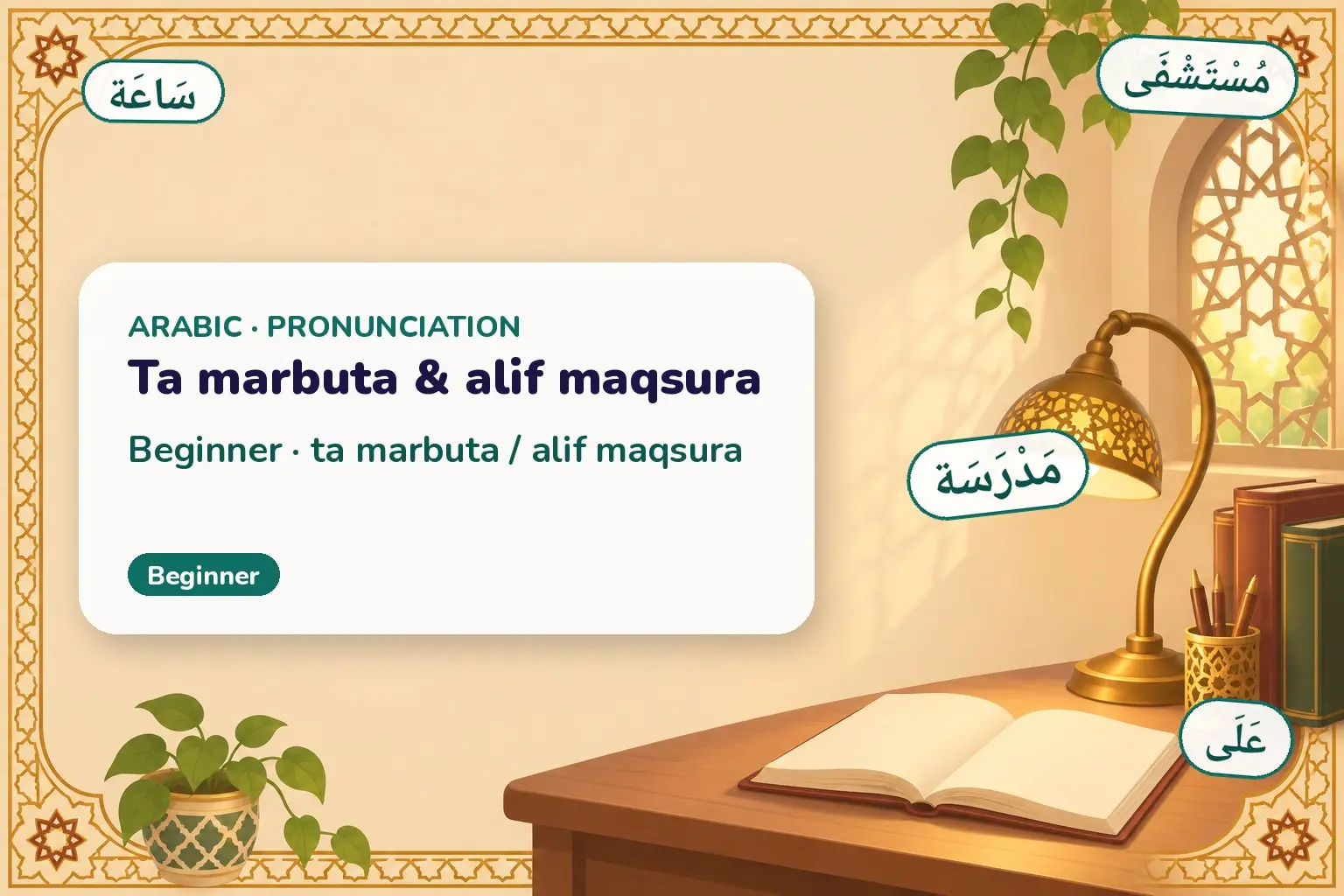
ة (tāʾ marbūṭa) ends most feminine words and is read as a soft -a when you stop, but as -t- when a vowel ending or another word follows: مَدْرَسَة (madrasa) but مَدْرَسَتي (madrasatī). ى (alif maqṣūra) is a final long -ā written like a dotless yāʾ: عَلَى (ʿalā).
Level: Beginner. Two Arabic letters appear only at the end of a word and trip up almost every beginner. ة (tāʾ marbūṭa) is the ending that marks most feminine words; ى (alif maqṣūra) is a final long -ā sound written like a yāʾ with no dots. By the end you can read both correctly and know when ة (tāʾ marbūṭa) sounds like -a and when it sounds like -t.
The tied tāʾ: ة (tāʾ marbūṭa)
The name ة (tāʾ marbūṭa) means the “tied tāʾ”. It looks like the letter ه (hāʾ) but with the two dots of ت (tāʾ) added on top. It appears only at the end of a word, and it is the single most common sign that a noun or adjective is feminine: طَالِب (ṭālib) is a male student, طَالِبَة (ṭāliba) is a female student.
How you say ة (tāʾ marbūṭa) depends on what comes after it:
- In pause (you stop on the word, or it stands alone), you do not say a t. You hear only the preceding -a vowel: مَدْرَسَة (madrasa), a school.
- In context (a case ending, a suffix, or a following word in a possessive phrase), the ending wakes up as a full -t-: مَدْرَسَتي (madrasatī), my school; مَدِينَةُ دُبَي (madīnatu Dubay), the city of Dubai.
The shortened alif: ى (alif maqṣūra)
The name ى (alif maqṣūra) means the “shortened alif”. It is written like a yāʾ ي (yāʾ) but without the two dots, and it sits only at the end of a word. Despite looking like a yāʾ, it is not a y or ī sound: it is a long -ā, exactly like a normal alif ا (alif).
You meet it in some of the most common words in the language: عَلَى (ʿalā), on; إِلَى (ilā), to; مَتَى (matā), when. It also ends many nouns and names: مُسْتَشْفَى (mustashfā), a hospital; لَيْلَى (Laylā), the name Layla.
Tell them apart
| Ending | Looks like | Dots | Sound | Example | Reading |
|---|---|---|---|---|---|
| ة | ه with two dots | two, on top | -a (pause) / -t- (context) | مَدْرَسَة | madrasa |
| ى | ي with no dots | none | long -ā | عَلَى | ʿalā |
| ه | plain loop | none | -h | هَذِهِ | hādhihi |
| ي | tall tooth | two, below | -ī / -y | فِي | fī |
The danger pairs are ة (tāʾ marbūṭa) versus ه (hāʾ) — same shape, but the dots change both meaning and sound — and ى (alif maqṣūra) versus ي (yāʾ) — same shape, but the dots turn a long -ā into an -ī or -y.
Read these aloud
- مَدْرَسَةmadrasaa school — ة read as -a in pausefeminine
- سَيَّارَةsayyāraa car — ة as -a
- مَدِينَةmadīnaa city — ة as -a
- طَالِبَةṭālibaa female student — the ة marks feminine
- سَاعَةsāʿaan hour / a watch — ة as -a
- غُرْفَةghurfaa room — ة as -a
- مَدْرَسَتيmadrasatīmy school — ة wakes up as -t- before the suffixcontext: -t-
- سَاعَتُكَsāʿatukayour watch — ة sounds as -t- here
- مَدِينَةُ دُبَيmadīnatu Dubaythe city of Dubai — ة as -t- in a possessive phrase
- عَلَىʿalāon — ى is a long -āalif maqṣūra
- إِلَىilāto / towards — ى as -ā
- مَتَىmatāwhen? — ى as -ā
- مُسْتَشْفَىmustashfāa hospital — ى as -ā
- كُبْرَىkubrābiggest (feminine) — ى as -ā
- لَيْلَىLaylāLayla (a name) — ى as -ā
- مُوسَىMūsāMusa / Moses — ى as -ā
- هُدَىHudāHuda (a name) — ى as -ā
- قَرْيَةqaryaa village — ة as -a
Notice every ة (tāʾ marbūṭa) word above is feminine, and every ى (alif maqṣūra) word ends in a clear long -ā.
Common mistakes
- ❌ reading مَدْرَسَة (madrasa) as madrasat when it stands alone → ✅ in pause it is madrasa; the -t- only appears in context.
- ❌ writing طَالِبَه (ṭālibah) with a plain ه (hāʾ) instead of ة (tāʾ marbūṭa) → ✅ طَالِبَة (ṭāliba): the feminine ending needs the two dots.
- ❌ reading عَلَى (ʿalā) as ʿalī or ʿalay → ✅ ى (alif maqṣūra) is a long -ā: ʿalā.
- ❌ putting dots on the final ى (alif maqṣūra) to make ي (yāʾ) → ✅ keep ى (alif maqṣūra) dotless when the sound is -ā; add the two dots only for a real -ī / -y.
- ❌ using ة (tāʾ marbūṭa) in the middle of a word → ✅ it appears only at the end; inside a word a t is written ت (tāʾ).
A short exchange
— مَا هَذِهِ؟ — Mā hādhihi? — What is this? — هَذِهِ مَدْرَسَة جَدِيدَة. — Hādhihi madrasa jadīda. — This is a new school. — وَأَيْنَ المُسْتَشْفَى؟ — Wa-ayna al-mustashfā? — And where is the hospital? — المُسْتَشْفَى عَلَى اليَمِين. — Al-mustashfā ʿalā al-yamīn. — The hospital is on the right.
Both feminine words مَدْرَسَة (madrasa) and جَدِيدَة (jadīda) end in ة (tāʾ marbūṭa), while المُسْتَشْفَى (al-mustashfā) and عَلَى (ʿalā) end in ى (alif maqṣūra).
Usage notes
- ة (tāʾ marbūṭa) marks agreement. Because ة (tāʾ marbūṭa) signals the feminine, an adjective describing a feminine noun usually takes it too: سَيَّارَة جَدِيدَة (sayyāra jadīda), a new car. See adjective agreement.
- Counting the ending. When you add the dual or sound feminine plural, the ة (tāʾ marbūṭa) opens into a ت (tāʾ): مُعَلِّمَة (muʿallima) → مُعَلِّمَات (muʿallimāt), teachers (f.).
- ى (alif maqṣūra) never takes a vowel sign. You will not see a fatḥa or ḍamma written on ى (alif maqṣūra); it is already a long vowel.
- Spelling is fixed. Whether a final -ā is written ا (alif) or ى (alif maqṣūra) is part of the word’s spelling to learn, not a rule you can derive from the sound.
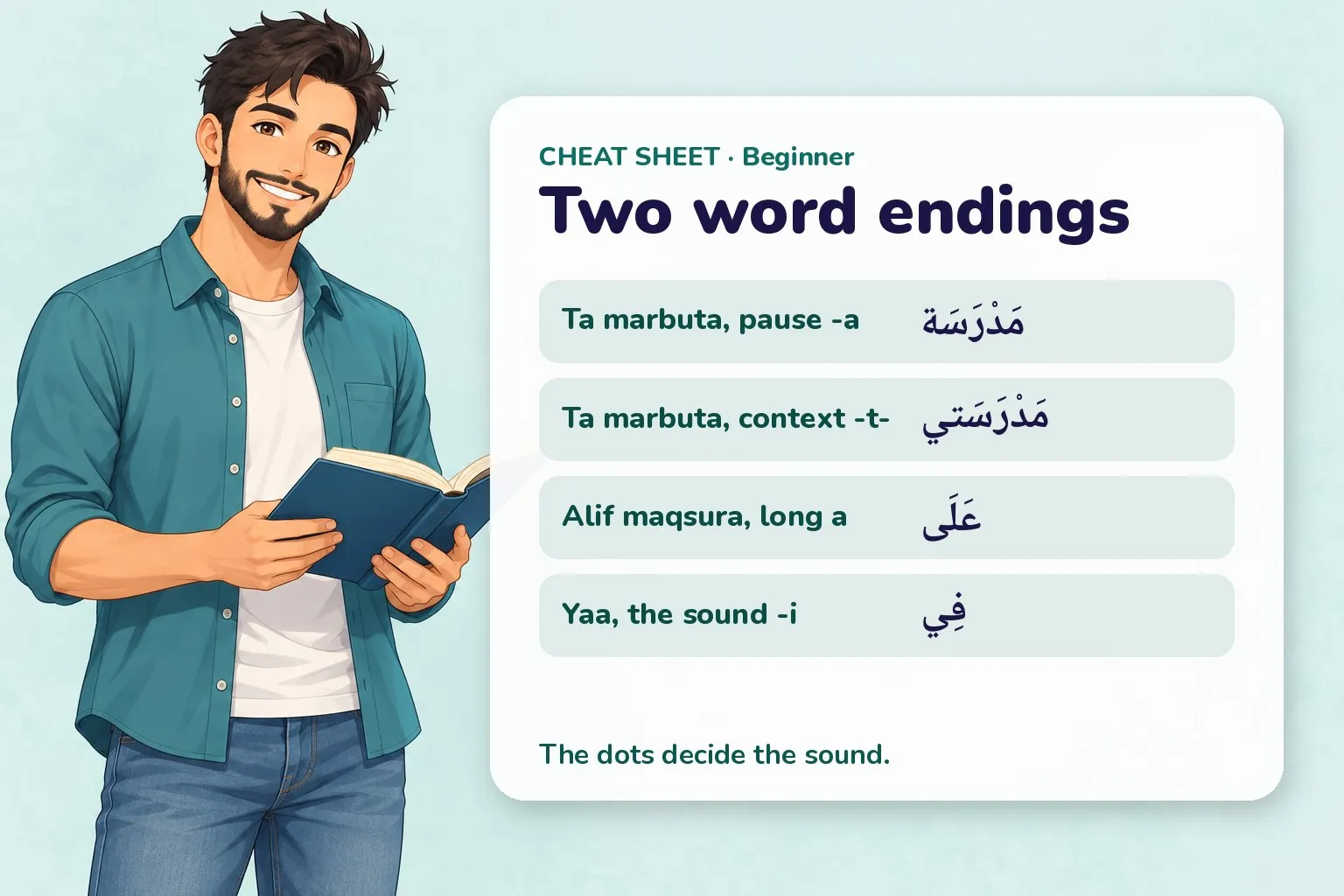
Quick recap before the quiz.
Practice
Ta marbuta and alif maqsura practice
Try each one, then press Check. No sign-up, nothing is sent anywhere — it all runs in your browser.
Hint: the ة (tāʾ marbūṭa) wakes up
Show answer
madrasatī — With a suffix the ة (tāʾ marbūṭa) becomes -t-: مَدْرَسَتي (madrasatī).
4 Match each ending to its sound.
- ة (pause)
- ة (context)
- ى (alif maqṣūra)
- ي (yāʾ)
Show answer
- ة (pause) → -a (madrasa)
- ة (context) → -t- (madrasatī)
- ى (alif maqṣūra) → long -ā (ʿalā)
- ي (yāʾ) → -ī (fī)
ة (tāʾ marbūṭa) is -a or -t-; ى (alif maqṣūra) is -ā; ي (yāʾ) is -ī.
Quiz
Ta marbuta and alif maqsura quiz
10 questions · pick an answer and you'll see straight away if it's right.
-
Show answer
only at the end — ة (tāʾ marbūṭa) is a word-final ending only.
-
Show answer
feminine — It is the usual sign of a feminine noun or adjective.
-
Show answer
-a — In pause the ة (tāʾ marbūṭa) is a soft -a: madīna.
-
Show answer
-t- — In a possessive phrase the ة (tāʾ marbūṭa) becomes -t-: madīnatu.
-
Show answer
ه (hāʾ) — It is ه (hāʾ) with the two dots of ت added on top.
-
Show answer
long -ā — ى (alif maqṣūra) is a final long -ā.
-
Show answer
إِلَى (ilā) — إِلَى (ilā) ends in ى; the others end in ة.
-
Show answer
the two dots: ي (yāʾ) has them, ى (alif maqṣūra) does not — ي (yāʾ) carries two dots and is -ī/-y; ى (alif maqṣūra) is dotless and is -ā.
-
Show answer
ʿalā — The final ى (alif maqṣūra) is a long -ā: ʿalā.
-
Show answer
a — In pause the ة (tāʾ marbūṭa) is a soft -a: sayyāra.
Recap cheat-sheet
| Ending | Name | Sound | Example |
|---|---|---|---|
| ة | tāʾ marbūṭa | -a (pause) / -t- (context) | مَدْرَسَة (madrasa) |
| ى | alif maqṣūra | long -ā | عَلَى (ʿalā) |
| ه | hāʾ | -h | هَذِهِ (hādhihi) |
| ي | yāʾ | -ī / -y | فِي (fī) |
Next
- See the feminine ending at work in adjective agreement
- Review the short vowels in Arabic short vowels (harakat)
- New here? Start with Start Learning Arabic Here
All Arabic pronunciation & writing topics
Vocabulary, pronunciation, phrases, practice and exam help, ordered by level. Pick a topic and go straight to it. New lessons go live every day, so topics marked Coming soon fill in over the next weeks.
Pronunciation & writing
Beginner 10 topics · 7 ready
- 01 Arabic Pronunciation Overview
- 02 The Arabic Script & Abjad
- 03 Arabic Letters: Connecting Forms
- 04 Harakat: Short Vowels & Sukun
- 05 Arabic Long Vowels (alif, waw, ya)
- 06 Sun & Moon Letters
- 07 Ta Marbuta & Alif Maqsura You are here
- 08 Arabic Handwriting & Numerals Coming soon
- 09 How to Type Arabic (Keyboard Guide) Coming soon
- 10 Arabic Transliteration Systems & Limits Coming soon
Elementary 2 topics · 2 ready
Intermediate 1 topics
- 13 Reading Arabic Without Vowels Coming soon