Arabic Pronunciation Overview
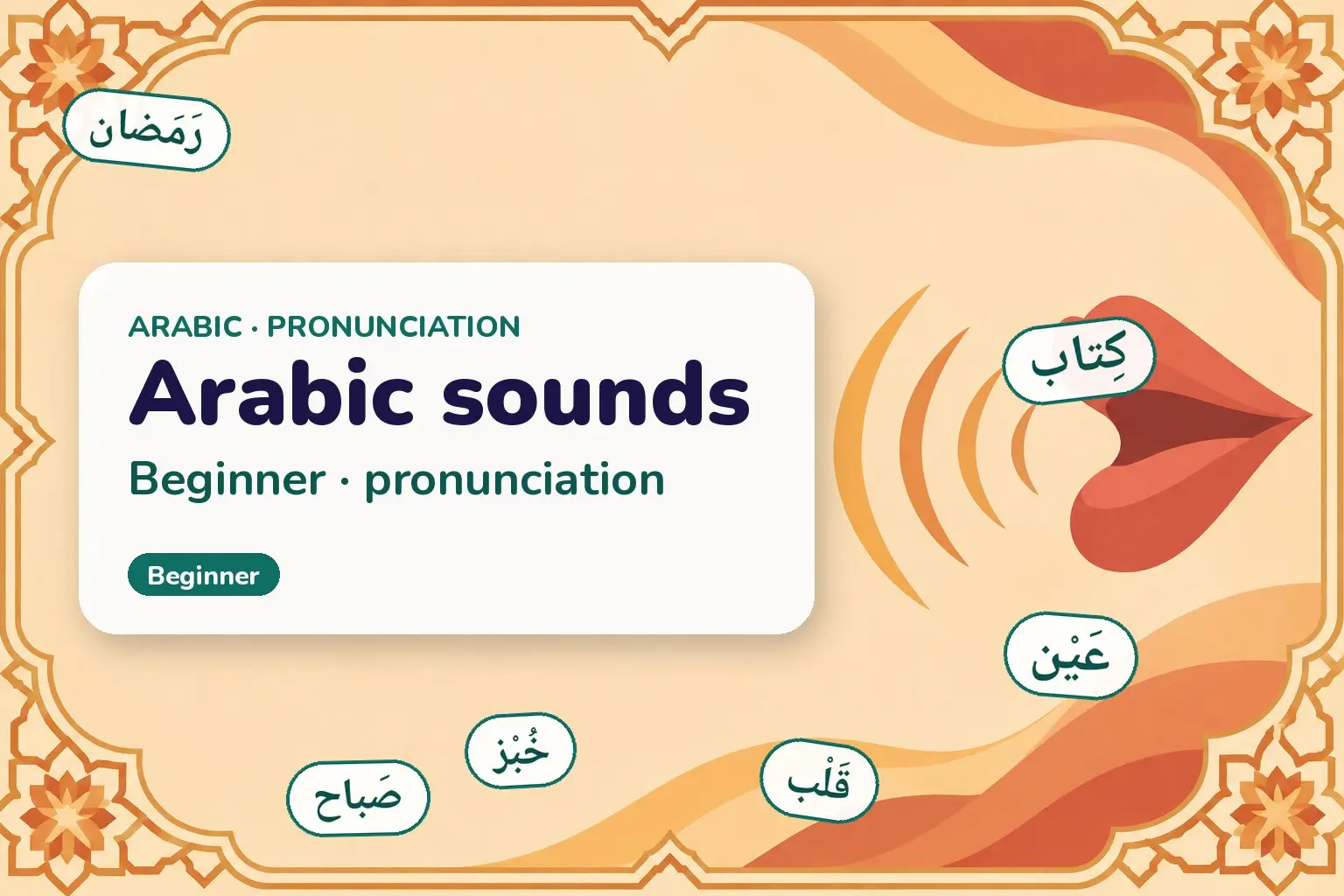
Arabic pronunciation hinges on a few throaty consonants with no English match — ع (ʿayn), ح (ḥāʾ), ق (qāf), خ (khāʾ) — plus emphatic consonants and the gap between short and long vowels. Get those right and most words read much as they are written.
On this page7 sections · tap to jump
Level: Beginner. Arabic sounds hard at first because a handful of its consonants are made deep in the throat, somewhere English never goes. The good news: Arabic spelling is almost perfectly regular, so once you own those few sounds, you can read most words aloud exactly as written.
What makes Arabic sound right
Three things carry most of a good Arabic accent:
- The throaty consonants. A small set of sounds live at the back of the mouth and throat: ع (ʿayn), ح (ḥāʾ), ق (qāf), خ (khāʾ) and غ (ghayn). None has a clean English twin, and mixing them up with their nearest English sound is the single biggest giveaway of a beginner.
- Emphatic versus plain consonants. Four letters — ص (ṣād), ض (ḍād), ط (ṭāʾ), ظ (ẓāʾ) — are “emphatic”: said with the tongue pulled low and back so the whole syllable sounds heavier and darker than their plain partners س (sīn), د (dāl), ت (tāʾ), ذ (dhāl).
- Vowel length. Arabic has three short vowels (a, i, u) and their long versions (ā, ī, ū). Length is not decoration — it changes meaning, so you must hold a long vowel clearly longer than a short one.
The biggest hurdles
- ع (ʿayn) is a tight squeeze from deep in the throat — think of the start of a strained “ahh” at the doctor’s. It is a real consonant, not a vowel, even though English has nothing like it.
- ح (ḥāʾ) versus ه (hāʾ). ح (ḥāʾ) is a sharp, breathy h made by tightening the throat, as if fogging a mirror hard; ه (hāʾ) is the soft English “h” in “hat”. Many pairs differ only in this.
- ق (qāf) versus ك (kāf). ق (qāf) is a “k” made far back against the uvula; ك (kāf) is the ordinary English “k”. قَلْب (qalb, heart) and كَلْب (kalb, dog) differ only here.
- خ (khāʾ) and غ (ghayn). خ (khāʾ) is the rasping “ch” of Scottish loch; غ (ghayn) is like a French throaty “r”, its voiced partner.
- The rolled ر (rāʾ) is a tapped or trilled r, like Spanish or Italian, never the English r.
How to use the Listen button
Every example below has a Listen button. It plays the sentence with your device’s built-in voice, which gives a close approximation of Modern Standard Arabic — useful for rhythm and vowel length, though it is a synthetic voice, not a native speaker. Play each line two or three times, then say it back, exaggerating the throaty consonants and the long vowels until they feel natural. Record yourself on your phone and compare.
Sounds to practise
- قَلْبqalbheart — the deep qāf
- كَلْبkalbdog — ordinary kāf (compare qalb)
- عَيْنʿayneye — the ʿayn sound
- حَبّḥabbgrain / seed — sharp ḥāʾ
- هَواءhawāʾair — soft hāʾ (compare ḥabb)
- خُبْزkhubzbread — rasping khāʾ
- غُرْفَةghurfaroom — voiced ghayn
- صَباحṣabāḥmorning — emphatic ṣād
- سَمَكsamakfish — plain sīn (compare ṣabāḥ)
- طَالِبṭālibstudent — emphatic ṭāʾ
- تِلْميذtilmīdhpupil — plain tāʾ
- رَمَضانramaḍānRamadan — rolled rāʾ and emphatic ḍād
- كِتابkitābbook — long ā held clearly
- كَتَبَkatabahe wrote — all short vowels (compare kitāb)
- شَمْسshamssun — the sh sound
Practice
Arabic sounds practice
Try each one, then press Check. No sign-up, nothing is sent anywhere — it all runs in your browser.
3 Match each letter to its description.
- ح (ḥāʾ)
- ه (hāʾ)
- خ (khāʾ)
- ص (ṣād)
Show answer
- ح (ḥāʾ) → sharp breathy h from the throat
- ه (hāʾ) → soft English h as in hat
- خ (khāʾ) → rasping ch as in Scottish loch
- ص (ṣād) → emphatic, dark s
ḥāʾ and hāʾ are a classic minimal pair; khāʾ rasps; ṣād is emphatic.
Hint: hold the ā
Show answer
kitāb — كِتاب (kitāb) has a long ā; كَتَبَ (kataba) is all short vowels.
Where to go next
Pronunciation improves fastest alongside reading and grammar. Learn how the letters join and when they are sounded in The Arabic Definite Article ال (al-), which covers the “sun” and “moon” letters, then build real sentences in The Nominal Sentence (Jumla Ismiyya). Browse everything in the Arabic grammar section, or get oriented from Start Learning Arabic Here.
Quiz
Arabic pronunciation quiz
8 questions · pick an answer and you'll see straight away if it's right.
-
Show answer
it is almost perfectly regular once vowels are marked — With the harakāt shown, Arabic is read as written, with few silent letters.
-
Show answer
emphatic consonants — They are the emphatic consonants, said with the tongue low and back.
-
Show answer
ḥāʾ is a sharp, tight throat h while hāʾ is a soft English h — ḥāʾ is tense and breathy from the throat; hāʾ is the soft h of hat.
-
Show answer
three (a, i, u) — Three short vowels a, i, u, each with a long version ā, ī, ū.
-
Show answer
can change the meaning of a word — Length is meaningful: kitāb (book) versus kataba (he wrote).
-
Show answer
the ch in Scottish loch — خ (khāʾ) is the rasping ch of loch; غ (ghayn) is its voiced partner.
-
Show answer
your device's synthetic voice, a close approximation — It uses your device voice for rhythm and vowel length, not a native recording.
-
Show answer
a tapped or trilled r like Spanish — It is a rolled/tapped r, never the English r.
All Arabic pronunciation & writing topics
Vocabulary, pronunciation, phrases, practice and exam help, ordered by level. Pick a topic and go straight to it. New lessons go live every day, so topics marked Coming soon fill in over the next weeks.
Pronunciation & writing
Beginner 10 topics · 1 ready
- 01 Arabic Pronunciation Overview You are here
- 02 The Arabic Script & Abjad Coming soon
- 03 Arabic Letters: Connecting Forms Coming soon
- 04 Harakat: Short Vowels & Sukun Coming soon
- 05 Arabic Long Vowels (alif, waw, ya) Coming soon
- 06 Sun & Moon Letters Coming soon
- 07 Ta Marbuta & Alif Maqsura Coming soon
- 08 Arabic Handwriting & Numerals Coming soon
- 09 How to Type Arabic (Keyboard Guide) Coming soon
- 10 Arabic Transliteration Systems & Limits Coming soon
Elementary 2 topics
- 11 Arabic Emphatic & Throat Letters Coming soon
- 12 Hamza & Its Seats Coming soon
Intermediate 1 topics
- 13 Reading Arabic Without Vowels Coming soon