Arabic Long Vowels: alif, waw, ya
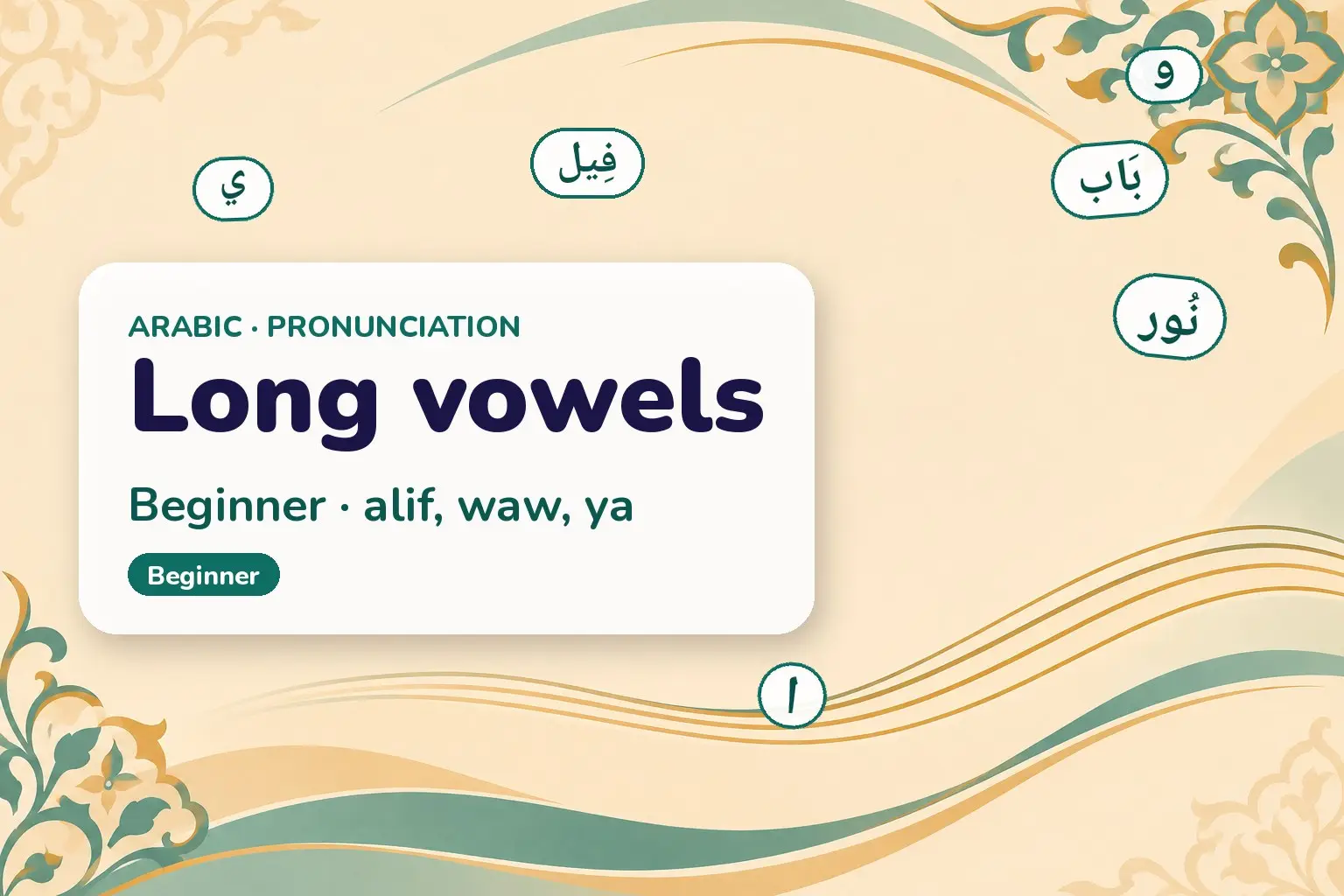
Arabic has three long vowels written as full letters: ا (ā) from alif, و (ū) from waw and ي (ī) from ya. Each is simply the matching short vowel held about twice as long, and that length can change a word's meaning.
Level: Beginner. Arabic has short vowels and long vowels, and telling them apart is one of the first real listening skills you need. The short vowels are tiny marks above or below a letter; the long vowels are written as full letters you can see in every word. By the end of this page you can name all three long vowels, hear how they differ from the short ones, and know why the difference matters.
Short vowels versus long vowels
A short vowel in Arabic is a ḥaraka — حَرَكَة (ḥaraka) — a small mark: فَتْحَة (fatḥa) for a short a, ضَمَّة (ḍamma) for a short u, and كَسْرَة (kasra) for a short i. These are often left out of everyday writing.
A long vowel is the same vowel held about twice as long, and it is spelled with a whole letter:
- ا (alif) gives a long ā, the stretched version of fatḥa.
- و (waw) gives a long ū, the stretched version of ḍamma.
- ي (ya) gives a long ī, the stretched version of kasra.
So بَاب (bāb, door) holds its a, while a short fatḥa would give a quick a. The length is not decoration — it is part of the word.
The three long vowels
| Letter | Name | Long sound | Example | Reading |
|---|---|---|---|---|
| ا | alif | ā (as in father) | بَاب | bāb (door) |
| و | waw | ū (as in food) | نُور | nūr (light) |
| ي | ya | ī (as in see) | فِيل | fīl (elephant) |
Each long vowel follows its matching short vowel in the spelling: a fatḥa before the ا (alif), a ḍamma before the و (waw), a kasra before the ي (ya). That pairing is the whole system.
The madd (extra-long alif)
Sometimes an alif carries a wavy sign called madd — مَدّ (madd). It marks an alif that is lengthened even more, usually where two alifs would meet. The best-known example is القُرْآن (al-Qurʾān, the Quran). You will also see it at the start of words like آسِف (āsif, sorry).
Hear the long vowels
- بَابbābdoor — long ā
- كِتَابkitābbook — long ā at the end
- نُورnūrlight — long ū
- سُوقsūqmarket — long ū
- فِيلfīlelephant — long ī
- كَبِيرkabīrbig — long ī
- جَمَلjamalcamel — short a only
- جَمَالjamālbeauty — long ā changes the word
- مَلِكmalikking — short i
- مَالِكmālikowner — long ā changes the word
- عَلَمʿalamflag — short a
- عَالَمʿālamworld — long ā changes the word
- وَلَدwaladboy — waw is the consonant w here
- يَدyadhand — ya is the consonant y here
- القُرْآنal-Qurʾānthe Quran — madd, extra-long alif
- طَوِيلṭawīltall / long — long ī
Common mistakes
- ❌ saying جَمَال (jamāl, beauty) when you mean جَمَل (jamal, camel). Shortening the long ā turns one word into the other.
- ❌ treating the و (waw) in وَلَد (walad, boy) as a vowel → it is the consonant w here, because no ḍamma precedes it.
- ❌ ignoring length because the short vowels are not written. Even when the ḥaraka marks are missing, the long-vowel letters ا (alif), و (waw) and ي (ya) are always there to guide you.
- ❌ pronouncing فِيل (fīl, elephant) with a quick i → the ي (ya) gives a held ī, so it sounds like English feel, not fill.
A tiny dialogue
— أَيْنَ الكِتَاب؟ — Ayna al-kitāb? — Where is the book? — عَلَى البَاب. — ʿalā al-bāb. — By the door.
Both كِتَاب (kitāb) and بَاب (bāb) end in a clear, held ā — listen for the length.
Practice
Long vowels practice
Try each one, then press Check. No sign-up, nothing is sent anywhere — it all runs in your browser.
2 Match each long vowel to its letter.
- ā
- ū
- ī
Show answer
- ā → ا (alif)
- ū → و (waw)
- ī → ي (ya)
alif = ā, waw = ū, ya = ī, each after its matching short vowel.
Hint: فِيل (fīl)
Show answer
ī — فِيل (fīl) has the long ī from ي (ya).
Where to go next
Build on this with the short-vowel marks in Arabic harakat and short vowels, see how letters change shape in the forms of Arabic letters, and get the big picture in the Arabic pronunciation overview. New here? Begin at Start Learning Arabic Here.
Quiz
Arabic long vowels quiz
9 questions · pick an answer and you'll see straight away if it's right.
-
Show answer
three — Three long vowels: alif (ā), waw (ū) and ya (ī).
-
Show answer
ا (alif) — ا (alif) spells the long ā, as in بَاب (bāb).
-
Show answer
the short vowel held about twice as long — It is the same vowel quality, held longer.
-
Show answer
ضَمَّة (ḍamma) — The waw follows a ḍamma to give the long ū, as in نُور (nūr).
-
Show answer
ū — The و gives a long ū: nūr (light).
-
Show answer
feel — The long ī makes it rhyme with feel, not fill.
-
Show answer
an extra-long alif — Madd lengthens the alif, as in القُرْآن (al-Qurʾān).
-
Show answer
it can change a word's meaning — عَلَم (ʿalam, flag) vs عَالَم (ʿālam, world): length alone changes meaning.
-
Show answer
the consonant y — With no kasra before it, ي is the consonant y: yad (hand).
All Arabic pronunciation & writing topics
Vocabulary, pronunciation, phrases, practice and exam help, ordered by level. Pick a topic and go straight to it. New lessons go live every day, so topics marked Coming soon fill in over the next weeks.
Pronunciation & writing
Beginner 10 topics · 7 ready
- 01 Arabic Pronunciation Overview
- 02 The Arabic Script & Abjad
- 03 Arabic Letters: Connecting Forms
- 04 Harakat: Short Vowels & Sukun
- 05 Arabic Long Vowels (alif, waw, ya) You are here
- 06 Sun & Moon Letters
- 07 Ta Marbuta & Alif Maqsura
- 08 Arabic Handwriting & Numerals Coming soon
- 09 How to Type Arabic (Keyboard Guide) Coming soon
- 10 Arabic Transliteration Systems & Limits Coming soon
Elementary 2 topics · 2 ready
Intermediate 1 topics
- 13 Reading Arabic Without Vowels Coming soon