Sun and Moon Letters in Arabic
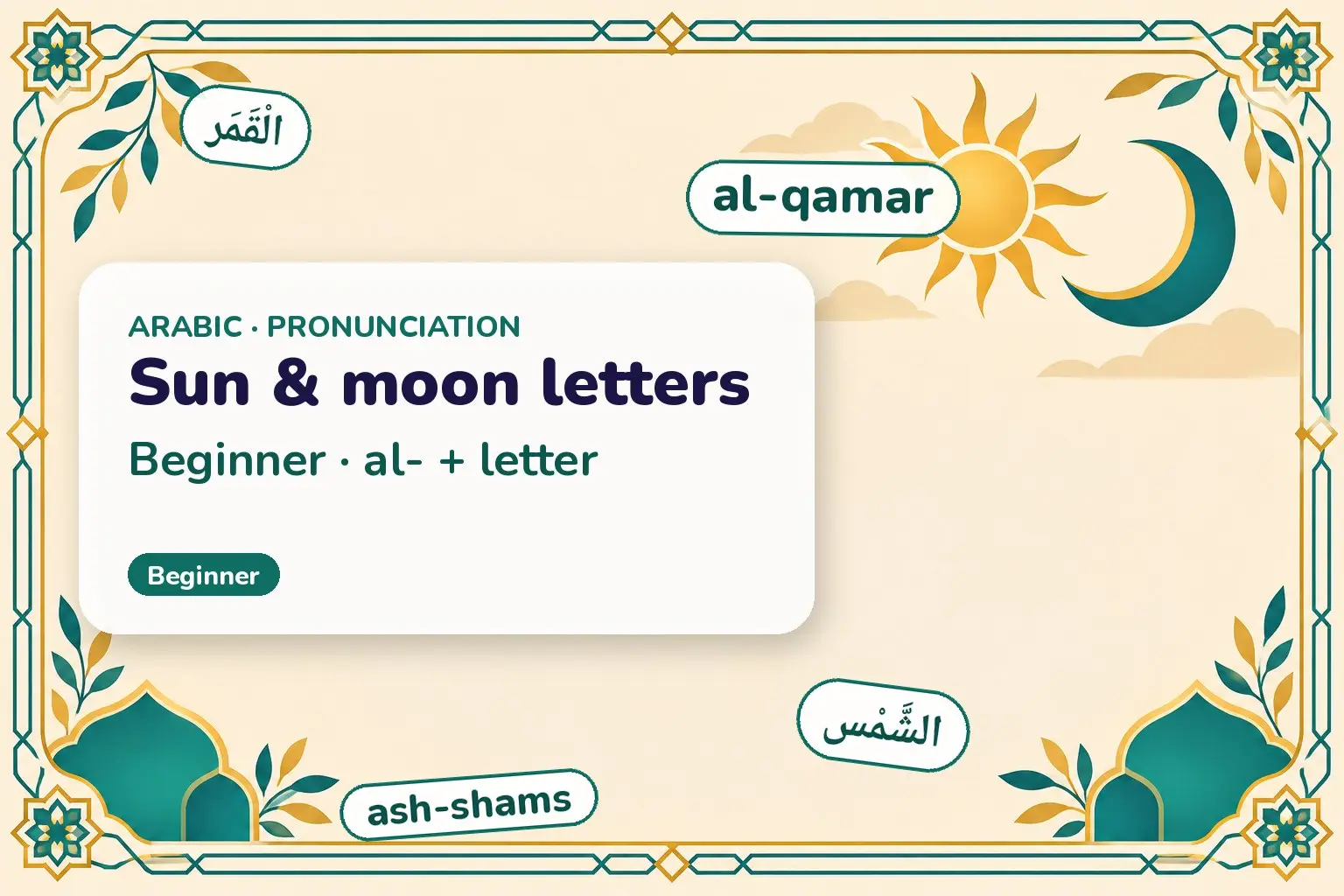
Before a sun letter, the ل (l) of the article الـ (al-) is not pronounced and the next letter doubles, so الشَّمْس is read ash-shams. Before a moon letter the ل stays: القَمَر is al-qamar. The alif is always written.
Level: Beginner. The Arabic definite article is always written الـ (al-), but it is not always said that way. With half of the alphabet — the sun letters — the ل (l) disappears in speech and the following letter is doubled instead. With the other half — the moon letters — the ل (l) is pronounced normally. By the end you can predict which happens from the first letter of the word.
What sun and moon letters are
A letter here means the first consonant of the noun after the article. Arabic grammarians sort the 28 letters into two groups, named after two example words:
- Sun letters — الْحُرُوفُ الشَّمْسِيَّة (al-ḥurūf ash-shamsiyya) — named after الشَّمْس (ash-shams, the sun).
- Moon letters — الْحُرُوفُ الْقَمَرِيَّة (al-ḥurūf al-qamariyya) — named after الْقَمَر (al-qamar, the moon).
The names are just labels — the sun is not “hotter” grammar. What matters is a sound change called assimilation: when the ل (l) of the article meets a sun letter, it stops being an l and instead merges into that letter, which is then pronounced twice as long. You mark that doubling with a small sign called a shadda, written over the doubled letter.
The two groups
The split is not random: sun letters are the ones made near the front of the mouth, close to where ل (l) is made, so the tongue finds it easier to merge them.
| Group | Letters | Reading | Article is said |
|---|---|---|---|
| Sun (assimilate) | ت ث د ذ ر ز س ش ص ض ط ظ ل ن | t th d dh r z s sh ṣ ḍ ṭ ẓ l n | a + doubled letter (ash-, at-, ar-…) |
| Moon (stay clear) | ا ب ج ح خ ع غ ف ق ك م ه و ي | ʾ b j ḥ kh ʿ gh f q k m h w y | al- |
There are 14 sun letters and 14 moon letters. You do not have to memorise both lists: learn the shorter idea that sun letters are the tongue-tip sounds (t, d, s, z, r, n and their emphatic partners), and treat everything else as a moon letter.
Hear the difference
- الشَّمْسash-shamsthe sun — sh is a sun letterl drops, sh doubles
- الْقَمَرal-qamarthe moon — q is a moon letterl stays
- النَّهَارan-nahārthe daytime — n is a sun letter
- الْبَيْتal-baytthe house — b is a moon letter
- الطَّالِبaṭ-ṭālibthe student — ṭ is a sun letter
- الْكِتَابal-kitābthe book — k is a moon letter
- الرَّجُلar-rajulthe man — r is a sun letter
- الْوَلَدal-waladthe boy — w is a moon letter
- السَّلَامas-salāmthe peace — s is a sun letter
- الْجَرِيدَةal-jarīdathe newspaper — j is a moon letter
- التِّلْمِيذat-tilmīdhthe pupil — t is a sun letter
- الْهَوَاءal-hawāʾthe air — h is a moon letter
- الدَّرْسad-darsthe lesson — d is a sun letter
- الْعَرَبِيَّةal-ʿarabiyyathe Arabic language — ʿ is a moon letter
- الزَّهْرَةaz-zahrathe flower — z is a sun letter
- الْفَصْلal-faṣlthe classroom — f is a moon letter
- اللَّيْلal-laylthe night — l is itself a sun letterl merges into l
- الْمَاءal-māʾthe water — m is a moon letter
Listen for the pattern: every sun-letter word has a doubled first sound and no audible “l”; every moon-letter word keeps a clean “al-”.
Common mistakes
- ❌ saying al-shams for الشَّمْس (ash-shams) → ✅ ash-shams. The sh is a sun letter, so the l assimilates and the sh doubles.
- ❌ writing the word without the ل (l), as if it were spelled “ash-shams” → ✅ keep الشَّمْس (ash-shams) with al- in writing; only the sound changes.
- ❌ doubling after a moon letter, as al-qqamar → ✅ al-qamar. Moon letters take a plain, single sound.
- ❌ treating ل (l) itself as a moon letter → ✅ it is a sun letter, so اللَّيْل (al-layl) has one long l, not al-l-layl.
- ❌ guessing from the look of the letter → ✅ guess from the sound: tongue-tip sounds (t, d, s, z, r, n…) are sun letters.
A short exchange
— مَا هَذَا؟ — Mā hādhā? — What is this? — هَذَا الْكِتَاب وَهَذِهِ الطَّاوِلَة. — Hādhā al-kitāb wa-hādhihi aṭ-ṭāwila. — This is the book and this is the table. — وَالشَّمْس؟ — Wa-sh-shams? — And the sun? — الشَّمْس فِي السَّمَاء. — Ash-shams fī as-samāʾ. — The sun is in the sky.
Notice الْكِتَاب (al-kitāb) keeps its l, while الطَّاوِلَة (aṭ-ṭāwila) and السَّمَاء (as-samāʾ) double.
Usage notes
- The alif joins the word before. In connected speech the a of al- often blends into the previous word: فِي السَّمَاء (fī as-samāʾ) becomes fi-s-samāʾ. The sun/moon rule still decides whether you hear an l.
- Emphatic letters count as their plain partner. The emphatics ص (ṣ), ض (ḍ), ط (ṭ) and ظ (ẓ) are all sun letters, just like their plain partners.
- The sun letters are the “tongue-tip” family. Every sun letter is pronounced with the tip or blade of the tongue near the teeth or ridge — the same zone as ل (l) — which is exactly why they merge.
- This underlies the definite article lesson. Once the article makes a noun definite, it behaves this way everywhere; see the grammar of the Arabic definite article al-.
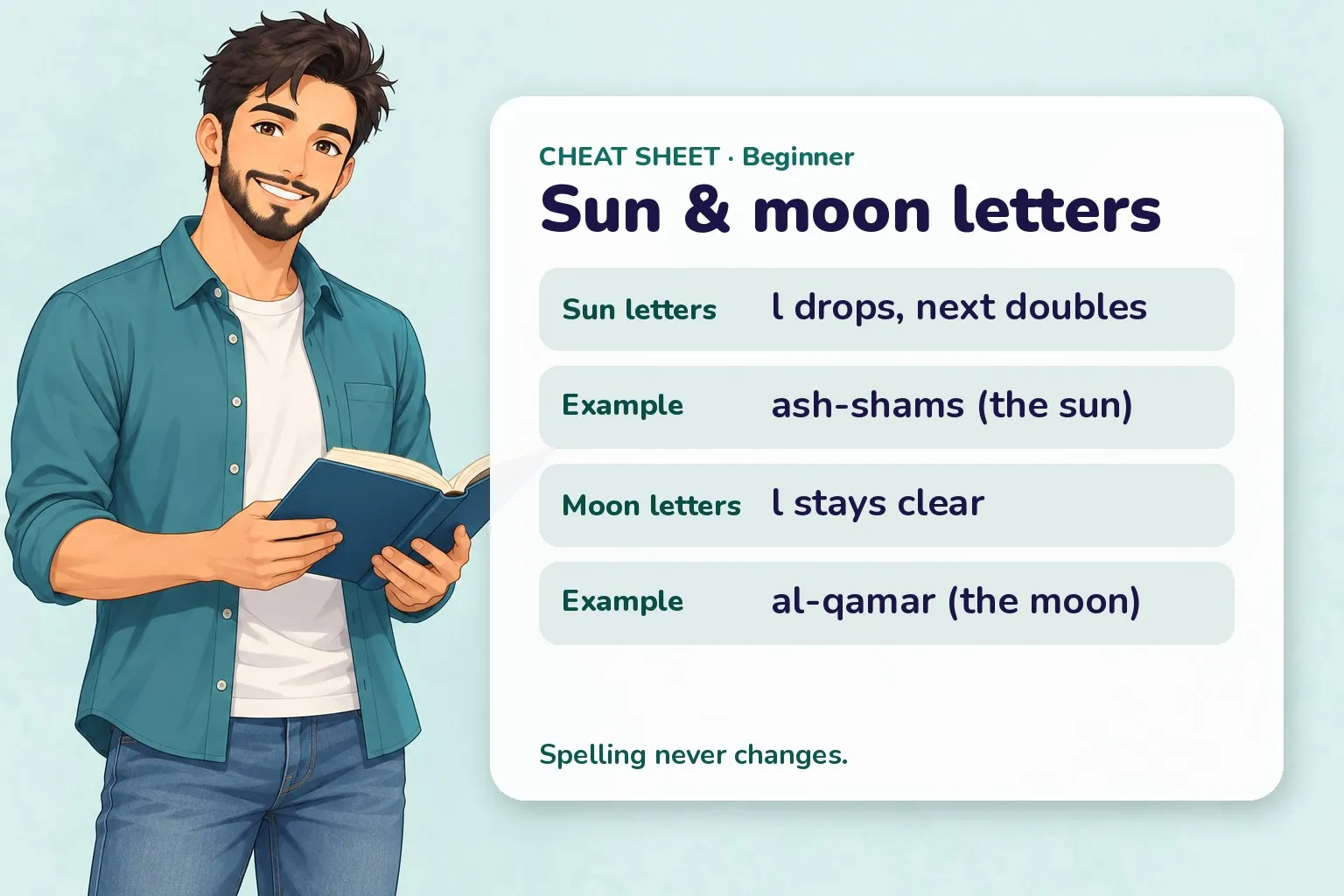
Quick recap before the quiz.
Practice
Sun and moon letters practice
Try each one, then press Check. No sign-up, nothing is sent anywhere — it all runs in your browser.
Hint: q is a moon letter
Show answer
al-qamar — Moon letters keep the l: al-qamar.
4 Match each word to how it is said.
- الطَّالِب (student)
- الْكِتَاب (book)
- السَّلَام (peace)
- الْوَلَد (boy)
Show answer
- الطَّالِب (student) → aṭ-ṭālib (sun)
- الْكِتَاب (book) → al-kitāb (moon)
- السَّلَام (peace) → as-salām (sun)
- الْوَلَد (boy) → al-walad (moon)
Sun letters double; moon letters keep al-.
Quiz
Sun and moon letters quiz
10 questions · pick an answer and you'll see straight away if it's right.
-
Show answer
14 — The alphabet splits evenly: 14 sun letters and 14 moon letters.
-
Show answer
assimilates and doubles the next letter — The l merges into the sun letter, which is then doubled (shadda).
-
Show answer
al-qamar — The q is a moon letter, so the l stays: al-qamar.
-
Show answer
n — n is a tongue-tip sound and a sun letter: an-nahār.
-
Show answer
an-nahār — n is a sun letter, so the l assimilates: an-nahār.
-
Show answer
الـ (al-) in full — Spelling never changes; only the spoken sound does.
-
Show answer
a sun letter — l is a sun letter, so اللَّيْل (al-layl) has one long l.
-
Show answer
all sun — The emphatics pattern with their plain partners as sun letters.
-
Show answer
with the tongue-tip near the teeth/ridge — Sun letters share the l zone (tongue-tip), which is why they merge.
-
Show answer
aṣ-ṣabāḥ — ṣ is a sun letter: aṣ-ṣabāḥ, with a doubled emphatic ṣ.
Recap cheat-sheet
| Group | Trigger | Example | Reading |
|---|---|---|---|
| Sun letters | tongue-tip sounds | الشَّمْس | ash-shams |
| Moon letters | everything else | الْقَمَر | al-qamar |
| Spelling | never changes | الـ | al- (always written) |
Next
- Build on this with the grammar of the Arabic definite article al-
- Review the vowels first in Arabic short vowels (harakat)
- New here? Start with Start Learning Arabic Here
All Arabic pronunciation & writing topics
Vocabulary, pronunciation, phrases, practice and exam help, ordered by level. Pick a topic and go straight to it. New lessons go live every day, so topics marked Coming soon fill in over the next weeks.
Pronunciation & writing
Beginner 10 topics · 7 ready
- 01 Arabic Pronunciation Overview
- 02 The Arabic Script & Abjad
- 03 Arabic Letters: Connecting Forms
- 04 Harakat: Short Vowels & Sukun
- 05 Arabic Long Vowels (alif, waw, ya)
- 06 Sun & Moon Letters You are here
- 07 Ta Marbuta & Alif Maqsura
- 08 Arabic Handwriting & Numerals Coming soon
- 09 How to Type Arabic (Keyboard Guide) Coming soon
- 10 Arabic Transliteration Systems & Limits Coming soon
Elementary 2 topics · 2 ready
Intermediate 1 topics
- 13 Reading Arabic Without Vowels Coming soon