Hamza & Its Seats
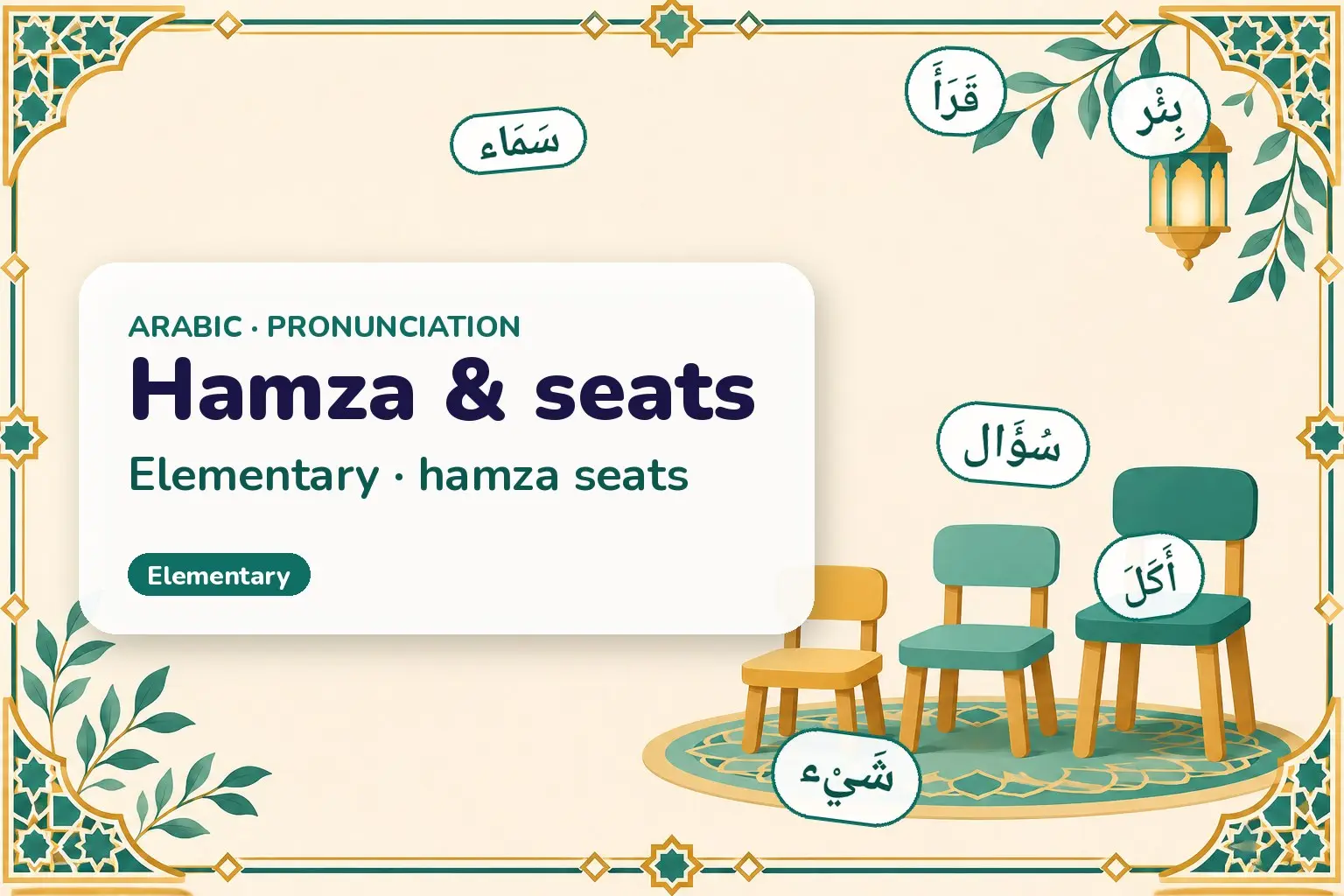
Hamza (ء) spells a glottal stop, and its seat depends on the vowels around it. At the start of a word it sits on an alif (أ, إ); in the middle or end it rides on alif, waw or ya, or sits alone on the line.
Level: Elementary. The hamza ء (hamza) is the letter for the glottal stop — the small catch in the throat you hear in the middle of English “uh-oh”. It is easy to say but famously fiddly to spell, because it can sit on three different “chairs” (an alif, a wāw, or a yāʾ) or on the line by itself. This page gives you the rules that decide which.
What the hamza is
The hamza is a consonant: a clean stop of the air in the throat, written ء (hamza). It is not the same as the long vowel ا (alif); the bare alif is just a stand or a long “ā”, while the hamza is the glottal-stop sound. Because early Arabic script had no separate shape for it, scribes “parked” the hamza on a nearby weak letter — alif, wāw or yāʾ — and that habit became the spelling rules you learn today.
The letter the hamza rests on is called its seat (kursiyy, “chair”). The seat carries no sound of its own; it only holds the hamza.
Vowel strength: the key idea
Every seat choice comes from one ranking of the vowels, strongest first:
- kasra (the i vowel) — strongest, wants a ya seat.
- damma (the u vowel) — wants a waw seat.
- fatha (the a vowel) — wants an alif seat.
- sukun (no vowel) — weakest.
| Vowel | Name | Seat it wants | Seat letter (reading) |
|---|---|---|---|
| i | kasra | ya | ئ (yāʾ) |
| u | damma | waw | ؤ (wāw) |
| a | fatha | alif | أ (alif) |
| — | sukun | (weakest) | — |
For a hamza inside a word you compare its own vowel with the vowel before it and let the stronger one choose the seat. A hamza on a ya seat is written without its two dots: ئ (yāʾ).
Initial hamza: always on alif
At the start of a word the hamza always sits on an alif. The hamza’s vowel decides whether it is written above or below:
- fatha or damma → hamza above the alif: أَكَلَ (akala, “he ate”), أُخْت (ukht, “sister”).
- kasra → hamza below the alif: إِسْلَام (islām), إِبْرَة (ibra, “needle”).
Medial hamza: compare the vowels
In the middle of a word, compare the hamza’s vowel with the vowel on the letter before it, and seat it by the stronger one:
- kasra wins → ya seat: سُئِلَ (suʾila, “he was asked”), بِئْر (biʾr, “well”).
- damma wins → waw seat: مُؤَلِّف (muʾallif, “author”), سُؤَال (suʾāl, “question”).
- fatha wins, with nothing stronger beside it → alif seat: سَأَلَ (saʾala, “he asked”), فَأْر (faʾr, “mouse”).
Final hamza: look at the letter before
At the end of a word, the seat is decided by the vowel on the preceding letter:
- after a letter with no vowel (sukun) or a long vowel, the hamza sits on the line, alone: شَيْء (shayʾ, “thing”), سَمَاء (samāʾ, “sky”), جُزْء (juzʾ, “part”).
- after a fatha → alif seat: قَرَأَ (qaraʾa, “he read”), بَدَأَ (badaʾa, “he began”).
- after a damma → waw seat: لُؤْلُؤ (luʾluʾ, “pearl”).
- after a kasra → ya seat: شَاطِئ (shāṭiʾ, “shore”), قَارِئ (qāriʾ, “reader”).
Hamza in action
- أَكَلَakalahe ate — initial hamza above alif (fatha)
- أُخْتukhtsister — initial hamza above alif (damma)
- إِسْلَامislāmIslam — initial hamza below alif (kasra)
- سَأَلَsaʾalahe asked — medial hamza on alif (fatha)
- سُؤَالsuʾālquestion — medial hamza on waw (damma)
- مُؤَلِّفmuʾallifauthor — medial hamza on waw (damma), no 'w' sound
- سُئِلَsuʾilahe was asked — medial hamza on ya (kasra wins)
- بِئْرbiʾrwell — medial hamza on ya (kasra)
- فَأْرfaʾrmouse — medial hamza on alif (fatha)
- قَرَأَqaraʾahe read — final hamza on alif after fatha
- شَاطِئshāṭiʾshore — final hamza on ya after kasra
- لُؤْلُؤluʾluʾpearl — hamza on waw after damma
- شَيْءshayʾthing — final hamza on the line after sukun
- سَمَاءsamāʾsky — final hamza on the line after a long vowel
- مَاءmāʾwater — final hamza on the line
- جُزْءjuzʾpart — final hamza on the line after sukun
How to read the seats
- A hamza on an alif, a wāw or a yāʾ is still just a glottal stop — say the catch, not a “w” or “y”.
- The dots under a normal ي (yāʾ) disappear when it is a hamza seat: ئ (yāʾ seat) has no dots.
- When you meet a new word, check the hamza’s vowel and the vowel before it; the stronger vowel tells you which chair you are looking at.
Practice
Hamza spelling practice
Try each one, then press Check. No sign-up, nothing is sent anywhere — it all runs in your browser.
2 Match each winning vowel to the seat it wants.
- kasra (i)
- damma (u)
- fatha (a)
- sukun or long vowel (final)
Show answer
- kasra (i) → ya seat — ئ (yāʾ)
- damma (u) → waw seat — ؤ (wāw)
- fatha (a) → alif seat — أ (alif)
- sukun or long vowel (final) → on the line — ء (hamza)
kasra chooses ya, damma chooses waw, fatha chooses alif; a final hamza after sukun or a long vowel sits on the line.
Hint: kasra beats damma
Show answer
kasra — The hamza's kasra is stronger than the preceding damma, so it takes a ya seat — ئ (yāʾ).
Where to go next
The hamza rides on the weak letters you met in the script basics: review them in the introduction to the Arabic script, get the short vowels that decide each seat in harakat: the short vowels, and see the full letter shapes in Arabic letter forms. New here? Start with Start Learning Arabic Here.
Quiz
Hamza and its seats quiz
10 questions · pick an answer and you'll see straight away if it's right.
-
Show answer
a glottal stop — Hamza is the glottal stop, the catch in the throat; the seat letter is silent.
-
Show answer
kasra > damma > fatha > sukun — kasra (i) > damma (u) > fatha (a) > sukun.
-
Show answer
ya — ئ (yāʾ) — kasra chooses the ya seat ئ (yāʾ), as in بِئْر (biʾr).
-
Show answer
waw — ؤ (wāw) — damma chooses the waw seat ؤ (wāw), as in سُؤَال (suʾāl).
-
Show answer
أ (above alif) — fatha or damma at the start goes above the alif: أَكَلَ (akala), أُخْت (ukht).
-
Show answer
إ (below alif) — Initial kasra goes below the alif: إِسْلَام (islām).
-
Show answer
no 'w' — just the glottal stop — The waw is only a seat; say the glottal stop, not a 'w'.
-
Show answer
without its dots — ئ (yāʾ) — A hamza-seat ya loses its dots: ئ (yāʾ).
-
Show answer
on the line — After a long vowel (or a sukun) a final hamza sits alone on the line.
-
Show answer
the kasra is stronger than the damma — Compare the vowels: kasra (i) beats the preceding damma (u), so ya wins.
All Arabic pronunciation & writing topics
Vocabulary, pronunciation, phrases, practice and exam help, ordered by level. Pick a topic and go straight to it. New lessons go live every day, so topics marked Coming soon fill in over the next weeks.
Pronunciation & writing
Beginner 10 topics · 7 ready
- 01 Arabic Pronunciation Overview
- 02 The Arabic Script & Abjad
- 03 Arabic Letters: Connecting Forms
- 04 Harakat: Short Vowels & Sukun
- 05 Arabic Long Vowels (alif, waw, ya)
- 06 Sun & Moon Letters
- 07 Ta Marbuta & Alif Maqsura
- 08 Arabic Handwriting & Numerals Coming soon
- 09 How to Type Arabic (Keyboard Guide) Coming soon
- 10 Arabic Transliteration Systems & Limits Coming soon
Elementary 2 topics · 2 ready
- 11 Arabic Emphatic & Throat Letters
- 12 Hamza & Its Seats You are here
Intermediate 1 topics
- 13 Reading Arabic Without Vowels Coming soon