Harakat: Arabic Short Vowels and Sukun
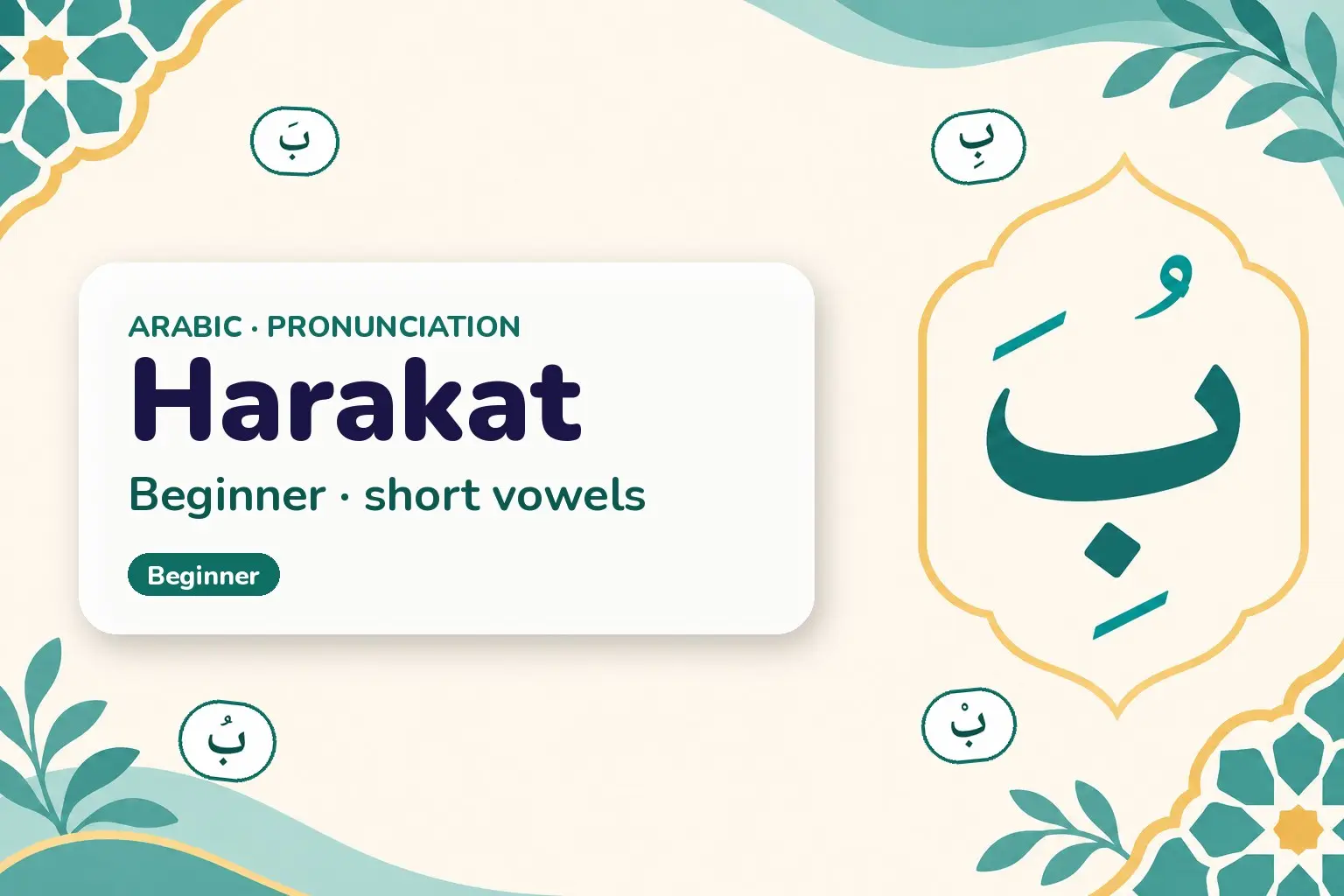
Harakat are the small marks that add short vowels to Arabic letters: fatha َ ('a'), kasra ِ ('i') and damma ُ ('u'). Sukun ْ means no vowel, shadda ّ doubles a letter, and tanwin adds a final -n.
Level: beginner. Arabic letters only spell the consonants and long vowels. The short vowels — the “a,” “i” and “u” sounds — are added with tiny marks called harakat — حَرَكَات (ḥarakāt, “movements”) — placed above or below the letter. Learn the six marks on this page and you can read any fully-voweled Arabic word aloud, even if you do not yet know what it means.
What harakat are
A ḥaraka (singular of harakat) is a small diacritic that tells you which short vowel follows a consonant. Arabic script normally shows only the consonant skeleton; the harakat are an optional overlay. You will see every mark in the Qur’an, in children’s books, in dictionaries and in material for learners. In a newspaper or a text message they are almost always left off, and a reader supplies them from knowing the word.
That is why learning them now matters: while you are a beginner you will read voweled text, and these marks are your pronunciation guide.
The six marks
| Mark | Name | Position | Sound | On بـ (b) |
|---|---|---|---|---|
| َ | fatha | above | short “a” | بَ (ba) |
| ِ | kasra | below | short “i” | بِ (bi) |
| ُ | damma | above | short “u” | بُ (bu) |
| ْ | sukun | above | no vowel | بْ (b, closes a syllable) |
| ّ | shadda | above | double the letter | بّ (bb) |
| ـً ـٍ ـٌ | tanwin | above / below | final -an, -in, -un | بًا بٍ بٌ |
The three short vowels
Fatha — فَتْحَة (fatḥa) — is a small slanted stroke above the letter and gives a short “a” as in “cat”: بَ (ba), تَ (ta), كَتَبَ (kataba, “he wrote”).
Kasra — كَسْرَة (kasra) — is the same stroke below the letter and gives a short “i” as in “sit”: بِ (bi), مِنْ (min, “from”), بِنْت (bint, “girl”).
Damma — ضَمَّة (ḍamma) — looks like a tiny و (wāw) above the letter and gives a short “u” as in “put”: بُ (bu), كُتُب (kutub, “books”), هُوَ (huwa, “he”).
Sukun, shadda and tanwin
Sukun — سُكُون (sukūn) — is a small circle above a consonant meaning no vowel at all — the consonant closes the syllable. In مِنْ (min) the نْ (n) carries a sukun: you stop on the “n” with no vowel after it.
Shadda — شَدَّة (shadda) — is a small “w”-shaped mark meaning say the consonant twice (a geminate). It never appears alone: a short vowel sits on top of it. In مُدَرِّس (mudarris, “teacher”) the shadda doubles the “r” and a kasra on top gives “ri.” In the definite article, the shadda shows an assimilated “sun letter”: الشَّمْس (ash-shams, “the sun”).
Tanwin — تَنْوِين (tanwīn, “nunation”) — doubles a short-vowel mark at the end of an indefinite noun to add a final /n/ sound you say but do not spell with a letter:
- dammatan ٌ (un) → كِتَابٌ (kitābun, “a book”)
- fathatan ً (an) → كِتَابًا (kitāban) — it usually sits on an added alif
- kasratan ٍ (in) → كِتَابٍ (kitābin)
Reading drills
- بَbaba — fatha, short 'a'
- بِbibi — kasra, short 'i' (mark below)
- بُbubu — damma, short 'u'
- كَتَبَkatabahe wrote — three fathas in a row
- مِنْminfrom — kasra then sukun on the nun
- كُتُبkutubbooks — two dammas
- بِنْتbintgirl — kasra, then sukun on the nun
- هُوَhuwahe — damma then fatha
- مُدَرِّسmudarristeacher — shadda doubles the r (rr)
- الشَّمْسash-shamsthe sun — shadda shows the assimilated sun letter
- كِتَابٌkitābuna book — tanwin damma, -un ending
- كِتَابًاkitābana book (object) — tanwin fatha, -an
- كِتَابٍkitābinof a book — tanwin kasra, -in
- بَيْتbaythouse — fatha then sukun on the ya
- سُكُونsukūnthe word 'sukun' itself
How it sounds versus how it is written
Two points trip up new readers:
- A long vowel uses a full letter such as ا (alif), و (wāw) or ي (yāʾ), not a haraka: قَالَ (qāla, “he said”) has a long “ā” written with alif, while قَلَم (qalam, “pen”) has a short fatha. The mark is short; the letter is long.
- When harakat are absent, the same skeleton كتب (k-t-b) can be read kataba (“he wrote”), kutiba (“it was written”) or kutub (“books”). The harakat are what pin down which word it is.
Practice
Harakat practice
Try each one, then press Check. No sign-up, nothing is sent anywhere — it all runs in your browser.
3 Match each mark to what it does.
- fatha
- damma
- shadda
- tanwin
Show answer
- fatha → short a, above the letter
- damma → short u, above
- shadda → double the consonant
- tanwin → final -n ending
Fatha = a, damma = u, shadda doubles the consonant, tanwin adds a final -n.
Hint: damma = short u
Show answer
bu — A damma over ب (b) gives بُ (bu).
Where to go next
Now put these marks onto real letters with the Arabic script introduction, learn how letters change shape in the letter forms guide, and hear the full sound system in the Arabic pronunciation overview. New here? Begin at Start Learning Arabic Here.
Quiz
Harakat quiz
10 questions · pick an answer and you'll see straight away if it's right.
-
Show answer
short vowels — Harakat add the short vowels a, i, u that the letters do not spell.
-
Show answer
short a — Fatha is a short 'a' as in 'cat'.
-
Show answer
kasra — Only kasra is written under the letter.
-
Show answer
waw — Damma is a small و (wāw) above the letter for short 'u'.
-
Show answer
no vowel follows — Sukun marks a vowelless consonant that closes a syllable.
-
Show answer
say the consonant twice — Shadda ّ doubles (geminates) the consonant, as the 'rr' in مُدَرِّس (mudarris).
-
Show answer
tanwin — Tanwin (nunation) adds a final -n to an indefinite noun: كِتَابٌ (kitābun).
-
Show answer
الكِتَابُ (al-kitābu), no tanwin — The definite article removes tanwin: الكِتَابُ (al-kitābu).
-
Show answer
readers supply them from knowing the word — Fluent readers reconstruct short vowels, so normal text omits the marks.
-
Show answer
qāla has a long ā written with alif — A long vowel uses a full letter (alif); a short vowel uses only a haraka.
All Arabic pronunciation & writing topics
Vocabulary, pronunciation, phrases, practice and exam help, ordered by level. Pick a topic and go straight to it. New lessons go live every day, so topics marked Coming soon fill in over the next weeks.
Pronunciation & writing
Beginner 10 topics · 7 ready
- 01 Arabic Pronunciation Overview
- 02 The Arabic Script & Abjad
- 03 Arabic Letters: Connecting Forms
- 04 Harakat: Short Vowels & Sukun You are here
- 05 Arabic Long Vowels (alif, waw, ya)
- 06 Sun & Moon Letters
- 07 Ta Marbuta & Alif Maqsura
- 08 Arabic Handwriting & Numerals Coming soon
- 09 How to Type Arabic (Keyboard Guide) Coming soon
- 10 Arabic Transliteration Systems & Limits Coming soon
Elementary 2 topics · 2 ready
Intermediate 1 topics
- 13 Reading Arabic Without Vowels Coming soon